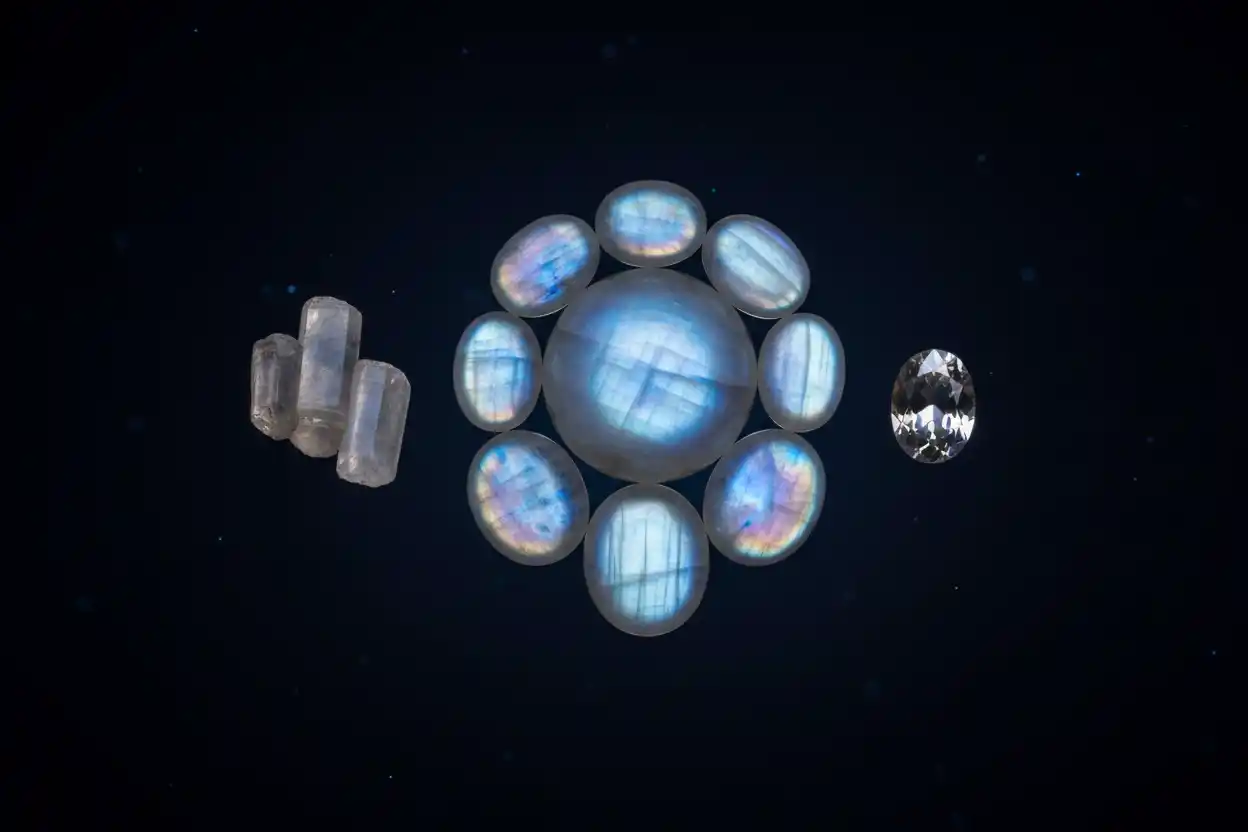
Rainbow Moonstone Meaning, Properties, Identification & Value
Rainbow Moonstone is the trade name for transparent to translucent white labradorite that displays blue, green, yellow, orange, violet, or multicolored iridescence. Despite its familiar name, it is generally a calcium-rich plagioclase feldspar rather than the orthoclase-rich material associated with traditional moonstone.
Fine pieces combine a nearly colorless body with a broad, mobile flash that appears to float beneath the surface. The effect can cover an entire cabochon, form one concentrated blue patch, or break into several shifting colors according to the stone’s internal layering and cutting orientation.
Rainbow Moonstone at a Glance
| Property | Rainbow Moonstone |
|---|---|
| Material type | Trade-name variety of transparent to translucent labradorite feldspar |
| Mineral group | Plagioclase feldspar |
| Composition | Variable sodium-calcium aluminum silicate within the labradorite range |
| Common bodycolors | Colorless, white, milky white, pale gray, cream, and faint yellow |
| Optical colors | Blue, green, yellow, orange, violet, pink, and multicolored |
| Crystal system | Triclinic |
| Typical habit | Massive cleavage pieces, tabular fragments, cabochons, rose cuts, beads, and occasional faceted gems |
| Luster | Vitreous to pearly |
| Transparency | Transparent to opaque, commonly transparent to translucent |
| Mohs hardness | Approximately 6–6.5 |
| Cleavage | Perfect in two directions meeting close to 90 degrees |
| Tenacity | Brittle |
| Specific gravity | Commonly approximately 2.68–2.72 |
| Common uses | Cabochons, rings, earrings, pendants, necklaces, bracelets, beads, carvings, and faceted collector gems |
| Main care concern | Cleavage, surface scratches, internal fractures, poor flash orientation, assembled imitations, and impact damage |
Rainbow Moonstone Is Labradorite
Rainbow Moonstone belongs to the broad feldspar family.
Traditional moonstone commonly consists of orthoclase or another alkali feldspar containing extremely fine albite-rich intergrowths. Its characteristic glow is usually white, silver, or blue.
Rainbow Moonstone instead falls within the plagioclase feldspar series and is generally identified as a light-colored variety of Labradorite.
The labradorite range lies between sodium-rich albite and calcium-rich anorthite. Therefore, its composition cannot be reduced accurately to one fixed chemical formula for every stone.
Calling the material white labradorite is mineralogically clearer, although Rainbow Moonstone remains the established jewelry and retail name.
The parent Moonstone guide owns the broader history, symbolism, adularescence, and traditional orthoclase material. This article focuses on the plagioclase variety, multicolored flash, identification, value, and care.
Why the Trade Still Calls It Moonstone
Rainbow Moonstone resembles traditional moonstone in three important ways.
Both have a pale feldspar body, both display a moving light effect, and both are normally cut with a smooth domed surface to reveal that effect.
Those visual similarities made the moonstone name commercially useful even though the underlying feldspar species differs.
Gemological references commonly acknowledge that Rainbow Moonstone is technically labradorite while accepting the established trade name.
This is similar to other gem names that describe appearance or tradition more strongly than strict mineral composition.
The distinction still matters. Labradorite has different compositional boundaries, internal structures, density, and optical behavior from orthoclase moonstone.
The dedicated Labradorite versus Moonstone guide owns the full side-by-side comparison.
What Creates the Rainbow Flash?
The multicolored effect develops when light interacts with extremely fine internal structures inside the feldspar.
During cooling, components within the original homogeneous feldspar become less compatible and separate into microscopic layers or domains.
Light enters the stone and reflects, scatters, and interferes at boundaries between those regions.
The visible color depends partly on layer thickness, spacing, orientation, and the angle between the light, stone, and viewer.
Very fine structures tend to produce blue. Other dimensions can produce green, yellow, orange, red, and violet.
The colors do not come from a painted surface. They originate below the polished face and move as the stone turns.
In labradorite, this broad phenomenon is often described as labradorescence. Within the moonstone trade, multicolored adularescence is also used.
The terminology overlaps because both effects arise from light interacting with submicroscopic feldspar structures, although their mineral hosts and visual character can differ.
Adularescence or Labradorescence?
Traditional adularescence usually appears as a soft white or blue cloud that rolls across an orthoclase-rich moonstone.
Labradorescence often looks more directional, saturated, and multicolored within labradorite.
Rainbow Moonstone can occupy a visual middle ground. Its pale transparent body resembles moonstone, while its blue, green, orange, or rainbow flash reflects its labradorite identity.
Consequently, some gemologists describe the effect as labradorescence, while established moonstone sources refer to rainbow adularescence.
The more important buying question is not which term the seller prefers. Instead, examine whether the flash is natural, mobile, well oriented, broad, and visible in normal lighting.
Blue Flash Rainbow Moonstone
Blue remains the most familiar and consistently demanded flash color.
Fine blue-flash material shows an electric or royal-blue light that moves across a colorless or white body.
The strongest cabochons display broad coverage rather than one tiny spot visible only at an extreme angle.
A pale blue reflection on the polished surface is not enough. True internal flash should shift beneath the surface while the light or stone moves.
Blue can appear alone or alongside green, yellow, and violet.
Transparent stones with centered blue flash commonly receive higher prices than cloudy material with weak scattered color.
However, an intense blue photograph can be misleading when captured under a powerful point light. A buying video should show how easily the effect appears during ordinary movement.
Orange and Multicolored Madagascar Material
Madagascar is an important source of high-quality transparent Rainbow Moonstone.
Recent production from the Andilamena area has included unusually clean material displaying strong blue adularescence combined with orange flash.
Some of these stones are transparent enough for faceting rather than conventional cabochon cutting.
The orange color is optical rather than an orange bodycolor. A stone may look nearly colorless under diffuse light and reveal orange, blue, green, or several colors under a directional source.
This premium material occupies a specialist market separate from ordinary Indian commercial cabochons.
A Madagascar label does not guarantee exceptional quality. Much material remains fractured, cloudy, weakly oriented, or ordinary in appearance.
Likewise, a transparent multicolored stone should not receive a new-discovery premium without credible source documentation.
Indian Rainbow Moonstone
India has supplied a large proportion of the Rainbow Moonstone used for beads, calibrated cabochons, carvings, rose cuts, and silver jewelry.
Indian material commonly has a white, translucent, or slightly gray body with blue or multicolored flash.
Black mineral grains, cleavage fractures, cloudy zones, and uneven transparency are common.
These features do not automatically indicate poor quality. Attractive inclusions can create character, while a few dark grains may be acceptable when the flash remains strong.
Nevertheless, open fractures, heavy cloudiness, weak orientation, and chalky polish reduce both durability and value.
India is also a major cutting center. Therefore, an Indian invoice may refer to manufacturing location rather than geological origin unless the source is stated clearly.
Rainbow Moonstone and White Moonstone
White Moonstone commonly refers to white or colorless traditional moonstone with white, silver, or blue adularescence.
Rainbow Moonstone is generally plagioclase labradorite and can display several spectral colors.
The two materials overlap visually, particularly when a Rainbow Moonstone shows only blue flash.
A laboratory can distinguish them through refractive index, specific gravity, optical character, spectroscopy, and compositional analysis.
Retail descriptions often use white moonstone for opaque milky material and Rainbow Moonstone for transparent labradorite. That distinction is practical but not scientifically universal.
Rainbow Moonstone and Peach or Black Moonstone
Peach Moonstone has a peach, apricot, pink-orange, or cream body and commonly displays white adularescence.
Black Moonstone has a gray, brown, charcoal, or nearly black body with silver, peach, or blue sheen.
Rainbow Moonstone usually has the lightest and most transparent body of the three.
Its identity depends more strongly on labradorite composition and multicolored flash than on bodycolor alone.
Commercial names can still overlap. A gray Rainbow Moonstone may be sold as gray moonstone, while a peach-tinted labradorite can enter the peach category.
The broader commercial framework belongs on types of Moonstone.
Transparency and Inclusions
Transparency strongly affects Rainbow Moonstone value.
The finest material is colorless to nearly colorless and transparent enough to reveal depth beneath the flash.
Common inclusions include cleavage fractures, stress cracks, cloudy growth zones, black mineral grains, fine needles, fingerprint-like structures, and small transparent crystals.
Some fractures reflect rainbow colors unrelated to true labradorescence. These flashes remain fixed along the crack and can appear sharp or mirror-like.
Natural labradorescence moves across a broader internal zone rather than following one broken surface.
A heavily fractured stone may show dramatic color while remaining too weak for a ring.
Clear resin or filler can also produce flash-like reflections inside cracks. Magnification helps separate treatment from the feldspar’s natural optical effect.
How Rainbow Moonstone Is Cut
Cabochons remain the standard cut because a curved dome reveals the moving light most effectively.
The cutter must orient the internal layers nearly parallel to the base. When the orientation is correct, the flash appears face-up near the center.
If the rough is rotated incorrectly, the same material may show color only from the side or lose the effect entirely.
Low domes preserve weight and can display broad flash. Higher domes may reveal greater depth but require thicker rough.
Rose cuts combine a flat base with a faceted crown. They can show both surface sparkle and internal color.
Faceting works best with unusually transparent material. However, excessive facet reflections can compete with the optical flash.
Carvings and beads often display several smaller patches because their curved surfaces cross the internal layers at changing angles.
How to Identify Rainbow Moonstone
First establish that the material is feldspar.
Rainbow Moonstone commonly has refractive indices around the labradorite range, approximately 1.56–1.57, although exact readings depend on composition.
Its specific gravity is generally higher than orthoclase moonstone.
The mineral is doubly refractive and usually displays polysynthetic twinning under suitable optical examination.
Magnification may reveal feldspar cleavage, lamellar structures, black mineral inclusions, stress fractures, and natural color zoning.
Rotate the stone under one concentrated light. Genuine flash should move beneath the surface and change with viewing angle.
Raman spectroscopy can confirm plagioclase feldspar. Quantitative chemical analysis can place the material within the labradorite range.
The process described in how to identify crystals explains why color and appearance must be supported by several physical observations.
Common Imitations
Opalescent glass can imitate a white body with blue or rainbow reflections.
Glass may contain round bubbles, flow lines, mold seams, and a more uniform glow.
Opalite glass commonly appears blue-white in reflected light and orange when strongly backlit. Its optical effect does not move like well-oriented feldspar flash.
Coated quartz, gypsum, plastic, and assembled products can imitate Rainbow Moonstone surprisingly well.
One documented imitation combined natural quartz, an iridescent coating, gypsum, cement, and an external plastic coating.
Coated feldspar and glass can also display intense surface rainbow effects.
A surface coating may look visible from every angle rather than moving within one internal plane. Scratches and worn edges can reveal the treatment.
Detailed consumer checks belong on real versus fake Moonstone.
Treatments and Enhancements
Most natural Rainbow Moonstone is sold without routine color treatment.
Ordinary cutting and polishing remain the principal processes.
Clear resin or fracture filling may strengthen damaged material and reduce the visibility of cracks.
Backing can support a thin cabochon or intensify its apparent flash.
Coatings may add iridescence, improve surface gloss, or imitate a stronger optical effect.
Oil, wax, or polymer can temporarily improve transparency or polish in fractured material.
Assembled stones may combine feldspar or another mineral with a cap, backing, glue, or coating.
Known treatment should be disclosed because it changes durability and care.
The broader distinctions among coating, filling, backing, dyeing, and assembly appear in gemstone treatments explained.
Durability and Jewelry Suitability
Rainbow Moonstone has a Mohs hardness of approximately 6–6.5.
Its relative scratch resistance appears in the gemstone hardness chart.
Quartz-rich household dust can abrade its polish gradually.
Two strong cleavage directions create the more serious risk. A hard blow can split the gem even when the surface remains largely unscratched.
The distinction between hardness, cleavage, and toughness is explained in gemstone toughness versus hardness.
Pendants and earrings provide safer daily use than exposed rings and bracelets.
A Moonstone ring should have a low profile, protective bezel, or closely fitted halo.
Prongs must not press directly against a surface-reaching fracture.
Large transparent stones are especially difficult to replace with a matching flash pattern, so premium material deserves conservative wear.
Current Rainbow Moonstone Asking Prices
Rainbow Moonstone ranges from inexpensive commercial cabochons to rare transparent Madagascar collector gems.
| Rainbow Moonstone product | Broad July 2026 retail asking range |
|---|---|
| Small commercial cabochon | About $5–$20 |
| Good blue- or multicolor-flash cabochon | About $20–$75 |
| Large transparent designer cabochon | About $75–$250 |
| Matched cabochon pair | About $30–$150 |
| Commercial loose material | Commonly about $3–$20 per carat |
| Fine broadly flashing material | Commonly about $20–$75 per carat |
| Premium transparent faceted or recent Madagascar material | About $200–$500 per carat or more |
| Sterling-silver jewelry | About $50–$300 |
| Gold or designer jewelry | About $300–$2,000 or more |
These figures represent broad asking-price context rather than appraisals or guaranteed resale values.
Detailed comparisons by size, transparency, flash, and jewelry format belong on the Moonstone price guide.
What Gives Rainbow Moonstone Value?
Flash coverage matters first. A broad centered effect receives more interest than a tiny patch at the edge.
Color also matters. Strong blue remains popular, while clearly visible green, orange, yellow, violet, and multicolored effects can add rarity.
Transparency improves depth and allows the flash to appear suspended inside the stone.
Bodycolor should be clean and attractive. Gray, brown, or heavily cloudy material usually carries a lower price unless the flash is exceptional.
Cut orientation determines whether the phenomenon appears face-up. Poor orientation can reduce valuable rough to an ordinary pale feldspar cabochon.
Clarity matters differently than it does in a faceted diamond. Minor inclusions are accepted, but open fractures and distracting black areas reduce quality.
Size raises value when the stone remains transparent and fully flashing.
Treatment disclosure, source documentation, polish, symmetry, and structural stability complete the assessment.
Buying Rainbow Moonstone
Request a rotating video under one concentrated light and a second video in ordinary indoor illumination.
The first shows maximum flash, while the second reveals how easily that effect appears in normal use.
Ask whether the stone is labradorite or traditional orthoclase moonstone.
Check the flash coverage from the intended face-up position rather than from one extreme side angle.
Inspect the girdle, drill holes, and surface for cleavage cracks, resin, coating, glue, and chipped edges.
A Madagascar claim should identify whether the stone belongs to recent transparent production or ordinary commercial material.
Do not rely on AAA, AAAA, rainbow fire grade, or divine blue grade. These terms have no universal standard.
The broader purchase framework appears in the Moonstone buying guide.
Seller-specific authenticity and return-policy checks belong on where to buy real Rainbow Moonstone.
Rainbow Moonstone appears in the rainbow-crystal directory and the rainbow-gemstone directory.
Cleaning and Storage
Clean Rainbow Moonstone with lukewarm water, mild soap, and a very soft brush or cloth.
Rinse briefly and dry it thoroughly.
Avoid ultrasonic and steam cleaning. Vibration, heat, cleavage, fillings, glue, and fractures create unnecessary risks.
Do not expose the stone to sudden temperature changes.
Remove rings and bracelets before housework, exercise, gardening, swimming, and activities involving hard surfaces.
Store the gem separately from quartz, topaz, sapphire, ruby, and diamond.
A padded compartment protects the polished dome and prevents one feldspar piece from striking another.
Complete jewelry instructions appear in how to clean Moonstone jewelry.
Rainbow Moonstone Meaning and Symbolism
Moonstone symbolism has developed across several cultures, although historic references usually concern traditional white or blue moonstone rather than modern trade-name Rainbow Moonstone.
Contemporary crystal traditions associate Rainbow Moonstone with new beginnings, intuition, adaptability, creative perception, and recognizing several possibilities within one situation.
Its multicolored flash can symbolize qualities that become visible only after perspective changes.
The pale body surrounding strong internal color also inspires associations with hidden complexity and avoiding judgments based only on first appearances.
Blue flash is commonly linked with reflection and communication, while green and orange colors receive associations with renewal, confidence, and creative action.
Rainbow Moonstone is also connected commercially with Moonstone’s role as a June birthstone, although its mineral identity remains labradorite.
These interpretations remain personal, artistic, cultural, or spiritual. Scientific evidence does not show that Rainbow Moonstone treats illness, changes hormones, increases fertility, or guarantees intuitive ability.
Frequently Asked Questions
Is Rainbow Moonstone a real moonstone?
It is a genuine natural feldspar gem accepted under the trade name Rainbow Moonstone, but it is generally labradorite rather than traditional orthoclase moonstone.
Is Rainbow Moonstone the same as Labradorite?
It is a light-bodied transparent or translucent variety of labradorite selected for blue or multicolored iridescence.
What causes Rainbow Moonstone’s colors?
Light interferes and scatters at microscopic internal feldspar structures, producing blue, green, yellow, orange, violet, and other moving colors.
Is its optical effect adularescence or labradorescence?
Both terms appear in the trade. Labradorite technically supports labradorescence, while Rainbow Moonstone is commonly described as showing multicolored adularescence.
Where does Rainbow Moonstone come from?
India and Madagascar are major commercial sources. Recent Madagascar material includes unusually transparent stones with blue and orange flash.
Is Rainbow Moonstone naturally transparent?
Some material is highly transparent, although translucent and inclusion-rich stones are more common.
Can Rainbow Moonstone be faceted?
Yes. Exceptionally transparent material can be faceted, while most stones are cut as cabochons or rose cuts.
Is Rainbow Moonstone commonly treated?
Routine color treatment is not standard, but filling, coating, backing, oil, wax, and assembled imitations can occur.
How can it be distinguished from opalite glass?
Rainbow Moonstone shows directional internal flash, feldspar cleavage, and labradorite optical properties. Opalite is manufactured glass with a more uniform blue-white and orange transmission effect.
Is Rainbow Moonstone suitable for an engagement ring?
It can be worn in a protective setting, but cleavage and moderate hardness make sapphire, spinel, and some other gems more durable.
Can Rainbow Moonstone go in water?
Brief gentle washing is normally suitable for intact untreated material. Avoid soaking fractured, filled, coated, glued, or backed stones.
What makes Rainbow Moonstone valuable?
Broad centered flash, attractive colors, transparency, clean bodycolor, size, cutting orientation, structural stability, treatment disclosure, and credible origin determine value.
Rainbow Moonstone’s most important distinction is also its strongest attraction: it looks like moonstone while revealing the broader spectral behavior of labradorite. Evaluating it through both feldspar identity and face-up flash prevents the trade name from concealing its actual geology.