Rainbow Obsidian Meaning, Properties, Identification & Value
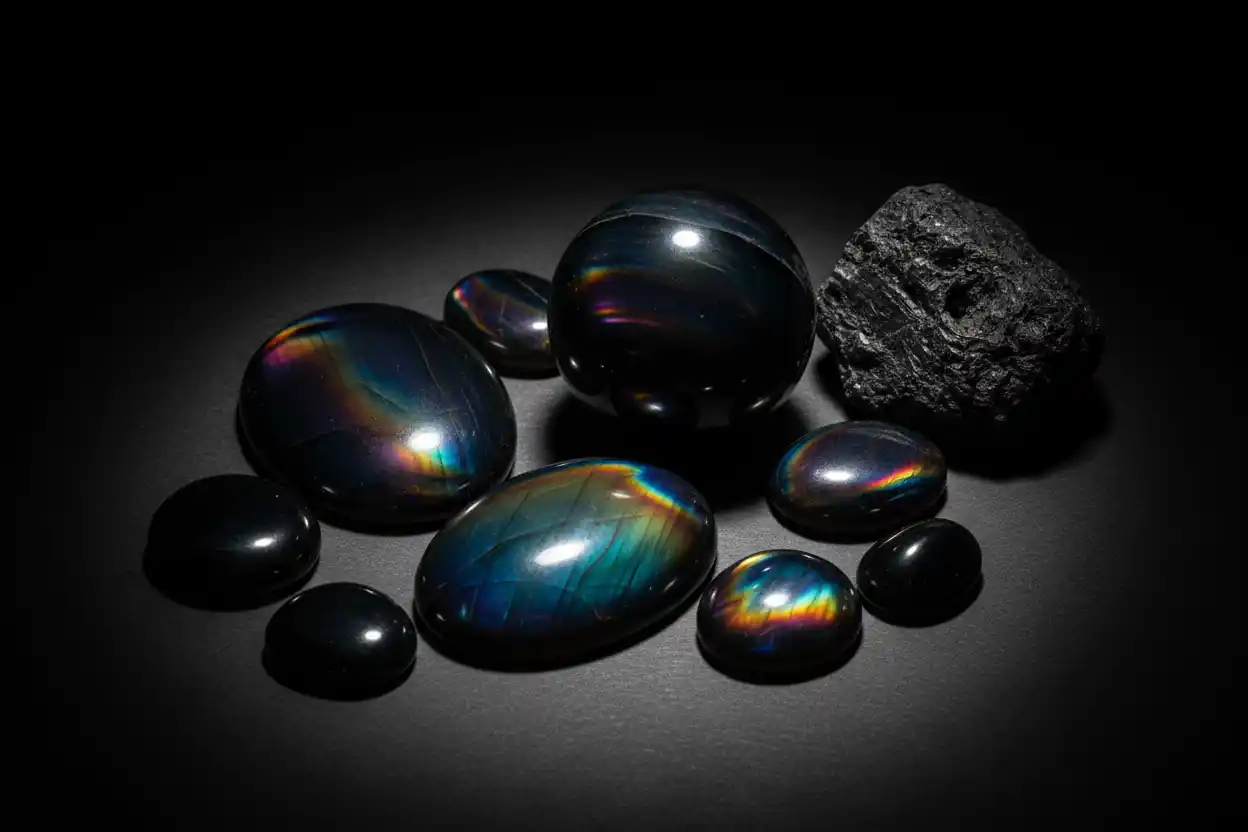
Rainbow Obsidian is natural volcanic glass containing internal flow-aligned layers that reflect green, violet, blue, gold, red, pink, or multicolored iridescence. Most rough looks black or dark brown until a cutter opens and polishes the correct surface, revealing concentric eyes, broad bands, arcs, or flowing rainbow patches.
The best-known commercial material comes from Mexico, particularly Jalisco. Its colors result from thin-film interference involving microscopic layers and aligned mineral inclusions rather than dye, surface paint, or the spectral diffraction seen in precious opal.
Rainbow Obsidian at a Glance
| Property | Rainbow Obsidian |
|---|---|
| Material type | Iridescent natural volcanic glass |
| Typical composition | Silica-rich rhyolitic glass with aluminum, sodium, potassium, iron, and minor mineral inclusions |
| Common bodycolor | Black, charcoal, dark brown, and smoky gray |
| Sheen colors | Green, violet, purple, blue, red, pink, gold, silver, bronze, and multicolored |
| Structure | Amorphous glass containing flow-aligned layers, microlites, and other inclusions |
| Crystal system | None; obsidian is noncrystalline glass |
| Typical form | Massive lava glass, nodules, flow-banded rough, cabochons, hearts, eyes, spheres, carvings, and freeforms |
| Luster | Vitreous |
| Transparency | Opaque to translucent at thin edges |
| Mohs hardness | Approximately 5–5.5 |
| Cleavage | None |
| Tenacity | Brittle |
| Fracture | Strongly conchoidal, producing very sharp edges |
| Specific gravity | Commonly approximately 2.35–2.60 |
| Common uses | Cabochons, pendants, rings, beads, carvings, spheres, display pieces, tools, and decorative objects |
| Main care concern | Chipped edges, internal fractures, sharp broken surfaces, poor sheen orientation, imitation glass, and silica-rich cutting dust |
Rainbow Obsidian Is Natural Glass
Obsidian forms when silica-rich lava cools too rapidly for abundant crystals to grow.
Its atoms become locked into a disordered glass structure rather than arranging into one repeating crystal lattice.
Therefore, Rainbow Obsidian is neither a crystal species nor a single mineral.
Its overall chemistry resembles rhyolite, commonly containing substantial silica along with aluminum, sodium, potassium, iron, and smaller amounts of other elements.
Microscopic crystals, bubbles, flow layers, and devitrification products can remain within the glass.
The parent Obsidian guide owns volcanic-glass formation, archaeological use, general symbolism, and broad physical properties.
This page focuses on the rainbow optical effect, Mexican material, cutting orientation, identification, value, and care.
How the Rainbow Effect Forms
Scientific study of Mexican Rainbow Obsidian has identified more than one internal structure capable of producing iridescence.
One studied type contained thin layers rich in aligned rods of hedenbergite, an iron-bearing pyroxene.
Another contained layers of aligned plagioclase rods.
These microscopic inclusions developed in preferred orientations as the viscous lava flowed and cooled.
When the layers are thin enough and arranged appropriately, light reflected from their boundaries interferes constructively or destructively.
Different wavelengths become intensified at different angles, producing green, violet, red, blue, or gold colors.
The mechanism is thin-film interference rather than one universal magnetite-particle explanation.
That distinction matters because several iridescent obsidians have different inclusion types and formation histories.
Mexican Rainbow Obsidian
Jalisco is the best-known commercial source of Rainbow Obsidian.
Material is associated with the Magdalena, San Andrés, Tequila, and related volcanic districts of western Mexico.
La Revoltosa and other named workings have supplied rough for lapidary cutting.
Commercial products may be described as Rainbow Obsidian, velvet obsidian, eye obsidian, Manto Huichol, or peacock obsidian.
These names emphasize color, texture, cultural marketing, or cutting pattern rather than separate mineral species.
Fine Jalisco material commonly displays concentric layers around a dark center. When cut across the flow structure, these layers form eyes, hearts, arcs, and nested bands.
A different cutting direction may reveal only weak gray sheen or no visible color.
Consequently, raw quality cannot be judged accurately from the outer black surface alone.
Manto Huichol and Velvet Obsidian
Manto Huichol is a trade name applied to particularly soft-looking, multicolored Mexican sheen obsidian.
Velvet Obsidian commonly refers to material with broad silky purple, green, gold, or rainbow reflection.
Neither name has one regulated mineralogical definition.
Some dealers use them for the same Jalisco material, while others distinguish velvet texture from more sharply banded Rainbow Obsidian.
The names should not be treated as evidence of a particular mine, cultural origin, or superior grade.
The stone’s face-up colors, natural-glass identity, cutting, and provenance remain more important than the number of aliases attached to it.
Rainbow Obsidian and Fire Obsidian
Fire Obsidian is a related but distinct iridescent volcanic glass associated especially with Glass Buttes in Oregon.
Fine fire obsidian can display intensely saturated red, orange, green, blue, gold, and violet colors.
Research on Oregon material has identified extremely thin layers containing nanoscale magnetite crystals as a likely cause of thin-film interference.
Mexican Rainbow Obsidian, by contrast, has been documented with aligned hedenbergite or plagioclase-rich layers in studied samples.
Both materials use interference to produce color, yet the inclusion minerals, layer scale, appearance, source, and cutting traditions differ.
Fire Obsidian commonly commands a specialist premium because thin colorful layers are difficult to locate and cut.
The name should not be transferred automatically to ordinary Mexican Rainbow Obsidian simply because both display several colors.
Golden and Silver Sheen Obsidian
Golden Obsidian displays warm gold, bronze, or coppery reflection.
Silver Sheen Obsidian produces gray, white, or silver light.
Research on sheen obsidian indicates that aligned gas-filled or glass-filled lenticular structures and differences in refractive index can create broad reflective effects.
Rainbow material shows several interference colors rather than one dominant metallic sheen.
Overlap is common. A single piece can contain gold, silver, green, and violet layers and receive different names according to its strongest face-up effect.
The exact variety should follow the polished appearance rather than the rough’s sales label.
Black, Mahogany, and Snowflake Obsidian
Black Obsidian lacks the pronounced multicolored internal layers that define Rainbow Obsidian.
Mahogany Obsidian contains reddish-brown and black patterns commonly related to iron-rich areas within the glass.
Snowflake Obsidian contains pale cristobalite spherulites produced as part of the glass devitrified.
All four remain natural volcanic glass or glass-rich materials.
Their different appearances record bubbles, inclusions, flow structures, oxidation, crystallization, and cooling history.
The complete commercial framework belongs on types of Obsidian.
Why Rough Rainbow Obsidian Looks Black
The colorful layers are usually internal and directional.
A rough surface may cut across them poorly, remain covered by weathering, or reflect light from the wrong angle.
Lapidaries create a small polished window to examine the layer direction.
Once the strongest plane is found, the cutter marks the rough and removes material carefully until the sheen appears face-up.
A thick black cap may need to be ground away before any color becomes visible.
The most valuable layer can be extremely thin. Removing a fraction too much can weaken or eliminate the rainbow effect.
This uncertainty makes high-quality rough more difficult to price than ordinary Black Obsidian.
A piece shown wet can appear more colorful because water temporarily reduces surface scattering. Buyers should ask whether photographs show dry polished material, wet rough, or digitally enhanced color.
Concentric Eyes and Layered Patterns
Concentric-eye material forms when flow structures curve or wrap through the obsidian mass.
A cross-section can reveal nested green, purple, gold, and red bands around a black center.
Cutters use ovals, circles, hearts, and freeforms to frame these layers.
A well-centered eye generally receives more demand than colors running partly off the edge.
However, a dramatic off-center arc can suit an asymmetric designer cabochon.
The pattern continues into the stone rather than remaining a surface coating.
Several cuts from one rough block may show related bands with different orientations and color sequences.
Matched pairs are difficult because each slice crosses the layers at a slightly different depth.
How to Identify Rainbow Obsidian
First confirm that the host is natural volcanic glass.
It should have vitreous luster, conchoidal fracture, no cleavage, and a hardness near 5–5.5.
Thin edges may transmit brown, gray, or greenish light.
Magnification can reveal flow bands, microlites, tiny bubbles, mineral rods, fractures, and polishing marks.
Rotate the polished surface under one concentrated light. Genuine rainbow sheen should change with angle and remain associated with internal layers.
The pattern should continue naturally along edges and across related surfaces.
Raman spectroscopy, chemical analysis, electron microscopy, and refractive measurements can separate obsidian from manufactured glass and identify some internal phases.
The practical testing sequence in how to identify crystals helps distinguish visual recognition from laboratory confirmation.
Natural Obsidian versus Manufactured Glass
Obsidian itself is glass, so the phrase “glass-like” does not identify an imitation.
The critical distinction is natural volcanic origin versus manufactured glass.
Artificial glass may contain round bubbles, flow swirls, colorant concentrations, mold seams, and a more uniform composition.
Natural obsidian can also contain bubbles and flow lines, so no single feature proves origin.
Manufactured iridescent glass may have surface coatings or metallic films that remain bright from many angles.
Natural Rainbow Obsidian usually shows a directional internal sheen visible most strongly on one oriented surface.
Slag glass, bottle glass, furnace glass, and decorative dichroic glass can be carved into obsidian-like shapes.
A laboratory can use chemistry, inclusions, refractive response, and structural examination to separate them.
Coatings, Dye, and Reconstructed Products
Natural Rainbow Obsidian normally receives no color treatment beyond cutting and polishing.
However, coatings can create artificial blue, purple, gold, or rainbow iridescence.
Dye can enter fractures or be applied to pale manufactured glass.
Resin may stabilize fractured rough or fill chips.
Composite products can combine a thin natural obsidian layer with backing or place colored film beneath a transparent cap.
Obsidian fragments and glass powder may also be fused or bound in resin.
A coating often scratches first along exposed edges and may show a different luster from the glass beneath it.
Treatment terminology and disclosure principles appear in gemstone treatments explained.
Durability and Jewelry Suitability
Obsidian has a Mohs hardness around 5–5.5.
Its scratch resistance is lower than quartz, topaz, sapphire, and diamond, as shown in the gemstone hardness chart.
The material has no mineral cleavage but remains very brittle.
A sharp impact can create a conchoidal chip whose edge is thin enough to cut skin.
The distinction between hardness and structural toughness appears in gemstone toughness versus hardness.
Pendants, earrings, brooches, bolo ties, and protected cabochons provide practical use.
An occasional-wear ring should have a low bezel that protects both the edge and polished rainbow surface.
Bracelet beads receive repeated impacts and can chip around drill holes.
Large carvings should rest securely because a fall onto a hard floor can shatter the glass into sharp pieces.
Current Rainbow Obsidian Asking Prices
Rainbow Obsidian is more valuable than ordinary Black Obsidian when the internal color is broad, saturated, well centered, and visible without extreme lighting.
| Rainbow Obsidian product | Broad July 2026 retail asking range |
|---|---|
| Small tumbled stone | About $3–$15 |
| Commercial cabochon | About $10–$40 |
| Strong multicolored cabochon | About $40–$150 |
| Premium eye or designer cabochon | About $100–$300 or more |
| Palm stone or small heart | About $20–$75 |
| Sphere, egg, or medium carving | About $40–$175 |
| Large premium freeform or carving | About $150–$900 or more |
| Bead strand or bracelet | About $15–$75 |
| Sterling-silver jewelry | About $40–$300 |
| Lapidary rough | Commonly sold by weight, with basic current material beginning around several dollars per pound |
These figures represent broad current asking prices rather than appraisals or guaranteed resale values.
Large online price differences often reflect sheen strength, carving labor, photography, source claims, and seller positioning rather than size alone.
What Gives Rainbow Obsidian Value?
Face-up color coverage is the principal factor.
A stone that shows green, violet, red, and gold through gentle movement receives more interest than one displaying a weak gray patch at one precise angle.
Saturation and contrast matter. Colors should remain distinct against the black body.
Pattern contributes strongly. Centered eyes, concentric bands, broad velvet layers, and balanced arcs are especially desirable.
Cut orientation determines whether the effect appears. A beautifully shaped cabochon with poor orientation has limited value.
Surface polish should remain smooth and free from scratches, flat spots, pits, and chipped edges.
Structural condition also matters. Hidden fractures can open during setting or wear.
Mexican mine or district provenance can add confidence, while an unsupported rare ancient Aztec mine claim should not create a premium.
Treatment disclosure and craftsmanship complete the assessment.
Buying Rainbow Obsidian
Request a video showing the exact stone turning through a full range of angles.
The seller should show the piece dry rather than only wet.
Ask whether the item is natural Mexican volcanic glass, manufactured glass, coated material, or reconstructed product.
Inspect the edges for chips and the back for fractures, backing, glue, or coating.
Do not judge quality from a dark front photograph with one artificially bright rainbow stripe.
Check whether the sheen remains visible in ordinary indoor light.
A source claim should include Mexico, Jalisco, or a more specific district when known.
Detailed authenticity and seller checks belong on where to buy real Rainbow Obsidian.
The broader Obsidian purchase framework appears in where to buy real Obsidian.
Rainbow Obsidian is listed in the rainbow-crystal directory and rainbow-gemstone directory.
Cleaning and Storage
Clean Rainbow Obsidian with lukewarm water, mild soap, and a soft cloth.
A soft brush can be used around simple settings, provided it does not catch a chipped edge.
Avoid ultrasonic cleaning when the stone contains fractures, glue, backing, filler, or a delicate setting.
Steam and sudden temperature changes create unnecessary stress.
Do not use abrasive polish, scouring pads, or harsh household chemicals.
Store the stone in a padded compartment away from quartz, topaz, sapphire, ruby, and diamond.
Handle rough or broken pieces carefully because conchoidal edges can be sharper than their appearance suggests.
The difference between natural rough and heavily polished pieces is discussed in raw versus polished crystals.
Rainbow Obsidian Meaning and Symbolism
Obsidian has a long history of use in Mesoamerican tools, mirrors, ornaments, weapons, and ritual objects.
However, modern Rainbow Obsidian symbolism should not be assigned automatically to every historic obsidian artifact. Ancient objects came from several sources and carried meanings shaped by specific cultures and contexts.
Contemporary crystal traditions associate Rainbow Obsidian with reflection, emotional complexity, resilience, and discovering constructive information within difficult experiences.
Its colors remain hidden until the correct surface and angle are found, creating a natural metaphor for qualities that are not visible during a first encounter.
Concentric eyes can symbolize perspective, repeated experience, or examining an issue layer by layer.
The contrast between black glass and bright internal color inspires associations with hope without denying uncertainty.
Healing claims belong on the broader Obsidian healing-properties guide. Scientific evidence does not show that Rainbow Obsidian treats illness, removes trauma, absorbs negative energy, or guarantees emotional change.
Frequently Asked Questions
Is Rainbow Obsidian a crystal?
No. It is natural volcanic glass and lacks a repeating crystal structure.
What creates Rainbow Obsidian’s colors?
Thin-film interference within flow-aligned internal layers creates the colors. Studied Mexican material contains aligned hedenbergite or plagioclase-rich rods.
Is the rainbow color on the surface?
No. In genuine material, the effect comes from internal layers beneath the polished surface.
Where does Rainbow Obsidian come from?
The best-known commercial material comes from Jalisco and related volcanic districts in western Mexico.
Is Rainbow Obsidian the same as Fire Obsidian?
No. Both are iridescent volcanic glasses, but Oregon Fire Obsidian and Mexican Rainbow Obsidian have different sources, structures, cutting traditions, and documented inclusions.
Is Rainbow Obsidian the same as Golden Obsidian?
No. Golden Obsidian has a predominantly gold or bronze sheen, while Rainbow Obsidian displays several colors.
Why does rough Rainbow Obsidian look black?
The iridescent layers are directional and often hidden beneath an unpolished black exterior. The correct surface must be opened and oriented.
How can natural Rainbow Obsidian be distinguished from artificial glass?
Natural material shows geological flow structures and directional internal sheen. Manufactured glass may show coatings, molds, artificial films, or uniform color, although laboratory testing can be necessary.
Is Rainbow Obsidian normally treated?
Most genuine material receives only cutting and polishing, but coatings, resin, backing, composite construction, and manufactured imitations occur.
Is Rainbow Obsidian suitable for rings?
It can be used in a protective occasional-wear bezel, but pendants and earrings reduce scratching and chipping risk.
Can Rainbow Obsidian go in water?
Brief washing is normally suitable for solid untreated material. Avoid soaking coated, glued, filled, backed, or fractured pieces.
What makes Rainbow Obsidian valuable?
Strong face-up iridescence, several saturated colors, attractive concentric patterning, correct cutting orientation, smooth polish, condition, provenance, and treatment disclosure determine value.
Rainbow Obsidian is most convincing when its colors behave as part of the volcanic glass rather than as a surface decoration. Its layered sheen records the movement and crystallization history of a cooling lava flow while rewarding the cutter who finds the precise plane on which that history becomes visible.
Broken Obsidian can produce extremely sharp edges, while cutting, grinding, or drilling creates silica-rich glass dust and fine fragments. Use wet methods, effective local extraction, eye protection, protective clothing, and suitable respiratory protection. Dispose of shards in a rigid puncture-resistant container.