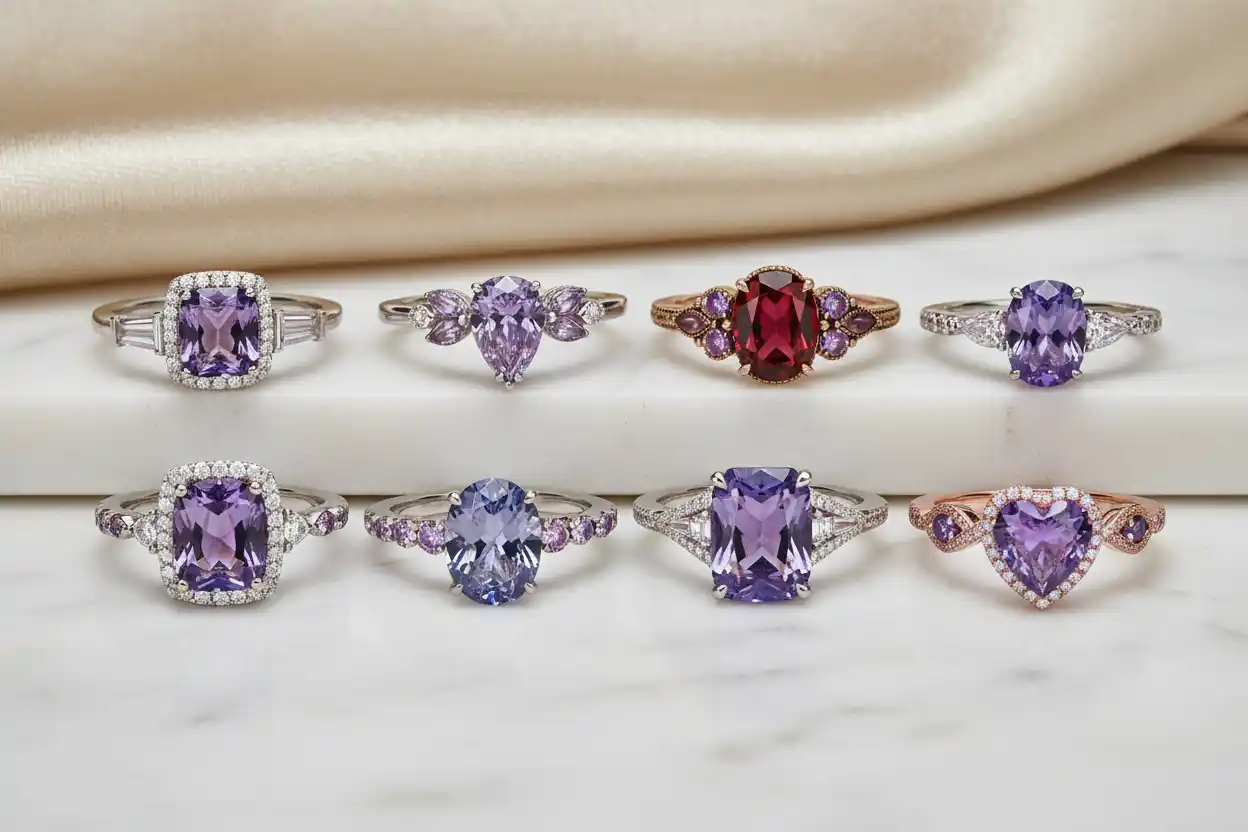
Purple Gemstones for Engagement Rings: Best Durable Choices
Purple engagement-ring stones range from durable sapphire, spinel and diamond to softer gems such as amethyst, iolite, tanzanite and kunzite. Their colors can be lilac, violet, grape, plum, lavender, blue-purple or reddish purple, but similar color does not mean similar performance.
A ring intended for daily wear needs more than an attractive hue. The center stone must tolerate abrasion, impact, temperature changes, cleaning and future repair. Setting height, cleavage, inclusions and treatment disclosure can matter as much as the Mohs hardness number.
For most wearers, purple sapphire and purple spinel provide the best balance of durability, beauty and practical maintenance. Amethyst offers an affordable alternative that may need repolishing over time. Iolite and tanzanite require more protective settings, while kunzite, fluorite and soft ornamental stones are better reserved for occasional rings.
The purple gemstones guide owns the complete color list. The broader best gemstones for engagement rings guide compares durable choices across every color.
Purple Engagement-Ring Stones at a Glance
| Gemstone | Approximate Mohs hardness | Daily-wear suitability | Color character | Main concern |
|---|---|---|---|---|
| Purple diamond | 10 | Excellent | Pale violet to rare saturated purple | Natural color, treatment and price |
| Laboratory-grown purple diamond | 10 | Excellent | Lilac to saturated violet | Growth origin and color treatment disclosure |
| Purple sapphire | 9 | Excellent | Lavender, violet, plum and reddish purple | Heat, diffusion and synthetic material |
| Purple spinel | 8 | Very good | Lilac, violet, grape and purple-red | Natural versus synthetic identity |
| Amethyst | 7 | Good with realistic maintenance | Pale lilac to deep purple | Abrasion and possible light sensitivity |
| Iolite | 7–7.5 | Conditional | Violet-blue, blue-purple and gray-violet | Perfect cleavage and low toughness |
| Purple garnet | About 7–7.5 | Good with care | Grape, raspberry-purple and plum | Darkness and variety identification |
| Tanzanite | 6–7 | Conditional | Violet-blue and blue-violet | Cleavage, impact and heat treatment |
| Purple scapolite | About 5.5–6 | Occasional wear | Lavender to violet | Cleavage and scratching |
| Kunzite | 6.5–7 | Occasional wear | Pale pink-violet and lilac | Cleavage and color fading |
| Purple zircon | About 6–7.5 | Conditional | Violet, plum and reddish purple | Brittle facet edges and treatment |
| Purple fluorite | 4 | Not recommended for daily wear | Pale violet to saturated purple | Perfect cleavage and rapid scratching |
Hardness measures scratch resistance. The gemstone hardness chart should be read alongside gemstone toughness versus hardness and gemstone cleavage explained.
1. Purple Sapphire
Purple sapphire is the strongest practical natural colored-stone choice for most engagement rings. It belongs to corundum, ranks 9 on the Mohs scale and has good toughness with no cleavage.
Colors range from pale lavender and violet to plum, reddish purple and blue-purple. Some stones shift subtly under different lighting, and color zoning may create mixed violet and blue areas.
The sapphire engagement-ring guide covers ring designs and construction, while the sapphire buying guide owns color, clarity, cut, origin and value assessment.
Heating is common. Diffusion treatment, fracture filling and laboratory-grown sapphire also occur. A report should identify natural or laboratory origin and detectable treatment when the price justifies documentation.
Purple sapphire suits solitaires, bezels, halos and three-stone rings. It is the safest recommendation for someone who rarely removes an engagement ring.
2. Purple Spinel
Purple spinel can appear lilac, violet, grape, gray-purple, plum or reddish purple. Its crisp brilliance and Mohs hardness of 8 make it suitable for daily ring wear.
Spinel is generally durable, though sharp blows can still chip a girdle or corner. Fine stones may be eye-clean, while individual inclusions and cutting still require evaluation.
The spinel buying guide explains quality assessment. Synthetic spinel is common enough that an important natural stone benefits from independent documentation.
Spinel often costs less than an equivalent fine sapphire while providing strong color and durability. Availability can be limited, especially when the buyer wants an exact shade and calibrated shape.
3. Purple Diamond
Natural purple diamond is exceptionally rare. Color may be modified by gray, pink, brown or red, and a laboratory must determine whether it is natural, treated or laboratory-grown.
Diamond offers maximum scratch resistance but can still chip along vulnerable edges. A secure setting remains necessary, particularly for pointed shapes.
The diamond engagement-ring guide owns diamond cut, setting and report decisions.
Natural purple diamonds can carry very high rarity premiums. A buyer should not pay for a natural-color claim without a report from a respected laboratory.
Laboratory-Grown Purple Diamond
Laboratory-grown diamond has essentially the same hardness and crystal structure as natural diamond. Purple or violet color may result from growth conditions, post-growth treatment or both.
The lab-diamond engagement-ring guide covers the ring-specific buying process. The laboratory-grown versus natural gemstones guide explains why laboratory-grown, treated and imitation describe different categories.
A laboratory-grown purple diamond is practical for someone who wants diamond durability and unusual color without requiring natural rarity.
4. Amethyst
Amethyst is the most accessible natural purple engagement-ring stone. Its broad availability supports large ovals, cushions, emerald cuts and custom designs at moderate cost.
The gem ranks 7 on the Mohs scale. It can be worn frequently, but years of contact may dull facet edges and require repolishing.
The amethyst ring guide owns settings and maintenance, while the amethyst buying guide covers color zoning, cut and quality.
A protective bezel, halo or substantial multi-prong setting is preferable to a high, exposed solitaire. Amethyst is suitable for a wearer who accepts maintenance and removes the ring during rough activities.
Deep color is not automatically better. Very dark amethyst can lose brilliance and appear nearly black indoors.
5. Iolite
Iolite displays strong pleochroism, showing violet-blue, blue and nearly colorless or grayish appearances from different directions.
Its directional color can create an unusual ring, but cutting orientation is critical. A poorly oriented stone may look washed out or uneven.
The iolite ring guide covers construction, while the iolite buying guide owns color and cut evaluation.
Iolite ranks 7–7.5 but has perfect cleavage and limited toughness. A hard blow can split the stone. A bezel or halo is strongly preferable, and the wearer should remove the ring during physical work.
6. Purple Garnet
Some garnets display grape, purple-red, raspberry-purple or plum colors. These may belong to complex mixtures involving pyrope, almandine, spessartine or other garnet components.
Garnet generally lacks cleavage and can perform well in jewelry, although hardness and toughness vary across the group.
Purple garnet can provide strong brilliance and a rich color distinct from amethyst. The main risk is excessive darkness, particularly in deeply cut stones.
A laboratory report may be worthwhile when a seller uses a rare variety name or charges a premium for unusual composition.
7. Tanzanite
Tanzanite’s violet-blue color can be striking in an engagement ring, especially under mixed lighting. Its pleochroism allows the face-up appearance to lean more blue or violet depending on orientation.
The tanzanite ring guide covers protective styles, while the tanzanite buying guide owns color, size, cut and treatment assessment.
Tanzanite ranks approximately 6–7 and has cleavage. It should not be treated like sapphire.
A low halo, bezel or substantial prong design is appropriate. The tanzanite-versus-sapphire guide explains why similar blue-violet color does not imply similar durability.
Tanzanite suits an occasional engagement ring or a careful wearer who is comfortable removing it frequently.
8. Purple Scapolite
Purple scapolite may appear lavender, violet, pink-purple or grayish purple. Transparent material can show attractive brilliance, but it remains uncommon in mainstream jewelry.
Scapolite ranks roughly 5.5–6 and has cleavage, making it vulnerable to scratches and impact.
The scapolite buying guide should be used for any significant purchase.
A purple scapolite ring works better as an anniversary or occasional piece than as an uninterrupted daily-wear engagement ring.
9. Kunzite
Kunzite offers a delicate pink-violet or lilac color and is available in large transparent stones.
Its beauty is offset by poor toughness, perfect cleavage and possible fading under prolonged intense light.
The kunzite ring guide covers the necessary protective construction.
Kunzite should be selected only when the wearer understands that the ring needs deliberate, occasional use. A pendant is often a more practical format for an important kunzite.
10. Purple Zircon
Natural zircon can occur in violet, purplish red and plum shades, though treatment may influence commercial colors.
Zircon has high brilliance and dispersion but can show brittle facet edges. Hardness varies, and repeated abrasion may create a worn appearance.
A bezel or protective halo helps, but purple zircon remains a conditional daily-wear choice rather than a first recommendation.
The name must not be confused with cubic zirconia, a manufactured simulant.
Why Purple Fluorite Is a Poor Engagement-Ring Stone
Purple fluorite is visually attractive but physically unsuitable for an exposed daily ring.
Its Mohs hardness of 4 means ordinary dust and harder jewelry can scratch it. Perfect cleavage allows it to split along structural planes after a blow.
A fluorite engagement ring may hold symbolic value as a ceremonial or occasional piece, but replacement should be expected. Pendant or earring settings are more sensible.
Color and Lighting
Purple gemstones can shift dramatically between daylight, warm indoor light and LED illumination.
Sapphire may lean red-purple or blue-purple. Spinel can look grayish in one light and vivid in another. Iolite and tanzanite show direction-dependent color. Amethyst may become darker and redder under warm lamps.
Request videos in several lighting conditions. A gem that appears intensely purple only under focused showroom lighting may look too dark or too gray in everyday environments.
Cut and Windowing
Pale purple stones reveal windowing readily. A shallow pavilion creates a transparent central area through which skin or the setting can be seen.
Deep cutting can increase saturation but hides weight beneath the ring and reduces face-up dimensions.
Compare millimeter measurements, not only carat weight. A lighter sapphire and heavier amethyst of similar dimensions will not have the same density or visual behavior.
The cut should distribute color evenly without broad dead zones, crooked outlines or poorly protected corners.
Setting Protection
A bezel offers the strongest girdle coverage. Halos provide some side protection and increase apparent diameter.
Six-prong settings create redundancy for rounds and ovals. Pears, marquises and square corners require properly shaped protective prongs.
Low settings reduce snagging and impact. High cathedral settings may accommodate a wedding band but place the center stone in a more exposed position.
The setting should reflect the individual material rather than being adapted from a diamond design without adjustment.
Treatments and Disclosure
Purple sapphire may be heated, diffused, filled or laboratory-grown. Amethyst may be synthetic, dyed or fracture-filled. Tanzanite is commonly heated. Kunzite may be irradiated and heated, while diamond color may be natural, treated or growth-related.
The gemstone treatments guide explains these categories.
Treatment does not automatically make a gem unsuitable. The buyer needs accurate disclosure, stable expectations and a price consistent with the material.
Reports and Online Buying
Important sapphire, spinel, diamond and unusual garnet purchases may justify independent documentation.
The gemstone certification guide explains report providers and scope. The guide to reading a gem laboratory report helps distinguish identity, treatment and origin statements.
For remote purchases, follow how to buy gemstones online. Request the exact stone’s measurements, weight, treatment disclosure, videos, setting profile, resizing limits and return period.
A retailer-created “AAA certificate” is not equivalent to independent gemological testing.
Matching the Stone to the Wearer
Someone who rarely removes a ring should choose sapphire, spinel or diamond.
A wearer comfortable with periodic repolishing may consider amethyst. Iolite and tanzanite require greater attention to impact. Kunzite and scapolite suit selective wear.
Lifestyle is more important than abstract preference. Consider work, exercise, cooking, childcare, travel, cleaning habits and willingness to use a ring box consistently.
The best engagement stone is the one that remains compatible with the wearer’s real routine after the excitement of the purchase has passed.
Frequently Asked Questions
1. What is the best purple gemstone for an engagement ring?
Purple sapphire is the strongest all-around natural colored-stone choice. Purple spinel also provides excellent durability and brilliance.
2. Is amethyst durable enough for an engagement ring?
Yes, with realistic expectations. It may show scratches and worn facet edges over time and may require repolishing.
3. Is tanzanite suitable for daily engagement-ring wear?
It is better for careful or occasional wear because it is softer and has cleavage. A protective setting is essential.
4. Is iolite stronger than amethyst?
Iolite can be slightly harder, but its perfect cleavage makes it more vulnerable to splitting from a sharp blow.
5. Are purple sapphires natural?
Natural purple sapphire exists, but heated, diffusion-treated and laboratory-grown material also occurs. Important stones should have clear disclosure.
6. Is purple spinel rare?
Fine vivid purple spinel can be uncommon, especially in larger sizes and specific shades. Synthetic spinel must be excluded.
7. Can fluorite be used in an engagement ring?
It can be mounted, but it is not practical for daily wear because it scratches easily and has perfect cleavage.
8. Which purple gemstone is most affordable?
Amethyst usually offers the largest natural purple stone for the lowest cost. Price still varies with color, clarity, cut and setting.
9. Which purple gemstone gives the largest face-up appearance?
Amethyst and kunzite can provide large dimensions at moderate prices, though kunzite has significant durability and fading concerns.
10. Do purple gemstones change color under different lighting?
Many do. Pleochroism, color zoning and light temperature can make violet stones appear bluer, redder, grayer or darker.
11. Which setting is safest for a purple engagement stone?
A low bezel or protective halo provides strong edge coverage. The best design depends on the gem’s cleavage, inclusions and shape.
12. Does a purple engagement-ring stone need a laboratory report?
A report is valuable when natural origin, treatment, rarity or price materially affects the purchase, particularly for sapphire, spinel and diamond.
A purple engagement ring should be designed around durability rather than color alone. Sapphire and spinel tolerate the widest range of daily routines; amethyst offers accessible color with maintenance; and iolite, tanzanite, scapolite and kunzite demand increasingly selective wear. Choosing honestly between those trade-offs creates a ring that can remain meaningful without becoming too fragile to enjoy.