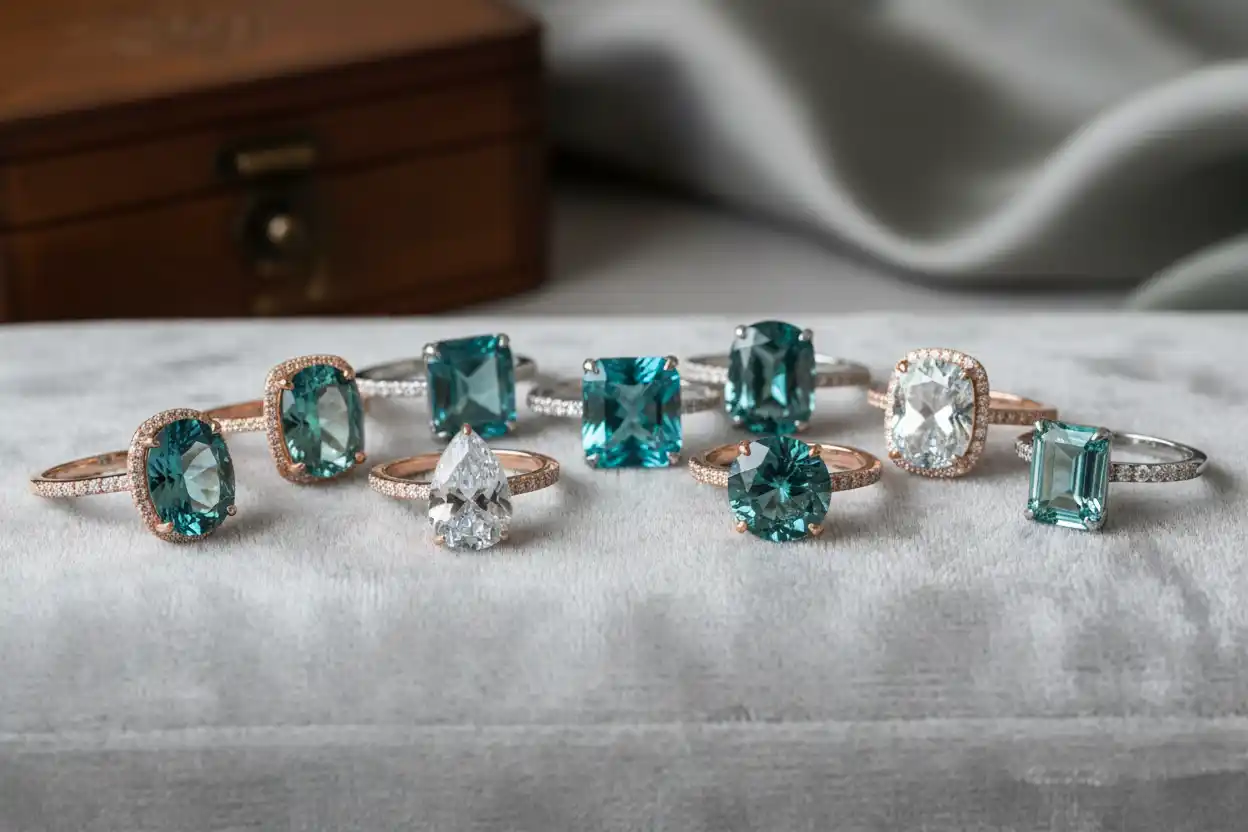
Teal Gemstones for Engagement Rings
Teal sits between blue and green, but the balance can shift from cool ocean blue-green to deeper peacock green-blue. That flexibility makes it one of the most distinctive engagement-ring colors.
Teal is not a standardized gemological grade. A seller may use the word for greenish-blue Sapphire, blue-green Tourmaline, pale greenish Aquamarine, copper-bearing Paraíba-type Tourmaline, colored Moissanite, or even a heavily edited photograph.
The strongest teal engagement-ring stones are those that combine stable color with adequate hardness, acceptable toughness, reliable treatment disclosure, and a setting designed for daily wear.
Teal Sapphire is the best all-around natural choice. Spinel offers excellent durability but is less available in true teal. Tourmaline provides the broadest natural blue-green range, while Aquamarine offers a lighter, calmer version of the color. Moissanite is the most durable accessible laboratory-created option, and Zircon provides exceptional fire for a careful wearer.
Teal engagement-ring stones at a glance
| Gemstone | Mohs hardness | Structural concern | Typical teal character | Daily ring verdict |
|---|---|---|---|---|
| Teal Sapphire | 9 | No cleavage; inclusions and treatment still matter | Blue-green, green-blue, gray-teal, parti-color | Best overall |
| Teal Spinel | 8 | No cleavage; availability can be limited | Bright blue-green to muted teal | Excellent when found |
| Teal Tourmaline | 7–7.5 | Brittle, heat sensitive, commonly included | Broad ocean, forest, and peacock teal range | Good with protection |
| Paraíba-type Tourmaline | 7–7.5 | Often included and valuable | Electric cyan, neon blue-green | Premium but needs care |
| Aquamarine | 7.5–8 | Fractures and inclusions require inspection | Pale seafoam, greenish blue, light teal | Good for careful daily wear |
| Teal Moissanite | About 9.25 | Check whether color is intrinsic or coated | Saturated blue-green with strong fire | Excellent laboratory-created option |
| Blue-green Zircon | About 6–7.5 | Brittle; facet edges abrade | Bright teal with strong brilliance and fire | Occasional or protected wear |
| Teal Diamond | 10 | Cleavage and origin or treatment disclosure | Rare natural blue-green or laboratory-grown color | Excellent but expensive |
| Blue-green Topaz | 8 | Perfect cleavage; color commonly treated | Cool blue-green, sometimes coating-created | Budget option with protection |
What counts as teal?
Teal combines blue and green rather than belonging entirely to either color family.
A stone may be described as teal when it appears blue-green, green-blue, cyan, peacock, lagoon, petrol blue, ocean green, or dark turquoise. Those names are commercial descriptions rather than universal grades.
The neighboring color categories are explored in Blue Gemstones for Engagement Rings and Green Gemstones for Engagement Rings.
The broader color list appears in Teal Gemstones: Names, Meanings and Uses. This page remains focused specifically on engagement-ring durability, settings, treatments, and buying priorities.
Teal Sapphire: the strongest natural all-around choice
Teal Sapphire is blue-green or green-blue corundum. Some stones show one blended hue, while others display distinct blue and green zones.
Montana Sapphire is particularly associated with gray-blue, green-blue, and teal colors, although attractive teal material also comes from Australia, Madagascar, Nigeria, Sri Lanka, and other sources.
Sapphire ranks 9 on the Mohs scale, has no cleavage, and generally offers very good toughness. That combination makes it much better suited to daily ring wear than Tourmaline, Zircon, Tanzanite, or Topaz.
The broader material profile appears in Sapphire: Meaning, Properties & Symbolism. Quality, treatment, cutting, and report questions belong to the Sapphire Buying Guide.
What to look for in teal Sapphire
The best color is the teal you actually prefer. Some buyers want a balanced blue-green, while others favor a darker forest teal or a cooler blue-dominant stone.
Inspect the gem in daylight-equivalent and warm indoor lighting. Gray modifiers can become more obvious in weak light, while concentrated retail lighting may make the stone appear more saturated.
Color zoning is common. It can produce a beautiful parti-color effect when thoughtfully oriented, but poor cutting may leave distracting patches or an uneven face-up appearance.
Heat treatment is common in Sapphire. Lattice diffusion and other treatments also occur, so a meaningful purchase should include a reputable laboratory report.
Teal Spinel: durable, brilliant, and uncommon
Spinel ranks 8 on the Mohs scale and has no cleavage. It combines useful scratch resistance with good toughness, making it an excellent engagement-ring material.
True natural teal Spinel is less widely available than blue, gray, violet, pink, or red material. Many stones described as teal lean gray-blue, greenish gray, dark cyan, or desaturated blue-green.
That muted character can suit buyers who prefer sophisticated color over neon saturation.
The material profile appears in Spinel: Meaning, Healing Properties & Uses. Natural-origin verification, color, cut, and seller questions belong to the Spinel Buying Guide.
Laboratory-created Spinel exists in numerous colors and can imitate Sapphire, Aquamarine, Zircon, and other stones. The invoice and report should distinguish natural Spinel from synthetic material.
Teal Tourmaline: the broadest natural color range
Tourmaline offers perhaps the most varied natural teal palette. Stones may appear ocean blue, green-blue, lagoon, dark peacock, petrol blue, mint-teal, or strongly zoned.
The gem’s strong pleochroism can create different blue and green directions. Cutting orientation therefore has a major influence on the face-up color.
Tourmaline ranks about 7–7.5. It is harder than window glass but less resistant to abrasion than Sapphire or Spinel. It can also be brittle, particularly when heavily included.
The material’s wider color and structural range appears in Tourmaline: Meaning, Properties & Symbolism. Purchase-specific guidance appears in the Tourmaline Buying Guide.
A low protective setting is preferable. Bezel settings, halos, substantial prongs, and rounded shapes reduce the risk of edge damage.
Paraíba-type Tourmaline: electric blue-green
Copper-bearing Paraíba-type Tourmaline can display exceptionally vivid cyan, turquoise blue, greenish blue, and neon blue-green color.
The term is connected to copper and manganese chemistry rather than color alone. Similar copper-bearing Tourmaline has been found in Brazil, Mozambique, and Nigeria, with laboratory chemistry used to support origin opinions.
Fine material can be extremely expensive. Inclusions are common, and buyers often accept visible internal features to obtain the desired color.
The broader material profile appears in Paraíba Tourmaline: Meaning, Properties & Symbolism. Quality, treatment, origin, and documentation belong to the Paraíba Tourmaline Buying Guide.
For an engagement ring, avoid a high exposed setting. A durable halo or bezel can protect a valuable center stone while preserving its electric color.
Aquamarine: pale and calm teal
Aquamarine is blue-to-greenish-blue beryl with Mohs hardness around 7.5–8.
Its most valuable market colors often lean more purely blue, but stones with a green component can create attractive pale teal, seafoam, lagoon, or watery blue-green engagement rings.
Aquamarine generally offers good durability when structurally sound. Large eye-clean stones are available, making it suitable for buyers who want size without extremely dark color.
The material profile appears in Aquamarine: Meaning, Healing Properties & Uses. Color, cut, clarity, treatment, and seller priorities appear in the Aquamarine Buying Guide.
Heat is commonly used to reduce green components and create purer blue. A naturally greener Aquamarine may therefore appeal to buyers seeking teal, but an unheated claim should not be accepted without evidence.
Teal Moissanite: durable laboratory-created color
Moissanite is laboratory-created silicon carbide in the modern jewelry market. It ranks approximately 9.25 on the Mohs scale and has strong brilliance and dispersion.
Teal Moissanite can provide saturated color, larger size, and strong durability at a lower cost than fine natural teal Sapphire or Paraíba-type Tourmaline.
The most important question is how the color was created. Some colored Moissanite has color distributed through the material, while other products may rely on a surface coating.
A coating can scratch, chip, or wear over time, especially on exposed pavilion facets and girdle edges.
The broader material profile appears in Moissanite: Meaning, Properties & Symbolism. Cut, coating, seller, and warranty questions belong to the Moissanite Buying Guide.
Teal Moissanite is a strong choice for someone who prioritizes color, durability, size, and replacement affordability over natural geological origin.
Blue-green Zircon: exceptional brilliance with more care
Natural Zircon has strong brilliance, high dispersion, and visible facet doubling. Blue and greenish-blue stones can create vivid teal color.
Most blue Zircon owes its color to heat treatment. The treatment is common, but some stones can show color instability after prolonged bright-light exposure.
Zircon’s hardness varies around 6–7.5 depending on its structural condition. It can be brittle, and facet junctions may abrade with daily wear.
The material profile appears in Zircon: Meaning, Properties & Symbolism. The Zircon Buying Guide owns color, heat treatment, cut, wear, and seller evaluation.
A Zircon engagement ring should use a bezel or substantial halo and should be removed during physical work. It offers remarkable fire but requires more maintenance than Sapphire, Spinel, or Moissanite.
Teal Diamond
Natural blue-green and green-blue Diamonds are rare and expensive. Their color may be connected with boron, radiation-related defects, hydrogen, or combinations of structural and trace-element effects.
Laboratory-grown colored Diamonds can provide similar hues at a more accessible price. Treated natural Diamonds also occur.
Diamond ranks 10 on the Mohs scale, although it has cleavage and can chip from a sharp blow. It remains an excellent engagement-ring material when properly cut and set.
A colored Diamond report should state whether the stone is natural or laboratory grown and whether the color is natural or treated.
Blue-green Topaz
Blue Topaz is widely available and generally owes its color to irradiation and heat. Some products lean greenish blue, while coated Topaz can create stronger teal or rainbow effects.
Topaz ranks 8 on the Mohs scale but has perfect cleavage. A concentrated impact can split it despite good scratch resistance.
Its affordability makes it attractive for a budget ring, but it is less forgiving than Sapphire or Spinel.
A protected setting is important, and coating disclosure must be clear. The stone should not be selected solely because the seller calls the color ocean, Caribbean, or teal.
Ranking teal stones for daily wear
For most buyers, the practical ranking begins with Teal Sapphire, followed by Spinel and Moissanite.
Aquamarine and Tourmaline can perform well when the stones are sound and the setting protects them. Paraíba-type Tourmaline belongs in the same structural category as other Tourmalines but may deserve even greater protection because of its value and inclusions.
Zircon and Topaz can work for careful wearers but are weaker default choices for a ring worn continuously.
The complete durability framework appears in Best Gemstones for Engagement Rings and Best Gemstones for Everyday Wear.
The Gemstone Hardness Chart explains scratch resistance, while Gemstone Toughness vs Hardness explains why hardness alone does not determine ring safety.
Choosing the right setting
A durable setting should match the gemstone rather than follow one design for every teal stone.
Sapphire, Spinel, Moissanite, and Diamond can tolerate conventional prong settings when the girdle and corners are protected.
Tourmaline, Aquamarine, Zircon, and Topaz benefit from lower profiles, halos, half-bezels, or full bezels. Pointed pears, marquises, kites, shields, and princess cuts need reinforced tips.
A setting should also allow cleaning and professional inspection. Fully closed backs can trap residue and make treatments or composite construction difficult to examine.
Metal color
White gold and platinum emphasize cooler cyan and blue-dominant teal stones. They create a crisp contrast and can make gray modifiers more noticeable.
Yellow gold warms the stone and can shift the visual balance toward green. It works especially well with dark peacock Sapphire and forest-teal Tourmaline.
Rose gold can complement muted teal but may introduce a brown or gray visual interaction in pale stones.
View the exact gemstone over the intended metal before approving the final setting.
Cut and color zoning
Teal stones often contain multiple color directions or zones.
Sapphire may have blue and green patches. Tourmaline may show strong pleochroism or lengthwise zoning. Aquamarine can contain pale and stronger areas, while colored Moissanite or coated products may show color differences near edges.
A skilled cutter uses zoning intentionally. A poor cut may create an obvious half-blue, half-green stone, a colorless window, or dark extinction through the center.
Examine the gemstone face up, from the side, and while rotating it. A stone that looks teal only from one narrow angle may disappoint in daily wear.
Treatments and laboratory reports
Heat treatment is common in Sapphire, Tourmaline, Aquamarine, and Zircon. Diffusion can affect Sapphire. Coatings may appear on Moissanite, Topaz, quartz, or other simulants.
Treatment does not automatically make a stone unsuitable, but the process should be disclosed because it can affect value, stability, repair, and cleaning.
A significant natural Sapphire, Spinel, Paraíba-type Tourmaline, colored Diamond, or rare-color stone should have an independent report.
The completed Gemstone Certification Labs Compared explains laboratory services. Before ordering from an unfamiliar dealer, follow How to Buy Gemstones Online Without Getting Scammed.
Budget expectations
Teal Sapphire covers a broad range. Gray or dark commercial stones may be accessible, while fine saturated, well-cut, minimally treated, or origin-documented material can be expensive.
Tourmaline also covers many price levels. Ordinary included blue-green stones can be affordable, while Paraíba-type material occupies a premium market.
Aquamarine often provides larger visual size for the budget, especially when the color is pale or greenish. Spinel can be valuable because true teal supply is limited.
Moissanite offers the strongest combination of size and durability at a predictable laboratory-created price. Zircon and Topaz can provide visual impact at lower cost but require greater care.
Frequently Asked Questions
1. What is the best teal gemstone for an engagement ring?
Teal Sapphire is the strongest overall natural choice because it combines hardness 9, good toughness, no cleavage, and broad availability.
2. Is teal a standardized gemstone color?
No. Teal is a descriptive blue-green range rather than a universal laboratory grade.
3. Are Montana Sapphires always teal?
No. Montana Sapphire occurs in many colors, although blue-green, green-blue, gray-blue, and teal stones are well known.
4. Is Tourmaline durable enough for an engagement ring?
It can be, especially in a protective setting, but it is less abrasion resistant and more brittle than Sapphire or Spinel.
5. Is Paraíba Tourmaline suitable for daily wear?
It can be worn carefully, but inclusions, value, and Tourmaline’s brittleness make a low protective setting advisable.
6. Can Aquamarine be teal?
Yes. Greenish-blue Aquamarine can produce pale seafoam and light teal colors.
7. Is teal Moissanite coated?
Some colored Moissanite may be coated, while other material has color throughout. The seller should disclose the process.
8. Is blue-green Zircon durable?
It can be worn in jewelry, but it is brittle and prone to facet-edge abrasion, making protection important.
9. Is Topaz a good teal engagement stone?
It is affordable and scratch resistant, but perfect cleavage and possible coatings make it a weaker daily-wear option.
10. Which metal looks best with teal?
White metals emphasize blue, while yellow gold warms the stone and can emphasize green. The best choice depends on the exact gem.
11. Do teal gemstones need laboratory reports?
Reports are advisable for valuable natural Sapphire, Spinel, Paraíba-type Tourmaline, colored Diamond, or any stone whose price depends on treatment or origin.
12. Which teal gemstone offers the best value?
Moissanite offers durability and size at an accessible price. Natural Aquamarine and commercial teal Sapphire can also provide strong value depending on color and treatment.
Conclusion
Teal Sapphire offers the strongest natural balance of beauty, durability, and daily-wear practicality. Spinel provides excellent performance when a true teal stone can be found, while Tourmaline supplies the widest and most expressive natural blue-green palette.
Aquamarine creates a lighter watery teal. Moissanite offers durable laboratory-created color and larger size. Zircon and Topaz provide brilliance or affordability but demand more protective wear.
The best ring is not simply the stone with the most saturated teal. It is the stone whose color, structure, treatment, setting, and maintenance requirements match the way the ring will actually be worn.