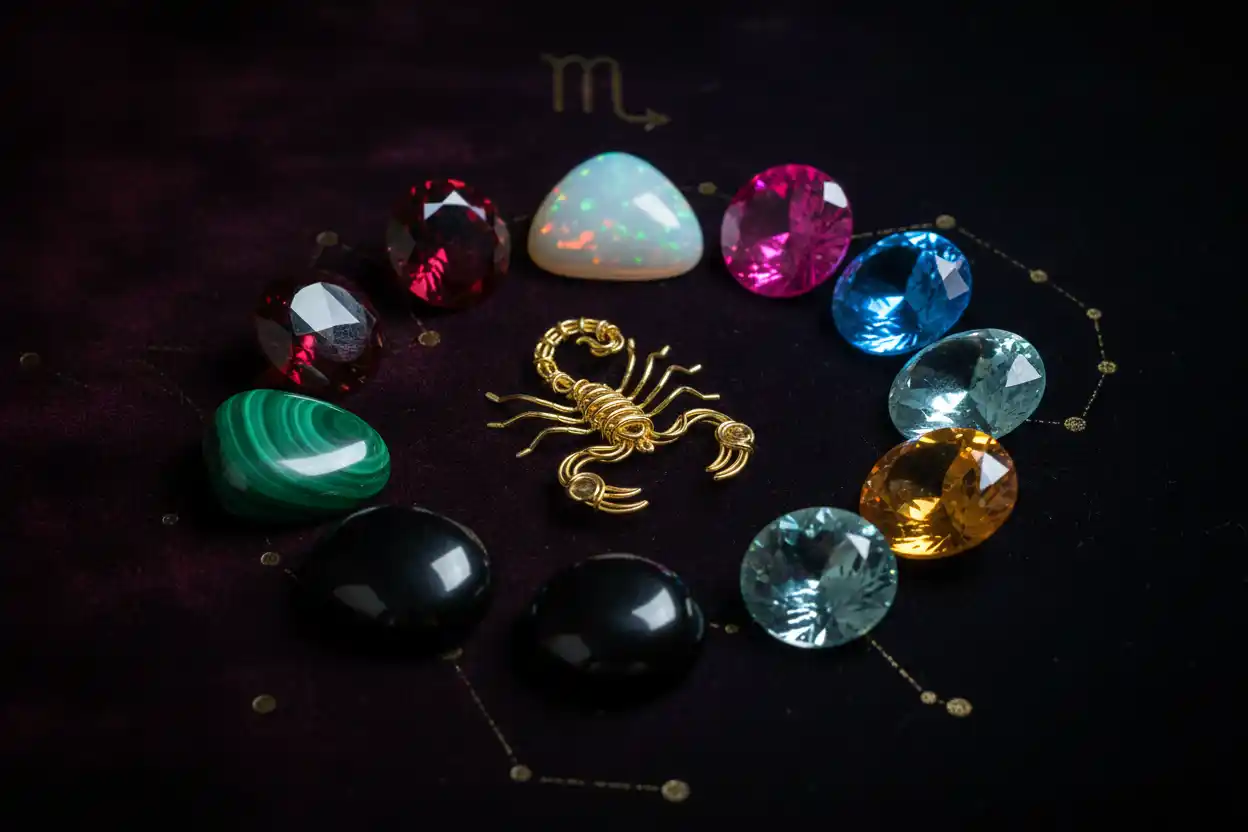
Scorpio Birthstone: 18 Spiritual Symbols of Topaz & Obsidian Shielding
The Scorpio birthstone tradition often brings topaz and obsidian together, but the two stones have very different reasons for being associated with the sign. Scorpio generally extends from late October into late November. Topaz has a recognized place in November birthstone traditions, giving it a direct calendar connection with many Scorpio birthdays. Obsidian is not an official monthly birthstone. Its Scorpio connection comes mainly from modern astrological and spiritual traditions that associate its dark volcanic appearance with protection, introspection, personal strength, and the symbolic release of unwanted patterns.
Gemologically, topaz and obsidian are fundamentally different. Topaz is a crystalline aluminum silicate mineral containing fluorine and hydroxyl, and it reaches 8 on the Mohs hardness scale. Obsidian is natural volcanic glass created when silica-rich lava cools so rapidly that an orderly crystal structure does not develop. It is typically around 5 to 5.5 on the Mohs scale, fractures with extremely sharp conchoidal surfaces, and is considerably more vulnerable to scratching and edge damage than topaz.
Their spiritual associations should therefore be separated from their physical properties. Topaz can symbolically represent purpose, confidence, honesty, and renewal, while black obsidian is frequently used as a symbol of boundaries, self-examination, and protection. Neither gemstone scientifically shields a person from negative energy, determines Scorpio personality traits, predicts events, or changes emotional health. Their value within astrology and spiritual practice comes from tradition, personal interpretation, jewelry use, and the meaning chosen by the wearer.
18 Spiritual Symbols Associated With Scorpio Birthstones
- Inner strength
- Transformation
- Self-awareness
- Courage
- Emotional honesty
- Personal boundaries
- Determination
- Renewal
- Focus
- Resilience
- Intuition
- Truth
- Purpose
- Reflection
- Loyalty
- Self-control
- Protection symbolism
- Personal growth
These 18 themes describe symbolic ideas often connected with Scorpio, topaz, and obsidian. They do not represent measurable powers contained within the stones. A wearer may use topaz or obsidian as a meaningful reminder of courage, restraint, self-knowledge, or change, but the gemstone itself does not create those qualities or determine how a person will behave.
Why Topaz and Obsidian Are Associated With Scorpio
Scorpio is commonly placed from about October 23 to November 21 in Western tropical astrology. Because the sign crosses two calendar months, recognized monthly birthstone traditions do not produce a single stone for every Scorpio. October is conventionally associated with opal and tourmaline, while November is associated with topaz and citrine. This means topaz has a clear recognized birthstone connection for November-born Scorpios.
Obsidian belongs to a different tradition. It is widely listed in contemporary zodiac, crystal, and spiritual practices as a Scorpio-associated stone because its dark color and volcanic origin are interpreted as symbols of intensity, transformation, truth, and protective boundaries. Those associations are cultural interpretations rather than a mineralogical classification. A gemologist identifies obsidian by its geological origin, glassy structure, physical characteristics, and optical behavior, not by astrology.
The pairing can still make sense symbolically. Topaz, particularly warm yellow, orange, and golden varieties, can represent clarity and purposeful movement, while obsidian can represent examining difficult experiences without avoiding them. This creates an appealing contrast between transparent crystalline topaz and opaque to translucent volcanic glass, but it does not imply that either stone physically changes Scorpio traits.
Topaz and Obsidian Gemological Comparison
| Property | Topaz | Obsidian |
|---|---|---|
| Mineral identity | Crystalline topaz | Natural volcanic glass |
| Chemical character | Al₂SiO₄(F,OH)₂ | Silica-rich volcanic glass with variable composition |
| Structure | Crystalline | Amorphous |
| Typical color | Colorless, blue, yellow, orange, pink, brown | Black, brown, reddish, gray, sometimes patterned or sheened |
| Mohs hardness | 8 | About 5 to 5.5 |
| Cleavage | Perfect basal cleavage | No true cleavage |
| Fracture | Uneven to conchoidal | Strong conchoidal fracture |
| Transparency | Transparent to translucent | Commonly opaque to translucent |
| Common treatments | Irradiation, heating, coatings | Treatment less common, imitation glass is important |
| Jewelry durability | Good with impact protection | Moderate and requires care |
The contrast between hardness and toughness is particularly important. Topaz is considerably harder than obsidian and therefore resists scratching better, but it possesses perfect cleavage. A strong impact in the wrong direction can split or chip a topaz even though it ranks high on the Mohs scale. Obsidian has no crystalline cleavage because it lacks an ordered crystal lattice, yet its glassy structure is brittle and capable of producing extremely sharp fractures.
For jewelry, this means neither stone should be judged from hardness alone. Topaz is usually the more practical choice for regular wear, particularly when protected by a thoughtful setting. Obsidian works very well in pendants, earrings, beads, carvings, and carefully worn rings, but exposed edges can chip relatively easily.
Topaz Meaning for Scorpio and Its Real Mineral Properties
Topaz has accumulated symbolic associations with truth, confidence, generosity, clarity, and purposeful action. Within Scorpio astrology, those ideas are sometimes connected with determination and personal transformation. A wearer might choose a golden topaz ring to represent deliberate change or a blue topaz pendant as a symbol of thoughtful communication.
The stone does not create courage, reveal hidden truths, guarantee loyalty, or improve mental health. Those are symbolic interpretations attached to a genuine mineral with measurable physical and optical properties.
Topaz forms in several geological environments, including certain granitic pegmatites and cavities associated with silica-rich igneous rocks. Its chemical structure can accommodate fluorine and hydroxyl in varying proportions. Natural topaz occurs in colorless, yellow, brown, orange, pink, reddish, blue, and other shades, although the abundance and commercial importance of each color differ greatly.
Much of the blue topaz found in modern jewelry has been treated. Pale or colorless natural topaz can be irradiated and then heated to create stable blue colors ranging from light to intensely saturated shades. These treatments are commercially accepted when disclosed. Treated blue topaz is still genuine topaz, but intense blue color should not automatically be interpreted as exceptional natural rarity.
Warm-colored topaz can occupy a different market. Fine orange, pinkish-orange, pink, or reddish stones described in the trade as imperial topaz can command substantial premiums, although the exact boundaries of the term are not universally standardized. Buyers considering expensive examples should focus on actual color, transparency, cut quality, treatment disclosure, and dependable identification rather than relying on an impressive trade name alone.
Obsidian Meaning for Scorpio and Its Volcanic Origin
Black obsidian is one of the most visually recognizable stones associated with Scorpio. Spiritual traditions often describe it using words such as shielding, grounding, truth, release, and protection. A more realistic interpretation is that a dark obsidian object can serve as a chosen symbol of boundaries, self-reflection, or determination without physically blocking harmful energy or altering another person’s intentions.
Obsidian forms when silica-rich volcanic lava cools quickly enough to prevent extensive crystallization. Because its atoms do not organize into a regular crystal lattice, obsidian is classified as natural glass rather than a mineral species in the strict scientific sense. This distinction is important even though obsidian is routinely grouped with gemstones and ornamental stones in jewelry and collecting.
Black is the most familiar color, but natural obsidian can show considerable variation. Brown and reddish varieties occur, and iron-related coloration can produce mahogany patterns. Snowflake obsidian contains pale spherulitic structures created through partial crystallization, commonly involving cristobalite. Sheen obsidian may display attractive silver or golden reflections caused by numerous tiny inclusions or bubbles interacting with light.
Rainbow obsidian can show subtle bands of iridescent color when cut and oriented correctly. These optical effects are real structural features rather than evidence of an energy field. The best examples depend heavily on cutting orientation because the reflective layers may disappear or become weak when the rough is fashioned at the wrong angle.
Why “Shielding” Should Be Understood Symbolically
The word shielding appears frequently in descriptions of obsidian, particularly black obsidian. Historically and spiritually, a dark reflective stone can be an effective symbol of defense, caution, or psychological boundaries. People may wear it during difficult periods because the object reminds them to protect their time, communicate limits, or avoid repeating an unhealthy decision.
That use does not establish a physical mechanism through which obsidian absorbs negative energy, prevents misfortune, or creates an invisible protective barrier. No gemological property such as refractive index, hardness, density, or chemical composition demonstrates such an effect.
The distinction does not make the symbolism meaningless. Jewelry has served as a carrier of memory, identity, vows, status, faith, and personal intentions throughout human history. An obsidian pendant can have genuine emotional significance because of what the wearer associates with it, just as an heirloom ring can carry meaning without requiring the gem to emit a measurable force.
Natural Obsidian, Man-Made Glass, and Misleading Colors
Because obsidian itself is natural glass, distinguishing it from man-made glass can sometimes be more difficult than buyers expect. Black manufactured glass may look similar to polished black obsidian, especially in inexpensive beads, cabochons, and carvings. Reliable identification may require examination of inclusions, flow features, refractive characteristics, density, or other gemological evidence.
Bright transparent blue, vivid green, and intensely colored red products sold as rare natural obsidian deserve particular caution. Natural obsidian does occur in several shades and can display colorful optical effects, but extremely transparent, uniformly colored decorative glass is sometimes marketed using the obsidian name.
Gas bubbles are not automatically proof that a specimen is artificial because natural volcanic glass can contain bubbles. Likewise, visible flow lines do not by themselves establish authenticity. Identification depends on the complete set of features rather than a single visual clue.
For valuable carvings, jewelry, or unusual varieties, a seller should describe whether the piece is natural obsidian and whether any claimed locality is documented. Claims of rare provenance can strongly influence price, so they should be treated separately from the stone’s appearance.
Scorpio Birthstone Jewelry: Durability, Settings, and Practical Wear
Topaz usually offers greater flexibility for regular jewelry because its Mohs hardness of 8 gives it good resistance to everyday abrasion. Rings, earrings, pendants, and bracelets can all perform well when designed properly. The important weakness is cleavage, so very high ring settings or exposed pointed corners may be vulnerable to accidental knocks.
Protective halos, bezels, or substantial prongs can reduce some impact risk. Large topaz gems are relatively available, but their size can make an exposed ring more vulnerable simply because there is more surface area to strike against hard objects.
Obsidian should be approached more cautiously in rings. Its hardness of about 5 to 5.5 means it can accumulate scratches faster than topaz, and its brittle glassy nature allows edges to chip. Smooth cabochons are generally more practical than thin faceted forms because rounded surfaces eliminate vulnerable facet junctions.
Pendants and earrings are particularly suitable for obsidian because they experience less frequent impact with desks, door frames, countertops, tools, and other hard surfaces. A polished black obsidian pendant can also emphasize the stone’s reflective appearance without demanding the durability expected from an everyday ring.
Cleaning and Storing Topaz and Obsidian
Topaz jewelry can generally be cleaned with lukewarm water, mild soap, and a soft brush when the setting is secure and no fragile coatings are present. Extreme heat and sudden temperature changes should be avoided, and aggressive mechanical cleaning is unnecessary. Because cleavage makes impact a concern, care should also be taken not to strike the stone against the sink or another hard surface during cleaning.
Coated topaz requires additional caution. Some colorful effects sold under trade descriptions such as mystic topaz are produced by thin surface coatings that can be scratched or damaged. A coating may require gentler care than untreated or conventionally irradiated topaz.
Obsidian is best cleaned simply with mild soap, lukewarm water, and a soft cloth. Abrasive cleaners should be avoided because the glassy surface is softer than many common jewelry gems. Steam or harsh ultrasonic cleaning offers little practical advantage and may place fragile settings or already damaged stones under unnecessary stress.
The two stones should ideally be stored separately. Topaz is hard enough to scratch obsidian if pieces repeatedly rub together. Soft pouches or divided jewelry compartments reduce contact and help preserve polished surfaces.
Choosing a Scorpio Birthstone With Meaning and Quality in Mind
A November-born Scorpio has a straightforward reason to select topaz because the stone belongs to recognized November birthstone traditions. A late-October Scorpio who chooses topaz is making more of a zodiac or aesthetic choice, since October has its own monthly birthstones. Obsidian, meanwhile, should be understood primarily as an astrological and spiritual association rather than an official Scorpio birthstone established by the jewelry trade.
Someone who wants transparent color, brilliance, and higher scratch resistance may prefer topaz. Someone drawn to opaque black, volcanic origin, polished reflection, and symbolic protection may prefer obsidian. Wearing the two together can create an effective visual contrast, particularly when warm golden topaz is paired with black obsidian.
The most important buying decisions remain practical. Topaz should be evaluated for color, clarity, cut, treatment disclosure, and damage around facet edges. Obsidian should be examined for polish, chips, authenticity, attractive patterning, and truthful representation of unusual colors or provenance. Symbolic meaning can influence the final choice, but it should not replace accurate identification.
Conclusion
Topaz and obsidian represent two very different sides of the Scorpio birthstone tradition. Topaz has a genuine connection with November’s recognized birthstone system and combines strong hardness with transparent color, although its perfect cleavage requires impact protection. Obsidian is natural volcanic glass with lower hardness and a strong tendency toward conchoidal fracture, making careful wear particularly important.
Spiritually, topaz can symbolize confidence, purpose, renewal, and honesty, while obsidian is commonly associated with boundaries, introspection, and symbolic shielding. These meanings can make either stone personally significant without treating astrology or crystal traditions as scientifically established effects.
FAQs About Scorpio Birthstone
What is the main Scorpio birthstone?
There is no single universally standardized gemological birthstone for the entire Scorpio zodiac period. Scorpio crosses October and November, and the two months have different recognized birthstone traditions. Topaz is a recognized November birthstone, giving it a direct connection with November-born Scorpios, while obsidian is mainly a popular astrological and spiritual association.
Is obsidian an official Scorpio birthstone?
Obsidian is widely associated with Scorpio in modern crystal and astrology traditions, but it is not an official monthly birthstone in the same sense as topaz for November. Its connection with Scorpio comes primarily from symbolic ideas involving transformation, reflection, boundaries, and protection.
Does black obsidian really protect Scorpio from negative energy?
There is no scientific evidence that obsidian creates a physical energy barrier or absorbs harmful forces around a wearer. Its protective meaning is symbolic. Someone may wear black obsidian as a reminder to maintain personal boundaries, avoid unhealthy patterns, or approach difficult situations deliberately.
Is topaz durable enough for everyday Scorpio jewelry?
Topaz has a Mohs hardness of 8 and resists scratching relatively well, which makes it suitable for many frequently worn jewelry designs. However, it possesses perfect cleavage and can chip or split after a strong impact. Rings therefore benefit from protective settings and sensible removal during demanding work.
Is obsidian suitable for an everyday ring?
Obsidian can be worn in rings, but it is less durable than topaz. With a hardness around 5 to 5.5 and a brittle glassy structure, it can scratch and chip during frequent wear. A low protective setting and a smooth cabochon shape are generally more practical than exposed edges.
Is blue topaz naturally blue?
Natural blue topaz exists, but much of the strongly colored blue topaz sold commercially is produced from pale or colorless natural topaz through irradiation followed by heating. The treatment does not make the gemstone artificial, but it should be disclosed because the blue color does not necessarily represent natural rarity.
Is obsidian a crystal?
In everyday spiritual vocabulary, obsidian is frequently called a crystal, but scientifically it is natural volcanic glass rather than a true crystalline mineral. Its rapid formation prevents the development of the ordered crystal structure expected in minerals such as topaz or quartz.
How can I tell natural obsidian from ordinary glass?
Visual inspection can provide clues, but no single feature is completely reliable. Natural obsidian may contain flow structures, inclusions, bubbles, or characteristic fracture surfaces, while manufactured glass can imitate several of these appearances. Unusual or expensive examples are best assessed using proper gemological examination rather than destructive home tests.
Can Scorpio wear topaz and obsidian together?
Yes. There is no scientific or gemological restriction against wearing the two together. Topaz and obsidian also create a striking visual contrast because one is typically transparent and faceted while the other is commonly dark, glassy, and polished as a cabochon. Their combined symbolism can be treated as personal rather than deterministic.
Which Scorpio birthstone is easier to care for?
Topaz generally resists scratching better because of its Mohs hardness of 8, but it needs protection from sharp blows due to cleavage. Obsidian is softer and more easily scratched or chipped. Both benefit from gentle cleaning and separate storage, though obsidian usually requires greater caution during regular wear.