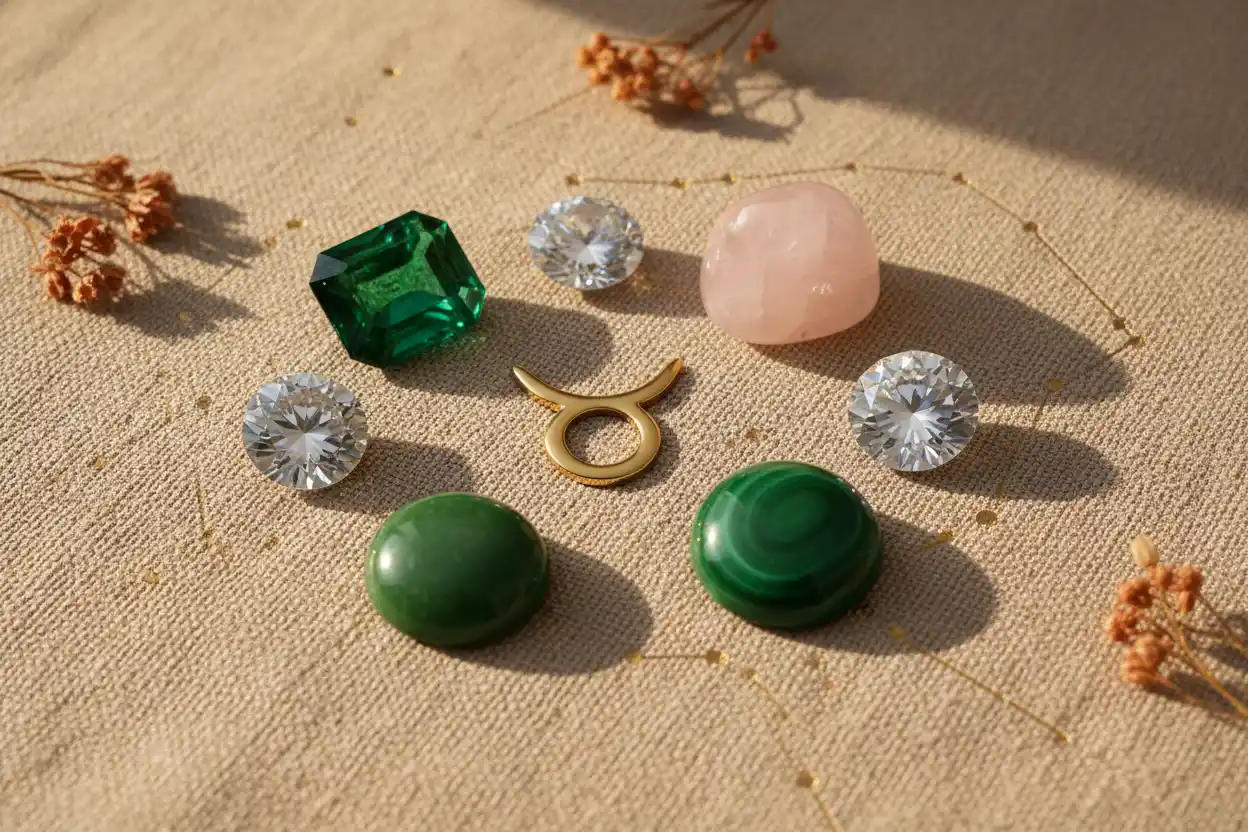
Taurus Birthstone: 14 Sacred Meanings of Emerald & Rose Quartz
The Taurus birthstone tradition commonly centers on emerald and rose quartz, although their associations come from different systems. Taurus generally spans late April through most of May. Emerald is the recognized birthstone for May, giving it a direct calendar connection with many people born under Taurus. Rose quartz does not belong to the standardized monthly birthstone system. Its Taurus association comes mainly from modern astrology and spiritual traditions that connect its pink color with affection, patience, harmony, comfort, and the symbolic influence of Venus.
Gemologically, emerald and rose quartz differ substantially. Emerald is the green variety of beryl, colored principally by chromium, vanadium, or both. It has a Mohs hardness of 7.5 to 8 but is commonly included and can be vulnerable to impact because internal fractures are frequent. Rose quartz is a pink variety of quartz with a Mohs hardness of 7. Its color involves microscopic structural features and trace components, and it is usually translucent rather than transparent enough for the faceted appearance expected from fine emerald.
Both stones carry extensive symbolic traditions, but those meanings should remain separate from measurable gemological properties. Emerald may symbolically represent loyalty, renewal, growth, and enduring affection, while rose quartz is frequently associated with tenderness, reconciliation, and self-respect. Neither gemstone scientifically controls relationships, attracts love, heals emotional trauma, changes hormones, or determines whether a Taurus person possesses particular personality traits.
14 Sacred Meanings Associated With Taurus Birthstones
- Loyalty
- Steadiness
- Love
- Patience
- Growth
- Commitment
- Harmony
- Self-respect
- Emotional openness
- Renewal
- Trust
- Stability
- Appreciation
- Lasting connection
These 14 meanings represent symbolic themes that people may associate with Taurus, emerald, and rose quartz. They are not scientific effects produced by the gemstones themselves. A Taurus wearer can use either stone to represent a value or intention without assuming that astrology determines personality or that a mineral can guarantee love, loyalty, wealth, or relationship success.
Why Emerald and Rose Quartz Are Associated With Taurus
Taurus is generally placed from about April 20 to May 20 in Western tropical astrology. Because the sign crosses April and May, different monthly birthstone traditions apply depending on the person’s exact date of birth. Diamond is the most familiar April birthstone, while emerald is the recognized birthstone for May. This gives emerald a particularly strong relationship with May-born Taurus individuals.
Rose quartz enters through astrological rather than monthly birthstone tradition. Taurus is associated in astrology with Venus, and modern spiritual practices frequently connect rose quartz with love, affection, beauty, emotional gentleness, and harmonious relationships. Its soft pink color makes that association visually intuitive, but it does not create a scientific connection between the mineral and the planet Venus.
The pairing remains attractive because emerald and rose quartz express very different forms of beauty. Fine emerald is prized for saturated green color, transparency, and the visual character created by natural inclusions. Rose quartz is valued for soft pink coloration, translucent depth, smooth cabochons, beads, carvings, and occasionally star effects. Combining them creates a strong green-and-pink contrast while allowing each stone to carry distinct historical and personal associations.
Emerald and Rose Quartz Gemological Comparison
| Property | Emerald | Rose Quartz |
|---|---|---|
| Mineral identity | Green beryl | Pink quartz |
| Chemical composition | Be₃Al₂Si₆O₁₈ | SiO₂ |
| Main color | Green to bluish green | Pale to medium pink |
| Main color origin | Chromium, vanadium, or both | Microscopic inclusions and trace-related structural features |
| Mohs hardness | 7.5 to 8 | 7 |
| Transparency | Transparent to translucent | Usually translucent |
| Cleavage | Indistinct to poor | None |
| Common inclusions | Fractures, crystals, fluid inclusions | Hazy microscopic inclusions, fractures |
| Common treatments | Oil or resin fracture filling | Treatment less central, some altered or imitation products exist |
| Typical cutting | Faceted cuts, cabochons | Cabochons, beads, carvings, occasional facets |
| Frequent-wear ring suitability | Good with careful protection | Moderate to good with sensible care |
Emerald’s higher Mohs hardness makes it more resistant to scratching than rose quartz, but hardness alone does not determine durability. Emeralds often contain numerous fractures, some of which reach the surface. These can make an otherwise hard stone vulnerable to sharp impacts. Rose quartz is slightly softer but lacks cleavage and can perform well in jewelry when the stone does not contain severe fractures.
This explains why an emerald should never be described as nearly indestructible simply because beryl ranks 7.5 to 8 on the Mohs scale. The internal condition of the individual stone matters greatly. A relatively clean emerald may withstand everyday wear better than a heavily fractured example with numerous surface-reaching fissures.
Emerald Meaning for Taurus and Its Gemological Identity
Emerald has long been associated with spring, renewal, fertility symbolism, love, status, and prosperity in different historical traditions. For Taurus, modern astrology often emphasizes loyalty, commitment, steadiness, and appreciation of beauty, so emerald is frequently interpreted as a symbol of enduring relationships and deliberate growth.
Those themes can be meaningful without assuming that emerald creates relationship harmony or attracts financial success. A person might wear an emerald anniversary ring because green represents renewal or because the stone marks a lasting commitment. The significance arises from intention, history, and the occasion rather than a measurable force emitted by the gem.
Emerald is a variety of beryl, the same mineral species that includes aquamarine and other colored beryls. For a green beryl to be accepted as emerald, its color must fall within the range recognized by gemological practice, generally involving chromium, vanadium, or both as coloring agents. The exact boundary between pale green beryl and emerald can involve professional judgment.
Color is normally the dominant value factor. Desirable emeralds show attractive green to bluish-green color with sufficient saturation while remaining lively rather than excessively dark. A stone does not need to be perfectly transparent to be valuable. Inclusions are expected in natural emerald and can provide evidence about geological origin, formation conditions, and sometimes treatment.
The trade has historically used the French term jardin, meaning garden, to describe the internal landscape visible in many emeralds. Attractive terminology should not hide serious durability problems, however. Large surface-reaching fractures can increase vulnerability, and a heavily fractured emerald needs more careful setting and wear than one with a more stable internal structure.
Emerald Treatments and Why Disclosure Matters
Fracture filling is particularly important when buying emerald. Many natural emeralds contain fissures that reach the surface, and these may be filled with colorless oil or resin to reduce their visibility and improve apparent clarity. The treatment is so common that buyers should not assume an emerald is untreated merely because a seller does not discuss enhancement.
The amount and type of filling can influence value. An emerald with minor traditional oiling may be evaluated differently from a stone with extensive fracture filling. Some fillers can also deteriorate, discolor, or change under heat, chemicals, or improper cleaning conditions.
For expensive emeralds, an independent gemological report can provide useful information about natural origin and the degree of clarity enhancement. Geographic origin can also influence market value for exceptional stones, but origin should be established through qualified testing rather than assumed from color.
Synthetic emeralds create another distinction. Laboratory-grown emerald has essentially the same fundamental mineral composition and crystal structure as natural emerald, but it was produced by people rather than geological processes. Hydrothermal and flux methods can produce attractive synthetic emeralds that may contain identifying internal features. A synthetic emerald should always be disclosed clearly rather than sold as a natural stone.
Rose Quartz Meaning for Taurus and Its Real Mineral Properties
Rose quartz is frequently associated with affection, emotional openness, reconciliation, gentleness, and self-respect. For Taurus symbolism, these ideas are often combined with themes of patience, loyalty, physical comfort, beauty, and stable relationships. A rose quartz pendant or carving may therefore serve as a personal reminder to approach relationships with kindness or to maintain healthy standards in giving and receiving affection.
The stone itself does not make another person fall in love, repair a relationship, guarantee compatibility, heal trauma, or scientifically alter emotional chemistry. Its meaning is symbolic, much like the emotional significance attached to flowers, wedding jewelry, heirlooms, or other personal objects.
Rose quartz is a variety of quartz and has a chemical composition of silicon dioxide. Most gem-quality rose quartz is translucent, with a cloudy or softly glowing internal appearance rather than high transparency. Research into its coloration has identified very fine inclusions and structural features that scatter light and contribute to its characteristic pink.
Some rose quartz can display asterism when cut as a cabochon. A correctly oriented stone may show a six-rayed star caused by light interacting with microscopic oriented inclusions. This is a genuine optical effect created by the internal structure of the stone, not a supernatural glow or energy emission.
The most attractive rose quartz usually has a pleasing pink color, good polish, and enough translucency to give the stone depth. Very pale pieces can appear almost colorless, while highly fractured pieces may lack the smooth internal appearance many buyers prefer.
Emerald and Rose Quartz in Taurus Jewelry
Emerald is one of the world’s classic precious gemstones and is frequently used in rings, earrings, pendants, and bracelets. Its high value means setting design deserves careful attention. A protective halo, bezel, or substantial prong arrangement can help reduce accidental impact, particularly in rings.
The traditional emerald cut was developed partly to complement emerald’s crystal habit and protect vulnerable corners. Its stepped facets can also emphasize color and transparency. Other shapes, including oval, cushion, pear, round, and cabochon cuts, are widely used depending on the quality and structure of the rough.
Rose quartz occupies a different jewelry category. It is especially suitable for larger cabochons, beads, pendants, carvings, and smooth statement pieces because attractive rough is available in sizes that would be costly in emerald. Its gentle pink color works with silver, white gold, yellow gold, and rose gold, although the surrounding metal can noticeably influence the way pale pink appears.
Rose quartz rings can be worn regularly with reasonable care. At Mohs 7, quartz has adequate scratch resistance for many jewelry uses, but it can still be scratched by harder gems such as sapphire, ruby, and diamond. Large domed cabochons may also receive more impacts simply because they rise above the setting.
For someone choosing between the two, emerald offers greater rarity, transparency, stronger market prestige, and a direct May birthstone connection. Rose quartz offers softer color, larger wearable sizes, lower cost, and a popular symbolic association with affection and harmony.
Color, Quality, and Buying Considerations
Emerald should be judged through a combination of color, clarity, cut, treatment, carat weight, and, when relevant, origin. Rich color normally has the strongest effect on desirability. An intensely saturated green stone can be valuable even with visible inclusions, provided those inclusions do not severely reduce transparency or structural stability.
Cutting quality is particularly important because poor proportions can make an emerald look dark, windowed, or unevenly colored. A well-cut stone should present its color attractively and distribute reflections across the face rather than allowing the viewer to see straight through a large dead area in the center.
Rose quartz should be judged differently. High transparency is not the primary goal for most specimens. Buyers should look for pleasing pink color, attractive translucency, even appearance, quality polish, and an appealing cut. For star rose quartz, the strength, centering, and movement of the star across the cabochon become important.
Marketing names should not replace identification. Quartz varieties, dyed stones, glass, and synthetic products can sometimes be sold under imaginative descriptions that imply unusual rarity. Likewise, an emerald’s country name or romantic trade description does not by itself establish provenance or quality.
Natural, Synthetic, and Imitation Risks
Natural emerald can be imitated by green glass, synthetic spinel, assembled stones, and other green gems. Synthetic emerald creates the most important distinction because it is genuine emerald in chemical and structural terms but does not have natural geological origin. Advanced synthetic stones can require trained examination or laboratory equipment for reliable separation.
Doublets and triplets can also imitate the appearance of valuable transparent gems by joining layers together. Magnification may reveal junction lines, bubbles in adhesive, or other evidence, but buyers should avoid relying on one home observation for an expensive purchase.
Rose quartz is relatively abundant, so sophisticated imitation is less economically necessary than for emerald, but glass and colored decorative products still occur. Very bright, perfectly uniform, or unusual transparent pink products should be evaluated carefully if sold for a premium.
Neither natural inclusions nor minor imperfections automatically prove geological origin. Some synthetic stones and manufactured glass can contain internal features, while natural gemstones can sometimes be unusually clean. Reliable identification depends on several observations considered together.
Caring for Emerald and Rose Quartz Safely
Emerald requires especially thoughtful cleaning because of its frequent fractures and common use of oil or resin fillers. Warm water, mild soap, and gentle wiping or brushing are safer than aggressive methods for most pieces. Steam and ultrasonic cleaning can create risks for filled or heavily fractured emeralds because heat, vibration, and cleaning solutions may disturb fillers or existing fissures.
High heat should also be avoided during jewelry repair. A jeweler working on an emerald piece should know that the stone is present and should consider possible treatment before applying heat near it.
Rose quartz is usually simpler to care for. Lukewarm water, mild soap, and a soft cloth or brush are generally suitable. Repeated harsh chemicals and abrasive cleaners should still be avoided because they can damage polish or the surrounding metal.
Some rose quartz can fade after prolonged exposure to intense light, depending on the stone and the nature of its coloration. Normal wear does not require keeping it constantly in darkness, but leaving a valued specimen permanently in strong direct sunlight is unnecessary.
Storage should keep emerald and rose quartz away from harder gems that could scratch their surfaces. Individual pouches or compartments also prevent emeralds from striking other jewelry and reduce the risk of damage to vulnerable edges.
Taurus Symbolism Without Treating Personality as Fixed
Astrological descriptions often characterize Taurus as loyal, steady, patient, comfort-loving, practical, and resistant to unwanted change. These themes may explain why emerald and rose quartz became appealing symbolic companions for the sign, but a birth date does not scientifically determine whether an individual possesses those traits.
Using the stones symbolically allows more flexibility. Emerald can represent the deliberate cultivation of something valuable, whether a relationship, skill, family tradition, or long-term goal. Its green color makes renewal and growth intuitive themes without requiring the stone to cause those outcomes.
Rose quartz can represent affection that includes boundaries and self-respect rather than only romantic love. A person might keep a rose quartz object because it marks an important friendship, family bond, personal milestone, or commitment to communicate more patiently.
This approach preserves the cultural and emotional appeal of birthstone jewelry while keeping the distinction between symbolism and physical evidence clear.
Conclusion
Emerald and rose quartz give the Taurus birthstone tradition two distinct forms of meaning. Emerald is the recognized May birthstone and a valuable green variety of beryl with a hardness of 7.5 to 8, although its common fractures and frequent clarity enhancement require careful buying and cleaning. Rose quartz is pink quartz with a hardness of 7, usually valued for soft translucent color, smooth polished forms, and occasional star effects.
Their Taurus meanings are symbolic rather than scientifically determined. Emerald can represent loyalty, growth, renewal, and commitment, while rose quartz can represent affection, patience, harmony, and self-respect. The best choice depends on birth month, jewelry use, genuine gemstone quality, treatment disclosure, budget, and the meaning the wearer personally wants the stone to carry.
FAQs About Taurus Birthstone
What is the main Taurus birthstone?
There is no single official gemological birthstone for the complete Taurus zodiac period. Taurus extends across late April and most of May, and those months have different recognized birthstone traditions. Emerald is the recognized May birthstone and therefore has a direct connection with May-born Taurus individuals. Rose quartz is primarily a popular astrological and spiritual association.
Is rose quartz an official Taurus birthstone?
Rose quartz is not a standardized monthly birthstone specifically assigned to Taurus. Its Taurus connection comes from astrology and spiritual traditions, particularly associations with affection, harmony, beauty, and Venus. It remains a popular Taurus stone even though its classification is symbolic rather than gemological.
Why is emerald associated with Taurus?
Emerald is strongly associated with Taurus because much of the Taurus period falls in May and emerald is the recognized May birthstone. Astrology later added themes such as loyalty, renewal, love, stability, and growth. The monthly connection is established by birthstone tradition, while the personality meanings remain symbolic.
Does rose quartz attract love for Taurus?
There is no scientific evidence that rose quartz attracts a partner, guarantees romance, repairs relationships, or changes another person’s feelings. It has a long-standing modern association with love and affection, so a wearer may use it as a meaningful symbol of kindness, self-respect, friendship, or relationship intentions.
Is emerald durable enough for an everyday ring?
Emerald has good scratch resistance because its Mohs hardness is 7.5 to 8, but many natural emeralds contain fractures that make them more vulnerable to impacts. A relatively stable emerald in a protective setting can be worn regularly, although it should be removed during strenuous work or activities likely to involve sharp knocks.
Are most emeralds treated?
Clarity enhancement with oil or resin is common in natural emerald because surface-reaching fractures are frequent. The amount of enhancement varies considerably from stone to stone. Treatment should be disclosed, particularly when buying an expensive emerald, because the degree and type of filling can influence value and care.
Can rose quartz be worn every day?
Rose quartz has a Mohs hardness of 7 and is suitable for many forms of regular jewelry. Rings require more care than pendants or earrings because they encounter more abrasion and impact. Protecting the stone from harder gems, heavy knocks, abrasive cleaning, and prolonged intense sunlight helps preserve its appearance.
Is synthetic emerald a fake emerald?
Synthetic emerald is not simply green glass. It is laboratory-grown beryl with the chemical composition and crystal structure expected of emerald, but it did not form naturally in the Earth. It should therefore be sold clearly as synthetic or laboratory-grown rather than represented as a natural emerald.
Which Taurus birthstone is more valuable?
Fine natural emerald can be vastly more valuable than ordinary rose quartz because gem-quality emerald is much rarer and strong color commands substantial demand. Rose quartz is generally more abundant and affordable. Exceptional star rose quartz or unusually fine specimens may have collector interest, but they normally occupy a different price category from high-quality emerald.
Can Taurus wear emerald and rose quartz together?
Yes. There is no gemological restriction against combining them. Green emerald and pink rose quartz also create an attractive complementary color pairing. A wearer may appreciate emerald for its May birthstone connection and rose quartz for personal symbolism without assuming that the combination produces measurable astrological effects.