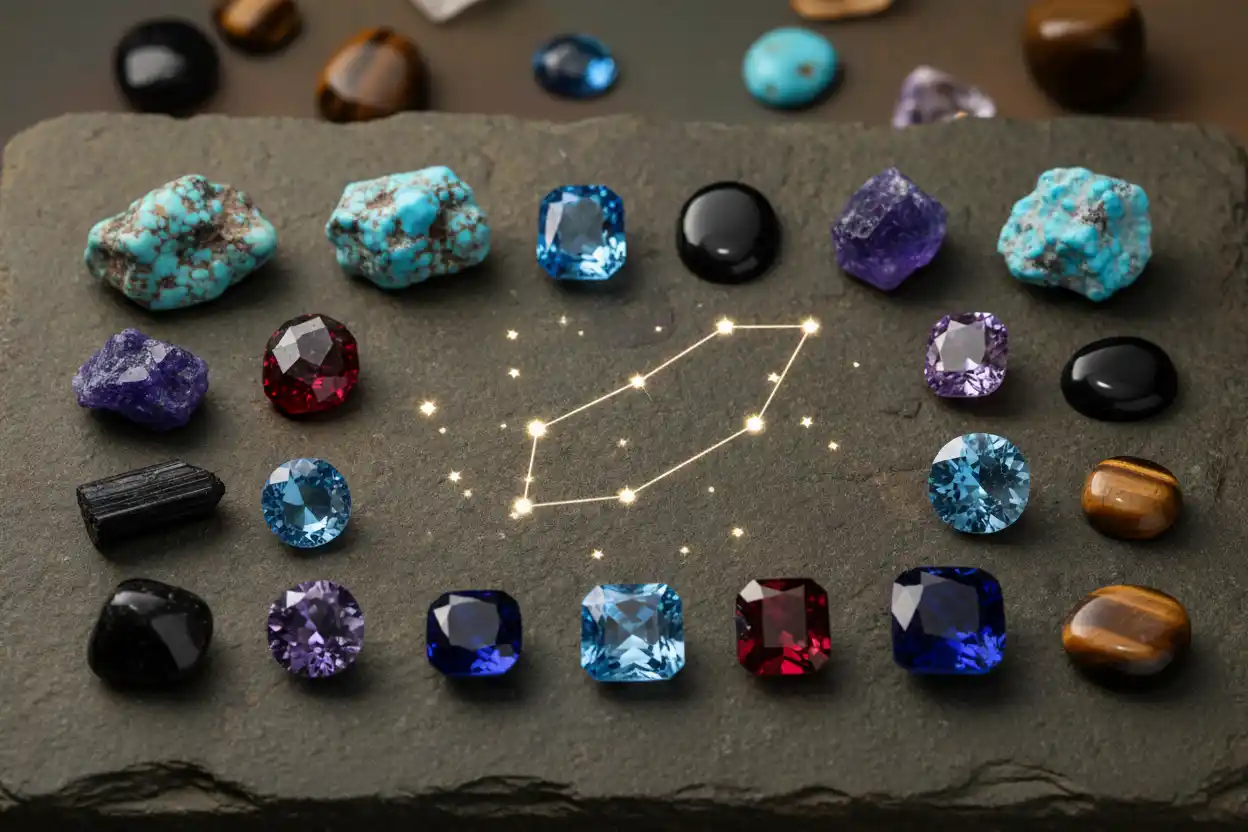
Capricorn Birthstone: 15 Spiritual Symbols of Garnet & Onyx Power
The Capricorn birthstone is most naturally associated with garnet and onyx in modern astrological gemstone traditions. Garnet has the strongest calendar connection because Capricorn spans late December and much of January, while garnet is January’s recognized birthstone. Onyx enters the tradition through its long symbolic association with discipline, restraint, protection and personal strength. The two stones are physically different, yet their dark red and black appearance creates a combination that suits themes often connected with Capricorn, including persistence, structure, responsibility and long-term ambition.
Garnet is not one single mineral variety but a group of closely related minerals that occurs in far more colors than the familiar deep red. Depending on species, garnet can appear red, orange, purple, green, yellow and even color-changing. Most jewelry garnets fall around 6.5 to 7.5 on the Mohs hardness scale and have fair to good toughness. Onyx, when the term is used correctly in gemology, is a parallel-banded variety of chalcedony and therefore belongs to the quartz family, generally around Mohs 6.5 to 7. Much of the solid black onyx sold in jewelry is treated or dyed chalcedony, which is normal in the trade when accurately represented.
A Capricorn birthstone can therefore carry meaningful symbolism without being treated as a source of literal astrological power. Garnet may represent the determination to continue through a demanding goal, while onyx can symbolize restraint, boundaries and concentration. Astrology does not scientifically determine personality, and neither gemstone has been demonstrated to create ambition, discipline or protection. Their value comes from the ideas and personal commitments the wearer chooses to associate with them.
15 Spiritual Symbols of the Capricorn Birthstone
- Garnet can symbolize persistence through demanding goals.
- Deep red can represent commitment rather than temporary excitement.
- January birthstone tradition strengthens garnet’s Capricorn connection.
- Garnet durability can symbolize resilience through ordinary pressure.
- Its ancient use can represent continuity and lasting values.
- Onyx can symbolize discipline and deliberate restraint.
- Dark color can represent strong personal boundaries.
- Parallel banding can symbolize structure and organized priorities.
- Onyx can represent calm strength rather than dramatic force.
- Garnet and onyx together can symbolize ambition balanced by judgment.
- Their contrasting colors can represent passion guided by discipline.
- A Capricorn birthstone can mark responsibility willingly accepted.
- Jewelry can symbolize progress built slowly over time.
- An heirloom piece can represent continuity between generations.
- Spiritual Capricorn power remains symbolic rather than scientifically measurable.
Garnet Has the Strongest Traditional Connection With Capricorn
Garnet is the most straightforward Capricorn birthstone because of its established connection with January. Many Capricorn birthdays occur during that month, giving the stone a calendar foundation that exists independently of modern astrology. Garnet has also been used in jewelry for thousands of years, including ornaments from ancient Egypt and carved signet stones from the Roman world. Its long use gives themes such as endurance and continuity a historical depth that does not depend on modern metaphysical claims.
The familiar dark red varieties make commitment an especially natural symbolic interpretation. Deep red can suggest seriousness, devotion and sustained effort rather than the brief excitement often associated with brighter orange or yellow gems. For someone who values Capricorn symbolism, a garnet ring may represent continuing a difficult professional path, remaining dependable in an important relationship or accepting responsibility for a long-term project.
That symbolism remains personal. Garnet does not make someone more disciplined or ambitious. The gemstone can, however, become a visible reminder of a commitment already chosen.
Garnet Is a Group, Not Just One Dark Red Gemstone
One of the most useful facts about garnet is that the name describes a mineral group. Almandine and pyrope produce many familiar red stones, while spessartine can be vivid orange, tsavorite is green, demantoid can be bright green and rhodolite often appears purplish red.
This variety allows a Capricorn birthstone to move beyond the traditional dark red palette without abandoning garnet entirely. Someone who prefers vivid orange can choose spessartine, while green garnet may suit a person who wants symbolism around gradual growth. Purplish rhodolite provides a softer interpretation of the classic red garnet appearance.
The physical properties also vary slightly across garnet species. Hardness generally falls between 6.5 and 7.5, and toughness is usually fair to good. This makes many garnets suitable for rings, earrings, pendants and bracelets when protected from severe impact.
The diversity within one mineral group also provides a useful symbolic message for Capricorn. Consistency does not require sameness. A person can maintain strong values while changing methods, interests or appearance over time.
Garnet’s History Makes Persistence More Meaningful Than Motivation
Modern spiritual writing often describes garnet through words such as passion, energy and motivation, but persistence is a more useful Capricorn theme. Motivation naturally rises and falls, while long-term results usually depend on continuing after enthusiasm has become ordinary.
A garnet can symbolize that second stage of effort.
Someone studying for a qualification may begin with enthusiasm and later rely on routine. A person building a business may experience periods when progress feels slow. A relationship may move beyond dramatic romance into years of ordinary responsibility and mutual support. Garnet symbolism fits these phases because its historical identity is strongly connected with durable jewelry and continuity.
This is one reason the Capricorn birthstone can become more meaningful when it is connected with a specific responsibility rather than a vague idea of success.
Onyx Brings Discipline and Structure Into Capricorn Symbolism
True onyx is a banded variety of chalcedony in which the bands are typically straight or parallel rather than curved and irregular like many agates. Traditional onyx commonly shows black and white layers, although other dark and light combinations can occur. In contemporary jewelry, the term black onyx is also widely used for uniformly dark chalcedony, much of which has been treated to achieve an even black appearance.
As chalcedony, onyx is composed primarily of silica and generally ranks around 6.5 to 7 on the Mohs hardness scale. It is therefore reasonably durable for rings and other everyday jewelry, although it can still scratch against harder gemstones such as sapphire, ruby and diamond.
The straight banding provides a natural visual metaphor for order and structure. Capricorn symbolism often emphasizes planning, discipline and measured progress, and onyx fits those ideas without requiring supernatural explanations.
A black onyx ring can represent choosing structure over distraction or holding a boundary when giving in would be easier.
Black Onyx Is Often Treated, and That Is Not Automatically a Problem
Buyers should know that perfectly even natural black chalcedony is less common than commercial jewelry might suggest. Dark chalcedony and agate have historically been treated through dyeing and other coloring methods to produce consistent black onyx.
Treatment is not automatically a defect.
The important issue is disclosure and price. A dyed chalcedony should not be marketed as an exceptionally rare naturally black gem simply because its color looks uniform.
This distinction also helps separate physical reality from symbolic meaning. The stone can still represent discipline or protection to the wearer even when the color has been enhanced. Personal meaning does not require pretending the gemstone is untreated.
For Capricorn birthstone jewelry, craftsmanship, polish, setting quality and the overall appearance of the finished piece often matter more than whether every symbolic detail has a completely natural origin.
Garnet and Onyx Express Two Different Forms of Strength
Garnet and onyx work particularly well together because they represent different visual forms of strength. Garnet is transparent to translucent and often rich in internal red color, while onyx is usually opaque and visually solid.
Garnet can therefore symbolize active commitment, the willingness to continue moving toward something meaningful. Onyx can symbolize containment, the ability to resist distraction and protect limits.
Someone working toward a difficult long-term goal needs both qualities. Persistent effort matters, but so does knowing when to refuse unnecessary obligations. Ambition without boundaries can lead to exhaustion, while boundaries without action can become avoidance.
A Capricorn birthstone combining garnet and onyx can represent this balance far more effectively than a simplistic idea of increasing “power.”
Capricorn Ambition Is Better Symbolized by Progress Than Wealth
Capricorn astrology is frequently connected with career, status and material success. Crystal marketing sometimes exaggerates this association by presenting garnet or onyx as tools for attracting wealth.
There is no evidence that either gemstone changes financial outcomes.
A stronger interpretation is to use the Capricorn birthstone as a symbol of the behaviors that make progress possible. Garnet can represent persistence, onyx discipline, and the jewelry itself can mark a concrete milestone such as completing a qualification, establishing a business or reaching a savings target.
This shifts abundance away from magical expectation and toward measurable achievement.
The gemstone becomes valuable because it records effort rather than because it promises future money.
Garnet Color and Cut Matter More Than Astrological Labels
A seller may describe a stone as a particularly powerful Capricorn garnet, but that wording provides no gemological information.
Quality depends on the actual garnet variety, color, transparency, cutting, size and condition. A well-cut stone should show attractive brightness rather than excessive darkness or a large dead area through the center. In red garnets, extremely dark tone can reduce visual appeal even when the gemstone is otherwise clean.
Green, orange and purple garnets require their own quality expectations because rarity and market value differ widely among varieties.
The best Capricorn birthstone is therefore not necessarily the darkest or largest garnet. It is the one whose color, proportions and overall appearance suit the wearer.
Onyx Jewelry Works Especially Well in Strong Geometric Designs
Because onyx is opaque and commonly black, it responds beautifully to simple geometric cutting. Cabochons, signet-ring tops, beads, rectangular inserts and carved forms can display the dark surface without needing faceted brilliance.
This gives Capricorn birthstone jewelry a noticeably different personality from transparent gemstone jewelry.
A black onyx signet ring can feel architectural and restrained, while a polished pendant may create a minimal design that suits someone who prefers understated symbolism.
Garnet accents can introduce color without overwhelming that structure.
This design combination reflects Capricorn themes naturally through form and contrast rather than forcing zodiac symbols into the jewelry.
Garnet and Onyx Need Different Storage From Harder Gems
Both garnet and onyx are reasonably practical jewelry stones, but neither should be stored carelessly with diamond, sapphire or ruby. Those harder gems can scratch their surfaces.
Warm soapy water is generally a safe cleaning choice for ordinary garnet. Steam is usually avoided, and stones with fractures or filling require additional caution.
Chalcedony onyx can generally tolerate gentle cleaning well, but treated or assembled jewelry should always be handled conservatively when treatment details are uncertain.
Separate storage compartments or soft pouches reduce unnecessary abrasion.
A Capricorn birthstone intended to symbolize longevity deserves care that actually supports longevity rather than relying on the gemstone’s spiritual reputation.
Capricorn Protection Is More Useful as Boundaries Than as an Invisible Shield
Onyx is frequently described as a protective stone in modern metaphysical writing. Garnet also accumulated historical protective traditions.
There is no established evidence that either stone creates a supernatural barrier against danger or negative energy.
Protection becomes more meaningful when translated into behavior. Onyx may represent saying no to an unreasonable demand, avoiding a risky financial decision or maintaining privacy. Garnet may symbolize staying committed to the people and responsibilities that genuinely matter.
These interpretations do not diminish spiritual symbolism. They make it actionable.
A piece of Capricorn birthstone jewelry can remind someone of a boundary each time it is worn without being presented as a substitute for judgment or safety.
Capricorn Personality Traits Should Remain Flexible Symbols
Astrology often describes Capricorn as disciplined, reserved, ambitious, practical and patient. Some people identify strongly with these descriptions, while others do not.
A birth date does not scientifically determine personality.
Using garnet and onyx as reflective symbols works best when the stones help someone examine a quality rather than assume they already possess it.
A person might ask whether persistence has become stubbornness, whether ambition has crowded out relationships or whether restraint has become excessive caution. Another person may use the same gemstones to strengthen consistency where it is currently lacking.
This makes zodiac symbolism more thoughtful and less deterministic.
Garnet and Onyx Can Create Strong Heirloom Jewelry
The visual contrast between deep red garnet and black onyx can work especially well in rings, pendants, cufflinks and statement earrings. Yellow gold creates a warmer traditional combination, while white metals can make the red and black contrast appear sharper.
Because both gemstones have reasonable durability when cared for correctly, they can also work in jewelry intended to remain in a family.
Heirloom meaning develops through history rather than gemstone energy.
A ring worn through decades of work, relationships and milestones may eventually represent far more than its original purchase price. For Capricorn symbolism, that gradual accumulation of meaning fits particularly well.
Conclusion
The Capricorn birthstone tradition is strongly represented by garnet and onyx because the two gems combine calendar relevance, physical durability and symbolism involving persistence, structure and responsibility. Garnet is January’s recognized birthstone and belongs to a diverse mineral group whose colors extend far beyond red, while onyx is traditionally a parallel-banded chalcedony with a long history in carving and jewelry. Together they can symbolize ambition guided by discipline, commitment supported by boundaries and progress built through repeated effort. Their spiritual meanings remain personal and cultural, while the lasting value of the jewelry comes from craftsmanship, care and the experiences attached to it.
FAQs About the Capricorn Birthstone
What is the main Capricorn birthstone?
Garnet is the most direct Capricorn birthstone because it is January’s recognized birthstone and many Capricorn birthdays fall during January. Onyx is also widely associated with Capricorn through modern astrological traditions involving discipline, protection and personal strength.
Is onyx a Capricorn birthstone?
Onyx is commonly treated as a Capricorn birthstone in modern gemstone astrology, although it is not a standardized monthly birthstone for Capricorn. Its dark appearance, durability and traditional symbolism make it a popular companion to garnet.
Can garnet be worn every day?
Many garnets are suitable for regular jewelry wear because their hardness generally ranges from about 6.5 to 7.5 and their toughness is fair to good. Rings still benefit from sensible protection against severe impact and abrasion from harder gemstones.
Is black onyx naturally black?
Some naturally dark chalcedony exists, but much uniformly black onyx used in jewelry has been treated or dyed to create an even color. This is a long-established practice and is not automatically a problem when the treatment is represented accurately.
Which is more durable, garnet or onyx?
Their durability is relatively similar in ordinary jewelry use, although exact performance depends on garnet species, inclusions, treatment and setting. Garnet may reach around Mohs 7.5, while chalcedony onyx is generally around 6.5 to 7.
What does the Capricorn birthstone symbolize?
Garnet and onyx are commonly used to symbolize persistence, discipline, responsibility, loyalty, boundaries and long-term ambition. These meanings come from cultural and astrological traditions rather than measurable forces within the stones.
Does a Capricorn birthstone attract wealth or career success?
There is no scientific evidence that garnet or onyx changes income, promotions or business success. The stones can instead symbolize behaviors such as consistency, planning and disciplined decision-making that may support long-term goals.
Can garnet and onyx be worn together?
Yes. Their deep red and black colors create a strong visual combination, and both are reasonably durable for jewelry. A well-designed setting can use garnet for color and brilliance while onyx provides a more solid geometric contrast.