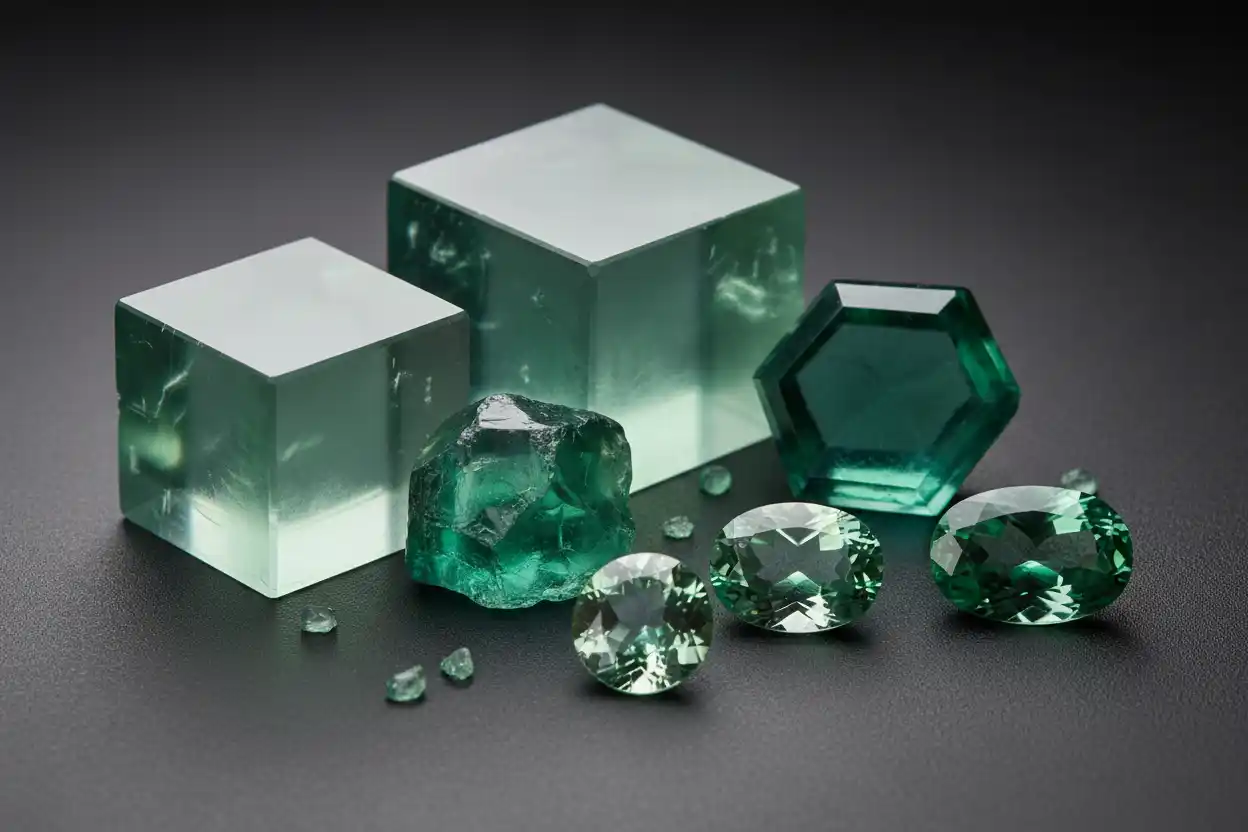
Green Fluorite Meaning: Properties, Uses & Symbolism
Green fluorite meaning begins with fluorite itself: calcium fluoride, CaF₂, a naturally occurring halide mineral that crystallizes in the cubic—or isometric—crystal system. Fluorite is the defining mineral for hardness 4 on the Mohs scale, typically has a specific gravity around 3.18, displays perfect and very easy cleavage along octahedral directions, and occurs in an unusually broad range of colors that includes green, purple, blue, yellow, pink, colorless, and multicolored varieties. Mindat notes that fluorite’s color depends on impurity ions and irradiation-related effects rather than one universal pigment, an especially important point when discussing green material.
The word green therefore describes appearance rather than a distinct mineral species. A pale mint cube from one deposit, a vivid apple-green crystal from another, and a yellow-green faceted fluorite may all be genuine fluorite while deriving their color from somewhat different defect centers, trace-element environments, or combinations of optical processes. Published research on natural fluorite shows that coloration can involve complex centers associated with rare-earth ions, oxygen, and radiation-produced defects; gemological work has also demonstrated that different green fluorites can have measurably different color mechanisms.
This distinction sets the correct boundary for green fluorite meaning. Formula, crystal structure, hardness, cleavage, density, refractive index, color centers, inclusions, and geological formation are measurable properties. Fluorite’s historical use as a flux and its role in the development of terms such as fluorescence can be documented. Modern associations with focus, renewal, organization, perspective, or emotional reflection belong to contemporary symbolism rather than mineral physics. Readers exploring related material-first references can use the Gemstone Guides, while this page remains focused specifically on what green fluorite is and what can responsibly be said about its meaning.
Green Fluorite Meaning at a Glance
| Property or question | Evidence-aware summary |
|---|---|
| Mineral identity | Fluorite |
| Chemical formula | CaF₂ |
| Mineral class | Halide |
| Crystal system | Cubic / isometric |
| Typical green range | Pale mint, yellow-green, apple green, medium green, blue-green |
| Mohs hardness | 4 |
| Typical specific gravity | About 3.18 |
| Refractive index | Commonly about 1.432–1.436 |
| Optical character | Isotropic / singly refractive |
| Cleavage | Perfect and very easy in four octahedral directions |
| Tenacity | Brittle |
| Luster | Vitreous |
| Transparency | Transparent to translucent |
| Green color cause | Variable; defect centers and rare-earth-related processes can contribute |
| Fluorescence | Variable; fluorite can fluoresce in several colors depending on composition |
| Common geological setting | Hydrothermal veins and replacement deposits; also granites, pegmatites, greisens, and some metamorphic rocks |
| Historical importance | Long used as fluorspar/flux; the term fluorescence derives from fluorite |
| Modern symbolism | Often associated with focus, renewal, organization, perspective, and reflection |
| Scientific status of symbolism | Interpretive, not demonstrated physiological or medical effects |
| Ownership caution | Softness and perfect cleavage make fluorite vulnerable to scratches, chips, and splitting |
| Safety distinction | Ordinary intact handling differs from cutting, grinding, crushing, or chemical processing |
Fluorite’s low refractive index is also distinctive for a transparent gem material. Gemological references commonly place it near 1.434, substantially below quartz, beryl, garnet, and many familiar colored stones. Combined with cubic optical behavior, density, cleavage, and hardness, this provides a useful identification package when color alone would be ambiguous.
What Is Green Fluorite?
Green fluorite is fluorite whose visible body color lies primarily in the green range. Its chemistry remains CaF₂, meaning calcium and fluorine are the essential structural elements. The mineral’s cubic structure permits many familiar crystal forms, especially cubes and octahedra, while combinations, stepped faces, interpenetrant twins, massive material, and other habits also occur.
Because fluorite is cubic, it is optically isotropic under ideal conditions. A transparent fluorite gem therefore lacks the ordinary birefringence and pleochroism expected in anisotropic gems such as tourmaline, beryl, or grandidierite. That physical simplicity does not imply that its color is chemically simple. Fluorite is famous precisely because its crystal lattice can host defects, trace rare-earth elements, and radiation-related centers capable of producing a remarkably broad spectrum of colors.
A green fluorite identification should therefore proceed in two stages. First establish that the material is fluorite. Only after that should the specific question of why that specimen is green be addressed.
Green Fluorite Identity Table
| Characteristic | Green fluorite |
|---|---|
| Species | Fluorite |
| Formula | CaF₂ |
| Crystal system | Cubic |
| Common crystal habits | Cubes, octahedra, combinations, stepped crystals |
| Typical green appearance | Transparent to translucent pale or saturated green |
| Hardness | Mohs 4 |
| Density | Usually close to 3.18 |
| Refractive index | Roughly 1.432–1.436 |
| Optic behavior | Singly refractive / isotropic |
| Birefringence | None in ideal cubic material |
| Pleochroism | Absent |
| Cleavage | Perfect {111}, producing octahedral cleavage fragments |
| Fracture | Subconchoidal to uneven/splintery when cleavage does not dominate |
| Streak | White |
| Luster | Vitreous |
| Common internal features | Color zoning, fractures, fluid inclusions, negative crystals, mineral inclusions |
| Main identification caution | Green color alone is not diagnostic |
| Main color-cause caution | No single rare-earth ion or defect explains every green fluorite |
| Main durability concern | Softness plus exceptionally easy cleavage |
The identity framework is especially useful when dealing with polished objects because crystal form may have been removed. A faceted green stone can look superficially like glass, apatite, tourmaline, prehnite, beryl, or other materials depending on hue and transparency. Refractive index, optic character, density, microscopy, and appropriate spectroscopy provide far more reliable evidence than visual color.
Why Is Green Fluorite Green?
The strongest answer is that the mechanism varies. Natural fluorite colors arise from interactions among lattice defects, impurity ions, rare-earth elements, oxygen-related centers, and irradiation. Research on natural fluorites has identified several distinct defect and rare-earth-associated centers, demonstrating that one simple “green element” model is inadequate.
Some literature associates green fluorite with divalent samarium-related absorption, but that is not universal. GIA examined bright green Indian fluorite whose spectrum was instead consistent with yttrium- and cerium-associated color centers, while previously studied Colombian material showed a different spectroscopic pattern linked to samarium and europium-related effects. In practical terms, two stones that appear similarly green to the eye can have different microscopic electronic causes.
This is why statements such as “all green fluorite is colored by samarium,” “all green fluorite gets its color from yttrium,” or “green automatically proves natural irradiation” should be avoided. A specific color mechanism becomes supportable only when appropriate spectroscopy, chemistry, or published locality-specific analysis is available.
The deeper treatment of absorption, fluorescence, color zoning, defect centers, and viewing conditions belongs in the Green Fluorite Optical Properties and Color Behavior guide.
Green Fluorite Can Change Appearance With Lighting
A fluorite crystal can appear somewhat different under daylight, indoor illumination, transmitted light, reflected light, or ultraviolet excitation. This does not necessarily mean it is a true color-change gemstone. Fluorescence, background color, internal zoning, transparency, and the spectral distribution of the light source can all influence the observer’s impression.
A crystal with pale green body color and blue fluorescence, for example, may look substantially more luminous under ultraviolet excitation than under ordinary white light. Another specimen may show almost no obvious fluorescence at all. Fluorescence is therefore a variable property of fluorite rather than a guaranteed feature of every green stone.
Photographs can exaggerate these differences further. Green fluorite is particularly easy to oversaturate into unnatural emerald or neon tones. A useful documentation set should include neutral white balance and ordinary visible illumination before any ultraviolet photographs are added.
Fluorite and Fluorescence
Fluorite has an important place in the history of luminescence terminology. Mindat notes that the term fluorescence ultimately derives from fluorite because specimens of the mineral were famous for emitting visible light under suitable excitation.
The linguistic relationship should not be mistaken for a diagnostic guarantee. Some fluorite fluoresces strongly, some weakly, and some may show little reaction under a particular ultraviolet wavelength. The emitted color can also vary because different activators and defect structures are present.
Fluorescence is therefore scientifically interesting but should not be used as a simplistic rule such as “real green fluorite must glow blue.”
How Green Fluorite Forms
Fluorite forms in several geological settings, but hydrothermal environments are particularly important. Mindat describes fluorite as a common gangue mineral in hydrothermal veins, especially in association with lead- and zinc-bearing mineralization, and also records it from greisens, granites, pegmatites, high-temperature veins, marbles, and other metamorphic rocks.
USGS describes most economically important fluorspar deposits as hydrothermal, formed when fluoride-bearing fluids precipitate calcium fluoride. Fluorite deposits can occur in veins, breccias, carbonate replacements, systems associated with differentiated granites, volcanic environments, alkaline intrusions, carbonatites, and several other geological contexts.
The color of the final crystal depends on more than the fact that fluorite precipitated. Fluid chemistry, trace elements, radiation history, defects, temperature, later alteration, and zoning can all affect appearance. Two green crystals from different deposits may therefore have very different geological stories.
The detailed deposit classifications, fluid history, host rocks, and paragenesis belong in the Green Fluorite Formation and Deposit Geology guide.
Cubes, Octahedra, and Cleavage
Fluorite is famous for cubic crystals, but broken fluorite often produces octahedral shapes because its perfect cleavage follows {111} planes. This creates one of the most common points of confusion in mineral shops: a neat fluorite octahedron may be a naturally developed octahedral crystal, a cleavage fragment, or a piece deliberately cleaved or shaped to emphasize that form.
The difference matters for specimen description. A natural crystal face records growth. A cleavage surface records breakage along the internal crystal structure. Both can be genuine fluorite, but they tell different geological stories.
A highly symmetrical octahedron sold as “completely natural crystal growth” deserves closer observation if every face resembles a fresh cleavage plane.
Diagnostic Characteristics of Green Fluorite
A good identification starts with a combination of properties rather than one destructive test. Green fluorite should be compatible with cubic optical behavior, low refractive index around 1.43, density near 3.18, Mohs hardness 4, perfect octahedral cleavage, vitreous luster, and fluorite-like inclusions or crystal morphology.
Microscopic examination can reveal growth zoning, healed fractures, two-phase inclusions, negative-crystal cavities, mineral inclusions, and cleavage-related features. GIA has documented a transparent green fluorite cluster containing a primary fluid inclusion with a mobile gas phase, demonstrating how internal structures can preserve information about conditions present during crystal growth.
Those observations are valuable, but they should not be turned into universal rules. Not every green fluorite contains a visible bubble, and one fluid inclusion does not determine geographic origin. The Green Fluorite Microscope Inclusion Notebook owns the specimen-scale microscopy rather than having individual features overgeneralized on this meaning page.
Why a Scratch Test Is a Poor Choice
Fluorite’s Mohs hardness of 4 can be useful during mineral identification, but deliberately scratching a polished stone or collectible crystal is usually unnecessary. Many common materials can damage fluorite, and a failed home test may leave permanent marks without resolving the identification confidently.
Cleavage testing is even less appropriate. Intentionally striking a specimen to see whether it produces an octahedral fragment destroys part of the object and creates sharp edges.
When the specimen has monetary, scientific, sentimental, or collector value, non-destructive gemological testing is preferable.
Original Information Gain: Green Fluorite Claim Audit
The combination of brilliant color, fluorescence, industrial history, and modern crystal symbolism creates many opportunities for true facts to be extended into unsupported conclusions. This audit separates the levels of evidence.
| Claim or label | Evidence-aware interpretation | What should not automatically be assumed | Stronger evidence when important |
|---|---|---|---|
| Green fluorite | Green-colored fluorite, CaF₂ | Separate mineral species | Confirm fluorite identity |
| Natural green fluorite | Natural mineral with green appearance | Color is untreated or caused by one specific center | Appropriate gemological/spectroscopic evidence |
| Samarium-colored fluorite | Valid for some analyzed material | All green fluorite is Sm-related | Spectroscopy/locality evidence |
| Y-Ce color-center fluorite | Demonstrated in specific green material | Universal mechanism | UV-Vis/EPR/chemical data |
| Fluorescent fluorite | Fluorite that emits light under excitation | Every fluorite fluoresces strongly or identically | UV observation under defined wavelength |
| Apple-green fluorite | Visual trade descriptor | Fixed chemistry or locality | Material identification plus provenance |
| Emerald-green fluorite | Color comparison | Relationship to emerald or beryl | Mineral identity remains CaF₂ |
| Octahedral fluorite | Shape description | Every octahedron is a natural growth crystal | Inspect surface morphology and cleavage |
| “Rare-earth fluorite” | May contain rare-earth-related defects or ions | Economically valuable rare-earth ore or unusually high REE content | Chemical analysis |
| “High vibration” | Modern metaphysical language | Measurable therapeutic energy | Reproducible physical evidence would be required |
| “Mental clarity stone” | Contemporary symbolism | Treatment for cognitive or neurological conditions | Clinical evidence would be required |
| “Detox fluorite” | Unsupported health claim | Removal of toxins from the body | Medical evidence |
| “Fluoride healing stone” | Chemistry-to-health inference | Wearing fluorite provides beneficial fluoride | Mineral composition does not establish treatment |
| “Protection crystal” | Symbolic use | Guaranteed physical or supernatural protection | Remains personal/spiritual interpretation |
| “Ancient green fluorite crystal” | Potential historical claim | Modern symbolism or terminology existed historically | Primary historical or archaeological evidence |
This framework protects green fluorite meaning from a common logical error: because fluorite contains fluorine and has real industrial or optical properties, its crystal chemistry is assumed to create unrelated effects in the human body. Material composition does not provide that bridge.
Original Specimen and Photo Checklist
A useful green fluorite documentation set should capture features that can actually be assessed visually while preserving the distinction between observation and identification.
| Observation | Photograph can often show | Photograph cannot reliably prove |
|---|---|---|
| Green hue | Approximate color, tone, saturation | Exact color center |
| Color zoning | Visible green/colorless or multicolor bands | Chemical cause of each zone |
| Cubic habit | External geometry | Whether every surface is a natural growth face |
| Octahedral surfaces | Shape and face relationships | Natural growth versus cleavage without closer evidence |
| Transparency | Relative clarity | Exact refractive index |
| Visible inclusions | Bubbles, crystals, fractures, clouds | Exact inclusion chemistry in most cases |
| UV fluorescence | Emitted color under specified lamp | Universal fluorite authenticity |
| Cleavage damage | Chips and cleavage planes | Full internal durability |
| Locality label | Reported origin | Geographic provenance |
| “Natural color” label | Seller claim | Treatment history |
| “Healing energy” | Nothing objectively measurable | Medical or supernatural effect |
For documentary photographs, use a neutral gray or white reference background, show at least two orientations, include a scale for rough crystals, and photograph zoning in transmitted light when transparency permits. A separate ultraviolet image can be useful, but it should identify whether long-wave or short-wave UV was used rather than simply saying that the specimen “glows.”
Green Fluorite Versus Green Calcite
Green Calcite Meaning concerns CaCO₃ rather than CaF₂. Calcite is Mohs 3, trigonal, strongly birefringent, and has perfect rhombohedral cleavage. Fluorite is Mohs 4, cubic, singly refractive, and cleaves octahedrally.
Both can appear pale mint green and transparent to translucent, so photographs may create genuine confusion. Their optical behavior quickly separates sufficiently clear specimens: calcite’s strong double refraction contrasts sharply with fluorite’s isotropic character.
Their similar calcium content is not evidence that they belong to the same mineral family.
Green Fluorite Versus Green Onyx
Green Onyx Meaning illustrates a naming problem rather than a close mineralogical relationship. “Green onyx” can be used commercially for green chalcedony, dyed silica material, or decorative banded carbonate sold under onyx-style trade terminology.
Fluorite is neither quartz nor calcite. Its CaF₂ chemistry, cubic structure, low hardness, isotropic optics, and octahedral cleavage provide a completely different identity.
A green polished object should therefore not be classified from its retail color name alone.
Green Fluorite Versus Grossular Garnet
Grossular Garnet Meaning covers a calcium-aluminum silicate garnet whose green varieties can overlap visually with fluorite. Both minerals are cubic and therefore singly refractive, which makes this comparison more interesting than color alone.
The differences are nevertheless substantial. Grossular is considerably harder and has a much higher refractive index and density profile than fluorite. A bright green faceted gem with strong brilliance is therefore not safely identified as fluorite simply because its hue resembles a fluorite specimen.
Standard gemological measurements resolve the distinction far more reliably than appearance.
Green Fluorite Versus Grape Agate
Grape Agate Meaning concerns clustered spheroidal quartz material, commonly purple but also found in green examples. Quartz is approximately Mohs 7, substantially harder than fluorite, and its botryoidal or spherulitic texture is very different from typical fluorite cubes and cleavage forms.
A green grape-like aggregate should therefore not be identified as fluorite merely because both materials can have vitreous or softly sparkling surfaces.
Morphology, hardness, optical behavior, and mineral chemistry provide the correct framework.
Documented History of the Name Fluorite
The mineral name derives from the Latin concept of flowing, reflecting fluorite’s historical use as a flux. Mindat records that the name was introduced in connection with this property, while USGS continues to use “fluorspar” as the industrial commodity name for fluorite used in metallurgy and fluorine chemistry.
A flux lowers or modifies melting behavior during metallurgical processes, which made fluorspar technologically important long before modern crystal shops began attaching symbolic meanings to green specimens. USGS identifies fluorite as the principal mineral mined on a large scale as a source of fluorine and as a feedstock or additive in several industrial processes.
That history is more securely documented than claims that ancient societies universally regarded green fluorite as a crystal of concentration, heart healing, or manifestation.
Fluorite’s Industrial History Is Not a Metaphysical Mechanism
The word “flow” in the mineral’s naming history can inspire modern symbolism. A person may choose to associate fluorite with moving through a difficult project or reducing obstacles.
However, the historical reason for the name is metallurgical. It does not establish that the mineral causes emotional, energetic, financial, or spiritual situations to “flow.”
A good symbolic interpretation can borrow a metaphor from documented history without rewriting that history into evidence for the metaphor.
Modern Green Fluorite Meaning
Modern green fluorite meaning commonly centers on organization, mental focus, renewal, perspective, learning, emotional reflection, and deliberate change. Its clear-to-translucent body, geometric crystals, green color, and frequently visible zoning make these themes easy to understand aesthetically.
A cube can become a metaphor for structure. Color zoning can represent complexity or stages of change. A transparent specimen can symbolize reviewing information carefully, while the green color can evoke growth or renewal.
These associations can be useful when tied to behavior. They do not require fluorite to emit a scientifically demonstrated therapeutic field.
Green Fluorite and Focus
Focus is one of the most repeated themes in green fluorite meaning. A grounded version of the idea can be simple: place the specimen near a study or work area and use it as a cue to define the next task, silence distractions, or return attention when the mind wanders.
The effectiveness comes from the behavioral routine and environmental cue.
Green fluorite is not scientifically demonstrated to treat attention disorders, enhance memory chemically, increase intelligence, alter neurotransmitters, or improve neurological function through skin contact.
Green Fluorite and Organization
Fluorite’s frequent cubic geometry naturally lends itself to symbolism around order and organization. A well-formed cube appears structured, bounded, and repetitive, making it a visually effective reminder to create systems.
Someone might associate the specimen with clearing a desk, organizing research notes, reviewing a budget, or establishing a sequence of priorities.
The crystal does not organize information by itself. Its value in this context is as a chosen physical prompt.
Green Fluorite and Perspective
Green fluorite crystals frequently contain color zoning, internal fractures, inclusions, or overlapping cubic growth. What appears uniformly green from one direction can reveal much greater internal complexity when rotated or illuminated differently.
That creates a responsible perspective metaphor. When a decision seems simple, examine it from another direction and distinguish visible facts from assumptions.
The mineral cannot read hidden motives, expose lies, predict outcomes, or reveal another person’s thoughts.
Green Fluorite and Renewal
The green color encourages associations with vegetation, spring growth, and renewal. This is cultural symbolism rather than a consequence of CaF₂ chemistry.
A person may use green fluorite meaning to mark a practical reset: restart a study plan, revise an unfinished project, reorganize a room, or establish a new routine.
The stone can symbolize the decision. It does not guarantee transformation.
Green Fluorite and Emotional Reflection
Some contemporary crystal traditions associate green fluorite with emotional balance or releasing unwanted patterns. The responsible interpretation is reflective rather than medical.
A person could use a fluorite specimen during journaling to identify one recurring reaction, the evidence behind it, and an alternative response. That practice may be useful because deliberate reflection can change behavior over time.
The mineral itself has not been established as a treatment for anxiety, depression, trauma, panic, mood disorders, or other mental-health conditions.
Green Fluorite and “Heart” Symbolism
Because many modern spiritual systems associate green stones with the heart, green fluorite may be described as heart-centered. That association belongs to symbolic practice.
Green fluorite is not scientifically demonstrated to regulate blood pressure, improve circulation, treat arrhythmias, reduce cholesterol, heal cardiac tissue, or treat cardiovascular disease.
Its green color does not provide a biological pathway to the heart.
Green Fluorite and Fluoride Claims
Fluorite contains fluorine as part of calcium fluoride, but that chemical fact should not be translated into a recommendation to obtain fluoride from mineral specimens. Geological CaF₂ is not a dental product, nutritional supplement, or prescribed therapeutic source simply because fluorine appears in its formula.
Holding or wearing fluorite does not provide a demonstrated beneficial fluoride dose through the skin.
Likewise, a person should not grind or dissolve decorative fluorite in an attempt to obtain health benefits from its constituent elements.
Green Fluorite “Benefits”: What Is Reasonable?
A practical benefit of green fluorite is aesthetic and educational. Its cubic forms, green zoning, fluorescence, low refractive index, and perfect cleavage make it a useful mineral for teaching crystallography and gem identification. High-quality specimens can also be valuable to collectors, while carefully faceted fluorite can be appreciated as a collector gem despite its limited durability.
A symbolic benefit may be that a person finds the stone useful as a visual reminder of organization, study, perspective, or intentional change.
Medical benefits require a different evidentiary standard. Green fluorite should not be represented as treating disease, improving cognition biologically, detoxifying organs, regulating hormones, strengthening immunity, curing pain, or guaranteeing emotional recovery.
The health and metaphysical boundaries used throughout Gems Lore are stated in the Gems Lore Disclaimer.
Where Buying Questions Belong
Material identity does not automatically establish whether a specific listing is correctly described, fairly priced, naturally colored, undamaged, or appropriate for jewelry. Those are purchase questions involving seller disclosure, photographs, measurements, treatment information, return terms, provenance, and intended use.
Readers evaluating an actual specimen can use Where to Buy Green Fluorite rather than treating a meaning page as a seller-selection guide.
One especially important buying issue is hidden cleavage damage. A beautiful transparent stone may contain subtle fractures or cleavage planes that materially affect durability even when photographs emphasize color.
Cutting and Polishing
Fluorite can be faceted into attractive collector stones, but its Mohs hardness of 4 and extremely easy cleavage demand greater care than quartz, beryl, garnet, or corundum. The Australian Museum notes that fluorite’s softness, perfect octahedral cleavage, and sensitivity to sudden temperature changes make it difficult to facet and preserve.
Orientation therefore involves more than optical appearance. A lapidary must consider cleavage planes, existing fractures, inclusions, rough shape, desired yield, and the risk of splitting during sawing, grinding, or polishing.
The detailed technical workflow belongs in the Green Fluorite Cutting, Orientation and Polish guide.
Jewelry Wear
Green fluorite can be used in jewelry, but it is poorly suited to unprotected daily wear when compared with harder, tougher gems. Surface abrasion can develop relatively quickly, while a well-placed impact can exploit cleavage and create a chip or complete split.
Pendants, brooches, and protected earrings generally place less mechanical demand on fluorite than exposed rings or bracelets. Even then, setting pressure must be carefully controlled because forcing a stone into position can initiate cleavage.
The detailed relationship between setting design, edge protection, impact exposure, and repairability belongs in the Green Fluorite Setting and Wear Engineering guide.
Safe Ownership: Hardness 4 Changes Expectations
Mohs hardness 4 means that many everyday abrasive materials can scratch fluorite. Dust containing quartz, for example, is much harder than fluorite and can abrade a polished surface.
Storage should therefore separate fluorite from harder gemstones rather than allowing loose stones to rub together in one container. Hardness also should not be confused with toughness: even if a surface remains unscratched, cleavage can allow sudden breakage.
A specimen that has survived for a long time is not proof that it can tolerate unrestricted handling.
Intact Fluorite Versus Cutting Dust
Ordinary handling of an intact crystal is different from sawing, grinding, drilling, sanding, or crushing the material. Mechanical processing creates fine particulate matter and increases exposure to the fluorite itself as well as any associated minerals, matrix, coatings, or contaminants.
Workshop processing should therefore use competent lapidary methods, appropriate wet techniques where suitable, eye protection, engineering controls, suitable respiratory protection when required, and controlled cleanup.
Crushing fluorite into ritual powder creates no necessary benefit and destroys the specimen.
Do Not Use Green Fluorite as an Elixir Ingredient
Green fluorite should not be powdered, swallowed, added to supplements, or deliberately dissolved or soaked for drinking-water preparations. Its natural-mineral status does not make it food or medicine.
A specimen can contain matrix, coatings, other minerals, polishing residues, cleaning compounds, surface contamination, or treatments that a retail name does not disclose. More fundamentally, there is no need to ingest fluorite to engage with its symbolism.
Keeping mineral specimens external preserves both the object and a clear safety boundary.
Specimen Conservation
Green fluorite can be an exceptional collector mineral because crystal form, zoning, fluorescence, associated minerals, locality, and inclusion scenes can all contribute to scientific and aesthetic interest. Those features are often more important than a polished surface.
Preserve original labels, dimensions, photographs, collection numbers, reported locality, prior ownership records, and laboratory information. Avoid unnecessary cleavage testing, harsh cleaning, heating, or polishing of a specimen whose natural faces or associations are significant.
The Green Fluorite Specimen Conservation Record provides the mapped framework for documenting condition and provenance-related information over time.
Provenance and Locality
Green fluorite occurs at numerous localities around the world. Mindat documents fluorite widely, and individual localities can develop recognizable combinations of habit, color, zoning, matrix, and associated minerals. Those patterns may suggest an origin but rarely prove it on their own.
For example, GIA has studied a transparent green fluorite cluster from Rogerley in England whose fluid inclusions and crystal relationships are visually distinctive. That documented example demonstrates what a locality-backed specimen looks like when acquisition information accompanies microscopic observation; it does not mean every similar green cube can be assigned to Rogerley from a photograph.
Original labels and chain-of-custody records remain stronger provenance evidence than color resemblance.
Green Fluorite and Treatment Claims
Fluorite color is influenced by defect chemistry and irradiation, which means radiation-related processes are part of the natural science of the mineral. That should not be confused with proof that any particular commercial specimen is natural-color or laboratory-treated.
Natural geological irradiation and intentional treatment are different provenance questions. A photograph cannot usually distinguish them.
If treatment status materially affects a high-value purchase or scientific specimen, appropriate specialist or laboratory examination may be needed rather than an assumption based on saturation.
Is Bright Green Fluorite Automatically Fake?
No. Naturally occurring fluorite can display vivid green colors. GIA has documented bright green natural fluorite whose spectra were consistent with yttrium- and cerium-associated color centers.
At the same time, unusually vivid photographs can result from lighting or image editing, and synthetic fluorite in multiple colors is known in the broader materials market. Color intensity therefore cannot establish natural origin by itself.
The correct response to unusually bright material is examination, not automatic acceptance or automatic rejection.
Source-Comparison Framework for Green Fluorite
| Source type | Strongest question it can answer | Main limitation |
|---|---|---|
| Mineral database | Formula, structure, hardness, cleavage, naming, occurrence | Does not determine the exact color center in every specimen |
| Gemological laboratory | Identity, optical properties, inclusions, unusual color behavior | Usually specimen-specific |
| Spectroscopic research | Color centers, rare-earth ions, absorption mechanisms | Findings may apply only to analyzed locality/material |
| Geological survey | Deposit formation, mining, industrial fluorspar context | Does not establish metaphysical meaning |
| Provenance documentation | Reported source and ownership history | Accuracy depends on chain of custody |
| Retail listing | Current commercial terminology | Does not independently authenticate technical claims |
| Metaphysical source | Documents contemporary symbolic interpretations | Does not establish medical or mineralogical effects |
| Personal testimony | Records individual experience | Cannot demonstrate universal causation |
A green fluorite meaning article becomes much more reliable when the source type matches the claim. Spectroscopy should answer why a studied crystal is green. A historical source should answer how the mineral name developed. A modern spiritual source can document present-day symbolism but cannot establish a physiological mechanism.
What Green Fluorite Meaning Does Not Prove
Green fluorite meaning does not prove that the mineral treats anxiety, depression, ADHD, neurological disorders, memory impairment, hormonal conditions, cardiovascular disease, immune problems, infertility, pain, sleep disorders, or any other medical condition.
It does not prove that CaF₂ supplies beneficial calcium or fluoride through skin contact. It cannot detoxify organs simply because fluorite is used industrially in chemical processing, and it cannot improve intelligence because a crystal is transparent or geometrically ordered.
The stone also cannot guarantee examination results, career advancement, financial success, protection from all harm, psychic perception, manifestation, or control over another person’s thoughts and behavior.
Evidence and Technical Limits
This article does not claim first-hand mine visits, direct extraction, unpublished spectroscopy, private laboratory testing, or personal authentication of a reader’s green fluorite. The broader material-first approach used by the site is described on About Gems Lore.
Exact color-center identification, treatment assessment, unusual inclusion identification, locality attribution, and technically important specimen questions may require a qualified gemologist, mineralogist, spectroscopist, or laboratory. Published research itself demonstrates why caution is appropriate: distinct green fluorites can derive their color from different defect and rare-earth-associated mechanisms.
Readers with documented corrections, analytical results, specimen records, or stronger technical evidence can submit them through Contact Gems Lore.
Frequently Asked Questions About Green Fluorite Meaning
What is green fluorite meaning?
Green fluorite meaning commonly combines the mineral’s CaF₂ identity with modern symbolic themes such as focus, organization, renewal, perspective, and reflection. Those symbolic themes are contemporary interpretations rather than scientifically measured therapeutic properties.
What is green fluorite made of?
Green fluorite is calcium fluoride, CaF₂. It belongs to the halide mineral class and crystallizes in the cubic system.
Why is fluorite green?
There is no single mechanism for every specimen. Natural fluorite color can involve defect centers, irradiation, rare-earth ions, and oxygen-related centers. GIA has documented green fluorites with different spectroscopic color mechanisms, reinforcing that color cause is locality- and specimen-dependent.
Is all green fluorite colored by samarium?
No. Samarium-related centers can contribute to green in some fluorite, but other analyzed material has shown green coloration associated with yttrium- and cerium-related color centers.
How hard is green fluorite?
Fluorite is Mohs 4 and is the reference mineral defining that level of the Mohs scale.
Does green fluorite break easily?
It can. Fluorite is brittle and has perfect, very easy octahedral cleavage. A well-placed impact can cause chipping or splitting even when the surface was not heavily scratched.
What is the refractive index of fluorite?
Gemological references commonly give approximately 1.432–1.436 for fluorite, with a typical value near 1.434.
Is green fluorite birefringent?
No under normal gemological conditions. Fluorite is cubic and isotropic, so it is singly refractive rather than displaying ordinary birefringence.
Does green fluorite fluoresce?
Some does, sometimes strongly, but fluorescence is variable. Different specimens can emit different colors or react differently to long-wave and short-wave ultraviolet light. The phenomenon of fluorescence itself takes its name from fluorite.
Where does green fluorite form?
Fluorite is especially common in hydrothermal veins and replacement deposits but also occurs in granites, pegmatites, greisens, high-temperature veins, and some metamorphic rocks.
Is a fluorite octahedron natural?
It can be, but fluorite’s perfect octahedral cleavage also makes it easy to produce octahedral fragments by breaking along cleavage planes. Surface morphology and provenance are needed to distinguish natural growth from cleavage in ambiguous specimens.
Is green fluorite the same as green calcite?
No. Fluorite is CaF₂, cubic, singly refractive, and Mohs 4. Calcite is CaCO₃, trigonal, strongly birefringent, and Mohs 3.
Does green fluorite improve concentration?
A person may use it as a visual reminder to study or return attention to a task, but green fluorite has not been scientifically demonstrated to improve concentration through a direct physiological effect.
Does green fluorite have healing properties?
There is no established scientific evidence that green fluorite treats disease or causes specific physiological healing effects. Healing descriptions belong to modern metaphysical interpretation rather than medical mineralogy.
Is green fluorite safe to touch?
Ordinary handling of an intact specimen is different from cutting, grinding, crushing, or chemically processing it. Intact stones should still be handled carefully because fluorite scratches and cleaves easily.
Can green fluorite go in drinking water?
It should not be powdered, ingested, or deliberately used to make drinking-water elixirs. A mineral specimen is not a nutritional or medicinal preparation.
Can green fluorite be used in jewelry?
Yes, but with realistic durability expectations. Its softness and perfect cleavage make protected pendants, earrings, or collector jewelry more practical than heavily exposed everyday rings.
Can a photo prove that green fluorite is natural?
No. A photograph can show color, zoning, apparent transparency, morphology, and visible damage, but it cannot reliably establish exact color-center chemistry, synthetic versus natural origin in every case, treatment history, or geographic provenance.
Final Perspective
Green fluorite meaning becomes more informative when the mineral’s genuine physical complexity is allowed to replace simplified crystal-market claims. Green fluorite is CaF₂, an isotropic cubic mineral with Mohs hardness 4, low refractive index near 1.434, specific gravity around 3.18, and exceptionally easy octahedral cleavage. Its color is not controlled by one universal green pigment; research demonstrates that rare-earth-associated centers, lattice defects, oxygen-related centers, and irradiation can contribute differently in different natural fluorites.
Its documented history is equally substantial without embellishment. Fluorite became important as fluorspar because of its use as a flux, remains the principal mineral mined commercially as a source of fluorine, and gave its name to fluorescence because of the striking luminescence seen in certain specimens. These are real connections between mineral chemistry, industry, optics, and language.
Modern associations with focus, organization, renewal, perspective, and deliberate change can still form a responsible green fluorite meaning when they are clearly identified as symbolism. The evidence-aware approach is material-first: establish fluorite identity, avoid assuming one color mechanism from appearance, recognize that fluorescence varies, respect the mineral’s softness and cleavage, preserve specimen documentation, distinguish intact ownership from processing, and keep medical, nutritional, financial, and supernatural promises separate from what CaF₂ actually demonstrates.