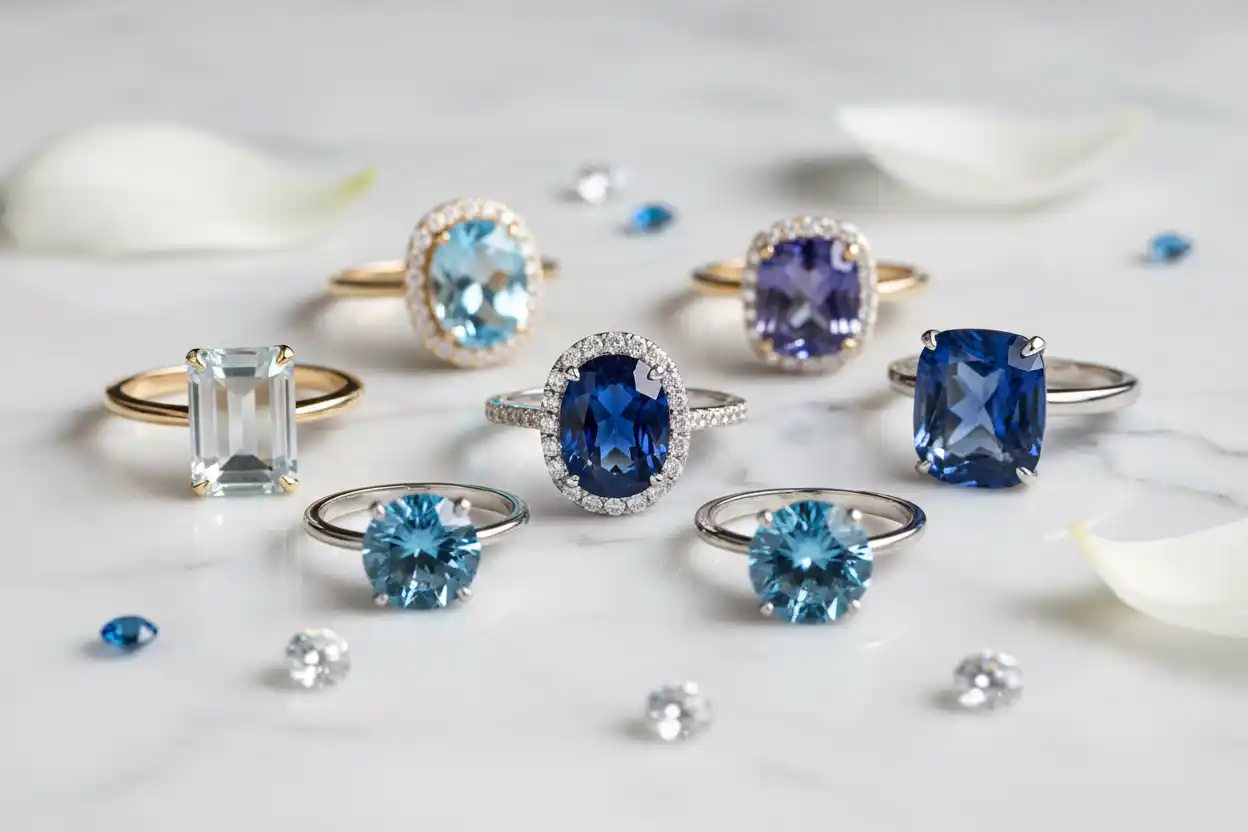
Blue Engagement Ring Stones: Prices, Quality & Buying Advice
Blue engagement ring stones range from exceptionally durable sapphire and diamond to elegant aquamarine, uncommon blue spinel, brilliant zircon, accessible blue topaz, and violet-blue tanzanite. They may share a color family, but they do not share the same resistance to scratching, impact, cleavage, treatment, maintenance, replacement difficulty, or market price.
Choosing blue engagement ring stones therefore requires more than deciding whether you prefer pale sky blue, saturated royal blue, teal-blue, violet-blue, or deep navy. An engagement ring is exposed to repeated contact with desks, door frames, clothing, cosmetics, cleaning products, harder jewelry, setting pressure, and accidental knocks, so the center stone needs to suit the way the ring will actually be worn.
For frequent wear, sapphire offers one of the strongest combinations of hardness, toughness, color range, availability, and setting flexibility. Spinel is an excellent less-conventional alternative, while aquamarine works especially well for someone who prefers a lighter blue and accepts somewhat greater care. Blue topaz, zircon, and tanzanite can also create beautiful blue engagement ring stones, but their specific structural weaknesses make setting design and wearing habits considerably more important.
The wider blue gemstones directory covers the color family broadly. This guide stays focused on the questions that matter when a blue gemstone will become the center of a ring: durability, price structure, treatment, setting height, cut shape, replacement difficulty, documentation, and long-term wear.
Blue Engagement Ring Stones at a Glance
| Stone | Mohs hardness | Cleavage / structural concern | Frequent-wear suitability | Typical market position | Best reason to choose |
|---|---|---|---|---|---|
| Blue sapphire | 9 | No easy cleavage | Excellent | Moderate to very high | Best overall natural blue choice |
| Blue diamond | 10 | Cleavage can still cause chipping | Excellent | Very high for natural fancy blue | Maximum scratch resistance |
| Blue spinel | 8 | No easy cleavage | Excellent to very good | Moderate to premium | Durable and less conventional |
| Aquamarine | 7.5–8 | Brittle under sharp impact; fractures matter | Very good | Accessible to premium | Pale blue color and larger clean stones |
| Blue topaz | 8 | Perfect basal cleavage | Conditional | Generally accessible | Large size and strong blue for the budget |
| Blue zircon | About 6.5–7.5 | Brittle; facet edges can abrade | Conditional | Accessible to moderate | Exceptional brilliance and fire |
| Tanzanite | About 6–7 | Cleavage and lower toughness | Careful wear | Moderate to premium | Distinctive violet-blue color |
| Iolite | About 7–7.5 | Cleavage and directional concerns | Careful wear | Accessible to moderate | Blue-violet pleochroism |
The gemstone hardness chart provides the scratch-resistance comparison, but a Mohs number alone should never determine which blue engagement ring stones are suitable for a particular wearer.
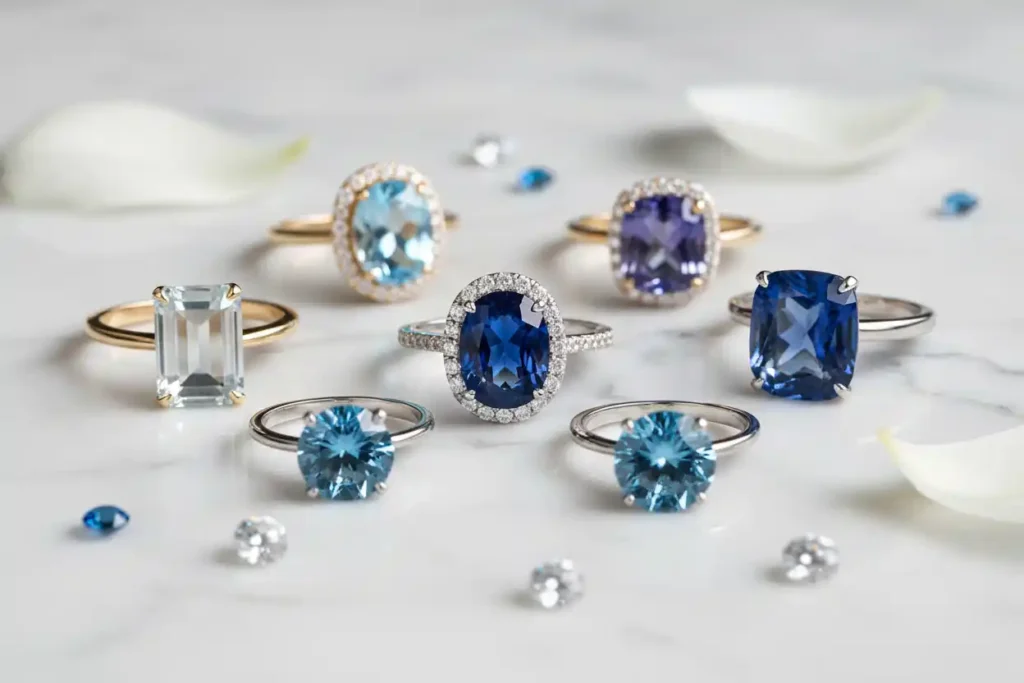
What Makes a Blue Stone Suitable for an Engagement Ring?
The best blue engagement ring stones balance several properties at the same time.
Hardness controls resistance to scratching and abrasion. Toughness describes resistance to chipping and breaking. Cleavage identifies structural directions where a crystal may split more readily, while stability concerns heat, chemicals, light, and temperature changes.
The distinction is important because a relatively hard gemstone can still be vulnerable.
Topaz ranks 8 on the Mohs scale, yet perfect cleavage can allow a concentrated impact to split it. Tanzanite may resist some scratches but remains more vulnerable to cleavage and edge damage than sapphire. Diamond has unmatched scratch resistance but is not impossible to chip.
The practical relationship is explained further in gemstone toughness vs hardness.
Individual condition matters as well. A clean sapphire and a sapphire with a large surface-reaching fracture do not have identical resistance to impact merely because both are corundum. Thin girdles, cavities, exposed inclusions, filled fractures, pointed cuts, and poorly protected corners can change the risk substantially.
When comparing blue engagement ring stones, evaluate the actual gemstone rather than relying only on the species average.
1. Blue Sapphire: Best Overall for Frequent Wear
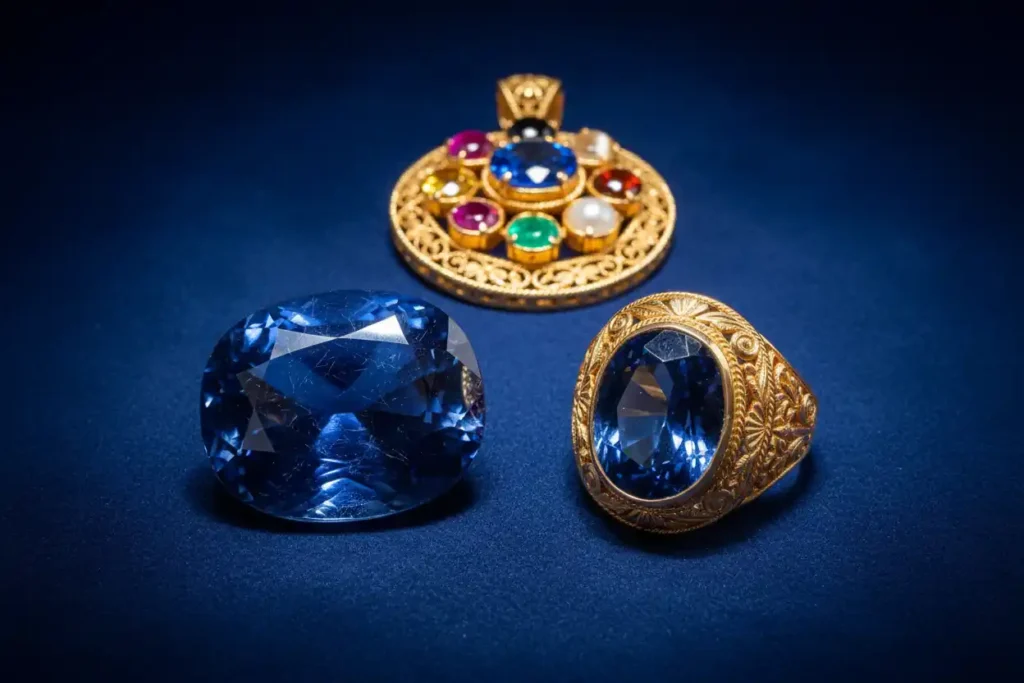
Among natural blue engagement ring stones, sapphire is the strongest starting point for most buyers.
Sapphire is corundum and ranks 9 on the Mohs scale. It combines exceptional scratch resistance with generally excellent practical toughness and no easy cleavage, giving it a durability profile that suits rings worn frequently.
Its color range is much broader than the phrase blue sapphire might suggest. Stones can appear pale icy blue, medium blue, violetish blue, cornflower-like blue, royal blue, greenish blue, deep navy, or nearly black.
The strongest color is not automatically the best.
A sapphire that becomes almost black in normal indoor lighting may have too much tone for someone who wants a lively blue ring. Conversely, an extremely pale sapphire may lose much of its blue character once mounted in white metal.
Well-cut blue engagement ring stones should show attractive color while still returning light through the crown.
Sapphire Quality
Color normally has the greatest visual influence on sapphire quality. Look for an appealing balance of hue, tone, saturation, and brightness rather than purchasing from a color name alone.
Color zoning should also be examined. Natural sapphire can contain areas of different color intensity, and skilled cutting may orient those zones to produce an attractive face-up result.
Clarity is important, but natural sapphire does not need to be perfectly inclusion-free. Some inclusions support natural origin, while large fractures or inclusions close to vulnerable edges can reduce durability.
Cut deserves serious attention because a sapphire with excellent rough color can still look dull if its proportions allow too much light to escape.
Sapphire Treatment
Heat treatment is common in the sapphire market and can produce attractive, durable gemstones when disclosed properly.
Other treatments occupy different market categories. Diffusion, fracture filling, coatings, dye, and laboratory growth should not be described as though they were equivalent to conventional heating.
Untreated natural sapphire can receive a substantial rarity premium, particularly when color, size, origin documentation, and quality align.
That does not mean treated sapphire is a poor choice. It means the price of blue engagement ring stones should reflect the treatment category being purchased.
Sapphire Price Position
Blue sapphire spans an unusually wide market.
Commercial heated stones may be accessible, while fine natural sapphires with exceptional color, larger size, strong documentation, or important provenance can become substantially more expensive.
Avoid relying on one universal price-per-carat figure. Sapphire price changes sharply with color, treatment, clarity, cut, size, geographic-origin opinion, and laboratory documentation.
For most buyers, a beautiful heated sapphire with honest disclosure can offer a stronger balance than stretching the budget toward an untreated stone with inferior color or cut.
2. Blue Spinel: A Durable Alternative to Sapphire
Blue spinel deserves serious consideration when blue engagement ring stones need to be durable without looking conventional.
Spinel ranks 8 on the Mohs scale, generally has good toughness, and does not have the strong cleavage concern associated with topaz or tanzanite.
Natural blue spinel ranges from pale gray-blue and steely blue to violet-blue and rare intensely saturated material. Some vivid examples owe part of their color to cobalt and can occupy a premium collector market.
Why Blue Spinel Works
Blue spinel offers useful scratch resistance and can handle frequent ring wear when the individual gemstone is structurally sound.
Rounds, cushions, ovals, and emerald-style shapes can all work, although any sharp corner still benefits from thoughtful protection.
Its relative unfamiliarity can also appeal to someone who wants blue engagement ring stones that do not immediately resemble the classic sapphire-and-diamond combination.
Spinel Price and Quality
Ordinary grayish or subdued blue spinel can be significantly more accessible than fine sapphire, while rare saturated blue material may become expensive.
Color should therefore justify the premium.
Do not buy a dark, weak, or heavily gray stone merely because the material is natural spinel. Compare its actual appearance with sapphire and aquamarine options within the same budget.
Synthetic spinel also exists, so unusually clean blue material sold at a surprisingly low price deserves proper disclosure.
3. Aquamarine: Best for Pale and Ocean Blue
Aquamarine is one of the most attractive blue engagement ring stones for buyers who prefer an airy, pale, or slightly greenish blue rather than saturated royal blue.
Aquamarine is the blue to greenish-blue variety of beryl and generally ranks around 7.5–8 on the Mohs scale.
It can occur in large, transparent crystals, which means cutters can produce substantial center stones without the extreme size premium associated with fine sapphire or natural blue diamond.
Aquamarine Quality
Color intensity is central.
Very pale aquamarine can look nearly colorless in small stones or against certain metals, while larger gems may show their blue more clearly because light travels through more material.
Strong transparency is common, so visible inclusions can influence price more than they might in naturally included stones such as emerald.
Cut also matters greatly. A well-proportioned aquamarine can appear crisp and bright, while a deep or poorly centered cut may carry excess weight below the setting without producing a proportionately larger face-up appearance.
Aquamarine Treatment
Heating is common and may reduce greenish or yellowish components, producing a purer blue appearance.
This treatment is widely encountered, but it should still be disclosed when known.
Aquamarine as a Ring Stone
Aquamarine is suitable for many rings, although it is not as forgiving as sapphire.
Large stones deserve particular protection because their wider face-up dimensions increase the chance of striking surrounding surfaces. A low-profile setting often makes more sense than a tall basket that raises the center stone unnecessarily.
For blue engagement ring stones in elongated shapes, protect vulnerable corners and points, especially on emerald, pear, marquise, or shield cuts.
4. Blue Diamond: Highest Durability and Highest Natural-Color Price
Natural blue diamond occupies a completely different price category from most blue engagement ring stones.
Diamond ranks 10 on the Mohs scale and provides the greatest scratch resistance among commonly worn gemstones. Fancy blue color in natural diamond is rare, and attractive saturation can create exceptional market premiums.
Natural blue diamond should not be confused with treated blue diamond or laboratory-grown blue diamond.
All three can be genuine diamond material, but origin and color origin have major consequences for rarity and price.
Natural vs Treated vs Laboratory-Grown Blue Diamond
A natural fancy-blue diamond formed geologically and acquired its color naturally.
A treated blue diamond began as natural diamond but received treatment to alter or create color.
A laboratory-grown blue diamond crystallized through a manufacturing process rather than geological growth.
Those categories can share diamond’s basic physical durability while occupying very different markets.
For expensive blue engagement ring stones, disclosure must specify both material identity and origin rather than relying on vague words such as genuine or real.
5. Blue Topaz: Best for Large Size on a Lower Stone Budget
Blue topaz is one of the most accessible transparent blue engagement ring stones, especially when a buyer wants a visually large center gem.
Topaz ranks 8 on the Mohs scale, giving it strong scratch resistance, but that number hides the most important durability issue: topaz has perfect basal cleavage.
A sufficiently unfavorable blow can split the gemstone.
Blue Topaz Color
Commercial blue topaz is commonly sold in pale, bright medium, and darker blue appearances, often under trade descriptions such as Sky, Swiss, or London Blue.
Much commercial blue topaz receives irradiation followed by heat treatment to produce or modify its color.
The abundance created by treatment is one reason large, clean blue topaz can remain affordable compared with equally large fine sapphire.
Setting Blue Topaz
Blue engagement ring stones made from topaz should sit relatively low and receive protection around the perimeter.
A bezel, partial bezel, halo, or substantial prong design can reduce direct impact. The jeweler must also avoid excessive pressure during setting because cleavage-sensitive stones can break while being mounted, not only while being worn.
Very large topaz deserves extra caution. A larger gemstone provides more visible blue, but it also creates a larger target for accidental impact.
Blue Topaz Price
Topaz usually offers substantial size for the money.
Its accessible market price does not mean it is fake or low quality; instead, treatment and supply create a different market structure from fine sapphire.
Pay for color, cut, condition, and setting quality rather than assuming a large carat number automatically represents superior value.
6. Blue Zircon: Best for Strong Brilliance and Fire
Blue zircon is one of the most optically lively blue engagement ring stones.
Zircon is a natural zirconium silicate mineral and should not be confused with cubic zirconia, which is a manufactured material with a different composition and crystal structure.
A well-cut zircon can show intense brilliance and noticeable spectral fire.
Durability Trade-Off
Zircon’s hardness varies, and facet edges can abrade more readily than sapphire or spinel.
It can also be brittle, which makes exposed girdles, sharp corners, and high settings less desirable for frequent wear.
Blue zircon therefore works best for someone who values its optical performance and is prepared to wear the ring deliberately.
Blue Zircon Treatment
Much blue zircon in jewelry receives heat treatment.
Treatment does not make it unsuitable, but the seller should disclose the expected category accurately.
Because zircon can resemble other brilliant stones in photographs, important purchases benefit from reliable identification rather than assumptions based on color and sparkle.
7. Tanzanite: Beautiful but Higher-Maintenance
Tanzanite offers one of the most distinctive colors among blue engagement ring stones, ranging from blue to violet-blue and blue-violet.
Tanzanite is the blue-to-violet gem variety of zoisite. Its color can be striking, but the material presents greater durability challenges than sapphire, spinel, or aquamarine.
Tanzanite has moderate hardness and cleavage that increases vulnerability to impact.
When Tanzanite Makes Sense
Choose tanzanite when its specific violet-blue appearance matters enough to justify greater care.
A low protective setting is particularly valuable. Bezel designs, halos, guarded corners, and substantial prongs can reduce exposure, although setting pressure itself must be controlled.
Very high baskets and exposed pointed shapes make less sense for someone who expects unrestricted frequent wear.
Tanzanite can produce an excellent engagement ring for a careful wearer, but it should not be marketed as though its maintenance profile were identical to sapphire.
What About Iolite?
Iolite can provide blue-violet color at a relatively accessible price and is notable for strong pleochroism, meaning the apparent color changes with viewing direction.
That optical behavior can make a well-oriented stone attractive, but it also complicates cutting.
Iolite has enough hardness for jewelry, yet cleavage and impact considerations make it less forgiving than sapphire or spinel.
For blue engagement ring stones intended for moderate rather than rough wear, iolite can be an interesting alternative when the setting protects the center stone and the wearer understands its limitations.
How Prices Differ Among Blue Engagement Ring Stones
Prices cannot be compared fairly by color alone.
A vivid blue topaz, a vivid sapphire, and a vivid natural blue diamond can appear within the same broad color family while occupying radically different markets.
| Stone | General price position | Main price drivers |
|---|---|---|
| Blue topaz | Lower | Size, cut, color, treatment, setting |
| Iolite | Lower to moderate | Color orientation, clarity, cut, size |
| Aquamarine | Lower to premium | Color strength, clarity, cut, size |
| Blue zircon | Lower to moderate | Color, brilliance, cut, condition, size |
| Tanzanite | Moderate to premium | Saturation, tone, clarity, cut, size |
| Blue spinel | Moderate to very high | Saturation, rarity, cobalt-associated color, size |
| Blue sapphire | Moderate to very high | Color, treatment, origin opinion, cut, size, report |
| Natural blue diamond | Very high | Natural color, saturation, rarity, cut, weight, report |
These are market positions rather than fixed prices.
Two stones of the same species and carat weight can differ substantially because color, treatment, cut quality, transparency, inclusions, provenance, laboratory documentation, and market scarcity change the value.
For blue engagement ring stones, the asking price should be compared with genuinely equivalent material rather than another gemstone that happens to be blue.
Carat Weight Is Not the Same as Visible Size
A common mistake when comparing blue engagement ring stones is to compare only carat weight.
Carat measures weight, not diameter.
Gemstones have different densities, and cutting styles distribute weight differently. One stone may carry much of its weight in a deep pavilion while another spreads more of its mass across the visible face.
Compare length, width, depth, and face-up appearance alongside carat weight.
This is particularly important with aquamarine and blue topaz, where large material may be readily available. A deeply cut gem can sound impressive on paper while looking smaller than a better-proportioned stone of lower weight.
Choose the Stone and Setting Together
Blue engagement ring stones should not be purchased independently from the setting design unless both pieces have already been measured carefully.
Setting height affects impact exposure. A center stone sitting far above the finger is more likely to catch on clothing or strike nearby objects than a lower-profile gem.
A low basket can improve practicality, although the pavilion still needs enough space and the design must allow cleaning underneath the stone.
Bezel Settings
A bezel surrounds much or all of the gemstone perimeter with metal.
This can provide excellent edge protection and produces a clean contemporary appearance. Bezel settings are particularly attractive for blue engagement ring stones with greater impact vulnerability.
The jeweler must still control pressure during setting, especially with topaz, tanzanite, or stones containing fractures.
Prong Settings
Prongs expose more of the stone and can create an open, light appearance.
Sapphire and spinel tolerate many prong designs well when the individual stone is sound.
Pointed shapes require specialized protection. V-prongs or guarded corners are useful for marquise, pear, princess, kite, and similar cuts.
Halo Settings
A halo can visually enlarge the center and create a protective buffer around its edge.
That does not make a fragile gemstone indestructible, but it can reduce direct contact.
Cut Shape Changes Durability
Round and oval blue engagement ring stones generally avoid exposed points and distribute the outline smoothly.
Cushions also provide a practical combination of visual size and softened corners.
Emerald and radiant cuts can work well, but corner condition matters. Princess, pear, marquise, kite, and shield shapes contain points or corners that need additional protection.
A thin girdle is vulnerable regardless of shape.
Before buying an expensive loose stone, inspect the girdle under magnification for chips, fractures, extremely thin sections, and inclusions that reach the edge.
The wider structural implications are explained in gemstone cleavage.
Metal Choice Affects Appearance and Maintenance
White gold and platinum generally emphasize cooler blue tones.
Yellow gold creates stronger contrast and can make medium-to-deep blue stones appear richer or warmer. Rose gold creates a softer contrast that works particularly well with pale aquamarine, gray-blue spinel, and violet-blue stones.
Metal selection also affects maintenance.
Prongs can wear over time regardless of metal, while very thin settings may deform more readily than substantial ones. Platinum behaves differently from gold alloys during wear and repair, so setting structure matters more than simply choosing the most expensive metal.
The center stone should remain secure without relying on unnecessarily delicate hardware.
Ring Size, Fit, and Wedding-Band Compatibility
Large blue engagement ring stones can affect how the ring sits on the finger.
A heavy center may cause rotation when the shank is too thin or the ring fits loosely. A slightly wider or structurally balanced band can improve stability.
Future resizing also deserves consideration.
Highly ornate settings, full eternity designs, unusual metal combinations, and stones extending far around the shank can make resizing more complicated.
If the engagement ring will be paired with a wedding band, check whether the basket or lower gallery allows the second ring to sit close beside it.
A protruding basket can force a visible gap.
These details are easy to overlook when attention is concentrated only on blue engagement ring stones, yet they strongly affect how comfortable the finished ring feels.
Treatments Matter to Price and Care
Treatment is one of the most important buying considerations for blue engagement ring stones.
Sapphire may be heated, diffused, filled, coated, dyed, or laboratory grown.
Blue topaz commonly receives irradiation and heating.
Blue zircon is frequently heat treated.
Aquamarine may be heated to reduce greenish components.
Tanzanite commonly receives heating associated with development of its familiar blue-to-violet appearance.
Treatments do not all have the same significance.
A stable conventional treatment may have little effect on practical wear, while filling, coating, or extensive fracture enhancement can change cleaning, repair, and value substantially.
Ask for treatment disclosure in writing.
Natural and Laboratory-Grown Stones Need Clear Disclosure
Laboratory-grown sapphire and diamond can make highly durable blue engagement ring stones because they share the essential crystal structure and composition of their natural counterparts.
Their origin is different, however, and that difference matters commercially.
Laboratory-grown does not mean imitation.
A laboratory-grown sapphire is corundum produced through manufacturing rather than geological formation. A blue glass simulant is a different material altogether.
The buyer should know whether a stone is natural, laboratory grown, treated natural, or an imitation before comparing prices.
When a Laboratory Report Is Worth Paying For
Not every engagement ring requires a gemological laboratory report.
A modest blue topaz may not justify the additional expense.
An expensive sapphire, natural blue diamond, rare blue spinel, or stone carrying a significant untreated or geographic-origin premium presents a stronger case.
A suitable report can establish gemstone identity, natural or laboratory-grown origin, and detectable treatments. Selected reports may also provide geographic-origin opinions for certain gem materials.
The report does not establish whether the asking price is fair or whether the setting is well made.
The practical differences are explained in how to read a gem lab report.
Inspect Blue Engagement Ring Stones in More Than One Light
Blue color can change dramatically between lighting environments.
A sapphire that looks vivid under intense display lighting may become dark indoors. Aquamarine may look strongly blue against a black background but nearly colorless against skin. Tanzanite can show more violet under some light sources, while spinel may appear grayer in subdued illumination.
Ask to see the stone in neutral light and ordinary indoor light before committing.
For online purchases, photographs should show the actual gemstone from several angles without extreme saturation or selective lighting.
The safeguards in buying gemstones online are especially important when the stone carries a high-value natural-origin or treatment claim.
Replacement Difficulty Should Influence the Decision
The cost of blue engagement ring stones is not only the purchase price.
Consider how difficult the stone would be to replace if it were damaged.
A commercially available blue topaz in a standard calibrated size may be relatively easy to replace.
A sapphire with unusual proportions, a rare cobalt-colored spinel, a matched heirloom stone, or an exceptionally specific tanzanite may be much harder to duplicate.
Custom settings can create an additional problem because a replacement stone may need nearly identical dimensions to fit correctly.
For one-of-a-kind blue engagement ring stones, insurance and detailed documentation become more important.
Cleaning and Maintenance
No single cleaning method suits every blue gemstone.
Sapphire and spinel are relatively durable, although fillings, fractures, and companion stones can still alter cleaning options.
Aquamarine generally responds well to gentle warm soapy cleaning when structurally sound.
Topaz should be protected from ultrasonic vibration, steam, and sudden temperature changes because cleavage creates additional risk.
Tanzanite also deserves conservative care.
Zircon should be protected from abrasion and hard impact.
Before cleaning blue engagement ring stones mechanically, identify every gemstone in the ring and any relevant treatments.
The safest routine for many rings remains lukewarm water, mild soap, gentle brushing, thorough rinsing, and careful drying, provided the stone and setting are suitable.
Which Blue Engagement Ring Stone Is Best for You?
The strongest choice depends on what you value most.
If unrestricted frequent wear and natural blue color are the priorities, sapphire is the strongest all-around option.
If you want a less conventional natural gemstone without giving up much durability, blue spinel deserves serious attention.
If you prefer pale ocean-like color and a visually substantial center, aquamarine provides a compelling balance.
If size and accessible cost matter most, blue topaz can deliver exceptional visual presence, provided cleavage is respected.
If maximum sparkle is the attraction, blue zircon offers distinctive brilliance but requires more careful wear.
If violet-blue color matters more than low maintenance, tanzanite can be worth the compromise.
Natural blue diamond belongs in a separate rarity and price category, while laboratory-grown blue diamond and sapphire provide durable alternatives when natural geological rarity is not a purchasing priority.
The broader best gemstones for engagement rings comparison helps put these blue options alongside other colors and gem families.
Frequently Asked Questions
What are the best blue engagement ring stones for frequent wear?
Blue sapphire is generally the strongest natural colored-gem choice because it combines Mohs hardness 9, excellent practical toughness, and no easy cleavage. Blue spinel is another strong option, while aquamarine works well with sensible protection.
What are the most affordable blue engagement ring stones?
Blue topaz, iolite, and many aquamarines can provide attractive blue color without the premium attached to fine sapphire, rare blue spinel, or natural blue diamond. Actual price still depends on quality, size, treatment, and setting.
Is sapphire better than aquamarine for an engagement ring?
Sapphire is more resistant to scratching and generally more forgiving for frequent wear. Aquamarine remains a practical ring stone but benefits from greater protection against hard impacts.
Is blue spinel suitable for an engagement ring?
Yes. Blue spinel has hardness 8, generally good toughness, and no major cleavage concern, making it one of the stronger blue engagement ring stones for frequent wear.
Can blue topaz be used in an engagement ring?
Yes, but it requires an appropriate setting. Topaz has strong scratch resistance but perfect cleavage, so hard impact or unfavorable setting pressure can cause serious damage.
Is tanzanite too fragile for an engagement ring?
Tanzanite can be used in engagement rings, but it requires more careful wear than sapphire, spinel, or aquamarine. Cleavage, moderate hardness, and impact vulnerability make protected settings preferable.
Is blue zircon the same as cubic zirconia?
No. Zircon is a natural zirconium silicate mineral. Cubic zirconia is a manufactured material with different composition, structure, and optical properties.
Which blue engagement ring stones look largest for their price?
Blue topaz and aquamarine commonly offer substantial face-up size for comparatively accessible stone budgets. Compare millimeter dimensions rather than relying only on carat weight.
Are laboratory-grown blue sapphires real sapphires?
Laboratory-grown sapphire is corundum with the essential composition and crystal structure of sapphire, but it forms through manufacturing rather than geological processes. Its origin should be disclosed clearly.
Should a blue sapphire engagement ring have a laboratory report?
A report becomes increasingly useful when the sapphire is expensive, represented as untreated, sold with a geographic-origin premium, or difficult for the buyer to verify independently.
What setting protects blue engagement ring stones best?
Low-profile bezels, partial bezels, halos, guarded corners, and appropriately designed prongs can reduce exposure. The best setting depends on the specific gemstone, cut shape, fractures, cleavage, and intended wear.
Does a higher Mohs hardness always mean a better ring stone?
No. Hardness measures scratch resistance. Toughness, cleavage, inclusions, treatment, stability, cut, and setting protection also determine whether a gemstone will tolerate frequent ring wear.
Choosing Blue Engagement Ring Stones With Long-Term Wear in Mind
Blue engagement ring stones should be evaluated as complete jewelry components rather than isolated pieces of color.
Sapphire provides the strongest overall balance for someone seeking a natural blue gemstone capable of frequent wear. Spinel offers impressive durability with greater individuality, while aquamarine creates a lighter and often larger appearance without moving into the premium market occupied by fine sapphire or natural blue diamond.
Blue topaz, zircon, tanzanite, and iolite expand the range considerably, but each asks the wearer to accept a specific compromise involving cleavage, abrasion, impact resistance, or maintenance.
Price should follow what the stone actually is: its natural or laboratory-grown origin, treatment, color, cut, condition, size, documentation, rarity, and market category. An expensive stone is not automatically better, while an accessible stone is not automatically inferior.
The most successful blue engagement ring stones are the ones whose beauty, structural properties, setting, budget, and intended wear all fit the same decision.