9 Important Jasper Healing Claims: Hopeful Traditions, Verified Facts & Safe Use
Jasper healing properties are commonly associated with grounding, emotional steadiness, courage, patience, motivation, resilience, practical thinking, relationship stability, and spiritual reflection. Its opaque earthy colors and dense polished feel make these themes easy to understand symbolically, especially in red, brown, yellow, and green varieties. That symbolism does not establish a therapeutic mechanism. Jasper has not been demonstrated to treat anxiety, depression, blood disorders, digestive problems, inflammation, fatigue, hormonal conditions, pain, or any other medical illness, nor does iron-rich coloration mean that wearing jasper delivers iron into the bloodstream. Gemologically, jasper is generally an opaque, impure variety of microcrystalline quartz or chalcedony composed predominantly of silica, SiO₂, with varying quantities of iron oxides, clays, and other inclusions producing its colors and patterns. It usually falls around Mohs 6.5 to 7, has no useful cleavage, is brittle, and commonly breaks with conchoidal to uneven fracture. Its genuine physical durability and geological variety are separate from its modern wellness reputation.
9 Jasper Claims Shaped by Earthy Color, Durability, and Steady Presence
- Grounding and present-moment awareness
- Emotional steadiness during stressful periods
- Courage when facing difficult situations
- Patience with gradual progress
- Motivation toward practical goals
- Resilience after setbacks
- Clearer practical thinking
- Relationship stability and boundaries
- Spiritual reflection on endurance and responsibility
These nine themes can support different personal practices without becoming nine scientifically established healing effects. Many jasper benefits become more useful when translated into actions the reader controls, such as slowing down before reacting, beginning one concrete task, reviewing a setback, setting a boundary, or paying deliberate attention to the immediate environment.
Jasper Mineral Science: Opaque Chalcedony, SiO₂ Chemistry, Hardness, and Natural Impurities
Jasper is not usually treated as a single perfectly pure mineral specimen. It is an opaque silica-rich gemstone composed mainly of microcrystalline quartz and chalcedony, often with enough iron oxides, clay minerals, or other inclusions that some geologists describe particular jasper occurrences as rocks rather than simple mineral varieties. The dominant chemical component remains SiO₂.
The quartz and chalcedony components belong to the trigonal silica system at the microscopic scale, but jasper normally occurs as massive, nodular, layered, brecciated, orbicular, or patterned aggregates rather than as visible quartz crystals. Its identity is therefore tied more strongly to texture, opacity, composition, and pattern than to an obvious external crystal form.
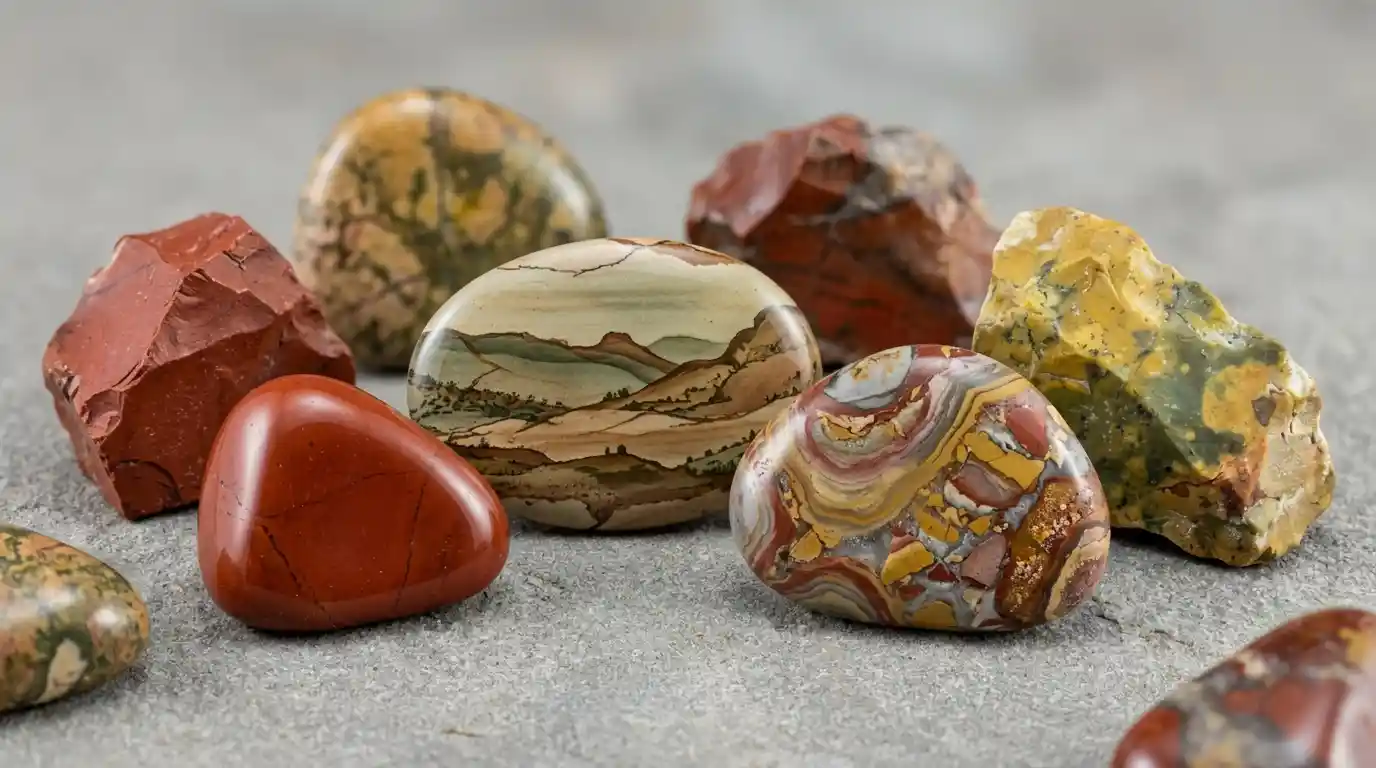
Jasper can occur in red, brown, yellow, orange, green, cream, gray, black, and multicolored combinations. Red coloration is commonly linked with hematite and other iron oxides, while yellow and brown shades may involve goethite or related iron compounds. Green colors can result from chlorite, amphiboles, epidote-group minerals, or other inclusions depending on the deposit. Because composition varies, color alone cannot establish a precise mineral assemblage.
Luster ranges from dull or waxy on rough surfaces to vitreous or highly polished on finished cabochons. Jasper is normally opaque, which separates it conceptually from translucent agate even though both belong to the chalcedony family. Banded stones can create borderline classification problems, and commercial naming is not always mineralogically consistent.
Jasper typically falls around Mohs 6.5 to 7. It therefore resists scratching better than calcite, fluorite, opal, and many common decorative stones. It lacks useful cleavage and usually breaks with conchoidal to uneven fracture. That makes polished jasper relatively durable for beads, pendants, carvings, bracelets, and many rings, although thin sections can still chip or break from a sharp blow.
Jasper is not a hydrated gemstone in the ordinary sense. Water is not an essential part of the ideal SiO₂ formula, although microscopic pores, fractures, and included minerals can affect how individual specimens respond to prolonged exposure.
Jasper History, Name Origins, Geological Formation, and Global Sources
Jasper has a long cultural history, although ancient references must be interpreted carefully because historical gemstone names were not always based on modern mineral identification. The word ultimately traces through old European and classical-language forms related to iaspis, a term applied historically to spotted or colored stones. Some ancient objects identified broadly as jasper are genuinely silica-rich gemstones, while others may not correspond exactly with today’s trade definition.
Jasper has been carved into seals, beads, amulets, decorative objects, bowls, and jewelry for centuries. Red and patterned forms have been especially popular because the stone takes a good polish and can preserve intricate designs. This historical use provides a genuine cultural foundation for symbolism involving endurance, protection, status, and decoration, but it does not validate modern claims about hormones, circulation, immunity, or crystal energy.
Geologically, jasper can form through several pathways. Silica-rich fluids may precipitate fine-grained quartz in cavities, fractures, sedimentary environments, volcanic settings, or hydrothermal systems. Some jaspers form through replacement of earlier rocks or fossils, while others occur with iron-rich sedimentary deposits or volcanic sequences.
Banded iron formations can contain silica-rich red jasper associated with hematite and magnetite. Other patterned varieties form when silica deposition alternates with impurities, fracturing, brecciation, or repeated mineral growth. This geological diversity explains why commercially named jaspers can look dramatically different from one another.
Jasper occurs worldwide, with important decorative stone sources in India, Australia, Madagascar, Brazil, the United States, South Africa, Russia, and many other regions. Mookaite from Western Australia, picture jasper from several North American deposits, and red jasper from numerous localities are examples of trade varieties built around locality, color, or pattern.
The jasper meaning attached to stability and endurance makes more sense when understood as symbolism inspired by an opaque, durable silica stone rather than as proof of a physical healing mechanism.
Grounding, Emotional Steadiness, and Courage Claims
1. Grounding Through Sensory Attention
Jasper is frequently described as grounding because its colors often resemble soil, rock, clay, and desert landscapes. The stone does not electrically anchor the body or alter the nervous system through an energy field. It can still work as a tactile focus object. Notice its weight, temperature, polished texture, patterns, breathing rhythm, and immediate surroundings. The sensory exercise brings attention to the present moment while the stone acts as a cue.
2. Emotional Steadiness During Stress
Another common claim says jasper stabilizes emotions. It has not been shown to regulate neurotransmitters, cortisol, heart rate, or other stress physiology through contact with the skin. A more practical use is to treat the stone as a signal to pause before reacting, separate facts from assumptions, and decide whether the situation requires immediate action or simply more information.
3. Courage When Facing Difficult Situations
Red and dark jaspers are often associated with courage and strength. A gemstone cannot remove fear or make a risky situation safe. Before an uncomfortable but appropriate action, use jasper as a reminder to identify what preparation can reduce risk, what remains outside your control, and what first step can still be taken. Courage then becomes behavior rather than a property transferred by the stone.
Patience, Motivation, and Resilience Claims
4. Patience With Gradual Progress
Jasper’s dense appearance and slow geological formation naturally support symbolism around patience. The stone does not alter impulse control. A practical ritual is to review long-term progress on a fixed schedule instead of judging success every day. Look at what has accumulated over weeks or months, identify what is still moving, and adjust only when evidence suggests the current approach is not working.
5. Motivation Toward Practical Goals
Some practitioners describe jasper as energizing or motivating. There is no evidence that silica increases dopamine, stamina, or physical energy through touch. The stone can instead become a start cue. Place it beside a planner, workbench, or computer and begin one predetermined task when it is set down. The consistent connection between cue and behavior may reduce hesitation.
6. Resilience After Setbacks
Jasper is frequently associated with endurance. A mineral cannot make someone psychologically resilient, but it can provide a useful symbol for reviewing disappointment. Identify what failed, what remains intact, what can be learned, and what the next attempt should change. Resilience is built through adaptation rather than through the chemical composition of SiO₂.
Practical Thinking, Relationship Stability, and Spiritual Reflection Claims
7. Clearer Practical Thinking
Jasper’s grounding symbolism often extends to practical judgment. It does not improve cognition biologically. A useful exercise is to ask four concrete questions: What is known? What is assumed? What can be controlled? What needs to happen next? The framework directs attention away from vague worry and toward actionable information.
8. Relationship Stability and Boundaries
Jasper is sometimes associated with loyalty, steadiness, or stronger relationships. It cannot make another person reliable, prevent betrayal, or remove conflict. Used symbolically, it can remind someone that stability depends on repeated behavior: direct communication, follow-through, appropriate boundaries, mutual respect, and recognizing patterns that should not be ignored.
9. Spiritual Reflection on Endurance and Responsibility
Jasper’s earthy colors and long use in carving make it a natural object for meditation on endurance, place, ancestry, responsibility, or connection with the physical world. A person may find these themes spiritually meaningful without assuming that jasper transmits a measurable healing frequency. The stone can focus attention while the reflective content comes from the practitioner.
Jasper Chakra Associations Across Red, Yellow, Green, and Brown Varieties
Jasper does not have one universal chakra association because commercially named varieties occur in many colors. Red jasper is usually linked with the root chakra and themes of stability or security. Yellow jasper may be associated with the solar plexus chakra, while green jasper is often linked with heart-centered symbolism. Brown and earth-toned pieces are commonly grouped with root-centered practices.
Chakras are a spiritual framework rather than anatomical structures. Jasper has not been demonstrated to affect the spine, heart, digestive organs, blood, adrenal glands, or other physiological systems through chakra placement. Color can still be used to organize meditation themes while remaining clearly symbolic.
Jasper Physical Care: Quartz Hardness, Water, Heat, Chemicals, and Treatment Concerns
Jasper is comparatively durable because its quartz-rich structure typically falls around Mohs 6.5 to 7 and lacks strong cleavage. It can tolerate regular use in beads, pendants, carvings, and many rings, although severe impact can chip edges or fracture thin pieces.
Quartz, chalcedony, and jasper can scratch softer gemstones, while topaz, sapphire, ruby, diamond, and other harder stones can scratch jasper. Separate storage is therefore useful for maintaining polished surfaces.
Brief contact with plain water is generally safe for natural untreated jasper. Warm water, mild soap, and a soft cloth or brush work well for routine cleaning. Prolonged soaking is unnecessary, particularly when a piece has open fractures, attached matrix, coatings, dye, adhesives, or unknown treatments.
Commercial jasper may be dyed, stabilized, resin-filled, or sold under imaginative trade names that conceal treatment. Bright colors, unusually uniform saturation, or very inexpensive stones deserve closer inspection. Solvents, bleach, acids, and harsh household chemicals may affect treatments even when the silica host itself is chemically durable.
Steam and ultrasonic cleaning are unnecessary defaults. Sound untreated jasper may tolerate more aggressive cleaning than fragile gems, but internal fractures, composite pieces, dyes, coatings, and glued settings create uncertainty. Gentle hand washing provides better control.
Hydrofluoric acid attacks silica and is extremely hazardous. It should never be used in gemstone cleaning. Cutting and grinding jasper also produce crystalline silica dust, so lapidary work should use wet methods, effective extraction, eye protection, and appropriate respiratory controls.
Gentle Ritual Cleansing for Jasper Without Abrasion or Chemical Exposure
Ritual cleansing can be kept completely separate from physical gemstone cleaning. There is no scientifically demonstrated negative energy that needs to be extracted from jasper.
Sound, intention-setting, quiet reflection, dry placement, or gently wiping the stone before assigning a new symbolic purpose are low-risk methods. An earth-themed ritual can simply involve sitting outdoors with the stone or observing the surrounding landscape without burying the gemstone.
Saltwater, harsh chemicals, prolonged soaking, flame, abrasive powders, and burying polished jewelry in wet soil are unnecessary. These methods add physical risk without providing evidence of a stronger symbolic effect.
Conclusion
Jasper’s appeal comes from real geological diversity, durable microcrystalline quartz, vivid iron-rich colors, and patterns that can resemble landscapes, breccias, bands, or abstract art. Its nine healing claims can still support grounding, patience, practical thinking, resilience, and reflection when the useful mechanism remains with attention and behavior rather than with an unproven therapeutic property of the stone.
Frequently Asked Questions About Jasper Healing Properties
What are the main jasper healing properties people claim?
Common claims include grounding, emotional steadiness, courage, patience, motivation, resilience, practical thinking, relationship stability, and spiritual reflection. These are traditional or contemporary beliefs rather than scientifically proven therapeutic effects.
What is jasper made of?
Jasper is an opaque silica-rich gemstone composed mainly of microcrystalline quartz and chalcedony, SiO₂, with varying iron oxides, clays, and other inclusions.
How hard is jasper?
Jasper generally falls around Mohs 6.5 to 7. It has good scratch resistance, lacks useful cleavage, and is durable enough for many forms of jewelry.
Why is red jasper red?
Red jasper commonly owes its color to hematite and other iron oxides dispersed through the silica-rich stone. Other colors can result from different mineral inclusions.
Does jasper scientifically improve blood health or physical energy?
No. Red coloration and iron-bearing inclusions do not mean wearing jasper raises iron levels, improves circulation, or increases physical energy.
Is jasper the same as agate?
Both are forms of chalcedony, but jasper is generally opaque while agate is usually translucent and commonly banded. Natural stones can show transitional textures that make trade classification less exact.
Which chakra is jasper associated with?
Associations depend on color. Red and brown jasper are commonly linked with the root chakra, yellow varieties with the solar plexus chakra, and green varieties with the heart chakra. These are spiritual correspondences rather than anatomical effects.
Can jasper go in water?
Brief contact with plain water is generally safe for untreated jasper. Mild soap and warm water are suitable for routine cleaning, while prolonged soaking is unnecessary when treatments or fractures are present.
How should jasper be cleaned?
Use warm water, mild soap, and a soft cloth or brush. Avoid harsh chemicals, hydrofluoric acid, unnecessary extreme heat, and aggressive cleaning when dyes, resin, coatings, or fractures are present.
Is jasper good for everyday jewelry?
Its Mohs 6.5 to 7 hardness and lack of strong cleavage make jasper suitable for many everyday pieces, although rings and bracelets should still be protected from hard impacts and harder gemstones.
Crystal healing claims are traditional or personal beliefs and should not replace qualified medical or mental health care.