11 Important Kyanite Healing Claims: Gentle Traditions, Verified Facts & Safe Use
Kyanite healing properties are commonly associated with clear communication, concentration, emotional steadiness, self-expression, confidence, decision-making, boundaries, adaptability, meditation, self-reflection, and spiritual awareness. Its long blue blades and strong directional character have encouraged modern symbolism around alignment and clarity, yet those associations do not establish a therapeutic mechanism. Kyanite has not been demonstrated to treat anxiety, depression, thyroid disorders, neurological conditions, insomnia, inflammation, pain, hormonal problems, or any other medical illness, and there is no evidence that its crystal structure realigns human energy pathways. Scientifically, kyanite is an aluminum silicate with the formula Al₂SiO₅. It crystallizes in the triclinic system, is polymorphous with andalusite and sillimanite, and has an unusually directional hardness that can be about Mohs 5.5 along one crystallographic direction and around 7 along another. Its perfect cleavage and brittle tenacity make it more fragile than a single hardness number suggests.
11 Kyanite Claims Inspired by Blue Blades, Directional Hardness, and Alignment Symbolism
- Clearer communication
- Concentration and sustained attention
- Emotional steadiness during stress
- Honest self-expression
- Confidence in difficult conversations
- More deliberate decision-making
- Stronger personal boundaries
- Adaptability when circumstances change
- Meditation and mental stillness
- Self-reflection and perspective
- Spiritual awareness and symbolic alignment
These eleven themes can support different routines without becoming eleven scientifically demonstrated healing effects. Many kyanite benefits become more useful when converted into actions the reader controls, such as preparing what to say, reducing distractions, identifying a boundary, reviewing a decision, or using a familiar object to begin meditation.
Kyanite Mineral Science: Al₂SiO₅ Chemistry, Triclinic Blades, Uneven Hardness, and Cleavage
Kyanite is a recognized aluminum silicate mineral with the formula Al₂SiO₅, sometimes written structurally as Al₂(SiO₄)O. It belongs to a remarkable polymorphic trio with andalusite and sillimanite. All three share the same overall chemical composition but have different crystal structures because they form under different pressure and temperature conditions.
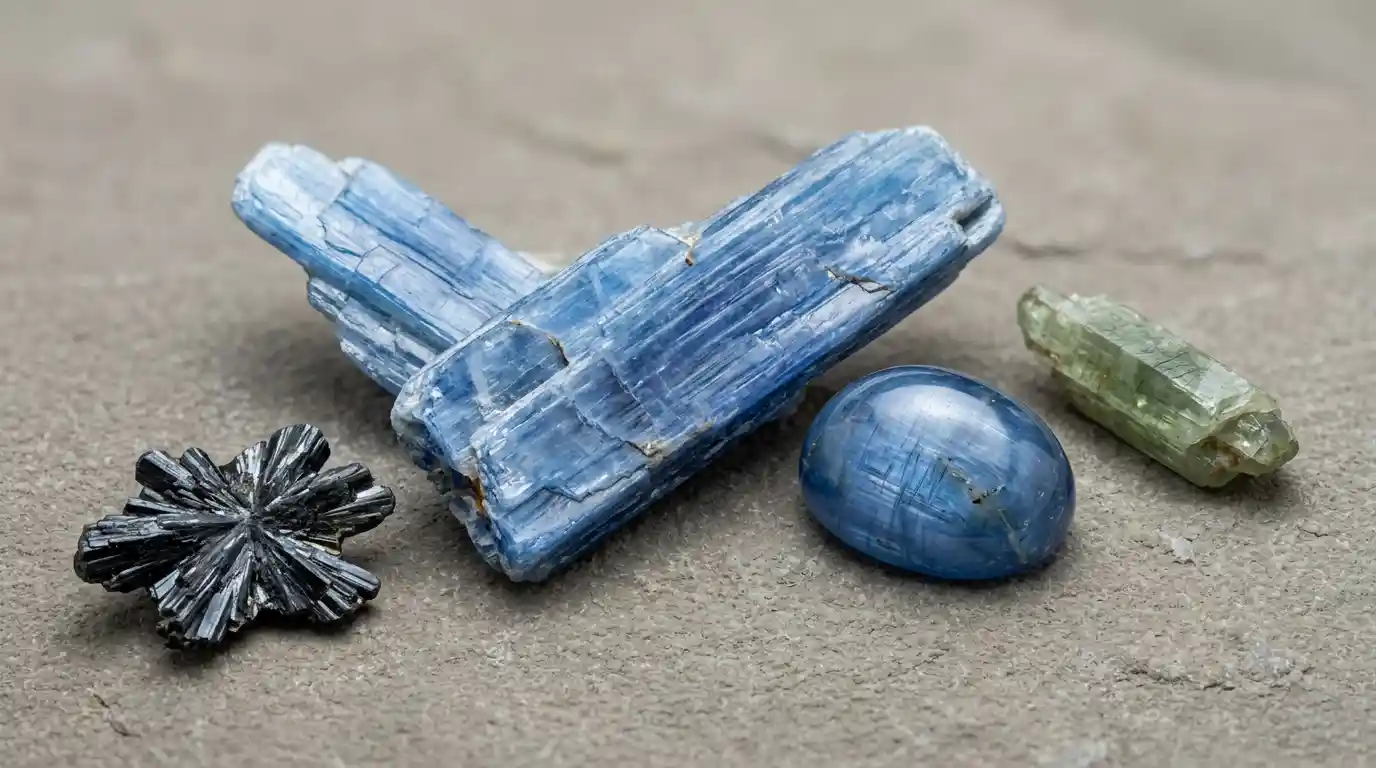
Kyanite crystallizes in the triclinic system and commonly develops flattened, elongated, bladed, or tabular crystals. Blue is the best-known color, but natural kyanite can also be white, gray, green, yellow, orange, pink, or nearly colorless. The familiar blue coloration is linked largely with iron-related electronic processes, while other colors can reflect different impurities and structural effects.
One of kyanite’s most distinctive physical properties is directional hardness. It measures roughly 5.5 parallel to the long crystal direction and around 7 across another crystallographic direction. This unusual anisotropy gave rise to the older name disthene, referring to “two strengths.” It also means a simple statement such as “kyanite is Mohs 7” is incomplete.
Luster ranges from vitreous and sub-vitreous to pearly or greasy on some surfaces. Tenacity is brittle. Cleavage is perfect in one direction and good in another, so thin blades can split or chip readily. Fracture away from cleavage is commonly splintery.
Kyanite is not a hydrated mineral. Water is not an essential component of the Al₂SiO₅ formula. Its fragility around water-related cleaning comes primarily from cleavage, fractures, matrix minerals, repairs, and thermal shock rather than from dissolution in ordinary water.
Kyanite Formation, Name Origin, Metamorphic Geology, and Important Sources
The name kyanite was introduced in 1789 by Abraham Gottlob Werner from the Greek kyanos, meaning blue. The older spelling cyanite remained common in mineralogical literature for many years. The mineral’s identity is therefore well established in modern mineral science, while today’s chakra and healing system developed much later.
Kyanite forms most characteristically in aluminum-rich metamorphic rocks subjected to relatively high pressure. It occurs in schists, gneisses, quartz-rich rocks, and related metamorphic environments. Because andalusite, kyanite, and sillimanite are stable under different combinations of pressure and temperature, geologists use their occurrence as evidence when reconstructing metamorphic conditions.
This geological role is one of the most useful facts about kyanite. Its presence can indicate that a rock experienced substantial pressure during burial and metamorphism, making the mineral an important index mineral rather than merely a decorative blue crystal.
Fine specimens and gem-quality crystals come from Brazil, Nepal, Kenya, Myanmar, Switzerland, the United States, India, Tanzania, and other regions. Nepal is particularly known for attractive blue gem kyanite, while Brazil has produced impressive collector crystals and blades.
Different localities can produce variations in color, transparency, habit, and inclusions, but locality does not create different healing properties. The modern wellness identity of kyanite is primarily symbolic and should remain separate from its metamorphic geology.
Communication, Focus, and Emotional Steadiness Claims
1. Clearer Communication Through Preparation
Blue kyanite is frequently associated with communication. The mineral cannot alter speech centers, improve language processing, or make another person understand automatically. A practical ritual is to use the crystal before an important conversation and identify the main point, the specific request, and the boundary that needs to remain clear. Preparation supports communication more plausibly than gemstone energy.
2. Concentration and Sustained Attention
Kyanite is also promoted as a focus stone. There is no evidence that aluminum silicate increases attention span or memory through skin contact. It can instead become a consistent work cue: place it beside one task, silence unrelated notifications, and work for a defined period without changing activities. The environment and routine support concentration.
3. Emotional Steadiness During Stress
Some practitioners say kyanite calms emotional intensity. It has not been shown to regulate neurotransmitters, cortisol, or other stress physiology. A more useful interpretation is to let the stone signal a pause before reacting. Slow the breathing, identify what actually happened, and decide whether an immediate response is necessary.
Self-Expression, Confidence, and Decision-Making Claims
4. Honest Self-Expression
Kyanite is commonly linked with speaking honestly or expressing an authentic point of view. The gemstone cannot force emotional openness. It can serve as a reminder to distinguish what you genuinely think from what you are saying only to avoid disagreement. The useful part is deliberate communication.
5. Confidence in Difficult Conversations
Communication often requires confidence as well as clarity. Kyanite does not biologically increase self-esteem. Before a difficult interaction, use it as a cue to review what has been prepared, what outcome is realistic, and which part of the conversation is under your control. Confidence can emerge from preparation and repeated experience.
6. More Deliberate Decision-Making
Kyanite’s blade-like form and symbolism of alignment often lead to claims about finding the right direction. The crystal cannot reveal the future or identify the objectively correct choice. A better ritual is to list the available options, evidence, risks, uncertainties, and consequences. This converts “alignment” into structured decision-making.
Boundaries, Adaptability, and Meditation Claims
7. Stronger Personal Boundaries
Some crystal traditions describe kyanite as protective or as clearing unwanted influence. There is no evidence that it creates an energetic barrier around the body. A practical boundary exercise is to decide what behavior you will accept, what request you will decline, and what you will do if a stated limit is ignored. The protection comes from action.
8. Adaptability When Circumstances Change
Kyanite’s strongly directional physical properties make adaptability an interesting symbolic theme. The mineral itself cannot change psychological flexibility. When plans fail, use it as a reminder to separate the goal from the route. The goal may remain valuable even when the original method needs to change.
9. Meditation and Mental Stillness
Blue kyanite is often used as a meditation object. Its elongated form, color, and natural striations can provide a stable visual focus. A person can observe the crystal, notice when attention wanders, and return to the breath or object. That is a real attention practice without showing that kyanite changes consciousness through a measurable frequency.
Self-Reflection and Spiritual Awareness Claims
10. Self-Reflection and Perspective
Kyanite is sometimes described as revealing inner truth. The stone cannot retrieve hidden psychological information. A more grounded ritual is to use it during journaling and ask what is known, what is assumed, what emotion is influencing the interpretation, and what evidence could change your view. Reflection becomes a process rather than a supernatural message.
11. Spiritual Awareness and Symbolic Alignment
Modern metaphysical systems often describe kyanite as aligning chakras or energy fields. There is no scientific evidence that the mineral reorganizes invisible human energy channels. Someone can still use the idea symbolically by asking whether daily behavior is aligned with stated values, responsibilities, and long-term goals.
Kyanite Chakra Associations: Throat, Third-Eye, and Alignment Symbolism
Blue kyanite is most commonly associated with the throat chakra because of its color and communication symbolism. Some practitioners also connect it with the third-eye chakra and themes involving insight or reflection, while broad metaphysical claims sometimes describe kyanite as aligning several chakras simultaneously.
Chakras are a spiritual framework rather than anatomical structures. Kyanite has not been demonstrated to affect the thyroid, vocal cords, brain, pineal gland, nervous system, or endocrine function through chakra placement.
The concept of alignment can still be used in a non-medical way. A person might reflect on whether words, behavior, priorities, and commitments match one another, using the stone as a visual reminder rather than as a physiological treatment.
Kyanite Physical Care: Directional Hardness, Perfect Cleavage, Water, Heat, and Ultrasonics
Kyanite needs careful handling because its directional hardness and strong cleavage make it more fragile than many owners expect. A surface that resists scratching well in one direction may be softer in another, while thin blades can split readily after impact.
Store kyanite separately from harder gemstones and protect exposed blades from pressure. Rings are relatively risky because hands frequently encounter hard surfaces. Pendants, earrings, and protected settings are generally better choices for gem-quality kyanite.
Brief contact with plain lukewarm water is generally acceptable for sound untreated kyanite. The mineral is not water-soluble under ordinary household conditions and is not hydrated. Long soaking is unnecessary, especially when specimens contain matrix, coatings, repairs, adhesives, or open fractures.
Steam cleaning should be avoided because temperature changes can stress cleavage and existing fractures. Ultrasonic cleaning is also a poor choice because vibration may cause thin crystals or cleavage-sensitive areas to break.
Use a soft cloth or gentle brush with mild soap when physical cleaning is needed. Avoid harsh acids, strong alkaline cleaners, bleach, and aggressive jewelry chemicals. Hydrofluoric acid is particularly dangerous and attacks silicate minerals.
Cutting and polishing kyanite create fine mineral dust. Wet lapidary methods, extraction, eye protection, and suitable respiratory precautions are preferable to dry grinding.
Ritual Cleansing Kyanite Without Stressing Its Bladed Structure
Ritual cleansing does not require immersion, heat, or physical alteration. There is no scientifically demonstrated negative energy that needs to be removed from kyanite.
Sound, intentional breathing, meditation, dry placement, or simply holding the crystal while deciding what it will symbolize next are low-risk choices. A communication-themed ritual can involve writing one message or boundary clearly before using the stone as a reminder to follow through.
Avoid saltwater soaking, steam, flame, abrasive powders, prolonged wet burial, and aggressive chemical sprays. Kyanite’s cleavage and thin bladed habit make gentle dry practices especially sensible.
Conclusion
Kyanite is already unusual for reasons that can be measured: Al₂SiO₅ chemistry, triclinic crystal structure, bladed growth, polymorphism with andalusite and sillimanite, and dramatically directional hardness. Its eleven healing claims can still support communication, reflection, boundaries, focus, and decision-making when those practices remain behavioral or spiritual rather than medical.
Frequently Asked Questions About Kyanite Healing Properties
What are the main kyanite healing properties people claim?
Common claims include communication, concentration, emotional steadiness, self-expression, confidence, decision-making, boundaries, adaptability, meditation, self-reflection, and spiritual awareness. These are wellness or spiritual beliefs rather than proven therapeutic effects.
What is kyanite made of?
Kyanite is aluminum silicate with the formula Al₂SiO₅. It has the same overall chemistry as andalusite and sillimanite but a different crystal structure.
How hard is kyanite?
Kyanite has unusual directional hardness. It is about Mohs 5.5 along one crystallographic direction and approximately 7 along another, so one simple hardness number does not describe it accurately.
Why is kyanite fragile despite reaching Mohs 7?
Hardness measures scratch resistance, not resistance to breaking. Kyanite has perfect cleavage, good secondary cleavage, and brittle tenacity, so it can split after a sharp impact.
Is kyanite scientifically proven to improve communication?
No. There is no evidence that kyanite changes speech, language processing, confidence, or communication biologically. It can function as a reminder to prepare and communicate deliberately.
Which chakras are associated with kyanite?
Blue kyanite is most commonly linked with the throat chakra and is also frequently associated with the third-eye chakra. These are spiritual correspondences rather than anatomical effects.
Can kyanite go in water?
Brief contact with plain lukewarm water is generally acceptable for sound untreated kyanite. Avoid prolonged soaking when crystals have fractures, matrix, repairs, coatings, or delicate blades.
Can kyanite be cleaned with steam or an ultrasonic machine?
No. Steam and ultrasonic cleaning are poor choices because heat, vibration, and kyanite’s cleavage can increase breakage risk.
What colors can kyanite be?
Blue is most familiar, but kyanite can also be white, gray, green, yellow, orange, pink, or nearly colorless.
Is kyanite suitable for everyday jewelry?
Gem-quality kyanite can be worn in jewelry, but its cleavage makes exposed rings vulnerable. Protected settings, earrings, and pendants are generally safer for frequent wear.
Crystal healing claims are traditional or personal beliefs and should not replace qualified medical or mental health care.