9 Labradorite Healing Properties: Popular Claims, Verified Facts & Safe Use
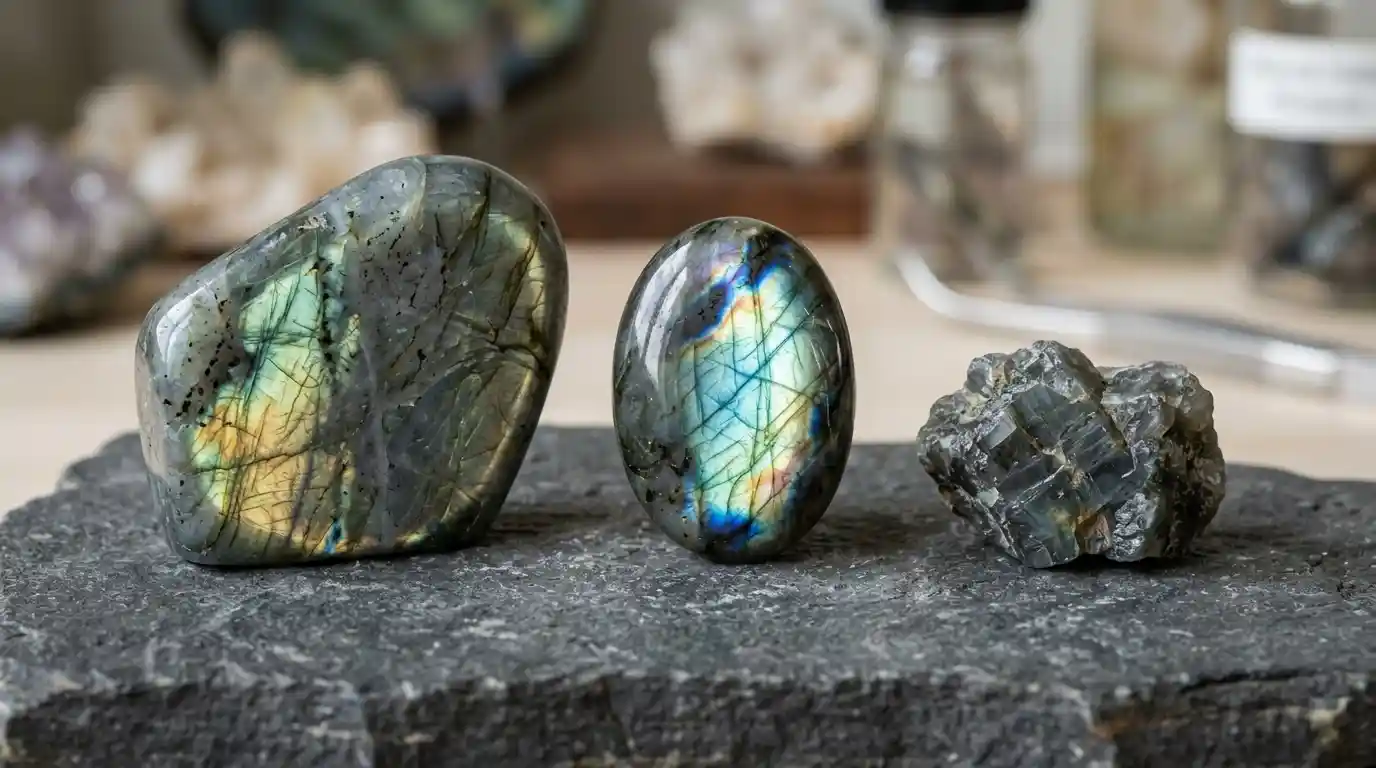
Labradorite healing properties are commonly associated with intuition, creativity, adaptability, confidence, emotional protection, resilience, focus, self-reflection, and spiritual awareness. Its dramatic flashes of blue, green, gold, orange, and violet seem to appear and disappear as the stone moves, making transformation and hidden potential natural symbolic themes. The optical effect is real, but the healing mechanism is not established. Labradorite has not been demonstrated to treat anxiety, depression, fatigue, neurological disease, hormonal disorders, pain, inflammation, sleep problems, or any other medical condition, and its iridescence does not show that the stone emits therapeutic energy. Mineralogically, labradorite is a calcium-rich plagioclase feldspar between albite and anorthite in composition. It crystallizes in the triclinic system, usually measures about Mohs 6 to 6.5, has perfect cleavage, and can display labradorescence when light interacts with nanoscale internal layers produced during cooling and exsolution.
9 Labradorite Claims Built Around Flash, Perspective, and Personal Change
- Intuition and reflective decision-making
- Creativity and imaginative thinking
- Adaptability during periods of change
- Confidence when entering unfamiliar situations
- Emotional protection and stronger boundaries
- Resilience after setbacks
- Concentration and reduced distraction
- Self-reflection and perspective
- Spiritual awareness and transformation symbolism
These nine themes can support separate practices without becoming nine scientifically verified healing effects. Many labradorite benefits become more useful when translated into behaviors such as reviewing evidence before a decision, experimenting creatively, preparing for change, defining a boundary, or using a visual cue for reflection.
Labradorite Mineral Science: Plagioclase Feldspar, Triclinic Structure, Cleavage, and Composition
Labradorite belongs to the plagioclase feldspar series, a continuous compositional range between sodium-rich albite, NaAlSi₃O₈, and calcium-rich anorthite, CaAl₂Si₂O₈. Labradorite occupies an intermediate calcium-rich portion of that series, commonly containing roughly 50 to 70 percent anorthite component.
A simplified formula can be written as (Ca,Na)[Al(Al,Si)Si₂O₈], although the exact sodium, calcium, aluminum, and silicon proportions vary across the compositional range. Labradorite is therefore better understood as a compositional feldspar variety than as a stone with one perfectly fixed formula.
It crystallizes in the triclinic system and commonly occurs as cleavage masses, granular crystals, or components of igneous rocks. Twinning is extremely common in plagioclase feldspars and contributes to the internal structure visible under magnification or polarized light.
Labradorite generally has Mohs hardness around 6 to 6.5. This gives it better scratch resistance than calcite, fluorite, or opal but less than quartz, topaz, sapphire, or diamond. It possesses perfect cleavage, which reduces toughness. A stone can therefore chip or split from a hard blow even when its surface resists ordinary scratching.
Luster is commonly sub-vitreous to vitreous, while bodycolor may appear gray, dark gray, pale green, blue-gray, white, or nearly colorless. What transforms ordinary-looking rough into valuable ornamental gemstone is often the strength, color, coverage, and orientation of its labradorescence.
Labradorescence Is an Optical Interference Effect, Not Healing Energy
Labradorescence is the defining optical phenomenon associated with fine labradorite. When the stone is moved under light, broad flashes of blue, green, gold, yellow, orange, red, or violet can appear across the surface, sometimes covering most of a polished cabochon and sometimes appearing only from a narrow viewing angle.
This phenomenon is created by the stone’s internal layered structure. As calcium-rich and sodium-rich plagioclase components separate during cooling, extremely fine lamellae can form. Light entering the stone interacts with these nanoscale layers, and interference between reflected light waves selects particular wavelengths that emerge as vivid color.
The orientation and spacing of the layers determine whether strong labradorescence is visible. A piece of rough can therefore look dull before cutting, while a skilled lapidary who understands the flash plane may reveal an intense sheet of color. Cutting the same rough at an unfavorable angle can suppress the effect almost completely.
Labradorescence is different from opal play-of-color and different again from the thin-film iridescence of fire agate. The visual similarity does not imply identical structure.
The phenomenon also explains why claims about hidden potential and transformation became attached to labradorite. A gray stone suddenly producing bright blue or gold light is symbolically powerful, but the effect is optical interference inside feldspar, not evidence of an energetic aura.
Labradorite’s Labrador Origin, Naming, Geological Setting, and Important Sources
Labradorite takes its name from Labrador in present-day Newfoundland and Labrador, Canada. Its historically important first recorded locality is at Ford Harbour on Paul Island within the Nain geological complex, where striking iridescent feldspar occurs in anorthositic rocks.
The name reflects that geographic origin rather than a healing tradition. Labradorite became known to European mineralogists through specimens from Labrador during the eighteenth century and later became established as a distinctive plagioclase variety.
Geologically, labradorite is common in mafic and intermediate igneous rocks such as basalt, gabbro, norite, and anorthosite. It can also occur in metamorphic rocks derived from feldspar-rich precursors. Large anorthosite bodies can contain abundant calcium-rich plagioclase, including labradorite.
Important gemstone and ornamental sources include Canada, Finland, Madagascar, Russia, Norway, Mexico, and the United States. Finnish labradorite with exceptionally vivid multicolor labradorescence is marketed as spectrolite. Madagascar supplies large quantities of polished cabochons, freeforms, spheres, and carvings with strong blue, green, and gold flashes.
Not every gray feldspar with a colored flash is equal in value or identity, and trade terminology can become loose. Buyers should evaluate the actual flash, bodycolor, fracture condition, cutting orientation, and treatment rather than relying on mystical descriptions. The workbook-verified buy labradorite topic focuses on those purchasing checks.
Intuition, Creativity, and Adaptability Claims
1. Intuition as Reflective Decision-Making
Labradorite is widely described as an intuition stone. There is no evidence that it provides extrasensory information or reveals future events. A practical ritual is to record an initial instinct about a decision, then compare it with evidence, likely consequences, and missing information. Intuition can be treated as one input into judgment rather than as supernatural certainty.
2. Creativity Through Visual Stimulation
The shifting colors of labradorite make it especially attractive in creative spaces. The stone does not directly enhance creative cognition, but its changing appearance can serve as a brainstorming prompt. Generate several interpretations or possible solutions before evaluating them. The visual stimulus may encourage exploration while the actual creative work remains cognitive.
3. Adaptability During Change
Because labradorescence appears only from certain angles, labradorite is often associated with transformation and changing perspective. The gemstone cannot make someone psychologically flexible. During a transition, use it as a reminder to distinguish the goal from the original plan and identify which parts can be adjusted without abandoning the goal itself.
Confidence, Emotional Protection, and Resilience Claims
4. Confidence in Unfamiliar Situations
Labradorite is sometimes recommended before travel, new work, public speaking, or other unfamiliar experiences. It does not biologically increase confidence. A useful ritual is to identify what can be prepared in advance, what remains uncertain, and the first action you will take when the situation begins. Preparedness creates a stronger basis for confidence.
5. Emotional Protection Through Boundaries
One of labradorite’s most common metaphysical claims is that it protects the aura or blocks unwanted energy. No evidence shows that feldspar creates an invisible barrier around the body. Protection can instead be translated into boundaries: decide which requests you will decline, how much emotional labor you are willing to provide, and when stepping away from an interaction is appropriate.
6. Resilience After Setbacks
Labradorite’s dark bodycolor and sudden flashes of brightness make resilience another intuitive symbolic theme. The gemstone cannot biologically make someone more resilient. After a setback, use it as a cue to identify what remains possible, what lesson should influence the next attempt, and which part of the situation deserves less attention because it cannot be changed.
Focus, Self-Reflection, and Spiritual Awareness Claims
7. Concentration and Reduced Distraction
Labradorite is sometimes associated with focus, especially in modern work or meditation routines. It has not been shown to improve attention span through mineral contact. It can become an environmental cue instead. Place the stone beside one active task, silence unnecessary notifications, and work for a defined period before switching.
8. Self-Reflection and Perspective
The way labradorite appears dull from one angle and brilliant from another makes perspective one of its strongest natural metaphors. A useful journaling practice is to write one interpretation of a difficult situation, then deliberately construct a second interpretation that fits the same known facts. This can reveal assumptions without suggesting that the stone itself provides insight.
9. Spiritual Awareness and Transformation Symbolism
Modern crystal systems frequently describe labradorite as a stone of transformation, magic, or heightened spiritual awareness. Those ideas are not measurable mineral properties. Someone may still use the gemstone during meditation, prayer, or reflection on identity and change while understanding that the optical flash comes from internal feldspar layers rather than from a supernatural energy field.
Labradorite Chakra Associations and Modern Third-Eye Symbolism
Labradorite is most commonly associated with the third-eye chakra in modern crystal practice because of its blue flashes and themes involving intuition, perception, and reflection. Stones showing violet color may also be linked with the crown chakra, while green flashes can be connected symbolically with the heart chakra.
Chakras are a spiritual framework rather than anatomical structures. Labradorite has not been demonstrated to affect the brain, pineal gland, nervous system, heart, endocrine glands, or another physiological system through chakra placement.
The shifting flash can still provide a powerful meditation metaphor. Seeing different colors from different angles can remind a practitioner that perspective changes what becomes visible, without converting that observation into a biological claim.
Labradorite Physical Care: Feldspar Hardness, Perfect Cleavage, Water, Heat, and Ultrasonics
Labradorite is moderately durable but not indestructible. At Mohs 6 to 6.5, it can be scratched by quartz, topaz, sapphire, ruby, and diamond. Store polished cabochons separately from harder gemstones to preserve the finish.
Perfect cleavage creates a larger structural concern than ordinary scratching. A hard impact can split or chip a cabochon, especially along thin edges. Rings and bracelets receive more frequent blows than pendants or earrings and therefore need more protection.
Brief exposure to plain lukewarm water is generally safe for sound untreated labradorite. Feldspar is not water-soluble under normal household conditions, and water is not an essential part of its crystal formula. Warm water, mild soap, and a soft cloth or brush are appropriate for routine cleaning.
Prolonged soaking is unnecessary, particularly when a stone contains open fractures, fillers, coatings, glue, or assembled components. Water itself is usually not the main concern, but settings and treatments may respond differently.
Steam cleaning should be avoided as a routine method because rapid heating can create thermal stress. Ultrasonic cleaning is also best avoided, especially when a stone contains cleavage fractures or internal weaknesses. Gentle hand cleaning preserves both the feldspar and its polished flash plane.
Strong acids, bleach, abrasive powders, and aggressive jewelry chemicals are unnecessary. Hydrofluoric acid attacks silicate minerals and is extremely hazardous.
Cutting labradorite also produces silica-bearing feldspar dust. Wet cutting, extraction, eye protection, and suitable respiratory precautions are important for lapidary work.
Ritual Cleansing Labradorite Without Damaging Its Flash
Ritual cleansing can remain simple because labradorite does not need to be physically altered to serve as a symbolic object. There is no scientifically demonstrated unwanted energy that must be washed, heated, or salted out of the stone.
Sound, intention-setting, meditation, dry placement, or gently wiping the polished surface are low-risk options. A transformation-themed ritual can involve identifying one outdated habit, one value worth keeping, and one action that represents the next stage.
Avoid saltwater soaking, harsh chemicals, abrasive powders, flame, extreme heat, prolonged wet burial, and rough handling. Preserving the polished orientation is particularly important because surface damage can reduce the visibility and quality of labradorescence.
Conclusion
Labradorite already possesses a remarkable verified phenomenon: nanoscale feldspar layers can transform an ordinary gray surface into intense blue, green, gold, orange, or violet flashes as the stone moves. Its nine healing themes naturally grew around ideas of perspective, transformation, intuition, and resilience, but the optical effect is not medical evidence. Labradorite can still support reflection and personal rituals when symbolism remains distinct from physiology.
Frequently Asked Questions About Labradorite Healing Properties
What are the main labradorite healing properties people claim?
Common claims include intuition, creativity, adaptability, confidence, emotional protection, resilience, focus, self-reflection, and spiritual awareness. These are contemporary wellness or spiritual beliefs rather than proven therapeutic effects.
What is labradorite made of?
Labradorite is a calcium-rich plagioclase feldspar between albite and anorthite in composition. A simplified formula is (Ca,Na)[Al(Al,Si)Si₂O₈].
What causes labradorite’s colorful flash?
Labradorescence results from light interference within extremely fine internal feldspar layers that developed during cooling and exsolution. The colors are structural optical effects rather than pigments or energy emissions.
How hard is labradorite?
Labradorite is approximately Mohs 6 to 6.5. It has moderate scratch resistance but perfect cleavage, so it can chip or split after strong impact.
Is spectrolite the same as labradorite?
Spectrolite is a trade name for especially vivid labradorite from Finland, often showing an unusually wide range of spectral colors. It remains labradorite mineralogically.
Is labradorite scientifically proven to improve intuition?
No. Labradorite has not been shown to provide extrasensory knowledge or alter intuition through a gemstone-specific mechanism. It can be used as a reflective cue when evaluating a decision.
Which chakra is labradorite associated with?
Modern crystal systems most commonly associate labradorite with the third-eye chakra and sometimes the crown chakra. These are spiritual correspondences rather than anatomical effects.
Can labradorite go in water?
Brief washing with plain lukewarm water is generally safe for sound untreated labradorite. Prolonged soaking is unnecessary when fractures, fillers, coatings, or glued settings are present.
Can labradorite be cleaned with steam or an ultrasonic machine?
Gentle hand cleaning is preferable. Steam introduces thermal stress, while ultrasonic vibration can exploit cleavage or hidden fractures.
What should buyers look for in labradorite?
Strong flash, attractive color range, good coverage, correct cutting orientation, limited cleavage damage, and honest treatment disclosure are important. The workbook-verified buy labradorite topic focuses specifically on quality and purchasing checks.
Crystal healing claims are traditional or personal beliefs and should not replace qualified medical or mental health care.