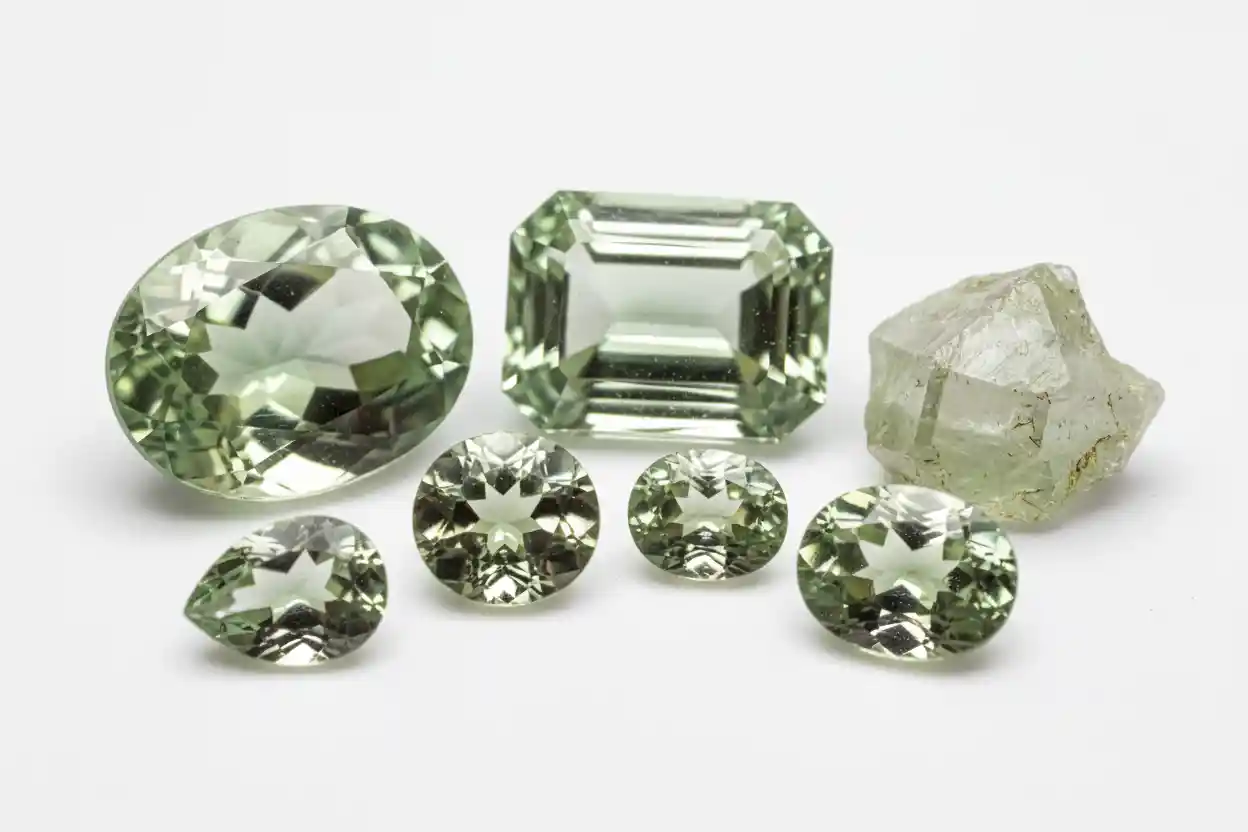
Prasiolite Healing Properties: 12 Claims, Green Quartz Facts & Safe Use
Prasiolite healing properties are commonly associated with emotional calm, perspective, confidence, compassion, concentration, optimism, resilience, adaptability, communication, creativity, meditation, and spiritual reflection. Its pale mint, leek-green, yellowish-green, and gray-green appearance creates an easy connection with renewal and heart-centered symbolism, but its color does not establish a therapeutic mechanism. Prasiolite has not been demonstrated to treat anxiety, depression, cardiovascular disease, immune disorders, pain, inflammation, fatigue, hormonal conditions, sleep disorders, or another illness. Scientifically, prasiolite is green quartz, SiO₂, with the same trigonal crystal structure and Mohs hardness of 7 as amethyst, citrine, and rock crystal. Much gem-quality prasiolite in commerce is produced by controlled heating of suitable amethyst, while naturally formed green quartz is uncommon. GIA has documented both heat-produced material and rare naturally heated green quartz.
12 Prasiolite Healing Claims
- Emotional calm during stressful periods
- Clearer emotional perspective
- Confidence during difficult choices
- Compassion with healthy boundaries
- Concentration and practical focus
- Optimism without ignoring problems
- Resilience after setbacks
- Adaptability during personal change
- Clearer communication
- Creativity and flexible thinking
- Meditation and present awareness
- Spiritual reflection on growth and values
These twelve themes can support personal practices without becoming twelve scientifically proven healing effects. Many Prasiolite benefits become more useful when translated into behavior such as slowing down before reacting, preparing for a difficult conversation, reducing distractions, reviewing a setback, or using the gemstone as a cue for quiet reflection.
Prasiolite Mineral Facts
Prasiolite belongs to the quartz species and has the chemical formula SiO₂. Quartz crystallizes in the trigonal system and commonly develops six-sided prismatic crystals terminated by rhombohedral faces. Transparent prasiolite has vitreous luster and usually appears pale rather than intensely saturated.
Its color can range from delicate mint and leek green through yellowish green, gray-green, or olive-tinged shades. Very dark emerald-like colors should prompt careful identification because genuine prasiolite is usually much softer in tone.
The gemstone measures Mohs 7, which gives it good scratch resistance for rings, pendants, earrings, bracelets, and other jewelry. Quartz has no useful cleavage and generally has good toughness, although hard blows can still chip edges or fracture included stones.
Prasiolite shares its basic physical properties with other quartz varieties. What distinguishes it commercially is color, not a different crystal lattice or different hardness.
Heat-Treated Green Quartz
Most commercial prasiolite begins as amethyst from deposits whose color centers respond to heat in an unusual way. Instead of turning yellow or orange like typical heat-treated amethyst used for citrine, suitable material can change to green.
GIA reported that amethyst from certain deposits, including Brazil’s Montezuma area, can become green after controlled heating. The necessary combination of iron-related defects, radiation history, and heating response is not present in every amethyst deposit.
This treatment creates genuine quartz rather than an imitation. The crystal remains natural quartz, but its final green color has been produced or enhanced through human-controlled heating.
The distinction matters for buyers because “natural gemstone” and “natural color” are different claims. A mined amethyst crystal that was later heated is still natural quartz, but describing its green color as completely untreated would be inaccurate.
The workbook-verified buy Prasiolite topic is therefore more relevant to authenticity and treatment disclosure than metaphysical descriptions are.
Natural Green Quartz
Naturally formed green quartz does exist, but it is uncommon. GIA documented a California-Nevada occurrence where natural geological heating changed amethyst to green quartz. Similar conditions require the right iron-related defects, prior irradiation, and temperature history.
Because naturally green quartz is unusual, sellers should not imply that every pale green quartz crystal formed with that color underground. Heat-treated material dominates normal jewelry supply.
Synthetic green quartz also exists. GIA has documented laboratory-grown green quartz that can resemble natural or treated prasiolite closely enough that ordinary appearance may not resolve origin.
This is another reason color alone cannot prove whether a specimen is naturally green, heat treated, synthetic, or otherwise processed.
Calm and Perspective
Emotional Calm
Prasiolite is frequently described as soothing because pale green colors are culturally associated with quietness, renewal, and nature. Quartz has not been shown to regulate neurotransmitters, cortisol, or heart rate through skin contact. A practical routine is to use the stone as a reminder to pause, slow the breathing, reduce unnecessary stimulation, and identify what actually needs attention.
Clearer Perspective
Some practitioners describe prasiolite as helping people understand emotions without becoming overwhelmed by them. The stone cannot reveal hidden psychological information. A grounded exercise separates facts, feelings, interpretations, and available actions. The clarity comes from structuring the problem rather than from quartz energy.
Confidence and Compassion
Confidence Through Preparation
Prasiolite is sometimes associated with calm confidence. It does not biologically raise self-esteem. Before a meeting, presentation, or difficult conversation, use it as a cue to review what has already been prepared, what remains uncertain, and what first action remains under personal control.
Compassion With Boundaries
Green gemstones frequently receive heart-centered symbolism, and prasiolite is often linked with empathy and compassion. The gem cannot biologically increase empathy. A more useful practice is to consider another person’s perspective while also asking whether their behavior is respectful and whether a boundary is still necessary.
Focus and Optimism
Concentration With Structure
Prasiolite is often used near workspaces or meditation areas for concentration. Quartz has not been shown to increase memory or attention span through contact. It can become a repeatable cue to begin one defined task, silence unrelated notifications, and work without switching activities for a chosen interval.
Optimism With Realistic Action
The gemstone’s fresh green color encourages themes of renewal and hope. It cannot guarantee positive outcomes. A grounded optimism exercise identifies one real difficulty, one reason improvement remains possible, and one practical action that could increase the chance of progress.
Resilience and Adaptability
Resilience After Setbacks
Prasiolite’s transformation from purple amethyst to green quartz during treatment makes change a tempting metaphor. Heat treatment does not give the gemstone psychological powers, but someone can still use that visual story as a reminder that a changed state does not erase the underlying identity.
After a setback, identify what failed, what remains useful, what lesson should be kept, and what next attempt should change.
Adaptability During Change
A practical interpretation of Prasiolite symbolism is flexibility. The stone cannot alter psychological adaptability. It can remind someone to separate the desired outcome from the original method. If one approach stops working, the goal may remain valid even when the route changes.
Communication and Creativity
Clearer Communication
Some modern crystal practices connect green quartz with honest or compassionate communication. Prasiolite cannot make another person understand or agree. Before an important conversation, use it as a reminder to define the main point, distinguish requests from accusations, and state boundaries clearly.
Creativity Through Fresh Association
The unusual green color of quartz can also make Prasiolite visually stimulating for writers, artists, and designers. There is no evidence that the stone changes creative cognition biologically. It can still function as a cue to generate several possibilities before evaluating them.
Meditation and Spiritual Reflection
Meditation With Green Quartz
A transparent Prasiolite gemstone can provide a simple visual meditation focus. Observe inclusions, reflections, color zoning, facet flashes, or crystal faces, then return attention to the breath whenever the mind wanders. This is a valid attentional exercise without demonstrating a quartz-specific change in consciousness.
Spiritual Reflection on Values
Prasiolite is often linked with spiritual growth, gratitude, compassion, and heart-centered awareness. Someone may use the stone during prayer or personal reflection on these themes. The practice can be meaningful without claiming that quartz transmits a measurable spiritual frequency.
Prasiolite Chakra Meaning
Prasiolite is most commonly associated with the heart chakra because of its green color. Modern crystal systems connect it with compassion, emotional openness, relationships, forgiveness, gratitude, and personal growth.
Some practitioners also associate transparent green quartz with the crown chakra, particularly when discussing spiritual reflection or meditation.
Chakras are a spiritual framework rather than anatomical structures. Prasiolite has not been demonstrated to affect the physical heart, lungs, endocrine glands, brain, nervous system, or another physiological structure through chakra placement.
Prasiolite Care
Prasiolite has Mohs hardness 7 and good quartz durability. It resists scratching better than feldspar, opal, fluorite, and calcite but can still be scratched by topaz, sapphire, ruby, diamond, and harder abrasives.
Warm soapy water is a reliable cleaning method for quartz. GIA recommends it for citrine, which shares prasiolite’s quartz structure and durability. Quartz can fracture after abrupt temperature changes, while hydrofluoric acid and some strong chemical environments can attack silica.
Ultrasonic cleaning is generally tolerated by sound untreated quartz but should be avoided when a stone contains significant fractures, fracture filling, glued components, or uncertain treatment.
Steam cleaning is best avoided because unnecessary heat can create thermal stress and may affect color stability in some quartz.
Strong prolonged heat should also be avoided because prasiolite’s color itself is related to specific heat-sensitive defect structures. A treated gemstone should not be deliberately reheated during home care.
Store prasiolite separately from harder gemstones and protect facet edges from knocks. The workbook-verified prasiolite quality grading focuses on color, clarity, cut, treatment, and condition rather than healing claims.
Safe Ritual Cleansing
Prasiolite does not need saltwater, intense sunlight, flame, smoke residue, or chemical exposure to remain meaningful in personal spiritual practice. There is no scientifically demonstrated negative energy that must be physically removed from quartz.
Sound, intentional breathing, dry placement, meditation, or a brief wash with warm soapy water are lower-risk options. A renewal-themed ritual can involve identifying one behavior that should change and one realistic action that will replace it.
Avoid strong heat, flame, harsh chemicals, abrasive salt, and prolonged high-intensity light exposure intended to “charge” the gemstone.
Conclusion
Prasiolite is best understood as green quartz whose commercial color is commonly produced by heating suitable amethyst, although naturally green and synthetic quartz also exist. Its twelve healing themes can support calm, confidence, compassion, focus, resilience, creativity, and reflection when symbolic practice remains separate from medical claims and treatment history remains accurately described.
FAQs
What are the main Prasiolite healing properties?
Common claims include calm, perspective, confidence, compassion, concentration, optimism, resilience, adaptability, communication, creativity, meditation, and spiritual growth. These are contemporary wellness or spiritual beliefs rather than scientifically proven therapeutic effects.
What is Prasiolite made of?
Prasiolite is quartz with the chemical formula SiO₂.
Is Prasiolite natural?
The quartz itself is usually natural, but most commercial green color is produced by controlled heating of suitable amethyst. Naturally occurring green quartz is much less common.
Is Prasiolite the same as green amethyst?
“Green amethyst” is a common trade expression, but Prasiolite or green quartz is more precise because amethyst specifically refers to purple quartz.
How hard is Prasiolite?
Prasiolite has Mohs hardness 7, the same as other quartz varieties.
Can synthetic Prasiolite exist?
Yes. Laboratory-grown green quartz has been documented, so green color alone cannot prove natural origin.
Which chakra is Prasiolite associated with?
Modern crystal practice most commonly connects it with the heart chakra and sometimes the crown chakra. These are spiritual correspondences rather than anatomical effects.
Can Prasiolite go in water?
Yes. Warm soapy water is generally safe for sound quartz. Avoid harsh chemicals, rapid temperature changes, and unnecessary prolonged soaking of filled or assembled jewelry.
Can Prasiolite fade?
Strong heat can alter quartz color centers, and prolonged intense environmental exposure is unnecessary. Store jewelry normally and avoid deliberate heating.
Does Prasiolite have ancient healing traditions?
Quartz has extensive historical use, but the modern Prasiolite identity and its current healing claims should not automatically be treated as an ancient green-quartz healing system.
Crystal healing claims are traditional or personal beliefs and should not replace qualified medical or mental health care.