7 Astrophyllite Benefits: Starburst Crystals, Rare Mineralogy & Collecting Value
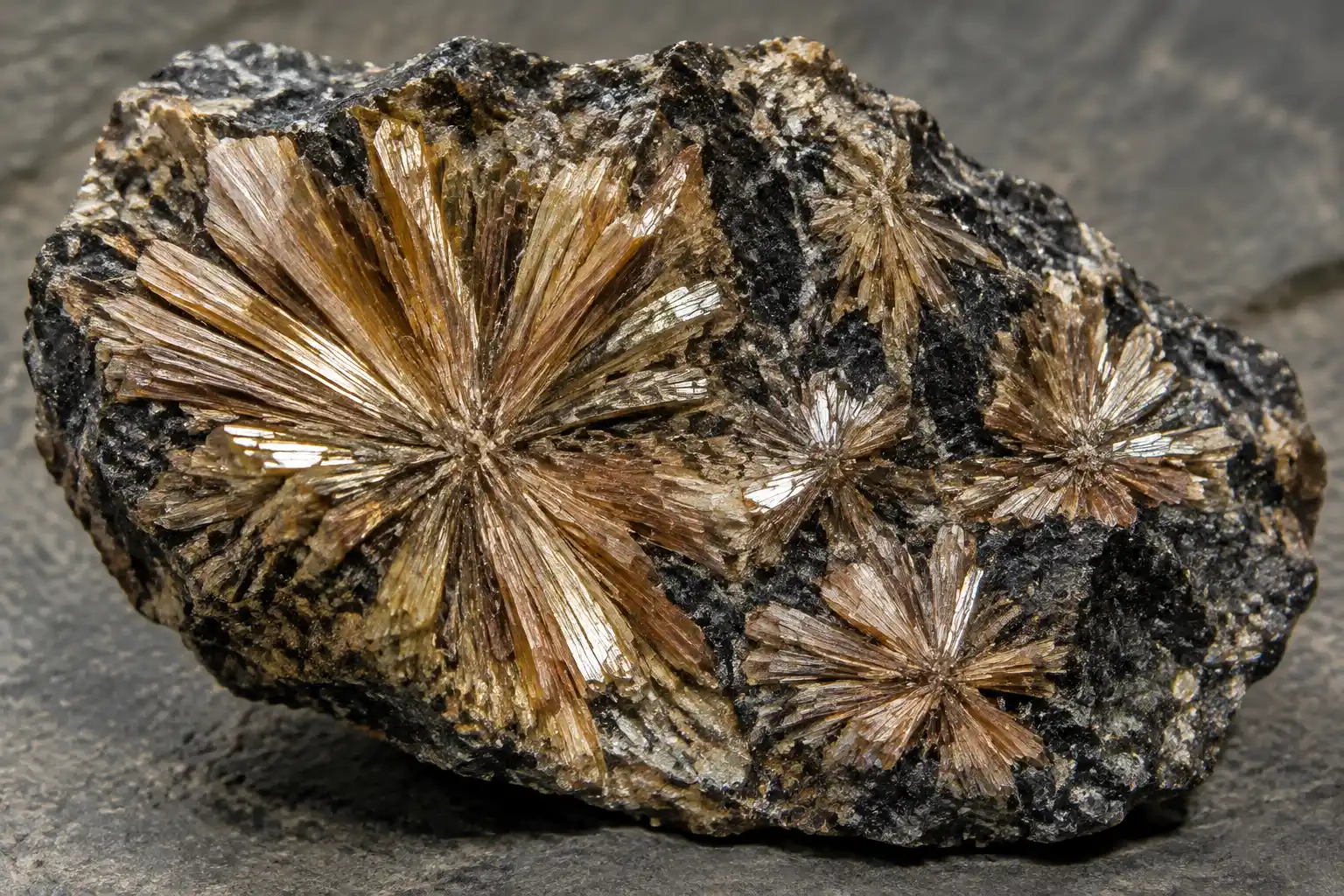
Astrophyllite benefits begin with a mineral appearance that is difficult to confuse once seen clearly. Thin golden-bronze to brown blades can radiate through a darker host rock in star-like sprays, creating natural patterns that look almost designed. Its name reflects that appearance, combining Greek roots associated with “star” and “leaf,” a reference to its radiating bladed habit and sheet-like cleavage.
Astrophyllite is a rare, chemically complex iron-titanium silicate mineral containing potassium and sodium. It crystallizes in the triclinic system, has a Mohs hardness around 3, possesses perfect cleavage, and is brittle. Those properties make it much better suited to mineral collecting, polished slabs, cabochons, and protected decorative use than to exposed everyday rings.
The strongest astrophyllite benefits come from mineralogy, natural pattern, collecting rarity, geological context, lapidary beauty, educational value, and personal symbolism. Its visual appeal is already unusual enough that exaggerated health or ancient-spiritual claims are unnecessary.
7 Astrophyllite Benefits at a Glance
- Radiating golden-bronze blades create distinctive natural starburst patterns.
- Pearly to submetallic luster gives specimens strong visual contrast against darker host rock.
- Relative rarity adds interest for serious mineral and locality collectors.
- Alkaline igneous environments make astrophyllite useful for understanding unusual rock chemistry.
- Slabs and cabochons can reveal striking patterns that natural crystal sprays create within the host rock.
- Its triclinic structure, perfect cleavage, and complex chemistry provide educational mineralogical value.
- Modern symbolism can add personal meaning without turning astrophyllite into a medical treatment.
Starburst Crystal Habits Lead the Astrophyllite Benefits
The most recognizable astrophyllite benefits are visual. Crystals commonly form thin blades, laths, or needle-like forms that may spread outward in radiating groups. Against dark host rock, bronze-gold blades can create patterns resembling stars, fireworks, feathers, or rays.
This growth habit explains the mineral’s name. Astrophyllite combines Greek-derived terms referring to star and leaf, reflecting both the radiating appearance and micaceous, leaf-like cleavage.
Unlike transparent gems that depend on faceting for their main optical appeal, astrophyllite often looks most interesting when left partly within the rock where it formed. The surrounding matrix creates contrast and preserves relationships among crystals.
A polished slab can enhance that pattern, but the natural arrangement is responsible for the effect. No coating or metallic foil is needed to create the golden starburst appearance.
Golden-Bronze Luster Creates Strong Decorative Appeal
Color and luster add another layer to astrophyllite benefits. The mineral commonly appears bronze-yellow, golden yellow, brown, or reddish brown, with surfaces that may look pearly, greasy, or submetallic depending on orientation and condition.
When narrow blades catch light, the result can be much brighter than the surrounding rock. Rotating a polished specimen may cause separate crystals to flash at different angles, revealing an internal arrangement that looked darker moments earlier.
This makes astrophyllite particularly effective in cabochons, polished freeforms, slabs, spheres, and display specimens. The appeal comes from contrast rather than transparency.
Designers can use the dark-and-gold appearance as the main feature without needing additional gemstones. Protective jewelry forms such as pendants are considerably more practical than rings because astrophyllite itself is soft and cleaves readily.
Rarity Gives Astrophyllite Strong Mineral-Collecting Interest
Astrophyllite is not among the common rock-forming minerals encountered in ordinary granite, basalt, or sedimentary rocks. It forms in specialized geological environments, which gives locality and mineral association particular importance.
The mineral was first recognized from Norway and received the name astrophyllite in the nineteenth century. The type locality is at Låven in the Langesundsfjord region of Norway, an area famous for unusual alkaline minerals.
Important specimens have also been associated with alkaline complexes in places such as Russia’s Kola Peninsula and other chemically unusual igneous environments.
Relative rarity is therefore one of the genuine astrophyllite benefits for collectors. A well-documented specimen carries information about an unusual geological setting rather than simply offering an attractive color.
Rarity should not be confused with guaranteed financial appreciation. Condition, locality, crystal form, aesthetics, size, matrix, workmanship, and demand still determine collector interest.
Astrophyllite Reveals Unusual Alkaline Igneous Geology
Geological context is one of the most informative astrophyllite benefits. The mineral commonly occurs in alkaline igneous rocks, pegmatites, nepheline-rich systems, and other environments where unusual combinations of elements become concentrated.
Astrophyllite contains titanium, iron, potassium, sodium, silicon, oxygen, fluorine, and hydroxyl within a complex structure. Such chemistry reflects geological systems very different from those producing simple minerals such as quartz.
Alkaline igneous complexes are particularly famous for rare and unusual mineral species because their magmas and late-stage fluids can concentrate elements that remain dispersed in more ordinary rocks.
An astrophyllite specimen can therefore serve as an introduction to advanced mineral chemistry. Its appearance may attract the collector first, but the host rock and associated minerals often tell an equally interesting story.
Polished Slabs and Cabochons Reveal Hidden Astrophyllite Patterns
Astrophyllite benefits lapidary work in a different way from transparent gemstones. Individual crystals are usually too soft, brittle, and cleavage-prone for conventional faceting, but astrophyllite-rich rock can create striking polished surfaces.
Cutting across radiating aggregates may reveal starburst patterns that were difficult to see on the rough exterior. Cabochons can concentrate those patterns into jewelry-sized pieces, while slabs preserve a wider view of the crystal arrangement.
The host rock often provides essential support because astrophyllite itself has a Mohs hardness around 3 and perfect cleavage. Cutting orientation and stabilization of fractured rock can therefore matter greatly.
A polished piece should not be judged solely by how much golden color it contains. Pattern, contrast, workmanship, fracture stability, authenticity, and whether the visible astrophyllite is actually well preserved all influence quality.
Softness and Perfect Cleavage Make Care an Important Lesson
Astrophyllite’s low hardness and cleavage provide one of its most useful educational lessons. At about Mohs 3, it can be scratched by many objects encountered in ordinary environments. Perfect cleavage means thin blades can also separate along preferred structural directions.
These properties explain why exposed everyday rings are a poor match for the mineral. A ring repeatedly hits desks, doors, counters, and tools, creating far more risk than a pendant or display piece.
Warm water and mild soap may be appropriate for some securely polished composite pieces, but valuable natural specimens deserve very conservative handling. Avoid hard brushing, ultrasonic cleaning, steam, high heat, and prolonged soaking when the host rock or associated minerals are unknown.
Store astrophyllite separately from harder specimens. Even quartz can scratch it easily.
Understanding these limits is one of the practical astrophyllite benefits because it reinforces an essential gemological principle: visual beauty and physical durability are separate qualities.
Astrophyllite Helps Collectors Learn Mineral Classification
Astrophyllite is a recognized mineral species and also a member of a larger astrophyllite mineral group. Chemically related species can resemble one another, making exact identification more complicated than simply recognizing a golden radiating pattern.
The mineral crystallizes in the triclinic system, the least symmetrical of the seven crystal systems. Its chemistry is complex compared with simple silicates such as quartz, and compositional variation can occur through relationships with related minerals.
This makes astrophyllite useful for collectors moving beyond basic color identification. Appearance can suggest an identification, but mineral classification ultimately depends on chemistry and crystal structure.
Knowing where to buy astrophyllite therefore involves more than finding the brightest golden slab. Reliable seller identification, locality information, photographs, dimensions, host-rock description, and treatment disclosure all matter.
Astrophyllite’s Scientific History Is More Recent Than Many Gem Legends
Astrophyllite was recognized and scientifically described during the nineteenth century rather than appearing as a named gemstone throughout ancient Mediterranean, Egyptian, or South Asian history.
Its modern mineral name dates to the work of mineralogists studying unusual Norwegian specimens. The name reflects visible crystal habit, not an ancient spiritual title.
This history matters because claims that astrologers, priests, or ancient civilizations universally used astrophyllite under that name deserve skepticism.
The genuine historical astrophyllite benefits lie in mineralogical discovery, classification, crystallography, and the study of unusual alkaline rocks. Modern symbolism developed later.
The absence of an ancient gemstone tradition does not reduce the mineral’s value. Its natural star-like sprays give it one of the most memorable appearances in mineral collecting.
Natural Specimens Often Offer More Value Than Conventional Jewelry
Astrophyllite is a good example of a mineral whose strongest use may be collection and display rather than jewelry. A natural cluster showing bronze blades through contrasting matrix preserves crystallography and geological context that cutting can remove.
Collectors may value radiating habit, undamaged blades, bright luster, association with other rare minerals, locality, and overall specimen balance.
Polished pieces appeal to a different audience. A cabochon or freeform sacrifices some natural surfaces but can expose internal starburst patterns and make the mineral easier to carry or display.
Neither format is automatically superior. The strongest astrophyllite benefits depend on what the owner values: natural crystal form, geology, lapidary design, rarity, or personal symbolism.
Modern Symbolism Often Centers on Direction and Self-Reflection
Modern crystal culture commonly associates astrophyllite with direction, self-acceptance, transformation, confidence, spiritual awareness, and understanding one’s path. The radiating star-like habit clearly encourages some of these interpretations.
Someone may use a polished stone as a reminder to consider several possible directions before choosing one. Another person may associate the dark host rock and golden blades with recognizing strengths that are not immediately obvious.
The forthcoming symbolism around astrophyllite meaning is most useful when treated as interpretation rather than a physical effect produced by the mineral.
Personal symbolism can coexist with accurate mineralogy. The starburst shape is real, while the meaning assigned to it belongs to the observer.
Astrophyllite Benefits Should Remain Separate From Healing Claims
Modern astrophyllite healing properties sometimes include claims involving hormones, reproductive health, nervous-system function, emotional trauma, digestion, pain, or other bodily processes.
Reliable scientific evidence does not establish those effects. Astrophyllite’s iron, titanium, potassium, or other chemical components do not become medical treatments simply because the stone is held or worn.
A specimen may still support a reflective routine because it has personal significance or gives someone a visual point of focus. That experience does not demonstrate that the mineral changes physiology.
The verified astrophyllite benefits already include rare mineralogy, starburst crystal habit, unusual geology, lapidary pattern, collecting value, educational interest, and striking natural beauty.
Conclusion
Astrophyllite benefits include distinctive starburst crystals, golden-bronze luster, mineral rarity, unusual alkaline geology, striking polished patterns, educational mineralogy, and personal symbolism.
Its softness and perfect cleavage make it far better suited to careful display, protected pendants, slabs, and collector pieces than exposed everyday jewelry. Understanding the mineral’s true nineteenth-century scientific history and complex geology provides a stronger reason to appreciate it than unsupported ancient or medical claims.
FAQs
What Are the Main Astrophyllite Benefits?
Astrophyllite benefits include rare mineral collecting, starburst crystal patterns, golden-bronze luster, geological education, lapidary display, unusual chemistry, and personal symbolism.
What Color Is Astrophyllite?
Astrophyllite commonly appears bronze-yellow, golden yellow, brown, or reddish brown.
How Hard Is Astrophyllite?
Astrophyllite is relatively soft at about Mohs 3.
Is Astrophyllite Good for Jewelry?
It is best for protected pendants, cabochons, or occasional-wear pieces. Low hardness, brittleness, and perfect cleavage make exposed rings risky.
Why Is Astrophyllite Called a Star Stone?
Its name combines Greek-derived words associated with star and leaf, referring to radiating bladed crystal habits and leaf-like cleavage.
Where Was Astrophyllite First Identified?
Its type locality is Låven in the Langesundsfjord region of Norway.
Does Astrophyllite Have Proven Healing Benefits?
No reliable evidence establishes astrophyllite as a medical treatment.
Modern symbolic astrophyllite benefits are personal wellness beliefs and should not replace qualified medical or mental health care.