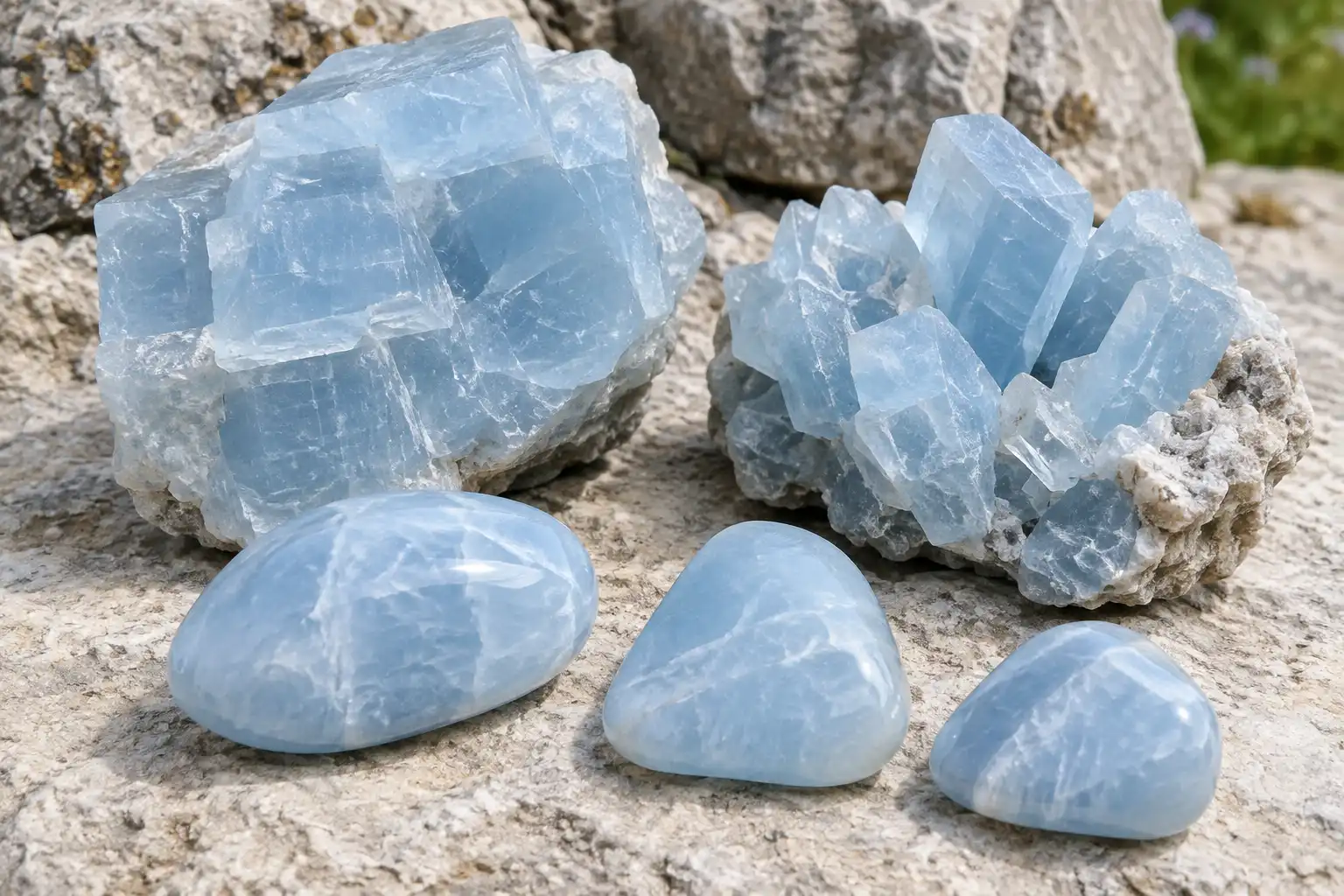
Blue Calcite Benefits: 9 Popular Uses, Gentle Symbolism & Verified Facts
Blue calcite benefits are easiest to understand when the mineral’s real properties come first. Calcite is calcium carbonate, one of the most important and widespread minerals in Earth’s crust. Blue varieties attract collectors because of their soft color, translucency, crystal forms, cleavage, fluorescence in some specimens, and relationship with carbonate rocks, caves, hydrothermal systems, and other geological environments.
The mineral is also an excellent teaching stone. Calcite has perfect rhombohedral cleavage, relatively low hardness, strong double refraction in clear varieties, and a characteristic reaction with dilute acid. These properties make it useful for learning fundamental mineral identification. Blue calcite adds visual appeal to those lessons, while polished forms and carvings provide decorative uses for specimens unsuitable for faceting.
Modern spiritual traditions often describe blue calcite benefits in terms of calmness, communication, emotional soothing, creativity, or meditation. Those ideas can serve as personal symbolism, but calcium carbonate does not become medicinal because it occurs as a gemstone. Holding blue calcite does not treat anxiety disorders, reduce inflammation, improve the throat, regulate hormones, or correct calcium deficiency.
9 Blue Calcite Benefits at a Glance
- Distinctive cleavage and low hardness make blue calcite useful for mineral identification practice.
- Some calcite specimens demonstrate strong optical effects that help explain double refraction.
- Pale blue color and translucency make attractive display specimens and decorative objects.
- Calcite occurs in many geological environments, giving collectors insight into carbonate mineral formation.
- Suitable rough can be polished or carved into ornamental shapes while retaining natural color variation.
- Crystal forms and cleavage surfaces provide hands-on lessons in crystallography.
- Some specimens fluoresce under ultraviolet light, adding another dimension for collectors.
- Modern symbolism can represent calm communication or reflection without requiring health claims.
- Responsible care teaches why softness, perfect cleavage, acid sensitivity, and truthful identification matter.
Blue Calcite Benefits Begin with a Geologically Important Carbonate Mineral
Calcite has the chemical formula CaCO₃ and belongs to the carbonate mineral group. It is a major component of limestone and marble and also occurs in caves, veins, hydrothermal deposits, sedimentary environments, biological shells, and many other geological settings.
This widespread occurrence gives blue calcite benefits an educational depth that extends far beyond decorative use. A single specimen can introduce carbonate chemistry, sedimentary processes, metamorphism, crystal growth, cleavage, optical behavior, and the relationship between minerals and rocks.
Blue coloration is less common than the familiar white, colorless, cream, or honey tones of calcite. The exact cause can vary between deposits and specimens, with trace components, inclusions, structural features, and geological environment influencing appearance. Commercial pieces range from pale powder blue and gray-blue to more saturated tones, sometimes with white areas or internal zoning.
Color alone does not change the mineral’s fundamental properties. Blue calcite remains relatively soft, ranking 3 on the Mohs scale, and retains calcite’s characteristic cleavage. This means an attractive polished stone can scratch much more easily than quartz, topaz, sapphire, or many common jewelry gems.
Understanding that softness is one of the most useful blue calcite benefits because it teaches buyers that beauty and durability are separate gemstone qualities.
Cleavage Makes Blue Calcite an Excellent Mineral Identification Stone
Calcite’s perfect cleavage is one of its defining properties. When a suitable piece breaks along cleavage directions, it tends to produce rhombohedral fragments rather than the curved conchoidal surfaces common in glass or quartz.
This makes blue calcite particularly useful for students learning to distinguish cleavage from ordinary fracture. Cleavage follows structural weaknesses within a crystal lattice, so the repeating angles reflect the mineral’s internal arrangement rather than random external damage.
The same property creates an important limitation. A carved or polished blue calcite object can chip or split if struck in an unfavorable direction. Its softness also means scratches develop relatively easily, particularly when the stone is stored beside harder gems.
For collectors, those vulnerabilities are part of the mineral’s identity rather than defects that make it unworthy of ownership. A natural cleavage surface may reveal crystal geometry beautifully, while an intact crystal can illustrate growth forms that polishing would remove.
A person deciding where to buy blue calcite should consider whether the specimen is intended for geological display, carving, meditation, decoration, or jewelry. The best form for one purpose may be inappropriate for another.
Optical Properties Give Calcite Exceptional Educational Value
Among the most fascinating blue calcite benefits is access to the optical behavior for which calcite is famous. Clear calcite can show strong double refraction, meaning a line or image viewed through a suitable transparent crystal may appear doubled.
This effect occurs because light traveling through the anisotropic crystal can split into rays that behave differently. The phenomenon has played an important role in the scientific study of optics and crystallography.
Not every blue calcite specimen is transparent enough to demonstrate dramatic doubling. Many blue pieces are translucent or cloudy, and inclusions may further reduce clarity. Still, understanding that the stone belongs to the same mineral species connects decorative blue specimens with an important scientific story.
Calcite can also display fluorescence in some localities. Under ultraviolet light, certain specimens glow in colors that may differ sharply from their daylight appearance. Fluorescence depends on activators, impurities, structural defects, and other factors, so it should not be assumed that every blue calcite will fluoresce strongly.
These optical features give collectors another reason to appreciate the mineral without assigning invisible healing energies to it. Light behavior in calcite is already extraordinary and measurable.
Soft Color and Translucency Give Blue Calcite Decorative Appeal
Aesthetic use is one of the most accessible blue calcite benefits. The stone often has a soft, cloudy appearance with areas of translucency that diffuse light rather than reflecting it sharply. This can create a gentle visual quality quite different from highly brilliant faceted gemstones.
Large pieces may be carved into spheres, bowls, towers, freeforms, hearts, animal figures, eggs, or abstract shapes. Smaller pieces can become cabochons, beads, pendants, or decorative inlays, although jewelry requires more caution because of the mineral’s softness and cleavage.
Blue calcite also works well as a display specimen in interiors because pale color contrasts naturally with dark wood, neutral stone, mineral shelves, or collections containing more saturated crystals. A rough specimen preserves geological texture, while a polished piece emphasizes translucency and color.
Decorative value does not depend on flawless clarity. Cloudiness, white bands, crystal boundaries, and natural fractures may all contribute to an individual appearance. Buyers should simply distinguish attractive natural variation from unstable damage that could cause a carving or polished object to break.
These practical blue calcite benefits rely on color, craftsmanship, and mineral character rather than metaphysical claims.
Carving Blue Calcite Reveals Both Its Advantages and Its Limits
Calcite’s softness makes it easier to shape than quartz or corundum, which can be an advantage for skilled carvers. Tools can remove stone efficiently, allowing detailed ornamental work that would take substantially more effort in harder gems.
The same softness creates limitations. Fine edges can chip, thin sections may break, and polished surfaces can scratch during careless handling. Perfect cleavage also means the cutter must pay attention to internal weaknesses when planning a shape.
These qualities make blue calcite benefits especially interesting from a craftsmanship perspective. The stone rewards careful technique rather than brute force. A successful carving reflects decisions about orientation, wall thickness, fracture avoidance, surface finishing, and the placement of color zones.
Polishing can produce a smooth attractive surface, but owners should not expect the same resistance to wear found in harder quartz carvings. Decorative objects usually perform better when placed somewhere protected from frequent handling or contact with abrasive surfaces.
For jewelry, pendants or earrings tend to be more practical than exposed rings. If blue calcite is used in a ring, a protective setting and occasional wear are much safer than daily exposure to desks, countertops, and household tasks.
Collectors Can Study Calcite Across Many Geological Environments
Collecting value is another significant source of blue calcite benefits because calcite forms in an extraordinary range of geological environments. It can develop as crystals lining cavities, as veins cutting through rocks, as cave deposits, as a major component of sedimentary limestone, and through metamorphic transformation into marble.
Some deposits produce attractive blue specimens alongside other minerals, creating associations that help collectors understand the geology of a locality. Crystal habit, matrix, transparency, color zoning, fluorescence, and inclusion patterns can all become reasons to collect particular pieces.
Locality information adds meaning when it is reliable. Two blue calcite specimens may appear similar but come from very different geological settings. Accurate labels allow collectors to compare those environments rather than treating every polished blue stone as interchangeable.
This context also makes general calcite benefits more substantial. Calcite’s scientific value includes its importance in rocks, caves, fossils, carbon cycling, mineral identification, optics, and industrial geology.
Blue color creates an appealing entry point, but the mineral itself offers far more than a decorative hue.
Calcite Chemistry Does Not Make Blue Calcite a Calcium Supplement
One of the most important limits on blue calcite benefits concerns chemistry. Calcite contains calcium carbonate, but that fact does not mean wearing or holding the gemstone supplies calcium to the body.
Mineral composition should not be confused with nutritional availability. A solid decorative specimen is not equivalent to food, a regulated supplement, or prescribed medical treatment. Someone concerned about calcium intake, bone health, deficiency, or another medical issue should rely on qualified healthcare guidance rather than gemstone chemistry.
The same principle applies to claims that blue calcite strengthens bones, heals fractures, improves teeth, changes blood calcium, or treats osteoporosis because it contains calcium. Chemical resemblance is not evidence of clinical effect.
This distinction is valuable because crystal marketing often borrows scientific terminology to make unsupported claims sound plausible. Knowing that calcite is CaCO₃ is useful mineralogy. Turning that formula into a medical promise is not.
Blue calcite benefits remain substantial without this leap. The mineral is scientifically important, visually appealing, educational, collectible, carvable, and culturally useful as a symbolic object.
Modern Blue Calcite Symbolism Often Centers on Calmness and Communication
Contemporary crystal culture frequently connects blue calcite benefits with relaxation, emotional calm, communication, gentle creativity, and reflective thinking. These associations probably owe much to modern blue color symbolism and to the stone’s soft translucent appearance.
A person can use those themes in ordinary ways. A blue calcite carving on a desk may represent the intention to slow down before responding to stressful messages. A specimen near a journal can symbolize thoughtful communication. Someone may include the stone in meditation because its appearance feels visually quiet.
These activities do not prove that calcite changes neurotransmitters, lowers anxiety, alters heart rate, or treats psychological conditions. The value comes from the person’s intention and the environment they create around the practice.
Claims surrounding blue calcite healing properties may also involve throat chakras, energy, sleep, emotional release, or physical healing. Such ideas belong to spiritual belief rather than established clinical evidence.
Blue calcite benefits remain more credible when symbolic use supports reflection without being described as medical treatment.
Gentle Care Is Essential Because Blue Calcite Scratches Easily
Care is especially important with calcite because a Mohs hardness of 3 leaves it vulnerable to many everyday surfaces. Quartz dust, harder gemstones, metal objects, and abrasive cleaning products can scratch polished blue calcite.
Separate storage is therefore sensible. A soft pouch or lined compartment protects carvings and cabochons from harder items, while display specimens should sit securely where they are unlikely to fall.
Cleaning should be gentle. Soft cloths, a little lukewarm water, and minimal mild soap can be suitable for stable polished pieces, but soaking is rarely necessary. Acids should be avoided because calcite reacts readily with acidic substances. Household vinegar, acidic cleaners, and similar products can etch or dull the surface.
Ultrasonic and steam cleaning are also poor choices because fractures, cleavage, inclusions, and rapid temperature changes can create unnecessary risk. Rough specimens attached to other minerals may require even more cautious treatment.
These limits are an important part of blue calcite benefits because understanding the stone’s physical behavior helps preserve it. Proper care comes from mineral knowledge, not from assuming a crystal is naturally resistant to damage.
Safe Expectations Make Blue Calcite More Trustworthy
Blue calcite is sometimes promoted for sleep, anxiety relief, throat health, blood pressure, inflammation, pain, memory, nervous-system function, calcium deficiency, and emotional healing. None of these medical claims has reliable evidence simply because the stone is calcite or blue.
A gemstone can still play a role in a person’s personal routine. It may mark meditation time, serve as a tactile object during quiet reflection, or symbolize calmer communication. Those uses differ fundamentally from treating a health condition.
The distinction matters most when symptoms are serious, persistent, or worsening. A person should not delay medical or mental-health care because a crystal is described as soothing or healing.
Responsible blue calcite benefits therefore focus on what the stone can genuinely offer: mineralogical education, optical interest, geological context, collecting, decorative use, carving, craftsmanship, personal symbolism, and an opportunity to understand how mineral properties affect care.
Realistic expectations strengthen appreciation because they remove the need for exaggerated promises.
Conclusion
Blue calcite benefits include mineral identification, crystallography, optical education, geological study, collecting, carving, decorative use, fluorescence in some specimens, and personal symbolism associated with calmness or thoughtful communication. Its soft blue appearance makes it appealing, while calcite’s cleavage, optical behavior, chemistry, and geological importance give the mineral substantial scientific value.
The same properties also create clear limits. Blue calcite scratches easily, can split along cleavage planes, reacts with acids, and does not provide medical benefits simply because it contains calcium carbonate. Appreciating blue calcite benefits means understanding both its beauty and its physical reality.
FAQs
What are the main blue calcite benefits?
The most verifiable blue calcite benefits include mineral education, collecting, carving, decorative use, crystal-structure study, optical interest, geological context, and personal symbolism.
What is blue calcite made of?
Blue calcite is calcium carbonate, CaCO₃, with color influenced by trace components, inclusions, structural features, and geological conditions depending on the specimen.
Is blue calcite durable?
Blue calcite is relatively soft at Mohs 3 and has perfect cleavage. It can scratch, chip, or split more easily than quartz and many traditional jewelry gemstones.
Does blue calcite show double refraction?
Calcite is strongly birefringent, and transparent specimens can show obvious double refraction. Many blue specimens are too translucent or included to demonstrate the effect dramatically.
Can blue calcite fluoresce?
Some calcite specimens fluoresce under ultraviolet light, depending on their chemistry and activators. Not every blue calcite specimen will show strong fluorescence.
Is blue calcite good for jewelry?
It can be used in jewelry, especially protected pendants or earrings, but its softness and cleavage make it less suitable for hard daily wear than more durable gemstones.
Does blue calcite provide calcium to the body?
No. Wearing or holding a calcium carbonate gemstone does not function as calcium supplementation or treatment for calcium deficiency or bone conditions.
What does blue calcite symbolize?
Modern symbolism commonly associates blue calcite with calmness, reflective thinking, gentle communication, patience, and emotional quiet. These are personal or spiritual interpretations.
How should blue calcite be cleaned?
Use gentle methods with a soft cloth and limited lukewarm water when appropriate. Avoid acids, harsh cleaners, abrasive scrubbing, ultrasonic cleaning, steam, and sudden temperature changes.
Blue calcite benefits described as healing, emotional, chakra, sleep, or physical effects belong to spiritual belief and should not replace qualified medical or mental-health care.