9 Real Blue Kyanite Benefits: Helpful Traditions, Hidden Facts & Responsible Use
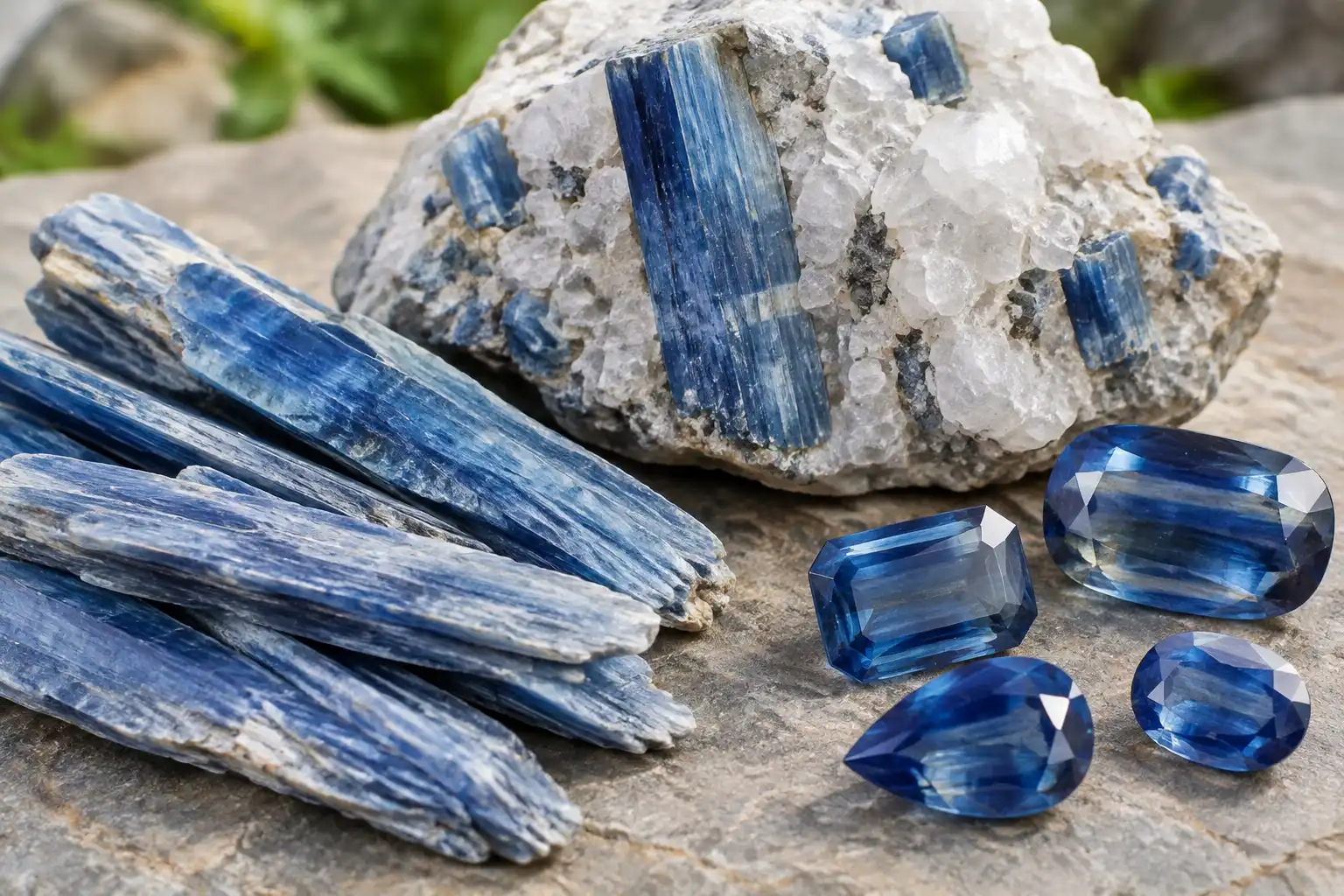
Blue kyanite benefits begin with an unusual aluminum silicate mineral whose real physical properties are more remarkable than many of the claims surrounding it. Kyanite typically forms in metamorphic rocks under elevated pressure, often as elongated or blade-like crystals. Blue specimens can show attractive color zoning, noticeable pleochroism, vitreous luster, and one of mineralogy’s most famous examples of directional hardness.
The mineral’s unusual hardness deserves particular attention. Kyanite can be considerably softer when scratched along one crystallographic direction than across another, with commonly cited values around 5.5 and 7 depending on orientation. It also has prominent cleavage, so a gemstone that appears reasonably hard on paper may still require careful cutting, setting, and wear. These properties create genuine blue kyanite benefits for mineral education, gemology, collecting, metamorphic geology, and skilled lapidary work.
Modern spiritual traditions associate blue kyanite benefits with communication, alignment, meditation, intuition, or energetic balance. Those ideas may carry personal meaning, but they should remain separate from medicine and mineral physics. Kyanite’s crystal structure and directional hardness do not prove that it heals the throat, changes brain function, aligns chakras, or alters the body’s energy systems.
9 Blue Kyanite Benefits at a Glance
- Directional hardness makes blue kyanite one of the most memorable minerals for studying anisotropy.
- Metamorphic occurrence gives geologists useful information about pressure and temperature conditions.
- Strong blue color and pleochroism can produce attractive collector and gemstone specimens.
- Bladed crystal habits make natural blue kyanite visually distinctive without cutting.
- Transparent pieces can be faceted into unusual collector gemstones.
- Color zoning, cleavage, and inclusions provide useful gemological identification clues.
- Lapidary work with kyanite teaches careful orientation because durability changes with direction.
- Jewelry offers a distinctive blue alternative when the stone receives a protective setting and careful wear.
- Modern symbolism can represent communication or alignment without requiring medical or supernatural claims.
Directional Hardness Is One of the Most Fascinating Blue Kyanite Benefits
Few commonly encountered gems demonstrate directional physical behavior as clearly as kyanite. Its hardness changes significantly depending on the direction in which the crystal is tested. Mindat lists approximately 5.5 parallel to one crystallographic direction and about 7 across another, a difference substantial enough to make the mineral famous for hardness anisotropy.
This property provides one of the strongest educational blue kyanite benefits. The Mohs hardness scale is often presented as though every mineral has a single fixed number, yet kyanite demonstrates that crystal structure can cause mechanical properties to vary according to direction.
The lesson becomes especially important for cutters. Polishing one orientation may behave differently from polishing another. A facet or cabochon surface can respond unevenly if the cutter ignores crystal direction, and cleavage adds another layer of difficulty.
Directional hardness also explains why simple durability comparisons can be misleading. Calling kyanite a “hard stone” because part of the crystal approaches hardness 7 overlooks its softer direction and strong cleavage. Its actual wear performance depends on several physical properties working together.
Blue kyanite benefits anyone learning gemology because it turns an abstract concept such as anisotropy into something tangible.
Metamorphic Geology Gives Blue Kyanite Scientific Value
Kyanite is an important metamorphic indicator mineral. It commonly forms in aluminum-rich rocks subjected to elevated pressure during regional metamorphism and occurs in rocks such as schist and gneiss, as well as in some quartz veins and pegmatitic settings. Its presence can help geologists interpret the pressure-temperature history of a rock.
This geological significance creates another genuine source of blue kyanite benefits. A specimen is not merely a blue crystal. It can represent a particular set of conditions deep within Earth’s crust and may preserve evidence of how an older rock changed during mountain-building or other tectonic processes.
Kyanite also shares the Al₂SiO₅ composition with andalusite and sillimanite. These minerals are polymorphs, meaning they have the same overall chemical composition but different crystal structures favored by different pressure and temperature conditions. Their occurrence is therefore useful in metamorphic petrology.
For collectors, a blue blade embedded in quartz or mica-rich matrix can preserve this geological relationship visually. Matrix specimens often provide more geological information than isolated polished stones because associated minerals help tell the story of formation.
These blue kyanite benefits remain scientifically meaningful regardless of whether the owner has any interest in spiritual interpretations.
Blue Color, Pleochroism, and Zoning Add Gemological Interest
Color is one of the most obvious blue kyanite benefits. Fine specimens can range from pale blue to vivid medium or dark blue, sometimes with greenish or violet components. Uneven color distribution is common, and some crystals display distinct zoning.
Transparent blue kyanite may also show pleochroism, meaning the apparent color can change when viewed along different crystallographic directions. GIA’s documented kyanite specimens show visible directional color differences and parallel color banding, illustrating why orientation matters when faceting the gem.
Cutters may orient the rough to emphasize the most attractive blue direction, but doing so can compete with other concerns such as cleavage, crystal shape, inclusions, and yield. This makes faceted kyanite a gemstone in which cutting decisions strongly influence appearance.
Color zoning can be either attractive or distracting depending on distribution. A stone with well-placed darker blue areas may look lively and dimensional, while uneven patches can make the face appear unbalanced.
These variables give blue kyanite benefits to gemology students and collectors because each specimen encourages observation rather than simple color labeling.
Natural Blade-Like Crystals Make Kyanite Valuable Without Cutting
Many minerals become most familiar only after polishing, but kyanite can be highly attractive in its natural form. Crystals often develop as elongated blades or flattened prisms, sometimes appearing singly and sometimes in groups associated with quartz, mica, or other metamorphic minerals.
Mindat describes bladed and tabular crystal habits as characteristic of kyanite, with elongated forms particularly common in certain geological environments.
This creates several blue kyanite benefits for specimen collectors. Natural crystals preserve growth surfaces, striations, color zoning, contacts with surrounding minerals, and evidence of geological formation that would disappear after cutting.
A well-formed crystal does not need gem transparency to be valuable as a specimen. Shape, luster, termination quality, association, locality, color, and overall aesthetics can matter more than whether the crystal could produce a faceted gem.
Collectors should still distinguish natural growth features from damage. Cleavage cracks, broken blade ends, repairs, and glued matrix sections should be disclosed when present.
The natural crystal habit is one reason blue kyanite appeals to both mineral collectors and gemstone enthusiasts without requiring the specimen to be transformed into jewelry.
Faceted Blue Kyanite Rewards Skilled Cutting
Transparent portions of blue kyanite can be faceted, producing attractive gemstones with vivid color and strong luster. Faceting is challenging, however, because cleavage, directional hardness, elongated crystal shape, and color zoning can all complicate the process.
GIA has documented faceted kyanite showing notable color zoning and has noted that cleavage can limit cutting choices and recovery from rough.
This challenge itself is one of the hidden blue kyanite benefits. A successful faceted stone reflects careful orientation, planning, polishing, and understanding of the crystal. The result is not simply a blue gem but evidence of skilled lapidary work.
Long rectangular, oval, cushion, and other elongated shapes can suit the natural crystal form, although cutters may choose different outlines depending on where the strongest blue color occurs. Maximizing weight is not always the same as maximizing beauty.
Kyanite is not usually the easiest choice for a beginner lapidary. Anyone cutting it needs to understand cleavage and uneven hardness rather than applying the same polishing approach used for quartz or corundum.
Jewelry Is Beautiful but Needs More Care Than the Color Suggests
Jewelry versatility belongs among blue kyanite benefits, but it comes with clear limitations. Attractive transparent stones can resemble sapphire in color, while translucent or opaque pieces work well in pendants, earrings, beads, cabochons, and artistic settings.
The mineral’s cleavage and directional hardness mean it is less forgiving than sapphire or spinel. Rings and bracelets expose gemstones to frequent impacts against counters, doors, furniture, and tools, so protective settings are especially important. Pendants and earrings usually face fewer hard blows.
Cleaning should also remain gentle. Warm water, mild soap, and a soft cloth are sensible defaults for stable stones. Ultrasonic or steam cleaning is not the safest approach because cleavage, internal fractures, or inclusions may create vulnerability.
Owners should avoid sudden temperature changes, hard impacts, abrasive storage, and unnecessary pressure on exposed crystal blades. Separate storage prevents harder gemstones from scratching softer directions or damaging fragile edges.
These limitations do not eliminate blue kyanite benefits for jewelry. They simply mean the stone performs best when design and wear habits respect its real physical properties.
Blue Kyanite Helps Distinguish Mineral Identity from Color Alone
Blue gemstones can resemble one another surprisingly closely. Kyanite may be visually confused with sapphire, iolite, blue tourmaline, glass, or other blue stones when color is considered alone.
Identification requires more information. Kyanite’s refractive properties, pleochroism, specific gravity, cleavage, inclusions, color zoning, crystal habit, and directional hardness can all contribute to diagnosis. GIA gemological records for blue kyanite document properties such as strong birefringence, pleochroism, and color banding that help distinguish the species.
A person deciding where to buy blue kyanite should pay attention to accurate identification, condition, treatments when relevant, cutting quality, color distribution, origin claims, and whether photographs represent the actual stone.
Marketing language about energy or rarity does not substitute for those details. A gemstone can carry symbolic meaning and still require ordinary gemological verification.
This is another useful blue kyanite benefit because the stone encourages buyers to look beyond color and ask how identification is actually established.
Collecting Kyanite Can Connect Gemstones with Metamorphic Processes
Collectors often begin with color or crystal shape, but blue kyanite benefits become more interesting when specimens are understood in geological context. Kyanite can record high-pressure metamorphic conditions and occur with minerals that tell complementary parts of the same geological story.
A matrix specimen containing kyanite, quartz, mica, garnet, feldspar, or other minerals may therefore be educational as well as attractive. Locality labels add further value because geological settings differ from one region to another.
Brazil, Nepal, Tanzania, Myanmar, and several other regions have produced noteworthy kyanite specimens or gem rough. Locality alone does not determine quality, however. Color, transparency, crystal habit, damage, matrix relationships, and documentation all influence collector interest.
A small but complete blue crystal with reliable locality data can sometimes be more informative than a much larger unlabeled piece. Collecting value depends on what the owner wants to learn or preserve.
These blue kyanite benefits encourage appreciation of the stone as part of a geological system rather than simply a decorative object.
Modern Spiritual Uses Should Remain Separate from Evidence
Contemporary crystal practice often connects blue kyanite benefits with communication, alignment, meditation, intuition, energy flow, and chakra work. Blue color commonly contributes to associations with the throat chakra and personal expression.
These beliefs can have symbolic meaning, but they should not be confused with physiological effects. There is no established evidence that wearing kyanite treats throat disease, improves neurological function, corrects hormonal problems, changes circulation, or physically aligns energy centers.
Modern beliefs about blue kyanite healing properties belong to spiritual and wellness traditions. Someone may use a crystal during meditation or as a reminder to communicate clearly, but the value of that practice comes from attention and intention rather than a demonstrated medical action of aluminum silicate.
The symbolism surrounding blue kyanite meaning can also be understood as a personal interpretation of color, blade-like form, metamorphic origin, and unusual physical properties rather than proof of supernatural effects.
Responsible language allows spiritual use without diminishing the mineral’s real scientific interest.
Responsible Care Protects Both Specimens and Finished Jewelry
Care is among the most practical blue kyanite benefits because understanding the mineral prevents avoidable damage. Natural blades can split or chip if dropped, while faceted stones may suffer along cleavage planes when struck.
Rough specimens should be handled by stable matrix areas when possible rather than thin projecting blades. Display stands should support the specimen securely, especially when crystals extend beyond the matrix.
Jewelry should be removed during heavy manual work, sports, cleaning, or tasks involving repeated impact. Protective settings can reduce risk, but they cannot make the gem as durable as sapphire.
Storage should separate kyanite from harder gemstones and from pieces that could strike exposed edges. Soft-lined compartments or individual pouches work well for jewelry, while mineral specimens need stable shelves away from vibration or accidental contact.
Respecting these limits preserves the color, crystal form, polish, and geological character that make the stone worth owning.
Conclusion
Blue kyanite benefits include exceptional mineralogical education, metamorphic significance, directional hardness, distinctive crystal habit, attractive color, pleochroism, gemstone potential, collecting value, identification practice, and meaningful personal symbolism. Few gems combine such memorable physical properties with such an obvious connection to metamorphic geology.
The stone’s real advantages also come with limitations. Kyanite has strong cleavage and uneven hardness, so cutting, setting, wearing, and handling require care. Modern spiritual associations can remain part of personal practice when they are kept separate from medical claims. Understanding those strengths and limits makes blue kyanite benefits far more interesting than treating the stone as simply another blue crystal.
FAQs
What are the main blue kyanite benefits?
The most verifiable blue kyanite benefits include mineral education, metamorphic geology, collecting, pleochroism, jewelry use, lapidary study, gemstone identification, distinctive crystal form, and personal symbolism.
What is blue kyanite made of?
Kyanite is an aluminum silicate mineral with the composition Al₂SiO₅. It is polymorphous with andalusite and sillimanite.
Why does kyanite have two hardness values?
Its hardness changes with crystallographic direction. This strong anisotropy produces a commonly cited hardness near 5.5 in one direction and around 7 in another.
Is blue kyanite durable enough for jewelry?
It can be used in jewelry, but strong cleavage and directional hardness make careful setting and wear important. Pendants and earrings are generally safer than exposed everyday rings.
Is blue kyanite naturally blue?
Yes. Blue is a common natural color of kyanite, although individual stones can show color zoning and variations from pale to deeper blue.
Does blue kyanite show pleochroism?
Many transparent blue kyanites show noticeable pleochroism, meaning color appearance can vary with viewing direction. Orientation therefore matters during cutting.
Why is kyanite important to geologists?
Kyanite forms under characteristic metamorphic pressure and temperature conditions, so its presence can contribute information about a rock’s metamorphic history.
What does blue kyanite symbolize?
Modern symbolism commonly associates blue kyanite with communication, alignment, reflection, honesty, and spiritual awareness. These themes are beliefs rather than scientifically demonstrated effects.
Does blue kyanite have healing powers?
There is no established medical evidence that blue kyanite treats disease, throat conditions, neurological disorders, hormonal problems, anxiety disorders, or other health concerns.
Blue kyanite benefits described as healing, chakra, energetic, or emotional effects belong to spiritual and personal belief and should not replace qualified medical or mental-health care.