9 Hidden Calcite Benefits: Gentle Traditions, Verified Facts & Safe Limits
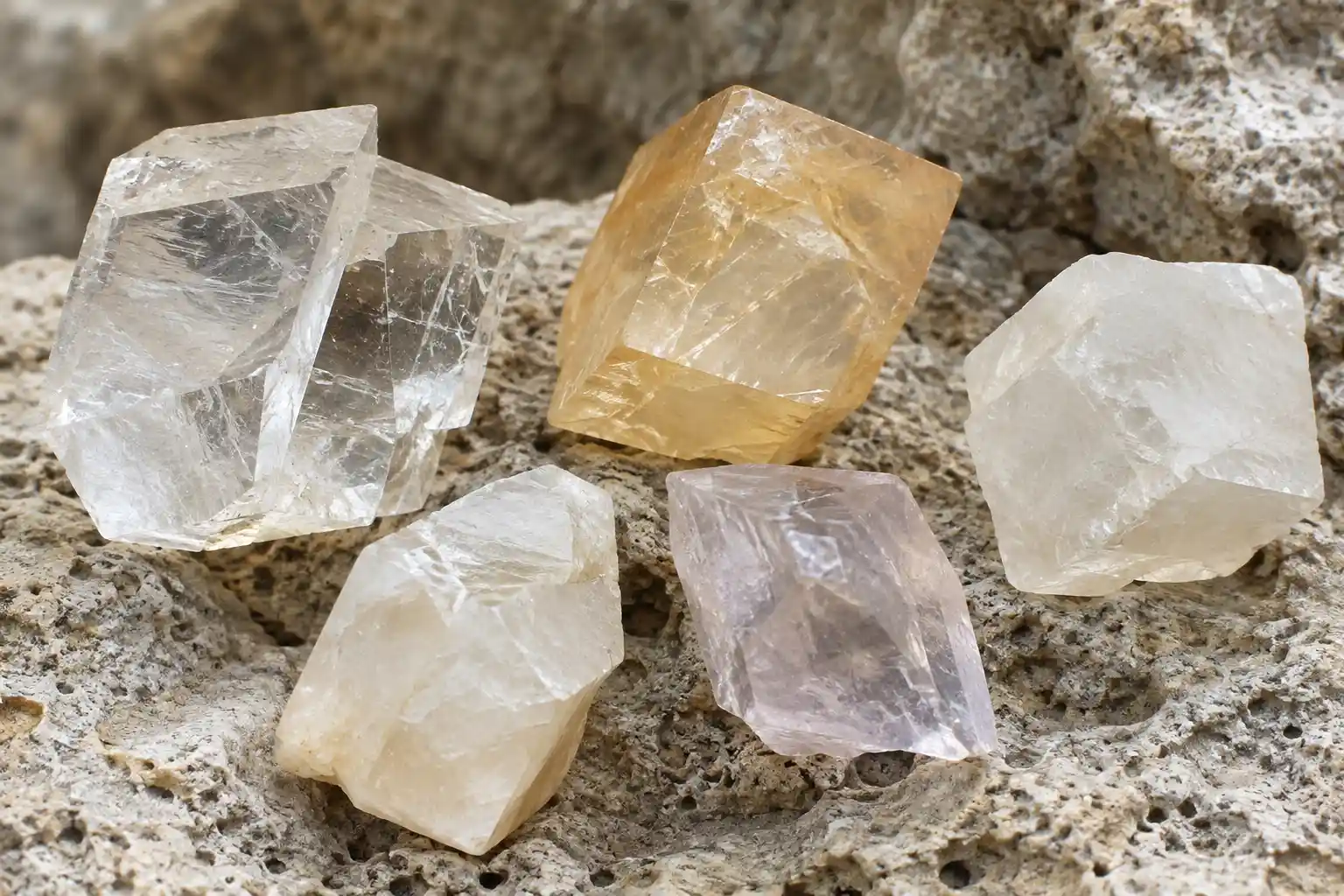
Calcite benefits begin with one of the most important and recognizable carbonate minerals on Earth. Calcite is calcium carbonate, CaCO₃, and occurs in an extraordinary range of geological settings, from limestone and marble to caves, veins, hydrothermal deposits, fossils, shells, and beautifully formed mineral crystals. It can be colorless, white, yellow, orange, green, blue, pink, gray, brown, or nearly black depending on impurities, inclusions, and geological conditions.
The mineral is especially valuable for learning because several diagnostic properties are easy to observe. Calcite has a Mohs hardness of 3, perfect rhombohedral cleavage, strong birefringence in suitable transparent specimens, and a characteristic reaction with dilute acid. Clear calcite can split light strongly enough to produce visible double images, while natural crystals demonstrate how internal structure controls cleavage and optical behavior. These are genuine calcite benefits for mineralogy, geology, collecting, optics, and education.
Modern crystal traditions often add calcite benefits involving energy, motivation, emotional cleansing, creativity, focus, or physical healing. These interpretations may serve as personal symbolism, but they are not medically established effects of calcium carbonate. Holding calcite does not strengthen bones, correct calcium deficiency, detoxify the body, cure anxiety, or alter organ function.
9 Calcite Benefits at a Glance
- Strong double refraction makes transparent calcite valuable for understanding mineral optics.
- Perfect rhombohedral cleavage provides a clear example of how crystal structure controls breakage.
- Reaction with dilute acid makes calcite useful for basic mineral and rock identification.
- Widespread occurrence helps students understand limestone, marble, caves, veins, and sedimentary processes.
- Diverse crystal habits, colors, and formations make calcite highly collectible.
- Softness allows suitable specimens to be carved and polished into decorative objects.
- Colored varieties provide visual diversity while retaining the same fundamental carbonate chemistry.
- Historical optical and geological importance gives calcite substantial scientific value.
- Modern symbolism can represent clarity, perspective, or renewal when kept separate from medical claims.
Double Refraction Is One of the Most Remarkable Calcite Benefits
Transparent calcite can display exceptionally strong birefringence. When a line, printed word, or small object is viewed through a suitable clear crystal, two images may appear instead of one. Light entering the crystal separates into rays that travel differently through the anisotropic structure, producing the visible doubling.
This optical behavior is one of the most memorable calcite benefits because it turns an abstract scientific principle into something a person can observe directly. Students learning mineral optics can use clear calcite to understand that light does not always travel through crystals in the same way in every direction.
Historically, exceptionally transparent calcite known as Iceland spar became important in optical instruments and studies of polarized light. Its properties contributed to the development of mineral optics long before modern analytical instruments became standard.
Not every calcite crystal is transparent enough to show obvious double refraction. Cloudiness, inclusions, fractures, color, and internal zoning can weaken the effect. Even so, the underlying optical property belongs to calcite as a mineral and remains one of its most scientifically important characteristics.
Perfect Cleavage Makes Calcite a Classic Mineralogy Teaching Stone
Calcite breaks readily along three directions of perfect cleavage, producing rhombohedral shapes rather than cubes. The angles between cleavage surfaces are characteristic and reflect the ordered internal arrangement of calcium, carbon, and oxygen within the crystal structure.
This makes cleavage another major source of calcite benefits. Students can compare a broken calcite fragment with quartz, glass, feldspar, mica, or halite to understand the difference between cleavage and irregular fracture.
Cleavage is not merely a surface characteristic. It develops because certain directions within the crystal lattice are structurally weaker than others. When force is applied, the crystal tends to separate along those planes.
For collectors, cleavage creates both beauty and vulnerability. Fresh surfaces may look smooth and reflective, but an attractive crystal can split if struck. Carved or polished pieces also need protection because a sharp impact may exploit one of those structural weaknesses.
Understanding this property improves both identification and care. Calcite benefits owners most when its softness and cleavage are treated as real physical limits rather than ignored because a polished stone looks solid.
Calcite’s Acid Reaction Helps Identify Carbonate Rocks and Minerals
One of the best-known diagnostic calcite benefits is its reaction with dilute acid. Calcite reacts readily with weak hydrochloric acid, producing visible bubbles of carbon dioxide. This effervescence helps geologists distinguish calcite-rich rocks and minerals from many visually similar substances.
The reaction is especially useful when identifying limestone, which is composed primarily of calcite. Marble, produced when limestone recrystallizes during metamorphism, also reacts because calcite remains a major component in many marble varieties.
This simple test demonstrates how chemistry can support identification where color cannot. Calcite occurs in so many colors that appearance alone is unreliable. A white mineral may be calcite, quartz, feldspar, gypsum, or something else entirely, so physical and chemical properties matter.
Acid testing should not be performed casually on valuable specimens, jewelry, carvings, or polished surfaces because acid can etch calcite permanently. Professional identification does not require damaging a treasured piece.
A buyer deciding where to buy calcite should rely on accurate mineral descriptions, photographs, locality information when available, and appropriate testing rather than attempting destructive home experiments.
Calcite Helps Explain Limestone, Marble, Caves, and Carbonate Geology
Geology is one of the broadest calcite benefits because the mineral is fundamental to many rocks and landscapes. Limestone forms largely from calcite and may develop through biological accumulation, chemical precipitation, or combinations of both. When limestone experiences sufficient heat and pressure, recrystallization can produce marble.
Calcite also plays a major role in caves. Mineral-rich water moving through limestone can dissolve calcium carbonate and later redeposit it as stalactites, stalagmites, flowstone, and other speleothems when conditions change.
Veins of calcite can form when mineral-rich fluids move through fractures in rock. Hydrothermal systems may produce well-formed crystals, sometimes alongside fluorite, quartz, sulfides, barite, or other minerals.
These relationships make calcite benefits especially valuable for anyone interested in Earth’s carbon cycle, sedimentary geology, metamorphism, cave formation, mineral veins, or fossil preservation.
A crystal specimen can therefore represent much more than a decorative object. It may preserve evidence of fluids, rock alteration, biological processes, or changing chemical conditions over geological time.
Calcite’s Variety Makes It an Exceptional Collecting Mineral
Few minerals occur in as many forms as calcite. Crystals may be rhombohedral, scalenohedral, prismatic, tabular, fibrous, massive, or complex combinations of forms. Some specimens are perfectly clear, while others contain attractive inclusions, phantoms, zoning, coatings, or associations with other minerals.
Color variation adds another layer. Clear, white, honey, orange, green, blue, pink, red, gray, and dark calcites all occur, although the cause of color can differ among deposits.
This diversity creates strong calcite benefits for collectors because one mineral species can support an extensive collection without becoming visually repetitive. A person may focus on crystal form, locality, fluorescence, color, inclusions, associated minerals, or optical properties.
Colored varieties can also have their own distinct visual appeal. The soft color and translucency that distinguish blue calcite show how one mineral species can take on a very different appearance while retaining calcite’s basic chemistry, softness, cleavage, and optical character.
Locality documentation can significantly increase scientific interest. A crystal with reliable provenance connects visible features with a specific geological environment rather than existing only as an anonymous decorative specimen.
Carving and Decorative Use Take Advantage of Calcite’s Softness
Calcite’s Mohs hardness of 3 creates limitations for jewelry, but the same softness can be useful for carving. Suitable pieces can be shaped into spheres, bowls, figures, eggs, towers, freeforms, ornamental objects, and polished display pieces with less effort than harder quartz.
This is one of the more practical calcite benefits for lapidary work. Large pieces with attractive translucency or color can become decorative objects that reveal internal zoning and natural variation across a wide surface.
The softness still requires careful finishing. Calcite scratches easily, and fine edges can chip. Cleavage may cause a carving to split if pressure is applied in an unfavorable direction.
Polished objects should therefore be treated more like decorative mineral pieces than hard-wearing quartz carvings. A soft cloth, stable display location, and separation from harder stones help preserve the surface.
Calcite can also react with household acids, so vinegar, lemon-based cleaners, and acidic cleaning products should be kept away from polished pieces. Even mild acid exposure can dull or etch the surface.
Calcite Has Scientific Value Beyond Gemstone Collecting
Calcite benefits extend into optics, geology, paleontology, environmental science, and industrial mineral study. Limestone and calcite-rich rocks are involved in cement and lime production, soil chemistry, construction, carbon storage, and many natural water systems.
In geology, calcite veins can record fluid movement through rocks. In sedimentary studies, carbonate textures can preserve evidence of ancient environments. In fossils, calcite may occur as original skeletal substance or as later mineral replacement and infilling.
Transparent calcite has long served as an important optical mineral, while crystal forms have contributed to the development of crystallography.
These scientific roles explain why calcite is far more important than its popularity in crystal shops suggests. It is a major Earth-forming mineral with a direct connection to rocks, landscapes, caves, organisms, and the carbon cycle.
For students, calcite benefits include being common enough to study easily yet complex enough to support advanced geological and optical research.
Modern Symbolism Can Use Calcite Without Inventing Physical Effects
Contemporary crystal culture often associates calcite benefits with cleansing, energy, focus, creativity, motivation, emotional release, or spiritual development. Different colors may receive different symbolic interpretations.
These themes can be used responsibly as personal reminders. Clear calcite might symbolize looking at a problem carefully, while a colored specimen might represent a particular goal or mood. Someone may keep a crystal near a desk because its appearance encourages reflection or because it marks an intention they want to remember.
Claims about calcite healing properties should remain separate from medical evidence. Calcite does not treat pain, hormonal disorders, neurological conditions, anxiety, digestive disease, infection, or other health problems through ordinary handling.
Likewise, because calcite contains calcium, it should not be assumed to strengthen bones or correct calcium deficiency when worn or held. Mineral composition inside a crystal is not the same as nutritional intake.
Symbolic calcite benefits remain perfectly meaningful without turning the stone into a medical treatment.
Proper Care Is Essential Because Calcite Is Soft and Acid-Sensitive
Care is one of the most important practical calcite benefits to understand because the mineral’s beauty can be damaged easily through inappropriate cleaning or storage.
A hardness of 3 means many ordinary objects can scratch calcite. Quartz dust, harder gemstones, metal edges, and abrasive cleaners can permanently mark polished surfaces.
Acid presents another problem. Even weak acidic substances can react with calcium carbonate and etch the stone. Vinegar, citrus-based cleaners, strong household chemicals, and acidic solutions should therefore be avoided.
Routine cleaning should be gentle. A soft dry or slightly damp cloth is often enough for polished pieces. When mild soap and water are appropriate, exposure should be brief and followed by careful drying. Steam and ultrasonic cleaning are unnecessary risks, especially for fractured crystals or carved objects.
Stable display and separate storage provide better protection than aggressive maintenance. Understanding these limits preserves the optical, structural, and decorative calcite benefits for much longer.
Conclusion
Calcite benefits include exceptional double refraction, diagnostic cleavage, acid reactivity, geological importance, collecting diversity, carving potential, optical education, scientific value, and meaningful personal symbolism. Few common minerals demonstrate so many fundamental concepts in such an accessible form.
Its softness, cleavage, and acid sensitivity also require realistic care. Modern spiritual traditions can add personal meaning, but claims about healing, calcium supplementation, detoxification, or physiological effects are not established by mineral chemistry. The strongest calcite benefits come from understanding what this remarkable carbonate mineral actually does in nature, science, and lapidary practice.
FAQs
What are the main calcite benefits?
The most verifiable calcite benefits include mineral identification, double refraction, geological education, collecting, carving, crystal-structure study, decorative use, and optical science.
What is calcite made of?
Calcite is calcium carbonate with the chemical formula CaCO₃.
How hard is calcite?
Calcite has a Mohs hardness of 3, making it much softer than quartz and relatively easy to scratch.
Why does clear calcite show double images?
Calcite is strongly birefringent. Light entering an appropriate transparent crystal splits into rays that travel differently, producing visible double refraction.
Why does calcite react with acid?
Calcium carbonate reacts with acids and releases carbon dioxide gas, producing the visible bubbling commonly used in mineral identification.
Is calcite good for jewelry?
It can be used in protected jewelry, but its softness and perfect cleavage make it less suitable for hard daily wear than quartz, sapphire, or other tougher gems.
Can calcite be carved?
Yes. Its softness makes calcite suitable for carving and polished decorative objects, although cleavage and scratch sensitivity require careful handling.
Does calcite provide calcium to the body?
No. Wearing or holding solid calcite does not function as calcium supplementation or treatment for bone or nutritional conditions.
Does calcite have healing benefits?
There is no established clinical evidence that calcite treats disease, pain, anxiety, hormonal problems, calcium deficiency, neurological disorders, or other medical conditions.
Calcite benefits described as healing, cleansing, emotional, chakra, or energetic effects belong to spiritual and personal belief and should not replace qualified medical or mental-health care.