10 Real Calcite Healing Claims: Gentle Traditions, Verified Facts & Safe Use
Calcite healing properties are commonly described in crystal practice through ideas of calm, emotional balance, clearer thinking, motivation, confidence, creativity, communication, energetic renewal, and spiritual reflection. These are popular traditions and personal interpretations, not established effects of calcium carbonate. Calcite has not been shown to treat illness, regulate brain chemistry, remove anxiety or emotional distress, or transmit a measurable healing force through the body. Its real identity is much easier to verify: calcite is a calcium carbonate mineral with distinctive cleavage, low hardness, strong optical properties, and an enormous range of colors and crystal habits, while the calcite meaning used in crystal practice comes from symbolism that people have developed around those visible characteristics.
Calcite Healing Properties: 10 Popular Claims
The ten recurring themes can be separated clearly rather than treating “healing” as one undefined effect:
- Calm and relaxation
- Emotional balance
- Mental clarity
- Concentration and attention
- Motivation and follow-through
- Confidence and self-belief
- Creativity and fresh thinking
- Communication and self-expression
- Symbolic clearing and reset
- Chakra and spiritual reflection
Each theme can be used as a deliberate ritual, reminder, or reflection prompt without assuming that the stone itself changes physiology.
Soft Calcium Carbonate With Perfect Cleavage
Calcite is calcium carbonate, CaCO₃, and belongs to the calcite group. It crystallizes in the trigonal system and appears in an exceptional range of habits, including rhombohedral, scalenohedral, prismatic, tabular, fibrous, stalactitic, granular, and massive forms. Well-developed crystals can look sharply geometric, while massive calcite may show little obvious external crystal shape until it breaks or is cut.
The mineral has a Mohs hardness of only 3, making it much softer than quartz. A copper coin, harder gem, or abrasive dust can damage polished surfaces more easily than many people expect. Calcite is also brittle and has perfect rhombohedral cleavage, so force applied in an unfavorable direction can split it along smooth internal planes. Its luster is commonly vitreous on crystal faces and may appear pearly along cleavage surfaces.
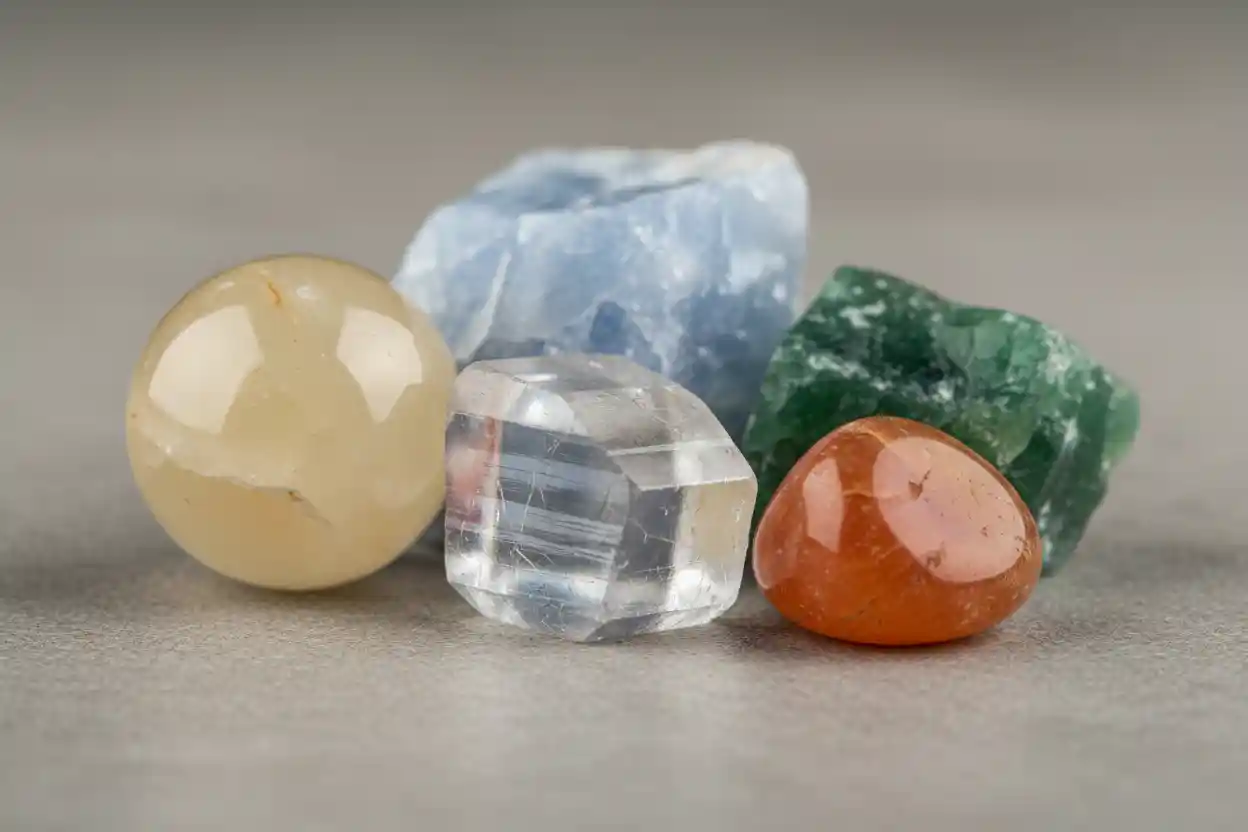
Colorless and white calcite are widespread, but impurities, structural effects, and inclusions can produce yellow, honey, orange, pink, red, green, blue, gray, brown, and nearly black specimens. Those colors have encouraged very different symbolic associations in modern crystal practice, which is why calcite color meaning can vary substantially from one variety to another. Color does not create a medical property.
Clear calcite is also famous for strong birefringence. When a sufficiently transparent cleavage piece is placed over printed lines or another object, two images may be visible because light traveling through the crystal divides into rays that behave differently. That optical behavior is a measurable property of calcite and is completely separate from claims about invisible spiritual energy.
Calcite can resemble aragonite because both are calcium carbonate, but their crystal structures differ. Dolomite may also resemble calcite in pale crystalline specimens, while gypsum can confuse identification when color and translucency are considered without testing hardness. Calcite’s low hardness, perfect rhombohedral cleavage, and vigorous reaction with weak acid provide more useful identification clues than color alone.
Ancient Mineral, Modern Mineral Name
Humans encountered calcium carbonate minerals long before modern mineralogical classification existed. Limestone, marble, chalk, shells, cave deposits, and calcite crystals have all been part of human environments for a very long time. The word behind calcite ultimately connects with the Latin calx, referring to lime, while the modern mineral name was established in nineteenth-century mineralogical literature.
That long physical history should not be confused with proof that today’s detailed calcite healing claims come from one continuous ancient therapeutic tradition. Modern crystal practice blends color symbolism, contemporary spiritual systems, personal ritual, and older cultural ideas in ways that are not always traceable to one historical source.
Calcite itself is extremely widespread. It is a major component of limestone and marble, occurs in hydrothermal veins, lines cavities, develops in caves as stalactites and stalagmites, appears as cement in sedimentary rocks, and can form through biological processes. Because the mineral was known long before current type-locality conventions, it does not have one meaningful modern species type locality.
Helgustaðir in Iceland became particularly famous for transparent optical calcite known as Iceland spar. The Elmwood mining district in Tennessee is celebrated among collectors for large amber and golden crystals, while numerous Mexican districts have produced attractive calcite in many habits and colors. The geology behind where calcite is found is therefore far more varied than a single deposit or rock type.
Calm and Emotional Rituals
1. Calm and Relaxation
Calcite is often described as calming, although the exact interpretation changes with color. Instead of assuming that holding the stone directly slows the nervous system, someone can use it as the cue for a chosen calming routine. Picking up the stone might mean putting down a phone, sitting quietly for several minutes, slowing breathing, or naming the problem that is creating tension.
There is no demonstrated mineral mechanism by which calcium carbonate suppresses stress or produces relaxation. The pause is the active part. A familiar object can still make that pause easier to remember when it has been intentionally associated with the routine.
2. Emotional Balance
Emotional balance claims often present calcite as a stone for processing difficult feelings or moving through emotional stagnation. A practical approach is to place the stone beside a journal and use it when identifying what happened, what emotion followed, what assumptions were made, and what response would actually be useful.
The stone does not regulate mood or medically resolve emotional distress. The calcite benefits described in crystal traditions become more realistic when they are translated into deliberate habits rather than treated as biochemical effects.
Clarity, Focus, and Motivation
3. Mental Clarity
Clear and pale calcite varieties are frequently associated with mental clarity. Crystal practitioners may describe them as helping to remove confusion or organize thoughts. The same symbolism can be used without making a neurological claim by assigning the stone a simple role: when it comes out, unanswered questions get written down and assumptions are separated from facts.
This is best treated as a metaphor rather than a mechanism. Calcite cannot clear neural pathways or alter cognition through contact. A structured thinking routine can nevertheless make a complicated problem easier to examine.
4. Concentration and Attention
Calcite is sometimes kept near desks, study areas, or workspaces as a focus stone. A person could use it to mark the beginning of a distraction-free work period, then silence notifications, choose one task, and work until a planned stopping point.
There is no evidence that calcite directly increases attention span or learning ability. The stone can instead function as a consistent environmental cue. The practical methods in how to use calcite are most defensible when they support routines that the user actually controls.
5. Motivation and Follow-Through
Bright yellow, orange, and honey-colored calcite varieties are particularly likely to be associated with motivation and forward movement. Rather than waiting for the stone to supply energy, a person can connect it with one concrete next action. That might mean opening a document, starting a short exercise session, making a difficult call, or completing the first five minutes of an avoided task.
The mineral does not increase metabolic energy or manufacture motivation. Starting behavior is what changes the situation. Calcite can simply become the visual signal that means “begin.”
Confidence, Creativity, and Communication
6. Confidence and Self-Belief
Confidence claims often focus on yellow, golden, and orange calcite, although crystal traditions vary. Someone preparing for a presentation, interview, meeting, or unfamiliar task might hold the stone while reviewing key points and identifying what is already within their control.
That part is belief, not biology. Calcite does not alter self-esteem or courage through mineral contact. Preparation and repeated experience do far more. Short calcite affirmations can still be useful when they state realistic intentions such as speaking clearly, asking a needed question, or taking one prepared action.
7. Creativity and Fresh Thinking
Orange and other brightly colored calcites are frequently connected with creativity. A useful ritual is to place a visually interesting specimen beside a notebook and use it as the starting cue for ten minutes of unrestricted writing, sketching, brainstorming, or problem-solving.
There is no established pathway through which calcite activates creativity. What the ritual can provide is a reliable starting point. Creative work often benefits from reducing the friction involved in beginning, and a repeated object can become associated with that first step.
8. Communication and Self-Expression
Blue calcite in particular is often associated with communication and speaking calmly. Someone can turn that symbolism into preparation before an important conversation by deciding what they need to communicate, what tone will help, and what they need to hear from the other person.
Calcite does not influence speech centers or cause another person to understand you. The person speaking still does the work. The stone may serve as a reminder to slow down, choose language deliberately, and listen before responding.
Clearing and Intentional Reset
9. Symbolic Clearing
Calcite is often described as an energetic cleanser or a stone that clears stagnant energy from rooms, objects, or people. No measurable harmful energy has been established that calcite absorbs and removes through this process.
The idea can still be translated into a useful reset ritual. Placing a calcite specimen on a cleared desk might mark the end of one project and the beginning of another. Moving it to a quiet space could accompany tidying a room, discarding unnecessary notes, or deciding what deserves attention next.
The stone doesn’t perform the clearing. The routine does. Its symbolic role is to make the transition visible and intentional.
Chakra and Spiritual Reflection
10. Chakra and Spiritual Symbolism
Calcite does not have one universal chakra association because the mineral occurs in so many colors. Orange calcite is commonly linked with the sacral chakra, yellow or honey calcite with the solar plexus, green and pink calcite with heart-centered symbolism, blue calcite with the throat, and clear or white calcite with upper-chakra practices. Individual systems may assign them differently.
Chakras are a spiritual framework, not anatomical structures established by medical science. A calcite chakra practice is therefore better understood as meditation, symbolism, or focused reflection rather than treatment of a physical organ or energy center.
The calcite spiritual meaning also changes according to color and practice. A transparent crystal may symbolize clarity, orange may represent creative movement, green may represent renewal, and honey tones may represent personal agency. These interpretations can provide a vocabulary for reflection without becoming claims about forces generated by calcium carbonate.
Gentle Care for a Soft Mineral
Calcite requires more physical care than its solid appearance suggests. Mohs hardness 3 means everyday dust containing quartz can scratch it, and contact with harder gemstones can leave visible marks. Store calcite separately in a soft pouch, lined compartment, or protected display position rather than allowing polished pieces to rub against quartz, topaz, sapphire, or other harder stones.
Perfect cleavage creates another risk. Dropping a crystal or striking a cleavage edge can cause pieces to split away cleanly. Avoid ultrasonic cleaning, steam cleaning, aggressive brushing, abrasive powders, and sudden temperature changes. Harsh chemicals are especially inappropriate because calcite is chemically reactive.
Calcite is not a hydrated mineral, but that does not make prolonged water exposure a good care method. Brief contact with plain lukewarm water during careful cleaning is different from leaving the stone submerged. Slightly acidic water can attack calcium carbonate, and vinegar, lemon juice, acidic cleaners, and similar liquids can visibly etch or dissolve the surface.
The safest routine is usually a soft dry cloth, with a slightly damp cloth when necessary, followed by immediate drying. The detailed guidance on whether calcite is safe in water is particularly important for polished pieces, delicate crystals, repaired specimens, and jewelry.
Dry Ritual Cleansing
Ritual cleansing should be separated from physical cleaning. There is no need to soak calcite, cover it with salt, scrub it, or expose it to chemicals in order to perform a symbolic reset. Sound, quiet reflection, intention-setting, or placing the stone in a clean dry location can all preserve the ritual without creating unnecessary wear.
A bell, singing bowl, short meditation, or a few minutes spent reconsidering the intention attached to the stone can serve the same spiritual purpose. These actions do not remove a scientifically demonstrated energy from calcite. They mark a transition for the person performing them.
Because calcite is soft and reactive, dry approaches are especially sensible. Cleansing calcite does not need to put the crystal’s surface or cleavage edges at risk.
Conclusion
Calcite is a soft calcium carbonate mineral defined by trigonal structure, perfect rhombohedral cleavage, remarkable optical behavior, and an extraordinary range of colors and forms. Its ten popular healing themes can provide personal symbols for calm, clarity, motivation, creativity, communication, and reflection, but those meanings have not been demonstrated as therapeutic properties of the mineral itself. Calcite is most useful in this context when the stone remains a reminder and the person remains responsible for the action.
Frequently Asked Questions
What are the main calcite healing properties?
Popular claims include calm, emotional balance, mental clarity, concentration, motivation, confidence, creativity, communication, symbolic clearing, and spiritual reflection. These are crystal-healing traditions rather than established medical effects.
What is calcite made of?
Calcite is calcium carbonate with the chemical formula CaCO₃. It belongs to the calcite group and crystallizes in the trigonal system.
How hard is calcite?
Calcite has a Mohs hardness of 3. It scratches much more easily than quartz and should be stored away from harder gems and abrasive surfaces.
Does calcite really help with anxiety or stress?
Calcite has not been shown to directly treat anxiety or produce a crystal-specific calming effect. It can still be used as a cue for breathing, journaling, reflection, or another chosen calming routine.
Can calcite improve concentration?
There is no evidence that calcite directly changes concentration or memory. Keeping it near a workspace may serve as a personal reminder to begin a focused work routine.
Why does calcite come in different colors?
Pure calcite can be colorless or white, while impurities, inclusions, structural features, and other geological factors can create yellow, orange, pink, green, blue, gray, brown, and additional colors.
What chakra is calcite associated with?
The association usually depends on color. Modern crystal practice may connect orange calcite with the sacral chakra, yellow with the solar plexus, green or pink with the heart, blue with the throat, and clear or white calcite with upper-chakra symbolism.
Is calcite suitable for jewelry?
Calcite can be used in jewelry, but its hardness of 3 and perfect cleavage make it vulnerable to scratching and impact. Pendants and occasional-wear pieces generally face less abrasion than exposed rings.
Can calcite go in water?
Brief contact with plain water during careful cleaning may be acceptable for many intact specimens, but prolonged soaking is unnecessary and acidic liquids can etch calcium carbonate. Vinegar, lemon juice, salt solutions, harsh cleaners, and long immersion should be avoided.
How should calcite be cleansed?
For ritual cleansing, sound, reflection, intention-setting, or dry placement are gentle approaches. Physical dirt should be handled separately with careful, low-moisture cleaning appropriate to a soft and reactive mineral.
Crystal healing claims are traditional or personal beliefs and should not replace qualified medical or mental health care.