9 Real Charoite Benefits: Meaningful Uses, Verified Facts & Important Cautions
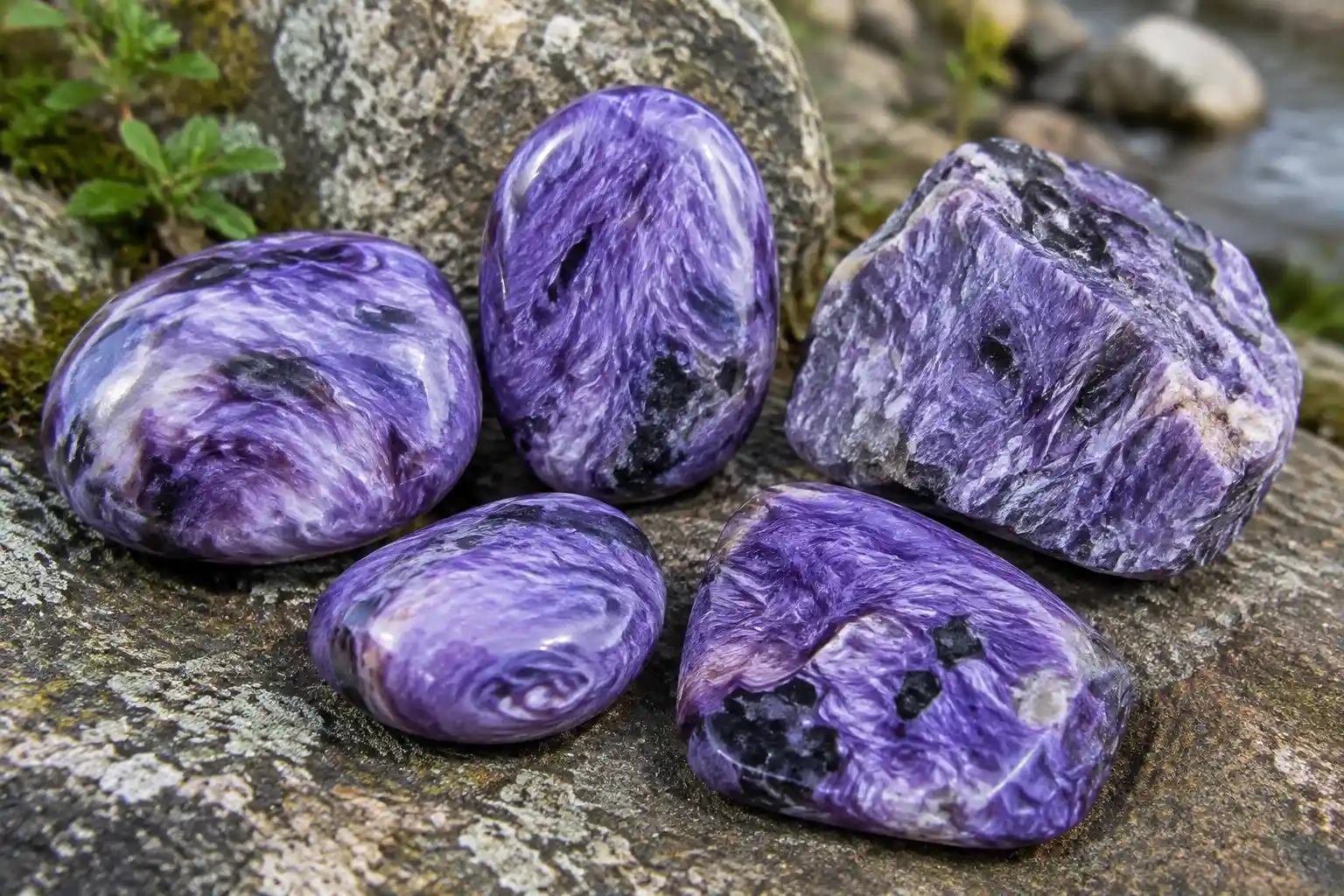
Charoite benefits begin with qualities that are genuinely unusual in the mineral world: vivid violet-to-lilac color, swirling fibrous patterns, silky luster, geological scarcity, and an origin strongly associated with the Murunskii Massif of Russia’s Sakha Republic. Unlike purple gemstones whose appearance depends mainly on transparent crystal color, polished charoite can display complex flowing structures that resemble feathers, waves, clouds, or interlocking ribbons. Those natural textures make individual slabs and cabochons difficult to duplicate.
Charoite is a complex hydrated silicate mineral containing potassium, calcium, sodium, strontium, and other components within a highly complex crystal structure. It belongs to the inosilicate group, has a monoclinic crystal system, and generally falls around 5 to 6 on the Mohs hardness scale. Fine pieces are usually translucent to opaque and may show vitreous to silky luster. White, black, brownish, or orange-associated minerals can occur within charoite-bearing rock and add contrast to the purple body.
These characteristics create real charoite benefits in collecting, lapidary work, jewelry, mineral education, geological study, decorative carving, and gemstone identification. Contemporary crystal culture also connects charoite with transformation, courage, emotional balance, intuition, and spiritual development. Those interpretations can remain personally meaningful, but they are not established medical effects of the mineral.
9 Charoite Benefits at a Glance
- Rare violet and lilac coloration gives charoite an immediately recognizable appearance.
- Swirling fibrous patterns make individual polished stones naturally distinctive.
- Silky to vitreous luster creates attractive movement across cabochons and larger polished surfaces.
- Limited geological occurrence gives well-documented specimens strong collecting interest.
- Lapidary cutting can reveal patterns that are difficult to appreciate in weathered rough.
- Jewelry designers gain a purple ornamental stone unlike amethyst, sugilite, or fluorite.
- Mineral collectors can study complex silicate chemistry, fibrous texture, associated minerals, and charoitite.
- Identification practice encourages attention to structure and pattern rather than purple color alone.
- Modern symbolism can represent purposeful change or resilience when kept separate from medical claims.
Rare Purple Color Is One of the Most Obvious Charoite Benefits
Color gives charoite much of its immediate appeal. Fine specimens range from pale lavender and soft lilac to strong violet, purple, and deeper saturated tones. Trace manganese contributes to the vivid coloration seen in classic material, while associated minerals and structural variations can produce white, gray, brown, orange, or black areas within the rock.
Unlike a uniformly colored transparent gem, charoite often becomes more attractive because several shades occur together. Pale lavender fibers may sweep across darker purple areas, while white patches and black inclusions create contrast. When polished, these differences can form a three-dimensional visual effect that changes subtly as the stone moves under light.
This color diversity creates practical charoite benefits for jewelry and decorative work. A cutter may choose a quiet lilac section for a smaller cabochon or preserve dramatic violet-and-black patterning in a larger pendant. Buyers can select according to pattern rather than assuming the darkest purple is automatically the finest choice.
Natural variation is part of the stone’s character. Extremely uniform color can actually remove some of the swirling visual identity that makes charoite distinctive.
Silky Swirls Make Every Polished Charoite Visually Individual
One of the most recognizable charoite benefits is its fibrous and swirling texture. Fine-grained aggregates can create ribbons, fans, feather-like structures, radial areas, or tangled flowing patterns across a polished surface.
These textures interact with light differently depending on orientation. Some areas appear silky or pearly, while others look more glassy. The resulting movement can make a polished stone seem almost layered even when the surface itself is smooth.
This characteristic distinguishes charoite from many other purple gems. Amethyst normally shows transparent quartz color and crystal structure. Purple fluorite may display cleavage and transparent cubic forms. Sugilite can be richly purple but commonly lacks charoite’s unmistakable fibrous swirling pattern.
For lapidaries, the challenge is deciding which direction will reveal the most attractive internal structure. Cutting across one orientation can expose sweeping ribbons, while another cut through the same rough may show tighter radial or mottled patterns.
These natural differences mean that two cabochons from one piece of rough can have very different personalities.
Geological Scarcity Gives Charoite Strong Collecting Interest
Charoite is particularly associated with the Murunskii Massif near the Chara and Tokko River region of the Sakha Republic in Russia. Its restricted geological occurrence has contributed significantly to its reputation among mineral collectors and ornamental-stone enthusiasts.
The mineral occurs within an unusual alkaline geological environment and is an essential component of the rock known as charoitite. Its formation is connected with metasomatic alteration involving potassium-rich fluids interacting with surrounding rocks under specific geological conditions.
This gives charoite benefits far beyond ornamental appearance. A specimen can represent a rare combination of chemistry, temperature, rock interaction, and regional geological history.
Collectors may prefer polished slabs when they want to examine pattern, while rough pieces can preserve more geological context. Matrix relationships and associated minerals often reveal information that disappears once a stone is cut into a cabochon.
Reliable locality information is especially valuable with charoite because geographic origin is central to the mineral’s identity. A buyer considering where to buy charoite should therefore pay attention to accurate mineral identification, provenance when available, treatment disclosure, and realistic photographs rather than relying only on a purple color label.
Charoite Gives Lapidaries an Exceptional Pattern Stone
Lapidary work reveals some of the strongest charoite benefits. Weathered or rough surfaces may hide the movement and contrast that become obvious after careful grinding and polishing.
Cabochons are especially effective because a broad smooth face preserves the natural pattern. Freeforms can be even more suitable when the best purple areas or fibrous structures do not fit neatly inside a calibrated oval or rectangle.
Large pieces may become spheres, carvings, boxes, decorative slabs, beads, or inlay. The stone’s striking internal pattern means relatively simple shapes can still have substantial visual impact.
Its hardness around 5 to 6 makes charoite workable, but that does not make it exceptionally durable. Good cleavage and variations within charoite-bearing rock require careful orientation and handling. Different associated minerals can also respond differently during polishing, so cutters may need to adjust technique across the same piece.
Successful work therefore depends on understanding the stone rather than simply polishing until the surface shines. Pattern placement, structural stability, and finishing quality all influence the final result.
Charoite Jewelry Offers a Purple Look Unlike Transparent Gems
Jewelry versatility is another practical source of charoite benefits. Its opaque-to-translucent purple appearance creates a very different effect from transparent amethyst, sapphire, or spinel.
Large cabochons can make distinctive pendants because the surface provides enough area for the fibrous pattern to remain visible. Earrings can use smaller matched or complementary pieces, while beads create repeated variations in purple and white as a necklace moves.
Silver-colored metals often emphasize charoite’s cool violet tones, while yellow or rose gold can introduce warmer contrast. Blackened metal may complement dark inclusions particularly well.
Rings are possible, but they need more protection than jewelry made from quartz or corundum. Charoite’s moderate hardness and cleavage mean an exposed cabochon can scratch or chip under hard everyday use. Pendants, brooches, and earrings typically expose the stone to fewer impacts.
Jewelry-focused charoite benefits are therefore strongest when design respects the physical properties rather than treating rarity as proof of durability.
Charoite Helps Explain Complex Silicate Mineralogy
Charoite’s chemistry is considerably more complicated than that of familiar gems such as quartz or calcite. Modern mineralogical formulas reflect a structure containing several alkali and alkaline-earth elements combined with elaborate silicate units, hydroxyl, fluorine, and water.
That complexity provides important educational charoite benefits. The mineral can introduce concepts involving inosilicates, crystal structure, solid-solution chemistry, metasomatism, trace-element coloration, fibrous mineral aggregates, and mineral-rock relationships.
It also demonstrates why a commercial gemstone name can refer to both a specific mineral and a patterned rock in which several minerals occur together. Charoite may be accompanied by other minerals that contribute white, black, orange, brown, or gray features to ornamental pieces.
Collectors who understand these associations can interpret a polished slab more carefully. A black patch, for example, should not automatically be described as part of pure charoite merely because it occurs within the same ornamental stone.
Scientific understanding makes the swirling appearance more interesting because each visual component becomes part of a geological story rather than simply a decorative pattern.
Identification Requires More Than Recognizing a Purple Stone
Purple color is not enough to identify charoite. Sugilite, lepidolite-bearing rocks, dyed stones, glass, fluorite, amethyst, and other purple ornamental products can overlap in photographs, especially when images are highly saturated.
Charoite’s fibrous swirling texture is a useful clue, but identification should consider luster, hardness, density, structural features, associated minerals, and geological origin when these details are available.
Polished pieces can be more difficult because natural crystal form has already been removed. Buyers should therefore be cautious when a seller relies entirely on color and marketing language.
A genuine charoite specimen does not need claims about extreme rarity, psychic power, or mysterious energy to establish identity. Clear photographs, accurate dimensions, realistic color, provenance, condition, and knowledgeable mineral descriptions provide far more useful information.
These identification skills are among the most transferable charoite benefits because they encourage buyers to evaluate evidence rather than appearance alone.
Modern Symbolism Often Focuses on Change, Courage, and Resilience
Contemporary crystal traditions commonly describe charoite benefits in terms of transformation, courage, resilience, intuition, emotional balance, and adapting to change. Its swirling purple patterns and unusual geological origin make those associations visually understandable.
Transformation can be interpreted without assuming a supernatural mechanism. Someone may associate a charoite pendant with a career transition, relocation, demanding period of study, or decision to change an established habit.
Courage can likewise mean taking necessary action despite uncertainty rather than expecting the stone to remove fear. A person might wear charoite during a difficult conversation because it symbolizes the intention to remain composed and direct.
Modern beliefs surrounding charoite healing properties sometimes extend these themes into claims involving anxiety, sleep, blood pressure, pain, neurological function, or physical healing. Those ideas belong to spiritual practice rather than established medicine.
The strongest symbolic charoite benefits keep responsibility with the person rather than assigning psychological or biological control to the mineral.
Proper Care Is Important Because Charoite Is Not a Hard-Wearing Quartz Gem
A Mohs hardness around 5 to 6 means charoite can be scratched by harder gemstones and abrasive particles. Cleavage also increases the possibility of damage from impact, particularly in thin pieces or exposed jewelry.
Routine care should therefore be gentle. A soft cloth and mild soapy water are appropriate for many stable polished pieces, followed by careful drying. Steam, aggressive ultrasonic cleaning, harsh chemicals, and abrasive compounds offer unnecessary risk.
Separate storage is especially important. Sapphire, spinel, quartz, and many other common jewelry stones are harder than charoite and can damage a polished surface if pieces rub together.
Large decorative items should sit on stable surfaces where they cannot fall. Cabochons in rings benefit from protective settings, while pendants and earrings generally experience safer wear.
These precautions preserve color, polish, pattern, and workmanship, which are the real features behind most charoite benefits.
Important Health and Safety Limits Keep Charoite Benefits Evidence-Based
Charoite’s complex chemistry should not be confused with medicinal value. The presence of calcium, potassium, manganese-related coloration, or other elements within the mineral does not make wearing it a nutritional or therapeutic treatment.
There is no established evidence that charoite treats anxiety disorders, insomnia, hypertension, neurological conditions, inflammation, pain, infection, or other medical problems.
Likewise, a purple gemstone does not alter the brain or endocrine system simply because modern spiritual traditions associate purple with intuition or higher awareness.
Someone may still find charoite beautiful, comforting, or personally significant. Jewelry and treasured objects can accumulate powerful memories and associations through human experience.
Those personal effects do not require a gemstone-specific biological mechanism.
Conclusion
Charoite benefits include rare purple color, distinctive fibrous patterning, silky luster, geological scarcity, lapidary potential, jewelry use, collecting value, mineral education, and meaningful personal symbolism. Its close association with the Murunskii Massif and its complex silicate structure make it scientifically unusual as well as visually distinctive.
The mineral also has practical limitations. Moderate hardness and cleavage require careful wear and storage, while healing claims should remain separate from scientific evidence. The strongest charoite benefits come from understanding its real geology, appreciating its individual patterns, choosing accurately represented specimens, and caring for the stone according to its physical properties.
FAQs
What are the main charoite benefits?
The most verifiable charoite benefits include collecting, distinctive purple color, lapidary use, jewelry, geological study, mineral identification, decorative use, and personal symbolism.
What is charoite?
Charoite is a complex hydrated silicate mineral with violet-to-lilac coloration, commonly occurring in fibrous or massive aggregates and associated strongly with the Murunskii Massif in Russia.
How hard is charoite?
Charoite generally has a Mohs hardness around 5 to 6, making it moderately hard but less scratch-resistant than quartz.
Why does charoite have swirling patterns?
Fine fibrous and intergrown mineral structures create the flowing, feathered, and swirling appearance visible in many polished specimens.
Is charoite rare?
Charoite has a highly restricted classic geological occurrence, which gives authentic specimens significant collecting interest compared with many widely distributed ornamental stones.
Is charoite suitable for jewelry?
Yes, particularly for pendants, earrings, brooches, beads, and protected cabochons. Rings require more care because charoite can scratch or chip.
What gives charoite its purple color?
Trace manganese is associated with the vivid purple coloration of classic charoite.
What does charoite symbolize?
Modern symbolism commonly connects charoite with transformation, resilience, courage, intuition, adaptation, and personal change.
Does charoite have healing benefits?
There is no established clinical evidence that charoite treats anxiety, insomnia, neurological disorders, pain, blood pressure, inflammation, or other medical conditions.
Charoite benefits described as healing, emotional, transformative, chakra, or energetic effects remain spiritual and personal beliefs and should not replace qualified medical or mental-health care.