10 Important Charoite Healing Claims: Gentle Traditions, Verified Facts & Safe Use
Charoite healing properties are commonly described in modern crystal practice through themes of calm, emotional balance, resilience during change, confidence, communication, concentration, creativity, intuition, personal boundaries, and spiritual reflection. These are contemporary traditions and personal interpretations rather than established therapeutic effects. Charoite has not been shown to treat anxiety or depression, alter brain chemistry, remove emotional distress, or transmit a measurable healing force through the body. Its verified identity is geological: charoite is a rare hydrated complex silicate mineral known for violet color and swirling fibrous patterns, while the charoite meaning used in crystal practice comes from symbolism attached to its unusual appearance, scarcity, and modern spiritual associations.
Charoite Healing Properties: 10 Popular Claims
The ten recurring themes can be separated clearly without padding the count with minor variations of the same idea:
- Calm during stressful moments
- Emotional balance
- Resilience during change
- Confidence and courage
- Clearer communication
- Focus and mental organization
- Creativity and fresh perspective
- Intuition and decision reflection
- Protective symbolism and personal boundaries
- Chakra and spiritual reflection
These themes can become useful when charoite serves as a reminder to pause, journal, prepare, reconsider a decision, or follow a deliberate routine. They do not establish that the mineral itself changes physiology, cognition, or external events.
A Rare Violet Silicate With Swirling Fibers
Charoite is a valid mineral species rather than a purple variety of quartz or another familiar gemstone. Its chemistry is unusually complex, containing potassium, calcium, sodium, silicon, oxygen, hydroxyl, fluorine, strontium, and variable structural water, with additional elements occurring in natural specimens. Modern mineralogical formulas therefore look much more complicated than the simple formulas of quartz or calcite. Charoite is classified as a hydrated silicate and crystallizes in the monoclinic system.
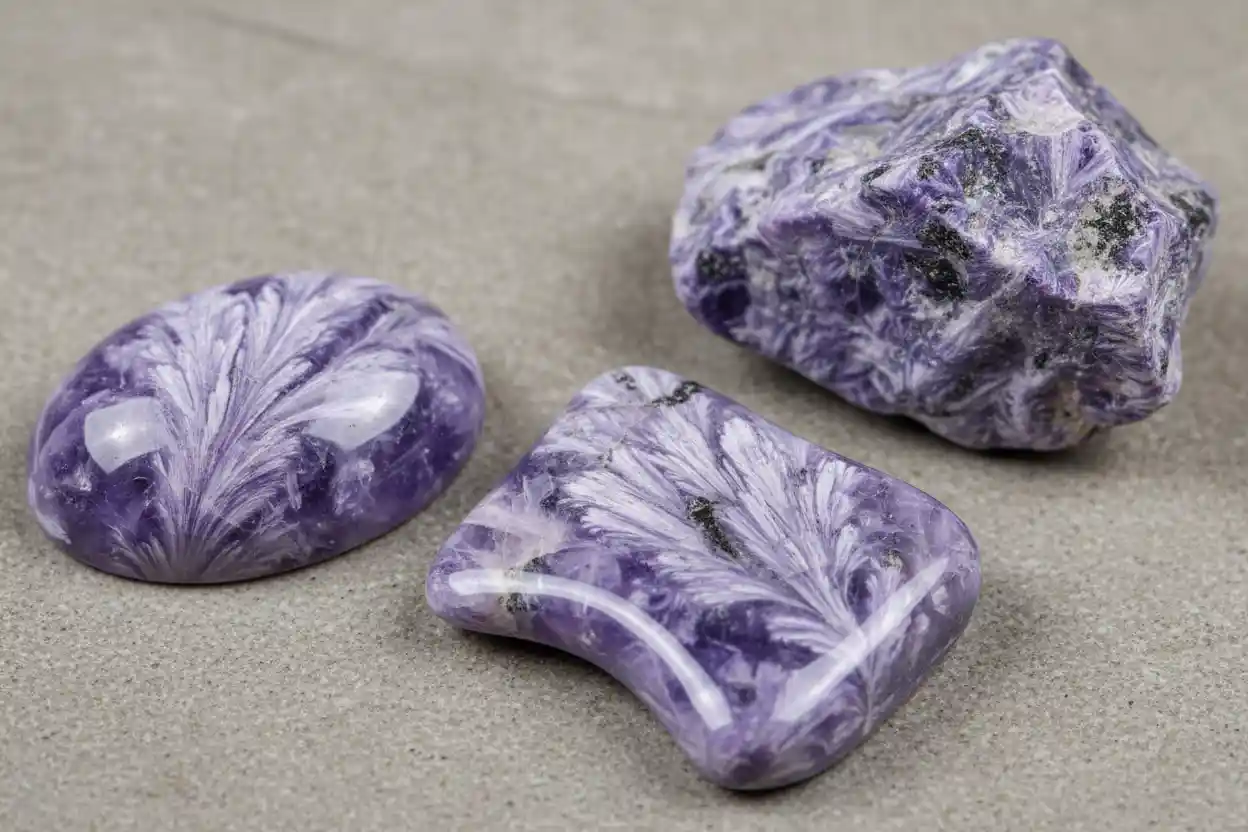
Collectors and jewelry buyers usually encounter charoite as massive fibrous stone rather than isolated textbook crystals. Its most distinctive feature is a flowing, feathered, swirling, or interlocking texture in violet, lilac, lavender, purple, and occasionally pinkish or brownish tones. Some polished areas show a silky or pearly sheen and localized chatoyancy as light moves across aligned fibers. Those visual effects have contributed strongly to charoite color meaning, although the color and optical texture are mineralogical characteristics rather than evidence of healing energy.
Charoite is generally placed around 5 to 6 on the Mohs hardness scale. That gives it better scratch resistance than calcite but leaves it softer than quartz. Mineralogical references also report cleavage, while massive fibrous charoite commonly breaks in ways influenced by its complex intergrowth and associated minerals. A hard impact can therefore chip a polished edge or open an existing weakness even when the piece feels substantial in the hand.
Natural charoite-bearing rock is rarely composed of one perfectly pure mineral. Aegirine may appear as dark green or black needles, while tinaksite and other associated minerals can create brown, yellowish, cream, or contrasting patches. This combination helps create the dramatic patterns prized in carvings, cabochons, beads, boxes, spheres, and ornamental pieces.
Sugilite is probably the best-known visual comparison because both can be intensely purple. Sugilite, however, tends to show a different texture and mineral association, while charoite is famous for directional fibrous swirls. Purple fluorite, lepidolite, dyed stones, and some composite products can also cause confusion when identification relies only on color.
A Modern Mineral From the Murun Massif
Charoite does not support claims of a documented ancient charoite-specific healing tradition. The mineral was approved as a distinct species in the 1970s and formally described in 1978. Its name refers to the Chara River region near the deposit where the studied specimens originated. Modern crystal practices can use charoite within older spiritual frameworks, but those practices should not be rewritten as evidence that ancient societies worked with charoite under its present mineral identity.
Its type locality lies in the Murun massif of eastern Siberia, Russia, in the region around the Chara and Tokko rivers. Charoite formed through unusual metasomatic processes where alkaline igneous rocks interacted with carbonate rocks such as limestone. Potassium-rich fluids altered the surrounding rocks under specific temperature and chemical conditions, producing charoite together with minerals such as aegirine, tinaksite, canasite, feldspar, and others.
This unusual geological setting is one reason genuine charoite is geographically restricted. Unlike quartz, calcite, or agate, it is not known from widespread commercial deposits across many continents. The places where charoite is found center overwhelmingly on the Murun complex and its closely related occurrences.
Rarity can make a gemstone culturally or commercially interesting, but it does not establish a therapeutic effect. The mineral’s genuine value for geology comes from its unusual chemistry, structure, formation environment, and highly distinctive appearance.
Calm, Emotional Balance, and Resilience
1. Calm During Stress
Charoite is often described as a calming stone for periods of pressure, uncertainty, or emotional overload. A practical interpretation is to assign the stone one consistent purpose: whenever it is picked up, pause before responding. That pause might involve several slow breaths, writing down the immediate problem, or deciding whether the situation truly requires action at that moment.
There is no mechanism by which charoite automatically suppresses a stress response. The mineral does not chemically calm the nervous system through touch. A familiar visual or tactile cue can still help someone remember a routine they have intentionally practiced.
2. Emotional Balance
Another common claim presents charoite as supportive during intense emotions. Someone can turn that symbolism into a structured reflection process by separating what happened from what was felt, what was assumed, and what remains unknown.
The stone does not regulate mood or remove difficult feelings. The charoite benefits described in crystal practice are most useful when they point toward behaviors that the person controls, such as journaling, taking time before replying, or seeking appropriate support when distress persists.
3. Resilience During Change
Charoite is strongly associated in contemporary practice with transformation and major life changes. The idea fits its visually dynamic swirls, but the practical version has little to do with mineral energy. A person facing relocation, a changed relationship, a career transition, or an uncertain plan might use the stone while writing three categories: what has changed, what remains controllable, and what needs to happen next.
This is best treated as a metaphor rather than a mechanism. Charoite cannot make an unwanted transition easier by itself. The ritual may help because it directs attention away from an undefined sense of disruption and toward specific decisions.
Confidence, Communication, and Focus
4. Confidence and Courage
Charoite is sometimes associated with courage, particularly when someone must act despite uncertainty. It can be used before a difficult meeting, presentation, phone call, appointment, or personal conversation as a reminder to review preparation and identify one action that needs to be completed.
The stone does not generate courage or increase self-esteem. Confidence develops through preparation, experience, competence, support, and repeated action. Charoite can represent the decision to proceed, but the person still performs the difficult step.
5. Clearer Communication
Communication claims often overlap with charoite’s purple and violet spiritual symbolism. A grounded practice is to use the stone before a sensitive conversation and decide exactly what needs to be said, what question needs to be answered, and what language would unnecessarily escalate the situation.
There is no evidence that charoite changes speech centers or makes another person receptive. Preparation changes communication because it affects the words and tone chosen by the speaker. Short charoite affirmations can fit this routine when they focus on realistic intentions such as speaking accurately, listening fully, or stating a boundary clearly.
6. Focus and Mental Organization
Charoite is sometimes promoted as a stone for mental clarity or concentration. A polished piece on a desk can instead serve as an environmental cue. When the stone is placed beside a notebook or computer, it might signal that notifications are turned off, one task is selected, and work continues for a predetermined interval.
Charoite does not increase memory, intelligence, or attention span. The ways to use charoite become more practical when the stone accompanies an actual concentration strategy rather than replacing one.
Creativity and Intuitive Reflection
7. Creativity and Fresh Perspective
The swirling patterns in charoite can make each polished piece visually complex, which lends itself naturally to creative ritual. A writer, artist, designer, or musician could use the stone as the starting point for ten minutes of unrestricted brainstorming, sketching, color exploration, or free writing.
There is no demonstrated pathway through which charoite activates creativity in the brain. The stone does not supply ideas. A distinctive object can nevertheless make it easier to begin by giving the person a repeatable transition from hesitation into creative work.
8. Intuition and Decision Reflection
Charoite is frequently linked with intuition, inner guidance, or recognizing a personal direction. A safer interpretation is to treat an intuitive reaction as something worth examining rather than as unquestionable information. Write down the immediate feeling about a choice, then compare it with evidence, previous experience, risks, practical consequences, and information that may still be missing.
The mineral does not predict outcomes or reveal hidden facts. Intuition can reflect experience and pattern recognition, but it can also reflect fear, wishful thinking, or bias. A reflection ritual becomes useful when it encourages someone to test an impression rather than automatically obey it.
Protection, Boundaries, and Spiritual Practice
9. Protective Symbolism and Personal Boundaries
Some modern crystal traditions describe charoite as spiritually protective or as a stone that helps prevent emotional influence from other people. There is no demonstrated force field or mineral mechanism that provides this kind of protection.
The stone can instead represent a boundary already chosen by the person. That might mean declining an unreasonable request, ending a hostile conversation, protecting uninterrupted time, delaying an answer when pressure is being applied, or limiting contact where repeated behavior has become harmful. The boundary works because it is stated and maintained. Charoite can simply make the intention visible.
10. Chakra and Spiritual Reflection
Modern crystal practice most frequently associates charoite with the crown chakra because of its violet color, while some systems also link it with the third-eye chakra through themes of contemplation, intuition, and inner reflection. Individual traditions differ, and color-based associations are not universal.
Chakras are a spiritual framework, not anatomical structures established by medical science. A charoite chakra practice therefore belongs to meditation, spirituality, symbolism, and personal belief rather than treatment of the brain, nervous system, glands, or other body structures.
The charoite spiritual meaning often centers on change, perspective, acceptance, purpose, and reflection. Its unusual purple swirls make it easy to understand why modern practitioners developed those associations. Personal symbolism can be meaningful without requiring the hydrated silicate mineral to alter external events or transmit a supernatural force.
Safe Care for Charoite
Charoite’s Mohs hardness of roughly 5 to 6 means polished pieces can scratch more easily than quartz, topaz, sapphire, or diamond. Store jewelry and carvings away from harder gems, especially when highly polished surfaces would show abrasion. A soft pouch, lined compartment, or stable display position reduces unnecessary contact.
Impact is another concern. Charoite has reported cleavage and commonly occurs as a fibrous, intergrown stone containing several associated minerals. A carved edge, thin section, drilled bead, or pre-existing fracture can chip when struck against tile, stone countertops, metal fixtures, or other hard surfaces.
For ordinary cleaning, begin with the least aggressive method. A soft dry cloth is appropriate for routine dust, while a slightly damp cloth can handle light surface dirt on a stable polished piece. Avoid abrasive powders, stiff brushes, harsh household cleaners, acids, bleach, steam, and ultrasonic equipment. These methods offer little advantage for a stone with complex texture and possible internal weaknesses.
Charoite is a hydrated mineral because variable water occurs within its accepted chemical formula. That does not mean a brief accidental splash destroys it, but prolonged soaking offers no care benefit and can create problems for fractures, associated minerals, treatments, adhesives, or jewelry settings. The practical guidance on whether charoite is safe in water therefore favors limited moisture rather than routine immersion.
Natural specimens may contain several associated minerals and trace elements, so charoite should not be soaked in drinking water for ingestion. Ordinary gemstone care and preparing a so-called crystal elixir are completely different activities.
Dry Cleansing for Charoite
Ritual cleansing does not require soaking or abrasive treatment. Sound, quiet reflection, intention-setting, or placing the stone in a clean dedicated location can all serve as symbolic cleansing methods without putting its polished surface or internal structure under unnecessary stress.
A bell, singing bowl, short meditation, or spoken intention may mark the transition between one use and another. These methods do not remove a scientifically demonstrated harmful energy from charoite. Their purpose is personal and ritualistic.
The gentlest ways to cleanse charoite avoid salt burial, long water baths, aggressive scrubbing, steam, and intense heat. With a comparatively rare stone, physical preservation should remain separate from spiritual symbolism.
Conclusion
Charoite is a rare hydrated silicate mineral from the Murun region of Russia, recognized by complex chemistry, violet coloration, fibrous swirls, and an unusual geological origin. Its ten popular healing themes can provide personal prompts for calm, resilience, communication, creativity, boundaries, and reflection, but they remain modern symbolic claims rather than proven therapeutic properties. Charoite is most meaningful when its physical identity is respected and the real work stays with the choices and routines built around it.
Frequently Asked Questions
What are the main charoite healing properties?
Popular claims include calm, emotional balance, resilience, confidence, communication, focus, creativity, intuition, protective symbolism, and spiritual reflection. These are modern crystal-healing traditions rather than established medical effects.
Is charoite an ancient healing stone?
No documented ancient charoite-specific healing tradition is established. Charoite was approved as a distinct mineral species in the 1970s and formally described in 1978, so its current crystal-healing associations are modern.
What is charoite made of?
Charoite is a complex hydrated silicate containing potassium, calcium, sodium, silicon, oxygen, hydroxyl, fluorine, strontium, and variable water, with additional elements occurring in natural specimens.
How hard is charoite?
Charoite is generally around 5 to 6 on the Mohs hardness scale. It can be scratched by harder gemstones and may chip along weaknesses or cleavage after a strong impact.
Can charoite reduce anxiety or emotional distress?
Charoite has not been shown to medically treat anxiety or remove emotional distress. It can be used as a reminder to pause, journal, breathe slowly, or begin another deliberate coping routine.
Does charoite improve intuition?
There is no evidence that charoite reveals hidden information or predicts correct decisions. A person may use it as a prompt to examine an intuitive reaction alongside evidence, experience, risks, and practical consequences.
What chakra is charoite associated with?
Modern crystal practice most commonly links charoite with the crown chakra and sometimes the third-eye chakra. These correspondences belong to spiritual systems rather than human anatomy.
Is charoite suitable for jewelry?
Yes, particularly in pendants, earrings, beads, and protected settings. Its moderate hardness and potential cleavage mean exposed rings and bracelets need more protection from scratches and impacts.
Can charoite go in water?
Brief contact with a small amount of clean water is different from prolonged soaking, but routine immersion is best avoided. Charoite is hydrated, can contain associated minerals and fractures, and needs gentler care than many quartz-family stones.
How should charoite be cleansed?
For ritual cleansing, sound, meditation, intention-setting, or dry placement are gentle approaches. Physical dirt should be handled separately with careful cleaning that avoids abrasion, prolonged soaking, harsh chemicals, steam, and ultrasonic equipment.
Crystal healing claims are traditional or personal beliefs and should not replace qualified medical or mental health care.