11 Real Demantoid Garnet Benefits: Helpful Uses, Evidence, Safe Use & Clear Limits
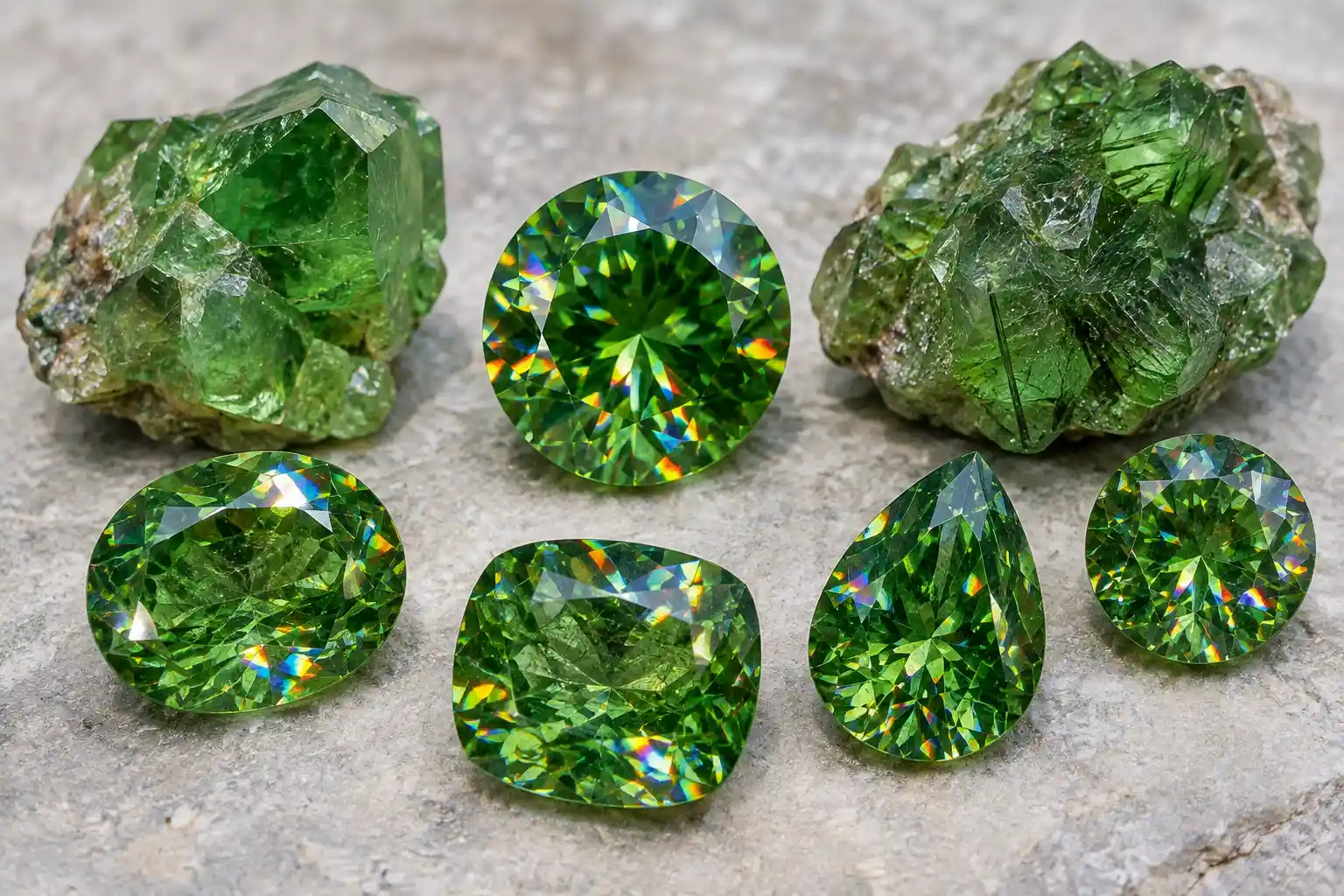
Demantoid garnet benefits begin with an unusual combination of vivid green color, exceptional dispersion, high refractive index, historical importance, collecting scarcity, and distinctive internal features. Demantoid is the green gem variety of andradite garnet, a calcium-iron silicate whose optical performance sets it apart from many other garnets. Fine stones can range from yellowish green through bright grassy green to deeper green, while well-cut examples may display flashes of spectral fire that remain visible even through relatively strong body color.
The name demantoid means diamond-like, a reference to the brilliance and dispersion that helped establish the gem’s reputation after its discovery in Russia’s Ural Mountains. Unlike the much older general history of garnet, demantoid’s distinct gem identity belongs mainly to the modern gemological era. Russian material became particularly admired in imperial jewelry, including work associated with prominent court jewelers, while later discoveries in other countries expanded the known sources without diminishing the historical importance of the Urals.
These measurable properties create substantial demantoid garnet benefits in jewelry, collecting, gem identification, mineral study, historical research, and appreciation of inclusions. Modern crystal traditions sometimes add meanings involving confidence, prosperity, renewal, creativity, or emotional balance, but those interpretations are symbolic rather than established medical effects. Demantoid garnet does not treat cardiovascular disease, anxiety, fertility problems, inflammation, fatigue, or other health conditions through ordinary wearing or handling.
11 Demantoid Garnet Benefits at a Glance
- Exceptional dispersion gives well-cut demantoid vivid flashes of rainbow fire.
- High refractive index produces strong brilliance and a lively visual appearance.
- Natural green coloration provides an alternative to emerald, tsavorite, and other green gems.
- Andradite-garnet identity gives the stone genuine mineralogical and gemological interest.
- Horsetail inclusions can add collecting appeal when they are attractive and appropriately positioned.
- Historic Russian material connects demantoid with important nineteenth-century jewelry traditions.
- International deposits allow collectors to compare color, inclusions, geology, and origin characteristics.
- Faceting can combine strong green body color with unusual optical fire in a single gemstone.
- Gem identification teaches the difference between demantoid, tsavorite, green zircon, peridot, and other green stones.
- Rarity in fine larger sizes gives exceptional specimens strong collecting and value interest.
- Modern symbolism can represent discernment, confidence, or renewal when kept separate from medical claims.
Exceptional Dispersion Gives Demantoid Its Famous Fire
One of the most remarkable demantoid garnet benefits is dispersion, the optical property that separates white light into spectral colors. Demantoid has exceptionally strong dispersion, high enough that a well-cut stone can display conspicuous flashes of red, orange, yellow, blue, and other colors as the gem or observer moves. This rainbow effect explains much of the diamond-like reputation behind the name and can remain visible even when the green body color is relatively strong.
Cutting is critical because optical potential alone does not guarantee beauty. Facet angles, symmetry, pavilion depth, table size, and polish determine how effectively light returns through the crown. A stone cut too shallow may show a transparent window through the center, while excessive depth can trap weight without improving appearance. Fine demantoid therefore rewards cutters who balance weight retention against brightness and fire.
These demantoid garnet benefits are especially important because many buyers initially focus only on green saturation. A slightly lighter stone with excellent cutting and strong dispersion can sometimes appear more lively than a darker specimen that absorbs too much light. Quality is therefore a relationship among color, fire, transparency, cut, inclusions, and size rather than a simple rule that darker green is always better.
Green Andradite Color Gives Demantoid a Distinctive Identity
Demantoid is the green variety of andradite garnet, and its color commonly ranges from yellowish green through vivid medium green to deeper tones. Chromium contributes strongly to the desired green coloration, while iron also affects the overall appearance and can introduce yellowish components. The most attractive stones often balance saturation with enough brightness for the dispersion to remain visible.
This color creates important demantoid garnet benefits for jewelry. Emerald may offer a different type of green, often with a softer appearance and different inclusion patterns, while tsavorite belongs to the grossular garnet species and has its own optical and durability characteristics. Demantoid combines green color with unusually strong fire, giving it an appearance that is difficult to reproduce exactly with other natural gems.
The comparison also illustrates why buyers should not identify a green gemstone by color alone. Several stones can overlap visually, especially in photographs. Mineral identity depends on measurable properties rather than on one hue.
Anyone evaluating demantoid garnet quality should therefore consider hue, tone, saturation, brilliance, fire, clarity, cut, size, inclusions, and origin documentation together.
Horsetail Inclusions Can Increase Rather Than Reduce Collector Interest
In many transparent gemstones, visible inclusions are considered undesirable because they interfere with clarity. Demantoid provides one of the most famous exceptions. Fine radiating fibrous structures known as horsetail inclusions can increase the appeal of certain stones, particularly when the inclusions form a graceful pattern without excessively reducing transparency.
These features became strongly associated with historic Russian demantoid, but they should not be treated as automatic proof of Russian origin. Similar horsetail structures have been documented in demantoid from other geological sources. Origin determination requires a wider set of gemological evidence rather than one inclusion alone.
The collecting significance of horsetails provides an important lesson among demantoid garnet benefits: an inclusion is not inherently good or bad. Its effect depends on the gem species, appearance, location, rarity, and what the inclusion reveals about formation.
A delicate horsetail positioned attractively beneath the table may become a focal feature, while a dense mass of inclusions that severely reduces transparency can still lower visual appeal. The quality judgment therefore depends on the entire stone rather than on the simple presence or absence of inclusions.
Demantoid Connects Jewelry with Important Russian Gem History
Historical context is another substantial source of demantoid garnet benefits. The gem became known after discoveries in Russia’s Ural Mountains and quickly attracted attention because of its green color, brilliance, and extraordinary fire. Demantoid later became associated with high-end Russian jewelry and objects created during the imperial period, including pieces from workshops connected with renowned court jewelers.
This history gives older Russian material significance beyond color and weight. An antique piece with credible provenance can represent gem discovery, mining history, lapidary fashion, jewelry craftsmanship, and changing political and economic conditions at the same time.
Collectors should nevertheless distinguish genuine historical provenance from modern styling. A newly cut demantoid placed in an antique-inspired setting does not automatically become an imperial Russian jewel, and an old-fashioned cut alone cannot establish age.
These distinctions make demantoid history useful for both collectors and buyers. Documentation, construction, setting style, stone characteristics, and professional evaluation all matter when an object is sold with important historical claims.
International Sources Make Demantoid an Excellent Comparative Gem
Although Russia established demantoid’s reputation, gem-quality stones have since been found in several other regions, including parts of Africa, Europe, the Middle East, and Asia. These deposits expand the range of colors, inclusions, sizes, and geological environments available to collectors.
Some non-Russian stones can be exceptionally bright and clean, while others contain inclusions that reveal distinctive formation conditions. Namibia and Madagascar became important commercial sources, and demantoid has also been documented from Italy, Iran, Pakistan, Afghanistan, and other locations.
This geographic diversity creates demantoid garnet benefits for comparative collecting. A collector can examine how geology affects color, inclusion scenes, crystal form, and rough morphology rather than assuming every demantoid must resemble classic Ural material.
Origin can influence market value, particularly when Russian provenance is well documented, but origin alone should not replace quality assessment. A beautifully cut, intensely green stone from another source may be visually superior to a weakly colored or poorly cut stone from a more famous locality.
Demantoid Provides Valuable Lessons in Garnet Mineralogy
Many consumers think of garnet as a dark red gemstone, yet the garnet group includes several mineral species and a wide range of colors. Demantoid garnet benefits mineral education because it demonstrates how dramatically members of the garnet group can differ in chemistry and appearance.
Demantoid belongs to andradite, the calcium-iron member of the garnet group, while tsavorite is green grossular. Both may appear green, yet their chemistry and optical properties differ. Demantoid generally has higher refractive index and dispersion, while grossular has somewhat different hardness and visual character.
These distinctions help explain why the word garnet describes a group rather than one single gemstone with one fixed set of characteristics. Composition influences color, optical behavior, density, hardness, inclusions, and geological occurrence.
For students, demantoid therefore turns a familiar jewelry category into a useful introduction to mineral groups, solid-solution relationships, trace-element coloration, and the relationship between chemistry and optical performance.
Jewelry Use Combines Rarity with Exceptional Optical Character
Demantoid works especially well in rings, earrings, pendants, brooches, and collector-focused jewelry where good lighting can reveal its fire. Smaller stones can appear surprisingly lively because dispersion remains strong even when carat weight is modest, while fine larger stones can become major focal gems because high-quality demantoid is less common in substantial sizes.
Andradite is not as hard as sapphire or diamond, so everyday ring wear deserves reasonable caution. A protected setting can reduce impact around the girdle, while earrings and pendants generally expose the gemstone to less abrasion. Warm soapy water and gentle cleaning are appropriate for many garnets, while harsh treatments and severe thermal shock should be avoided.
These practical limits do not diminish demantoid garnet benefits. They simply mean the setting should respect the actual gemstone rather than treating rarity as proof of invulnerability.
Good design can also emphasize optical properties. Open settings allow light access, while darkened metal or contrasting diamonds can make the green body color appear particularly vivid.
Identification Skills Help Separate Demantoid from Other Green Gems
Demantoid can resemble several green gemstones in photographs, including tsavorite, peridot, green zircon, tourmaline, and even emerald under certain conditions. Accurate identification therefore relies on gemological properties rather than color alone.
High refractive index, strong dispersion, garnet optical behavior, density, inclusions, spectroscopy, and other testing can help establish identity. Horsetail inclusions may support identification in appropriate cases, but they should not be treated as a universal requirement because many demantoids lack them.
A person preparing to buy demantoid garnet should therefore prioritize reputable identification, realistic photographs, cut quality, origin documentation when relevant, and seller disclosure rather than relying on phrases such as Russian style or horsetail type.
These identification-focused demantoid garnet benefits extend beyond one gemstone. Learning why two green stones require different tests improves judgment throughout colored-gem buying.
Fine Larger Stones Combine Scarcity with Strong Collector Demand
Demantoid occurs in small sizes more commonly than in fine large transparent gems. As size rises, maintaining strong green color, brilliance, acceptable clarity, and attractive cutting becomes increasingly difficult, which is why exceptional larger stones can attract significant collector attention.
This scarcity influences demantoid garnet price alongside color, origin, clarity, horsetail inclusions, cutting, certification, and overall beauty. Value therefore does not increase through carat weight alone. A large dull stone with weak color may be less desirable than a smaller gem whose brilliance and saturation are exceptional.
Collectors also need to distinguish rarity from automatic investment performance. Scarcity can support value, but future market prices depend on demand, provenance, condition, economic circumstances, and many other factors that no gemstone can guarantee.
The real benefit is the opportunity to own a gem combining rarity, optical fire, historical identity, and distinctive mineralogy in one stone.
Modern Symbolism Can Represent Discernment, Renewal, and Confidence
Green gems frequently acquire symbolism involving renewal, prosperity, growth, confidence, or abundance, and demantoid is no exception. Its unusually bright appearance can also inspire ideas about clarity and discernment, while the contrast between valuable horsetail inclusions and conventional clarity expectations can symbolize recognizing worth in features that initially appear imperfect.
These are modern or personal interpretations rather than demonstrated gem effects. Someone may wear demantoid to mark professional growth, a new chapter, or an important achievement because the green color and rarity feel appropriate. Another owner may associate the stone with discernment because buying fine demantoid requires careful evaluation rather than reliance on one simple quality rule.
The gemstone does not create confidence, attract money, guarantee success, or medically influence mood. The symbolic meaning comes from the connection the owner develops with the object.
Safe Limits Keep Demantoid Garnet Benefits Evidence-Based
Demantoid’s chemical composition, green color, and strong optical properties do not establish medicinal effects. There is no reliable clinical evidence that wearing the gem improves circulation, fertility, heart function, metabolism, inflammation, anxiety, or other health conditions.
Similarly, trace elements responsible for color remain bound within the gemstone structure and should not be treated as nutrients delivered through skin contact.
Gentle spiritual or meditative use can still be meaningful for someone who views the stone symbolically. The important distinction is that personal meaning and clinical treatment answer different questions.
The real demantoid garnet benefits are already considerable through fire, brilliance, green color, collecting rarity, jewelry use, historical importance, mineral education, inclusions, and gem identification.
Conclusion
Demantoid garnet benefits include exceptional dispersion, strong brilliance, natural green color, mineralogical interest, historic Russian significance, collectible horsetail inclusions, international locality diversity, jewelry appeal, identification value, and scarcity in fine larger sizes.
Its greatest strength is the combination of characteristics rather than any one feature. A fine demantoid can show intense green color, rainbow fire, historical provenance, and fascinating inclusions simultaneously. Modern symbolism involving confidence, renewal, or discernment can add personal significance when it remains clearly separate from medical or financial promises.
FAQs
What are the main demantoid garnet benefits?
The most verifiable demantoid garnet benefits include exceptional fire, strong brilliance, vivid green color, jewelry use, collecting, historical significance, mineral education, distinctive inclusions, and gemstone identification.
What type of garnet is demantoid?
Demantoid is the green gem variety of andradite garnet, a calcium-iron silicate member of the garnet group.
Why does demantoid sparkle so strongly?
Demantoid has unusually high dispersion and a high refractive index, allowing well-cut stones to display both strong brilliance and noticeable spectral fire.
What are horsetail inclusions?
Horsetails are distinctive radiating fibrous or tube-like inclusion structures found in some demantoid garnets. Attractive examples may add collector appeal instead of automatically reducing value.
Do horsetail inclusions prove Russian origin?
No. Horsetail-type inclusions have also been documented in demantoid from some non-Russian localities, so origin requires more evidence than one inclusion feature.
Is demantoid harder than tsavorite?
No. Demantoid is andradite, while tsavorite is grossular. Andradite is somewhat softer, although demantoid generally has higher refractive index and stronger dispersion.
Is demantoid suitable for jewelry?
Yes. Demantoid is widely faceted for jewelry, although rings benefit from protective settings and reasonable care because the stone is less hard than sapphire or diamond.
Why is Russian demantoid famous?
The Ural Mountains provided the classic historic source, and fine Russian stones became associated with imperial-era jewelry and exceptional horsetail inclusions.
Is demantoid naturally green?
Yes. Demantoid is naturally green to yellowish green, with chromium playing an important role in desirable green coloration.
Is large demantoid rare?
Fine transparent demantoid is more commonly encountered in smaller sizes, so larger stones combining strong color, good clarity, and excellent cutting can be particularly desirable.
Does demantoid garnet have healing benefits?
There is no established clinical evidence that demantoid garnet treats physical or mental-health conditions through ordinary wearing or handling.
Demantoid garnet benefits described as healing, prosperity-related, emotional, protective, or energetic effects remain spiritual and personal beliefs and should not replace qualified medical, mental-health, or financial advice.