Buy Demantoid Garnet: How to Evaluate Stones, Treatments, Grading & Cost
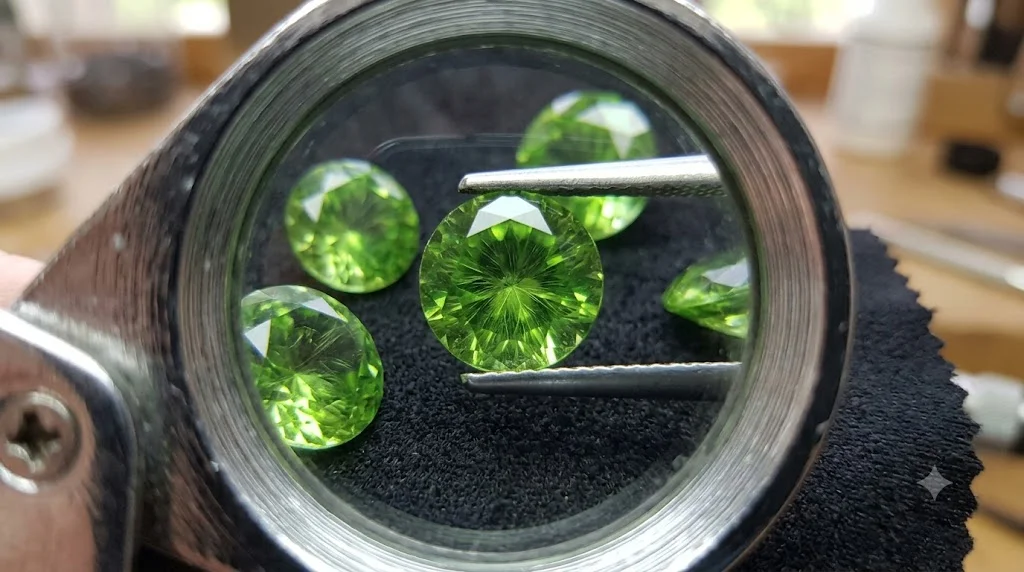
To buy demantoid garnet intelligently, evaluate color, fire, size, clarity, cut, origin, treatment, condition, documentation, and seller claims as one connected quality profile. Demantoid is the green gem variety of andradite garnet, not a type of emerald, tsavorite, peridot, or diamond. GIA identifies andradite as a calcium-iron garnet and describes demantoid as one of the rare and famous green members of the garnet group, distinguished by unusually high dispersion that can produce exceptional spectral fire when the stone is cut effectively.
This combination of rarity, strong green color, fire, small typical sizes, and collector interest makes demantoid a stone for which details matter greatly. GIA notes that demantoid is commonly found in smaller sizes and that its value can rise significantly as size increases. Fine stones can also contain distinctive “horsetail” inclusions that sometimes increase value instead of reducing it, an unusual reversal of the assumption that every inclusion is undesirable. Buyers should therefore avoid generic rules borrowed from diamonds and should never rely solely on a seller’s AAA label, Russian-origin claim, or carat weight.
Buy Demantoid Garnet At a Glance
| Buying Factor | What to Examine | Why It Matters |
|---|---|---|
| Identity | Green andradite garnet rather than tsavorite, peridot, glass, or another green gem | Correct identity is the basis of every value comparison |
| Color | Hue, saturation, yellow/brown modifiers, evenness | Rich green or fresh minty green with strong life attracts strong demand |
| Fire | Spectral flashes and brilliance | Demantoid is prized for unusually high dispersion |
| Size | Carat weight and millimeter dimensions | Fine larger demantoid is comparatively scarce |
| Clarity | Distracting fractures versus attractive horsetail inclusions | Some inclusions lower value, while classic horsetails can increase collector appeal |
| Cut | Proportions, symmetry, polish, face-up fire | Good cutting helps display demantoid’s defining optical character |
| Origin | Russia, Namibia, Madagascar, Italy, Pakistan, Iran, or other source | Origin can influence collector demand but requires evidence |
| Horsetails | Type, position and appearance of fibrous inclusions | Attractive examples can add value but do not automatically prove Russian origin |
| Heat Treatment | Known or detected heating | Some Russian demantoid is heated to reduce brownish color |
| Other Treatments | Fracture filling or unusual enhancement | Garnets are rarely treated, but disclosure remains important |
| Condition | Chips, abrasion, girdle wear, scratches | Demantoid is somewhat softer than several other popular garnets |
| Documentation | Independent identification and origin report when justified | Reduces uncertainty about identity, treatment, and geographic source |
Demantoid Is Green Andradite Garnet
The garnet group contains several different mineral species rather than one single mineral with one composition. GIA identifies andradite as one of the commercially important garnet species and distinguishes demantoid as its green gem variety. Tsavorite, although also green and marketed in overlapping colors, belongs to grossular garnet instead. GIA notes that andradite has higher refractive index and dispersion than grossular but is somewhat softer.
This mineralogical distinction matters when buying because visual similarity does not establish identity. A green stone may resemble demantoid but turn out to be tsavorite, peridot, green glass, synthetic material, or another gemstone entirely. A trusted specialist may provide adequate confidence for a modest purchase, while an expensive or unusually large stone deserves independent laboratory verification.
The name demantoid itself comes from the gem’s diamond-like optical effect rather than any relationship to diamond. GIA’s reporting on Russian material explains that its high refractive index and dispersion inspired the name, which literally alludes to diamond-like appearance.
Color Should Be Balanced With Fire
Demantoid ranges from yellowish green through rich green, and GIA field reporting from Madagascar identifies rich jungle green and fresh minty green material with strong fire as particularly sought after while noting that stronger brown or yellow components tend to be less desirable. Russian production likewise spans multiple greens, with pure vibrant green considered especially fine in the material documented by GIA.
The deepest green stone is not automatically the best purchase. Demantoid’s famous fire becomes more visible when bodycolor allows spectral flashes to show through, so very strong color can sometimes mask part of the dispersion. GIA’s Madagascar field reporting specifically notes that lighter material can reveal more fire than more saturated stones.
This produces a real aesthetic trade-off. One buyer may prefer maximum green saturation, while another values the distinctive rainbow flashes that justify the demantoid name. The strongest stone for a particular buyer is the one that achieves an attractive balance rather than winning a single-variable contest.
Fire Is a Defining Demantoid Quality
GIA highlights demantoid’s high dispersion and notes that a well-cut stone can display an exceptional amount of fire. Dispersion refers to the separation of white light into spectral colors, which appears as red, blue, orange, and other flashes when the gemstone moves under suitable lighting.
Cut quality directly affects whether this optical property becomes visible. A stone with excellent rough material but poor proportions can show less life than a smaller gem cut to display both brilliance and dispersion. GIA notes that demantoid is often cut to exact proportions specifically to maximize fire.
When shopping online, request video rather than relying exclusively on static photographs. Still images can capture an isolated flash but do not reveal whether the stone remains lively across ordinary movement and lighting.
Larger Fine Demantoids Deserve Greater Scrutiny
GIA’s garnet quality guidance states that demantoid is commonly found in smaller sizes and that value rises significantly as size increases. Field reporting from Russian mines similarly notes limited production of larger stones and historically stronger prices for larger sizes.
Large stones should consequently receive more verification, not less. If a several-carat demantoid combines strong green color, excellent clarity, fine cutting, and a prestigious origin claim, the financial importance of confirming those characteristics increases.
Carat weight still does not equal quality. A larger stone with brownish color, a large window, weak fire, serious fractures, or poor polish may be less desirable than a smaller but exceptional stone. Compare face-up dimensions alongside weight so that you understand how much visual size the cut delivers.
Horsetail Inclusions Can Increase Value
Demantoid is unusual because certain inclusions can add collector appeal. GIA states explicitly that horsetail inclusions in demantoid are among the few internal features that can increase a gemstone’s value. These inclusions typically appear as radiating fibrous structures and can create a beautiful internal pattern when well positioned.
A horsetail should not automatically be treated as proof that every included demantoid is superior. Heavy fractures, dark crystals, cloudy areas, or inclusions that substantially interfere with brilliance can still lower visual quality. The premium applies to attractive or characteristic horsetails within an otherwise desirable gemstone, not to inclusion quantity in general.
Some cutters intentionally orient a particularly beautiful horsetail under the table so that the feature becomes part of the stone’s visual identity. GIA has documented faceted demantoids cut specifically to showcase spectacular horsetail inclusions.
Horsetails Do Not Automatically Prove Russian Origin
The popular association between Russian demantoid and horsetail inclusions is real but incomplete. GIA states that not all Russian demantoids contain horsetails and that similar inclusions occur in demantoids from locations including Italy and Iran; research also documents fibrous inclusions in material from Pakistan.
GIA research further shows that classic-looking horsetail structures can occur in non-green andradite as well, meaning the inclusion itself should not be treated as a standalone identity or origin test.
A seller who says “horsetail therefore Russian” is oversimplifying modern gemological evidence. If Russian origin materially influences the asking price, request independent geographic-origin documentation rather than relying on the inclusion alone.
Geographic Origin Can Now Be Reported by GIA for Demantoid
Origin matters in the demantoid market because Russian stones have a long historical reputation and specific deposits in Namibia, Madagascar, Italy, Pakistan, and Iran produce material with different typical characteristics. As of current GIA services, natural demantoid is eligible for GIA’s Colored Stone Identification & Origin Report, which can include geographic origin when determinable.
This is especially useful because seller origin statements and laboratory origin conclusions are not equivalent. A dealer may have strong mine-to-market provenance, but a written sales claim should still be described for what it is. When a large premium rests on Russian, Namibian, Madagascan, Pakistani, or another specific origin, independent laboratory evidence can reduce uncertainty.
Origin should also remain separate from quality. A mediocre Russian demantoid is not automatically finer than an exceptional stone from another source. Color, fire, size, cut, clarity, treatment, and condition still determine the actual beauty of the individual gem.
Russia Is Historically Important but Not the Only Source
The Russian Ural Mountains are the classic historical source of demantoid, and GIA documents both historic and modern production from Russian deposits. Modern gem-quality demantoid is also known from Namibia, Madagascar, Italy, Iran, and Pakistan, with different geological settings and inclusion profiles.
Pakistan is particularly relevant because GIA has studied demantoid from Baluchistan and documented serpentinite-related material containing magnetite and chrysotile features. Italian Val Malenco demantoid is also well documented and can contain classic horsetail inclusions.
These sources expand buyer choice and reinforce why “Russian-looking” is not a gemological origin determination.
Heat Treatment Is Possible and Should Be Disclosed
Garnet has traditionally been considered a relatively untreated gemstone group, but demantoid is an important exception. GIA’s review of gem treatments documents low-temperature heating of some Russian demantoid to reduce or remove brown coloration. GIA field reporting from Russian mines likewise notes that brownish material from some deposits can be heated to improve green appearance.
Treatment should not automatically disqualify an otherwise fine stone. Heated demantoid can be beautiful, and treatment acceptance depends on market expectations and disclosure. The critical issue is whether the seller states what is known and whether any premium for untreated material is supported by appropriate evidence.
Detection can also be complex. GIA’s treatment literature notes that low-temperature demantoid heating may not always produce simple measurable indicators, which means buyers should avoid demanding certainty that current gemological science cannot always provide.
Fracture Filling Is Rare but Still Worth Asking About
GIA notes that garnets may rarely be treated through fracture filling and recommends gentler cleaning for filled stones. Fracture filling should be treated separately from heat because it alters the apparent clarity of surface-reaching fractures and can introduce different durability considerations.
A seller who describes a demantoid simply as “natural” has not necessarily answered the treatment question. Natural geological origin and treatment status are separate concepts.
For a high-value purchase, written treatment disclosure is preferable to vague verbal assurances.
AAA and Similar Garnet Grades Are Seller-Defined
GIA states clearly that no standard AAA, AA, or A quality-grading scale exists for garnet, even though individual sellers may create their own commercial descriptions. That means one retailer’s AAA demantoid cannot automatically be compared with another retailer’s AAAA or “collector grade” stone.
Replace the label with actual characteristics: hue, tone, saturation, brown or yellow modifiers, fire, carat weight, dimensions, clarity, horsetail quality, cutting, treatment, origin, and condition.
A transparent seller should be able to explain why a stone occupies the highest level of their inventory without relying solely on the grade name.
Cut Quality Should Reveal Both Green Color and Dispersion
Demantoid has enough optical power that poor cutting wastes one of the stone’s strongest natural advantages. GIA specifically notes that demantoid is often cut to proportions chosen to enhance fire.
Examine whether the stone has a large transparent window through the center, excessive dark extinction, poor symmetry, uneven polish, or unnecessary depth. Weight retention can be understandable in rare rough, but a buyer should pay for the finished gemstone rather than for carats hidden beneath the girdle.
Face-up millimeter size therefore belongs next to carat weight in every serious comparison.
Durability Is Good but Requires Realistic Expectations
Garnets range from approximately 6.5 to 7.5 on the Mohs scale, and GIA identifies demantoid as somewhat softer than harder garnet varieties such as tsavorite. Garnets generally have fair to good toughness and can be used in jewelry with sensible care.
This makes demantoid suitable for rings, earrings, pendants, and other jewelry, but a valuable stone should be protected from hard blows and abrasive wear. Warm soapy water is the safest general cleaning method; GIA advises against steam and recommends avoiding ultrasonic cleaning for fractured stones.
Existing chips or abrasion should influence price because repolishing can remove weight from a gem whose larger sizes already command scarcity premiums.
A Laboratory Report Is Not an Appraisal
GIA’s colored-stone services can identify demantoid, document measurable characteristics, report detectable treatments, and—through its current origin service—provide a geographic-origin conclusion when determinable.
That report does not state whether the seller’s asking price is fair. Monetary appraisal requires a separate market analysis based on comparable stones, quality, transaction type, and intended value definition.
A high-value demantoid can benefit greatly from a laboratory report because identity and origin uncertainty may materially affect marketability, but documentation should support the valuation rather than replace it.
Compare Demantoid With Demantoid, Not Just “Green Garnet”
Tsavorite and demantoid can overlap visually but belong to different garnet species and display different optical characteristics. GIA states that tsavorite is green grossular while demantoid is green andradite, with demantoid having higher refractive index and dispersion.
A general “green garnet price” comparison can therefore be misleading. Buyers should compare demantoid against demantoid of similar size, color, fire, clarity, treatment, origin, and cut.
For broader context, Gems Lore’s rarest gemstones in the world guide explains why rarity must be separated from individual stone quality, while most expensive gemstones shows why record-level gems should not be used as everyday retail benchmarks.
Red Flags When You Buy Demantoid Garnet
Several claims deserve further verification:
“Horsetail inclusion proves Russian origin.”
“AAA” presented as an independent laboratory grade.
Exceptionally large vivid-green demantoid offered with no credible documentation.
Seller origin claim carrying a large premium without an origin report or strong provenance.
“Untreated” used without explaining the basis for the statement.
Brownish material represented as top vivid green in heavily edited photographs.
No millimeter dimensions supplied for an expensive loose stone.
Large windows or weak fire concealed by one favorable photograph.
Laboratory report described as an appraisal or guarantee of fair price.
Guaranteed appreciation or investment return claims.
A reputable seller should be comfortable discussing what is known, what remains uncertain, and what independent documentation supports.
Conclusion
To buy demantoid garnet well, judge the complete stone rather than one prestige signal. Demantoid is green andradite valued for its combination of green color and exceptional dispersion, while fine larger examples are comparatively scarce. Horsetail inclusions can add collector appeal, but they do not automatically prove Russian origin, and treatment through low-temperature heating has been documented in some Russian material.
The strongest purchase balances color, fire, size, cut, clarity, condition, treatment disclosure, origin evidence, and seller protection. Current GIA services can provide geographic-origin reporting for natural demantoid when determinable, making unsupported locality claims less necessary for serious transactions. Buyers who insist on those distinctions can appreciate demantoid’s rarity without allowing rarity language to replace gemological evidence.
Frequently Asked Questions
What should I look for first when I buy demantoid garnet?
Confirm identity, then examine green color, fire, carat weight and dimensions, clarity, cut, treatment, condition, and origin evidence. Fine demantoid should combine attractive green color with the lively dispersion for which the variety is famous.
Is demantoid a type of garnet?
Yes. Demantoid is the green gem variety of andradite garnet. Tsavorite is a different green garnet belonging to grossular.
Are horsetail inclusions good in demantoid?
They can be. GIA notes that attractive horsetail inclusions are among the unusual inclusions that can increase demantoid value. Other fractures or distracting inclusions can still reduce beauty or durability.
Does a horsetail prove Russian origin?
No. GIA reports horsetails in demantoid from other localities, including Italy and Iran, and research has documented similar fibrous structures in Pakistani material. Geographic origin should be supported independently.
Can GIA determine demantoid origin?
Yes. GIA currently includes natural demantoid among stones eligible for its Colored Stone Identification & Origin Report when origin can be determined.
Is demantoid usually treated?
Most garnets are not routinely treated, but low-temperature heating of some Russian demantoid to reduce brown coloration is documented. Rare fracture filling is also possible within the garnet group.
Is larger demantoid more valuable?
Fine larger stones can command sharply higher values because demantoid is more commonly encountered in small sizes. GIA states that value rises significantly with size for demantoid when quality remains strong.
What does AAA demantoid mean?
AAA is a seller-defined commercial label rather than a universal laboratory grade. GIA states that no standardized A/AA/AAA quality scale exists for garnet.
Is Russian demantoid always better?
No. Russian material has strong historical recognition and can be exceptional, but demantoid from Namibia, Madagascar, Italy, Pakistan, Iran, and other sources can also be beautiful. Color, fire, size, cut, clarity, treatment, and condition still matter.
Is demantoid suitable for rings?
Yes with appropriate care. Garnet has fair to good toughness, but demantoid is somewhat softer than several other garnet varieties. Protective setting design is sensible for a valuable daily-wear ring.