Buy Garnet: Buying Criteria, Provenance, Treatments & Returns
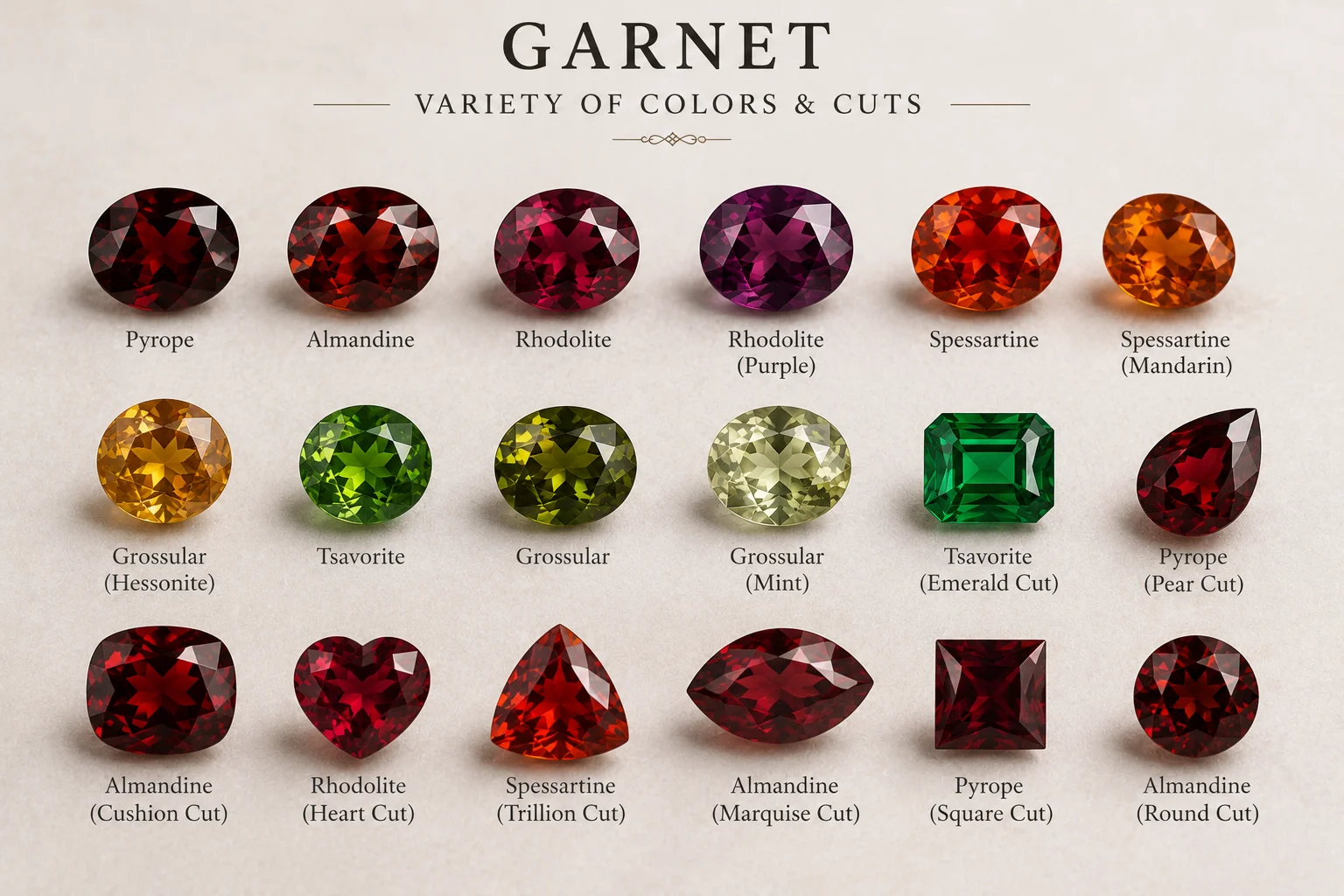
To buy garnet intelligently, identify the specific garnet species or variety before comparing color, clarity, size, cut, origin, or price. Garnet is not one single mineral with one predictable quality profile. It is a group of closely related minerals sharing a general crystal structure while varying in chemical composition, color, optical properties, typical inclusion patterns, durability, rarity, and size availability. GIA identifies pyrope, almandine, spessartine, grossular, and andradite as the principal commercially important gem species, with uvarovite also recognized as a green garnet that normally occurs in crystals too small for conventional faceting. Many gem garnets are chemical mixtures rather than perfectly pure end-member species.
That diversity explains why generic advice such as “good garnet should be eye-clean,” “large garnet is rare,” or “garnet is inexpensive” can all be misleading. Red almandine may remain affordable in large sizes, while fine tsavorite and demantoid can become significantly more valuable as size increases. Rhodolite is commonly expected to be relatively clean, whereas hessonite and some spessartines can show characteristic visible inclusions. GIA therefore advises buyers to think of garnets by type and color rather than as one homogeneous gemstone.
Buy Garnet At a Glance
| Buying Factor | What to Examine | Why It Matters |
|---|---|---|
| Species/Variety | Almandine, pyrope, rhodolite, spessartine, hessonite, tsavorite, demantoid, or another garnet | Different garnets have very different rarity, clarity, size, and price profiles |
| Color | Hue, tone, saturation, secondary modifiers | Color is the leading garnet quality factor |
| Clarity | Expectations appropriate to the garnet variety | Some types are normally eye-clean; others commonly contain visible inclusions |
| Cut | Brightness, symmetry, windowing, polish, face-up spread | Poor cutting can reduce brilliance and marketability substantially |
| Size | Carat weight plus millimeter dimensions | Large-size rarity differs sharply among garnet varieties |
| Phenomena | Color change, star, cat’s-eye, demantoid fire | Optical phenomena can create specialized collector demand |
| Inclusions | Ordinary clarity features versus desirable demantoid horsetails | Inclusion effect depends strongly on garnet type |
| Treatment | Fracture filling or unusual modification | Garnet is commonly untreated, making disclosure of treatment important |
| Origin | Provenance and evidence rather than country name alone | Source can interest collectors but does not replace quality |
| Condition | Chips, facet abrasion, fractures, repolishing | Garnet hardness and toughness vary by type |
| Documentation | Laboratory identification for expensive or unusual material | Confirms what garnet type the seller is actually offering |
| Retail Grade | AAA, AAAA, collector grade, investment grade | No universal garnet grading scale exists |
Start by Identifying the Garnet Type
The biggest mistake when buyers shop for garnet is assuming that every red, orange, or green garnet follows the same quality and pricing rules. GIA describes garnet as a group containing many gem types across almost the entire color spectrum and emphasizes that the first task is understanding the type being purchased.
Almandine and pyrope dominate much of the traditional red-garnet market, while rhodolite is a purplish-red pyrope-almandine mixture valued for its brighter color. Spessartine covers attractive orange tones, hessonite is an orange-to-brownish-red grossular variety, tsavorite is vivid green grossular, and demantoid is green andradite famous for strong dispersion.
A listing that says only “genuine garnet” therefore provides incomplete buying information. Ask what variety or species the seller believes the stone represents and what evidence supports that identification.
Color Is the Most Important Garnet Quality Factor
GIA explicitly identifies color as garnet’s leading quality factor. Red pyrope and almandine can range from purple-red through orangy red; rhodolite commonly offers purplish-red color; spessartine occupies orange hues; andradite can occur from yellow through green; grossular spans colorless, yellow, orange, reddish-orange, and vivid green.
The best color therefore depends on the variety. A deep red that might be attractive in pyrope does not define quality in spessartine, while vivid green is central to tsavorite and demantoid markets.
Tone also matters. Some red garnets become so dark that areas appear nearly black because light is absorbed inside the stone. GIA notes that strongly brown or very dark red material is much more common than pure bright red garnet. A buyer should therefore inspect brightness and saturation rather than assuming darker always means finer.
Rhodolite Should Be Judged Differently From Ordinary Dark Red Garnet
Rhodolite is a purplish-red garnet variety generally associated with pyrope-almandine compositions. GIA identifies it specifically as a purplish-red variety and notes that red garnets such as pyrope, almandine, and rhodolite commonly lack eye-visible inclusions.
This means buyers can reasonably expect clean-looking transparent rhodolite in ordinary faceted sizes. A heavily included stone should therefore offer another exceptional attribute or a lower price to justify the compromise.
Bright raspberry, purplish-red, and pinkish-red appearances can attract stronger demand than overly dark brownish-red material because they preserve transparency and brilliance more effectively.
Spessartine Requires Its Own Clarity Expectations
Spessartine is an orange garnet, and GIA notes that orange garnets such as spessartine often contain eye-visible inclusions. Buyers should therefore avoid automatically rejecting every included orange garnet if the stone possesses exceptional vivid color and strong brilliance.
Clean stones can still command premiums, particularly when color, size, and cut are also strong. The key is whether inclusions interfere with transparency or beauty rather than whether any inclusion exists.
Bright pure-to-reddish orange material generally occupies a different market from brownish or dark orange stones, so color quality should remain the starting point.
Hessonite’s Internal Appearance Can Be Characteristic Rather Than Defective
Hessonite is an orange to reddish-orange or brownish-red grossular garnet that can show a characteristic turbulent or roiled internal appearance. GIA specifically highlights this “roiled” effect when discussing garnet clarity.
A buyer should therefore not apply rhodolite clarity expectations to hessonite. Some internal texture is typical for the variety and can even support identification.
Value still depends on how strongly the internal structure interferes with transparency and brilliance. A lively orange hessonite with characteristic texture may be preferable to a darker, duller stone simply because the latter looks superficially cleaner.
Tsavorite Is Rare in Larger Fine Sizes
Tsavorite is the vivid green variety of grossular garnet. Unlike common red garnets, fine tsavorite becomes significantly scarcer as size increases. GIA explicitly notes that tsavorite and demantoid are more commonly found in smaller sizes and that their values can rise substantially with carat weight.
Color remains critical. Fine tsavorite should look lively and richly green rather than overly dark, yellowish, or gray. Large size should not compensate for weak saturation or obvious windowing.
An expensive green garnet should also be identified professionally because tsavorite, demantoid, and other green gems can overlap visually while belonging to different mineral species and markets.
Demantoid Combines Green Color With Exceptional Fire
Demantoid is green andradite garnet and has unusually high dispersion, producing strong spectral fire in well-cut stones. GIA identifies that optical effect as one of demantoid’s defining attractions.
The Gems Lore guide on how to buy demantoid garnet covers its specialized buying issues in detail, including color, fire, horsetail inclusions, treatment, and origin. The companion demantoid garnet price guide explains why fine larger stones belong to a much more expensive market than ordinary red garnet.
Buyers should therefore never use a generic “garnet price per carat” figure to evaluate fine demantoid.
Horsetail Inclusions Can Increase Demantoid Value
Most gemstone markets reward fewer inclusions, but demantoid provides an important exception. GIA notes that classic horsetail inclusions are one of the rare internal features that can actually increase a gemstone’s value.
The premium depends on attractiveness rather than inclusion quantity alone. Delicate radiating fibers positioned beautifully beneath the table can add collector appeal, while distracting fractures or dark inclusions can still reduce quality.
Horsetails should also not be treated automatically as proof of Russian origin. GIA notes that similar inclusions occur in demantoid from other localities.
Color-Change Garnet Belongs to a Specialized Category
GIA recognizes color-change garnets among the unusual optical phenomena found in the garnet group. These stones can shift significantly under daylight-equivalent and incandescent illumination and may contain mixed garnet compositions.
The strength, attractiveness, and completeness of the change become major value factors, meaning ordinary red-garnet rules do not capture the market properly.
When buying a substantial color-change garnet, request continuous video under different identified light sources and consider independent laboratory identification, particularly when the seller makes rare-variety claims.
Garnet Clarity Standards Depend on Variety
GIA’s buyer guidance makes one point especially clear: there is no single garnet clarity expectation. Almandine, pyrope, and rhodolite commonly lack visible inclusions, while spessartine and hessonite often show them.
A buyer who pays a premium for “eye-clean garnet” therefore needs to know whether eye-clean appearance is unusual for that particular variety. In red rhodolite it may be relatively normal; in certain fine orange garnets it may be a more meaningful distinction.
The same applies to inclusion type. A demantoid horsetail can increase value, while a large fracture crossing a tsavorite may reduce both appearance and durability.
Cut Should Never Be Treated as an Afterthought
GIA advises garnet buyers not to compromise on cutting because poor cutting makes stones less brilliant and less marketable. Common red garnets are often fashioned into calibrated commercial sizes, while expensive varieties such as tsavorite may be cut into shapes designed to retain more valuable rough. Demantoid is often cut to precise proportions to reveal its strong fire.
Inspect windowing, extinction, symmetry, polish, and face-up spread. A transparent center through which the background is clearly visible can weaken color and brilliance, while excessive depth can hide weight below the girdle.
Rare rough may justify some weight-retention compromises, but the finished stone should still look lively.
Carat Weight Means Different Things for Different Garnets
GIA specifically contrasts demantoid and tsavorite, which become significantly rarer and more valuable in larger sizes, with almandine, which remains comparatively available in large stones and does not show the same dramatic size-driven value increase.
This is perhaps the strongest reason to avoid generic garnet per-carat charts. Ten carats of dark red almandine and ten carats of exceptional tsavorite do not represent comparable rarity.
Weight only becomes useful after species, variety, color, clarity, and cut have been identified.
Large Does Not Automatically Mean Rare
Common red garnet can occur in substantial sizes, and cutters can produce large faceted stones, cabochons, beads, and carvings without entering an elite rarity category. GIA’s quality guide specifically notes that almandine remains relatively common in larger sizes.
A seller marketing an ordinary large red garnet as exceptionally rare solely because of carat weight should therefore be questioned.
Large size becomes more meaningful in varieties where fine rough is genuinely scarce, particularly demantoid and tsavorite.
Origin Can Matter, but Quality Comes First
Garnets occur across many parts of the world. GIA identifies sources spanning Africa, Asia, Europe, Australia, and the Americas and notes that different garnet types have different geological distributions.
Particular origins can interest collectors. Russian demantoid has historic prestige, East African tsavorite has strong market recognition, and Bohemian red garnet has an important jewelry tradition.
Country name should still not replace stone quality. An ordinary gem from a famous source does not automatically become fine, and a beautiful stone from a less prestigious locality can offer excellent value.
Seller Origin Claims Need Appropriate Evidence
A seller may have mine records, supplier invoices, or longstanding provenance that supports a source statement, but buyers should distinguish such documentation from a formal laboratory origin opinion.
For most garnets, standard identification may be more straightforward than exact geographic origin, and laboratory origin services are not universally available for every garnet variety. The practical approach is to demand evidence proportional to the premium attached to the origin claim.
If a seller wants significantly more money because a stone is supposedly from a prestigious deposit, ask what documentation supports the locality.
Most Garnets Are Not Routinely Treated
Garnet differs from markets such as emerald, sapphire, or opal because routine treatment is generally not a major commercial issue for most garnet types. GIA notes that garnets do not typically present significant treatment-related durability concerns, although fracture filling can occur rarely.
This relative lack of treatment can be a buying advantage because the observed color and clarity commonly reflect the natural stone more directly. It should not become an absolute statement that treatment never occurs.
Ask for written disclosure on valuable stones, especially if fractures appear unusually unobtrusive or if the seller uses a strong untreated premium.
Fracture-Filled Garnet Requires Gentler Care
GIA specifically notes that garnets may rarely be fracture filled and recommends warm soapy water as the appropriate cleaning approach for such stones.
Filling should be disclosed because it can affect apparent clarity, care, and market comparison.
An ordinary untreated garnet and a fracture-filled stone should not be treated as identical products solely because they have similar color.
AAA and AAAA Garnet Are Not Universal Grades
GIA explicitly states that no standard A, AA, or AAA garnet quality-grading scale exists, even though individual retailers may create proprietary categories.
One seller’s AAA rhodolite can therefore differ substantially from another seller’s AAA stone. The label becomes even less useful when comparing different garnet species, because the underlying clarity, size, rarity, and color expectations may be completely different.
Translate retailer grades into specific measurable or observable characteristics before paying a premium.
Laboratory Identification Makes More Sense as Value Rises
For inexpensive red garnet jewelry, a reputable retailer’s description may be sufficient for many buyers. As price rises, unusual color, rare variety, claimed phenomenon, prestigious origin, or exceptional size can justify independent identification.
GIA recommends obtaining a laboratory report when a significant garnet purchase raises uncertainty about what the seller is offering.
A report establishes gemological identity and relevant characteristics; it does not automatically establish a fair market price.
Garnet Durability Varies by Type
GIA gives garnets a Mohs hardness range of roughly 6.5 to 7.5, with almandine, pyrope, spessartine, and tsavorite generally toward the harder side and demantoid somewhat softer. Garnets have fair to good toughness.
This makes many garnets suitable for rings, earrings, necklaces, bracelets, and other jewelry, but hard blows and rough wear should still be avoided.
Daily-wear rings benefit from protective settings, particularly when the garnet is valuable, fractured, or on the softer side of the group.
Cleaning Should Match the Individual Stone
Warm soapy water and gentle cleaning are safe for garnets. GIA states that ultrasonic cleaning is usually acceptable except for fractured stones, while steam cleaning is not recommended.
A treated, fracture-filled, heavily included, or antique garnet deserves more conservative handling.
Condition should also be checked before cleaning aggressively because worn facet edges and existing fractures may require professional attention.
Pre-Owned Garnet Condition Can Affect Value
Inspect secondhand garnet for chipped girdles, rounded facet junctions, scratched tables, worn cabochon surfaces, setting damage, and evidence of repolishing. Surface wear can be particularly visible in darker transparent gems because dull facets reduce brilliance.
A repolished stone may look better but can lose weight or alter historically important cutting proportions. Antique jewelry can carry separate value from design, craftsmanship, provenance, or period even when the garnet itself has moderate wear.
Condition should therefore be considered alongside gem quality rather than hidden inside a general “vintage” description.
Garnet Is Not Automatically a Cheap Gemstone
Common dark red garnet is often affordable, but the group includes rare and expensive green, orange, and color-change materials. GIA specifically contrasts affordable dark red varieties with rare valuable greens.
The Gems Lore demantoid garnet price guide illustrates this point clearly: exceptional demantoid belongs to an entirely different market from ordinary commercial almandine.
The broad garnet name should therefore never be used as shorthand for one price level.
Common Red Flags When You Buy Garnet
Be cautious when:
The seller lists only “garnet” but charges a premium associated with a rare variety.
AAA or AAAA is presented as an international laboratory grade.
A large ordinary red garnet is marketed as rare solely because of weight.
A horsetail inclusion is claimed to prove Russian demantoid origin.
A green garnet is sold as tsavorite or demantoid without credible identification.
Color-change claims appear only in separately edited photographs.
The seller refuses treatment disclosure.
A prestigious locality carries a major premium with no provenance evidence.
Dark material is photographed under extreme lighting to conceal extinction.
A laboratory identification report is presented as a monetary appraisal.
Guaranteed appreciation is used to justify the selling price.
The more unusual and expensive the garnet, the stronger the supporting evidence should become.
How to Compare Garnet Listings Fairly
Before comparing prices, align:
Garnet species or recognized variety.
Natural material identity.
Hue, tone, saturation, and secondary colors.
Transparency and variety-appropriate clarity.
Carat weight and millimeter dimensions.
Cut proportions and face-up brilliance.
Optical phenomena when present.
Treatment disclosure.
Geographic provenance.
Condition.
Laboratory identification.
Loose stone versus finished jewelry.
Return and independent inspection rights.
Once those variables are comparable, price becomes meaningful.
Conclusion
To buy garnet successfully, begin with the garnet type rather than the generic group name. Garnet includes numerous closely related minerals whose colors, clarity expectations, size availability, optical properties, and market values differ sharply. GIA identifies color as the leading quality factor while emphasizing that clarity and size must be evaluated according to the specific garnet variety.
Common red almandine can remain readily available in large sizes, whereas fine tsavorite and demantoid become significantly rarer as size rises. Demantoid can even gain value from attractive horsetail inclusions and strong dispersion, making ordinary “cleaner is better” rules inappropriate for the entire garnet group.
The strongest purchase combines correct identification, attractive color, appropriate clarity, skilled cutting, realistic size expectations, treatment disclosure, sound condition, and documentation proportional to the price. Seller-defined grades and origin stories should support those facts rather than replace them.
Frequently Asked Questions
What should I check first when I buy garnet?
Identify the garnet type first. Garnet is a mineral group containing varieties with very different colors, clarity expectations, size rarity, and prices. GIA specifically advises buyers to think in terms of garnet type and color rather than treating all garnets alike.
What garnet color is most valuable?
There is no single answer across the group. Fine vivid green demantoid and tsavorite can be rare and valuable, while bright orange spessartine, attractive rhodolite, color-change garnet, and other varieties have their own markets. Color quality must be judged within the specific garnet type.
Are red garnets usually expensive?
Many ordinary dark red almandine and pyrope garnets are relatively affordable because supply is broad. Exceptional color, unusual composition, fine cutting, provenance, or important jewelry design can still increase value.
Are green garnets rare?
Some are. Tsavorite and demantoid are considerably rarer than common red garnets, and GIA notes that both become significantly more valuable as size increases.
Is demantoid the same as tsavorite?
No. Demantoid is green andradite, while tsavorite is green grossular. GIA notes that demantoid has higher refractive index and dispersion but is somewhat softer than grossular.
Should garnet be eye-clean?
It depends on the variety. Red almandine, pyrope, and rhodolite are commonly free of eye-visible inclusions, while spessartine and hessonite can commonly show them.
Can inclusions ever increase garnet value?
Yes. Attractive horsetail inclusions in demantoid are a famous exception and can increase collector interest and value.
Are garnets treated?
Most garnets are not routinely treated, but GIA notes that fracture filling can occur rarely. Treatment disclosure remains appropriate, especially for expensive stones.
Does AAA garnet have an official meaning?
No. GIA states that no standard AAA, AA, or A quality scale exists for garnet. Such labels are seller-defined.
Are large garnets rare?
That depends on the type. Large almandine can be common, while fine large tsavorite and demantoid are substantially scarcer.
Is garnet suitable for everyday rings?
Many garnets can work well in rings with sensible care. GIA gives the group a hardness range of roughly 6.5 to 7.5 and fair to good toughness, although demantoid is somewhat softer than several other varieties.
Is garnet a guaranteed investment?
No. Rare garnets can be highly collectible, but future value depends on type, quality, size, condition, provenance, demand, documentation, and market liquidity. No grade or origin claim guarantees appreciation.