9 Hidden Emerald Benefits: Meaningful Uses, Evidence, Safe Use & Clear Limits
Emerald benefits begin with a rare combination of intense green color, recognizable crystal identity, centuries of jewelry history, meaningful geological complexity, and enough hardness for carefully designed jewelry. Emerald is the green gem variety of beryl, a beryllium aluminum silicate whose crystal structure can incorporate small amounts of chromium and/or vanadium that produce the characteristic green coloration. With a Mohs hardness of about 7.5 to 8, emerald resists ordinary scratching reasonably well, although fractures and inclusions mean its practical durability must be considered more carefully than hardness alone suggests.
One of the most distinctive emerald benefits is that internal features are accepted to a greater degree than they are in many other transparent gemstones. Fine emeralds frequently contain fissures, crystals, fluid inclusions, and growth structures that form part of the stone’s natural identity. The traditional French term jardin, meaning garden, is often used for complex internal scenes. These inclusions can reduce transparency when excessive, but they may also provide valuable evidence about formation, origin, treatment, and natural versus laboratory-grown identity.
Modern spiritual traditions add emerald benefits involving love, renewal, prosperity, compassion, wisdom, or emotional balance. These ideas can serve as personal symbolism, but they should remain separate from medical claims. Emerald does not treat cardiovascular disease, eyesight problems, fertility conditions, anxiety disorders, infections, or other illnesses through ordinary wearing or handling.
9 Emerald Benefits at a Glance
- Chromium- and/or vanadium-related green color gives emerald one of the most distinctive appearances in the gem world.
- Mohs hardness around 7.5 to 8 provides useful scratch resistance for carefully protected jewelry.
- Natural inclusions can reveal geological growth, provenance clues, treatment, and gemstone identity.
- Important deposits provide exceptional opportunities to study different emerald-forming geological environments.
- Centuries of jewelry, royal, ceremonial, and decorative use give emerald significant cultural history.
- Skilled cutting can transform strongly included rough into vivid gems with excellent face-up color.
- Gemological testing helps distinguish natural emerald from laboratory-grown emerald, imitations, and other green stones.
- Collectors can compare color, inclusions, locality, crystal habit, treatment, rough specimens, and faceted stones.
- Modern symbolism can represent renewal, commitment, wisdom, or hope when clearly separated from health and financial claims.
Vivid Green Color Is the Most Recognizable Emerald Benefit
Color is central to almost every discussion of emerald benefits. Emerald belongs to the beryl family, but trace chromium and/or vanadium create the green coloration that separates it from aquamarine, morganite, heliodor, and other beryl varieties. Fine emerald can range from slightly yellowish green through balanced green to somewhat bluish green, while tone and saturation determine whether a stone looks vivid, dark, pale, or subdued.
The best-looking emerald is not simply the darkest stone. Excessively dark gems may lose transparency and lively appearance, while very pale green beryl may not meet the color expectations traditionally associated with emerald. Fine stones combine strong saturation with enough lightness and transparency to preserve an attractive glow.
Color can also vary according to lighting, cut, iron content, and geographic source. Colombian, Zambian, Brazilian, Afghan, Ethiopian, and other emeralds can show overlapping appearances, so color alone cannot establish origin. A buyer evaluating emerald quality grading should consider hue, tone, saturation, transparency, cut, inclusions, treatment, size, and overall visual impact together rather than relying on one commercial color label.
Emerald Hardness Supports Jewelry, but Inclusions Require Thoughtful Protection
A hardness of about 7.5 to 8 gives emerald useful scratch resistance and allows it to perform well in rings, pendants, earrings, bracelets, and other jewelry. This is one of the most practical emerald benefits because a properly set stone can remain wearable for generations.
Hardness does not tell the entire durability story. Natural emerald commonly contains surface-reaching fractures, internal fissures, and other inclusions that can reduce toughness. Many stones receive clarity enhancement with oil, resin, or similar fillers introduced into fractures to reduce their visibility. These treatments can improve appearance, but they also influence cleaning and maintenance.
A protected ring setting can reduce accidental impacts around the girdle and corners, while earrings and pendants generally face less mechanical stress. Warm water, mild soap, and gentle cleaning are usually safer than steam or ultrasonic methods, particularly because heat and vibration can affect fracture-filled stones.
These emerald benefits become more useful when durability is understood realistically. Emerald is hard enough for important jewelry, but it deserves gentler handling than ruby, sapphire, or diamond.
Natural Inclusions Turn Emerald into a Geological Record
Inclusions are among the most fascinating emerald benefits because they can record the circumstances under which the crystal formed. Fluid inclusions, mineral crystals, growth tubes, healed fissures, mica, pyrite, calcite, amphibole, and other internal features may occur depending on the geological source.
Some emeralds contain complex multiphase fluid inclusions in which liquid, gas bubbles, and solid crystals coexist inside microscopic cavities. These features can provide useful clues about formation and sometimes about geographic origin, although no single inclusion should automatically be treated as proof of one locality.
Collectors and gemologists often find these internal landscapes valuable because they reveal that a gemstone is more than a polished color. An inclusion may identify a natural growth process, help separate natural from laboratory-grown emerald, or contribute to origin determination when combined with trace chemistry and spectroscopy.
The presence of inclusions does not mean every fractured stone is equally desirable. Large cracks can threaten durability or reduce transparency, while attractive fine internal structures may contribute character without dominating the appearance. Emerald benefits from a quality tradition in which inclusions are evaluated with more nuance than a simple flawless-versus-included rule.
Different Emerald Deposits Reveal Remarkably Different Geological Histories
Geology adds unusual depth to emerald benefits because emerald requires conditions that bring beryllium together with chromium and/or vanadium. Those elements often originate in very different geological environments, so producing emerald can require uncommon interactions among rocks and mineralizing fluids.
Colombian emerald deposits are particularly unusual because many formed through hydrothermal fluids interacting with sedimentary rocks rather than through the classic contact relationships seen in several other emerald regions. Zambia, Brazil, Zimbabwe, Afghanistan, Ethiopia, and other important sources formed under different geological circumstances, often involving schists, pegmatitic fluids, mafic or ultramafic rocks, and metamorphic processes.
These differences influence inclusions, trace chemistry, color, and the kinds of minerals found alongside emerald. Geographic origin determination therefore requires more than recognizing one visual feature.
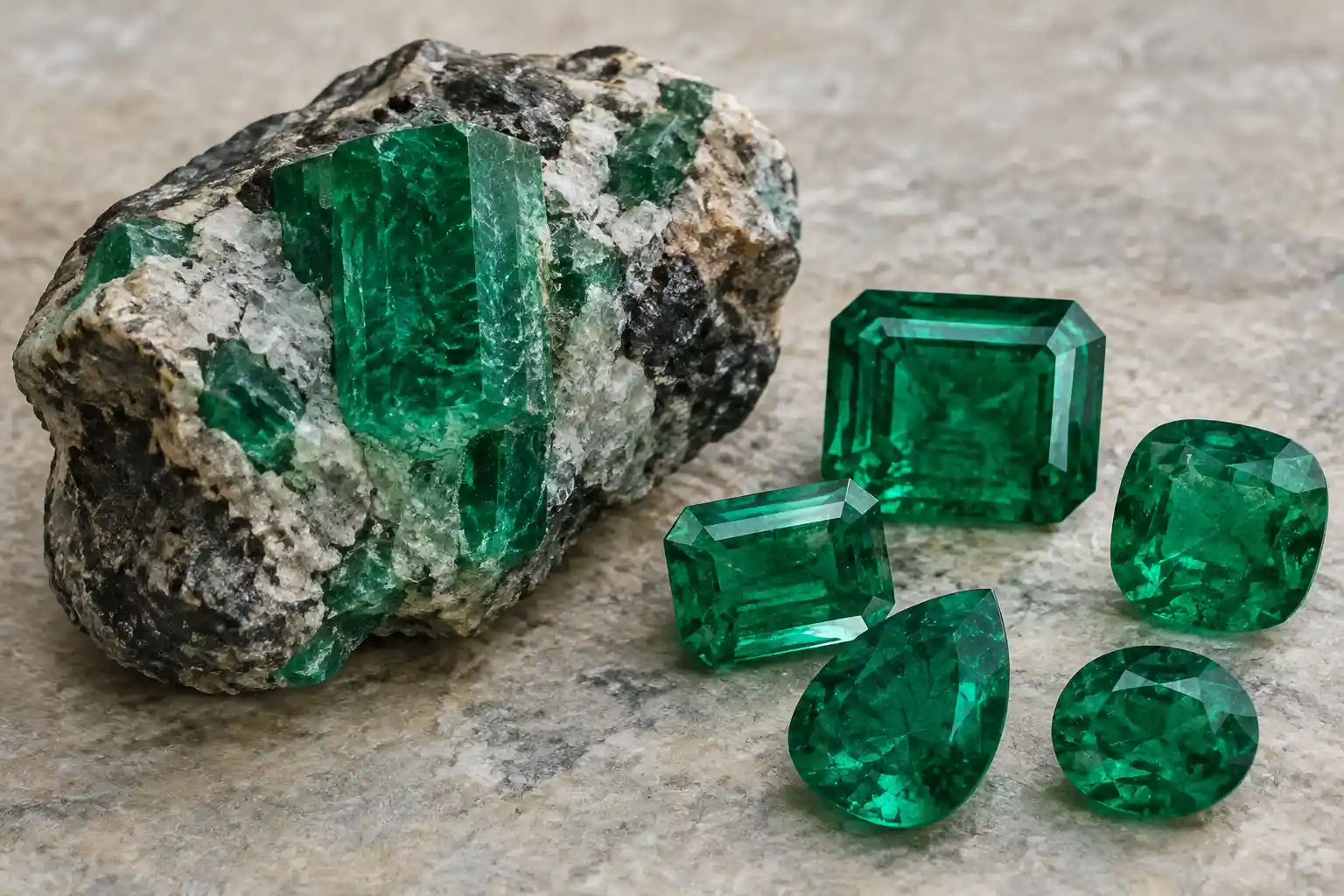
For collectors, this geological diversity means two emeralds of similar color can represent completely different formation stories. Rough crystals on matrix can be especially informative because they preserve relationships that disappear when the gemstone is removed and faceted.
Centuries of Jewelry Use Give Emerald Genuine Cultural Depth
Historical importance is another major source of emerald benefits. Emeralds have been prized across several ancient and historic cultures, appearing in jewelry, royal collections, ceremonial objects, trade networks, carved gems, and later European court jewelry. Their green color encouraged associations with fertility, spring, renewal, status, sight, love, and divine favor in different cultural settings.
Those associations should not be treated as one universal belief shared by every society. Emerald moved between cultures and periods, and its meaning changed according to religious traditions, social status, trade access, and local symbolism.
This genuine history is richer than generic statements that ancient people everywhere considered emerald a healing stone. Historical medicinal uses tell us what people believed, but they do not establish clinical effectiveness.
The cultural emerald benefits are instead found in understanding how one gemstone became connected with royalty, trade, religious imagery, love, green symbolism, and changing ideas of beauty across many centuries.
Cutting Emerald Requires Balancing Color, Weight, Inclusions, and Durability
Emerald rough presents difficult decisions for cutters because strong color may be concentrated in some parts of the crystal while inclusions and fractures limit other areas. This makes skilled lapidary work another important source of emerald benefits.
The rectangular step cut commonly called the emerald cut became strongly associated with the gem because it can protect vulnerable corners while displaying color across a broad table. Yet emeralds are also cut into ovals, cushions, rounds, pears, cabochons, and other forms depending on the rough.
Cutters must decide how much weight to preserve, where the strongest green color lies, which inclusions threaten durability, and how deep the finished stone should be. A shallow stone may appear washed out or windowed, while excessive depth can retain carat weight without creating better face-up beauty.
These tradeoffs explain why carat weight alone is a poor measure of quality. A smaller emerald with balanced proportions, appealing color, good transparency, and careful orientation may look far more impressive than a larger stone whose cut sacrifices optical performance.
Emerald Identification Protects Buyers from Synthetic and Imitation Stones
Modern identification provides some of the most useful emerald benefits for gemstone education. Natural emerald, laboratory-grown emerald, green glass, green beryl, synthetic spinel, assembled stones, and other green products may resemble one another in photographs.
Laboratory-grown emerald is genuinely emerald in terms of basic composition and crystal structure, but its growth environment is artificial rather than geological. Hydrothermal and flux growth can produce stones with characteristic internal features that help trained gemologists separate them from natural emeralds.
Treatments add another level of complexity. Fracture filling is common in natural emerald, and the degree of clarity enhancement can influence value. Disclosure matters because a heavily enhanced stone and a minimally treated emerald may have very different market positions even if they initially look similar.
Someone preparing to buy emerald should therefore prioritize reliable identification, treatment disclosure, realistic photographs, grading information where appropriate, and careful examination of color and transparency rather than relying solely on origin or prestige claims.
Emerald Collecting Can Extend Far Beyond Faceted Jewelry
Collectors can appreciate emerald in natural crystals, matrix specimens, historic jewelry, faceted gems, cabochons, included stones, locality suites, and comparative natural-versus-laboratory-grown collections. Each form reveals different emerald benefits.
A rough hexagonal beryl crystal can display natural growth surfaces that a polished gemstone no longer shows. Matrix specimens may reveal associated minerals and geological environment, while faceted stones emphasize color, transparency, and cutting skill. Included gems can become useful teaching specimens because internal features are visible without destroying the crystal.
Locality collecting adds another layer. A Colombian emerald in calcite and pyrite-bearing matrix may look very different from emerald associated with mica-rich schist from another source. Documented provenance therefore becomes part of the scientific value.
Fine collecting rewards knowledge rather than simply seeking the largest or darkest green stone.
Modern Symbolism Can Represent Renewal, Hope, and Commitment
Green makes renewal one of the most intuitive modern emerald benefits. Vegetation, spring growth, and new leaves give green a strong visual connection with renewal in many cultural settings, although the exact meanings vary.
Someone may wear emerald to mark a new marriage, career, personal achievement, or return to an important goal. Another person may inherit an emerald ring and associate the gem primarily with family continuity rather than any standard crystal tradition.
Modern spiritual systems may connect emerald healing properties with the heart, fertility, eyesight, emotional healing, or physical regeneration. These interpretations belong to cultural and spiritual belief rather than established clinical evidence.
Emerald can therefore symbolize hope, compassion, loyalty, renewal, or commitment without being described as a medical device. The meaning comes from human history and personal association rather than from a guaranteed physiological effect.
Safe Care Protects Emerald’s Color, Fillers, and Fracture System
Responsible care is essential because many emeralds contain fractures that reach the surface, and clarity enhancement is common. Warm water, mild soap, and gentle cleaning are safer for many stones than ultrasonic or steam methods. Heat can extend existing fractures or affect fillers, while harsh chemicals can alter oils, resins, or polymers used for clarity enhancement.
Jewelry should also be protected from direct hard impacts. Rings can remain practical when settings shield vulnerable corners and edges, but emerald should be removed during heavy manual work. Periodic professional inspection is useful for valuable pieces because loose prongs or structural damage can turn ordinary wear into a serious risk.
A second safety boundary concerns gemstone powders or homemade remedies. Emerald contains beryllium within its stable crystal structure, but finished jewelry is not a nutritional source and should not be ground, ingested, dissolved, or used in drinking elixirs.
The verified emerald benefits are already extensive through beauty, geology, history, collecting, jewelry, and symbolism without introducing unnecessary health risks.
Conclusion
Emerald benefits include exceptional green color, useful beryl hardness, geological complexity, informative inclusions, historical importance, skilled lapidary work, identification value, collecting diversity, and meaningful symbolism. Its beauty depends on more than clarity because natural inclusions, color distribution, treatment, origin, and cutting all contribute to the finished gemstone.
The strongest emerald benefits come from understanding both the gem’s strengths and its limits. Emerald can survive generations of jewelry wear with proper care while still requiring protection from impacts, heat, and aggressive cleaning. Modern symbolism involving hope, renewal, love, or wisdom can add personal meaning when it remains separate from unsupported medical claims.
FAQs
What are the main emerald benefits?
The most verifiable emerald benefits include distinctive green color, jewelry use, geological study, collecting, historical importance, gem identification, craftsmanship, and personal symbolism.
What is emerald?
Emerald is the green gem variety of beryl, a beryllium aluminum silicate colored mainly by chromium and/or vanadium.
How hard is emerald?
Emerald has a Mohs hardness of about 7.5 to 8. Its scratch resistance is useful, but fractures and inclusions can reduce toughness.
Why are emeralds often included?
Emerald commonly forms in geologically complex environments, and natural crystals frequently contain mineral inclusions, fluid inclusions, fissures, and growth features.
Are emeralds treated?
Many natural emeralds receive clarity enhancement by introducing oil, resin, or another filler into surface-reaching fractures. Treatment disclosure can be important for value and care.
Is laboratory-grown emerald real emerald?
Laboratory-grown emerald has the fundamental composition and crystal structure of emerald but forms through artificial growth processes rather than natural geology.
Is emerald suitable for everyday jewelry?
Emerald can be worn regularly when appropriately set and cared for, although rings require more caution than earrings or pendants because of fracture and impact risks.
What does emerald symbolize?
Emerald commonly symbolizes renewal, hope, love, commitment, wisdom, prosperity, and growth in historical, modern, or personal contexts.
Does emerald have healing benefits?
There is no established clinical evidence that wearing emerald treats eyesight, cardiovascular disease, fertility conditions, anxiety, infection, or other medical concerns.
Emerald benefits described as healing, heart-related, fertility-related, protective, prosperity-related, or energetic effects reflect cultural, spiritual, and personal beliefs and should not replace qualified medical, mental-health, or financial advice.