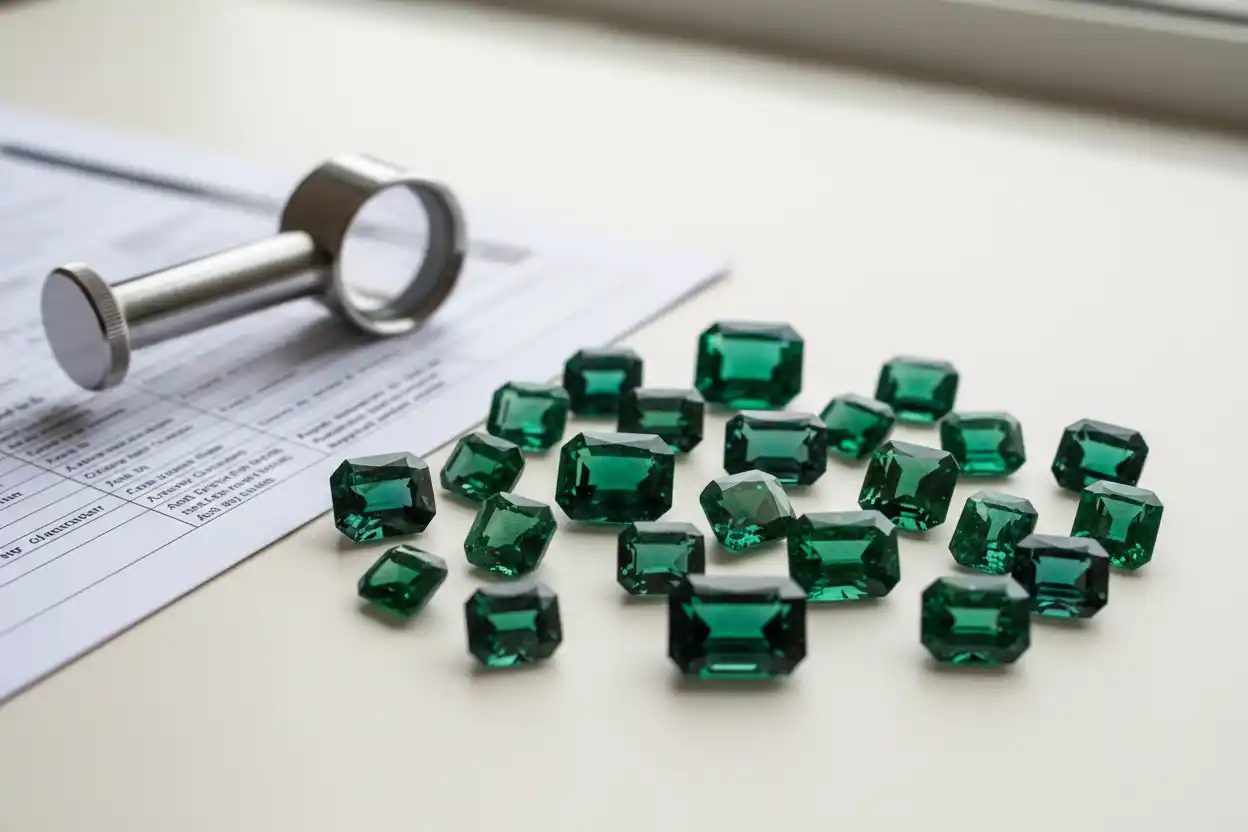
Buy Emerald: Quality & Authenticity, Provenance, Treatments & Returns
To buy emerald confidently, evaluate the stone as a colored beryl rather than applying diamond-style rules to it. Emerald is the bluish green to green variety of beryl, the same mineral species that includes aquamarine, but emerald’s value is driven most strongly by green color, transparency, clarity character, cut, size, treatment, origin, and documentation. GIA identifies color as the most important emerald quality factor and describes the most desirable stones as bluish green to pure green with vivid saturation, a tone that is not too dark, strong transparency, and evenly distributed color.
Emerald buyers also need a different attitude toward inclusions. Eye-visible inclusions are common and widely accepted in natural emerald, while eye-clean examples are particularly rare. Many fashioned emeralds contain surface-reaching fissures whose appearance has been reduced by oil, resin, polymer, or another filler, making treatment disclosure central to a fair purchase. GIA does not give emeralds an overall quality grade; instead, its colored-stone reports establish identity, natural or laboratory-grown status, detectable treatments, measurements, color, and—when requested and determinable—geographic origin.
Buy Emerald At a Glance
| Buying Factor | What to Check | Why It Matters |
|---|---|---|
| Identity | Natural emerald, laboratory-grown emerald, another green beryl, or imitation | Visual green color alone does not establish emerald identity |
| Color | Hue, tone, saturation, uniformity | Color is the dominant quality factor in emerald |
| Transparency | How clearly light passes through the stone | Heavy inclusions can reduce transparency and value |
| Clarity | Type, position, extent, and visibility of inclusions | Eye-visible inclusions are normal, but some affect beauty or durability strongly |
| Clarity Enhancement | None, minor, moderate, or significant | Amount of fracture filling can materially affect comparison and value |
| Cut | Brightness, proportions, orientation, symmetry, windowing | Cutting can strengthen color and minimize the effect of fissures |
| Carat Weight | Weight together with millimeter dimensions | Fine emeralds can rise dramatically in value as size increases |
| Origin | Colombia, Zambia, Brazil, Afghanistan, Pakistan, or another source | Origin can influence provenance and demand but does not replace individual quality |
| Natural/Lab-Grown Status | Natural versus flux-grown or hydrothermal synthetic emerald | Both can be chemically related beryl but occupy different markets |
| Condition | Chips, fissures, abrasion, repolishing | Emerald is harder than many gems but more brittle than corundum |
| Documentation | Identification and origin report where appropriate | Reduces uncertainty about identity, treatment, and provenance |
| Seller Terms | Return period, independent inspection, treatment disclosure | Important when subtle quality differences create large price differences |
Emerald Is a Variety of Beryl, but It Should Not Be Judged Like Aquamarine
Emerald and aquamarine belong to the same mineral species, beryl, yet their commercial quality expectations differ substantially. Aquamarine is commonly available in relatively clean transparent material, while natural emerald typically contains inclusions visible without magnification. GIA explicitly notes that inclusions are normal in emerald and that eye-clean stones are especially valuable because they are rare.
This difference is important for buyers who have already shopped for aquamarine. A level of inclusion that might significantly reduce the desirability of a faceted aquamarine can be completely normal in a fine emerald when the stone retains strong color and transparency. The related aquamarine price guide is useful for understanding how two varieties of the same mineral species can follow very different clarity expectations and market structures.
Do not reject an emerald merely because it has an internal “garden.” Instead, determine whether those inclusions interfere with transparency, weaken the structure, dominate the face-up appearance, or create durability problems.
Color Is the First Quality Factor to Evaluate
GIA describes the most desirable emerald color as bluish green to pure green with vivid saturation and a tone that is not excessively dark. Fine stones should also show good transparency and even color rather than obvious eye-visible zoning.
Color should be examined under neutral lighting because warm store lights, phone-camera processing, and edited photographs can shift green toward yellow, blue, or greater apparent saturation. Request unedited video or inspect the stone personally when color is responsible for a substantial premium.
A very dark emerald is not automatically finer than a medium-dark stone. If darkness suppresses transparency and brilliance, the gem may appear dull even though the green looks intense. Conversely, a pale stone may lack the saturation required for strong emerald demand. The best value lies in an attractive balance of hue, tone, saturation, transparency, and brightness.
Do Not Treat Country Stereotypes as Color Grades
Emeralds from different deposits can show broad tendencies, but GIA cautions that appearance overlaps between sources. Colombian emeralds are often described as warm, intense green, while Zambian stones are often described as cooler or more bluish, yet individual stones from different localities can overlap significantly in actual appearance.
A buyer should therefore evaluate the individual emerald before paying for the country name. Fine material can emerge from multiple sources, including Colombia, Zambia, Brazil, Afghanistan, and Pakistan. GIA identifies Zambia as a major modern source and also recognizes Pakistan and Afghanistan as important producers.
Origin can add collector interest and provenance, but it is not a substitute for color, transparency, cut, condition, and treatment status.
Clarity Expectations Are Different From Diamond
Emeralds commonly contain crystals, fluid inclusions, fractures, growth features, and complex internal structures that dealers sometimes call jardin, meaning “garden.” GIA states that the trade accepts eye-visible inclusions in high-quality emerald because such features are so common, while eye-clean natural emeralds are exceptionally rare.
This means the goal is not automatically to find the least included stone at any cost. A somewhat included emerald with exceptional color and transparency can be more desirable than a cleaner stone with weak or unattractive color.
Inclusions should still be evaluated carefully. Large central opaque features can reduce beauty, while fissures reaching the surface may affect durability and may also contain clarity-enhancing fillers. An emerald’s inclusion pattern can help support natural identity, but inclusions alone should never be used as a home identification method for an expensive purchase.
Fracture Filling Is Common and Must Be Disclosed
Many emeralds contain surface-reaching fractures, and filling those fractures with oil, resin, polymer, wax, or related substances can make the fissures less visible and improve apparent clarity. GIA identifies fracture filling as a common emerald treatment and notes that different filling substances can have different stability.
Treatment does not automatically make an emerald undesirable. Fracture filling is deeply established in the emerald trade, and an attractive filled stone can be an excellent purchase when the treatment is accurately disclosed and the price reflects the degree of enhancement.
The amount of filling matters because it reveals how much the treatment changes the face-up appearance. GIA’s emerald reporting system expresses clarity enhancement as minor, moderate, or significant; its F1, F2, and F3 terminology corresponds to those levels.
Understand What F1, F2, and F3 Mean
On a GIA report for a treated emerald, F1 indicates minor clarity enhancement, F2 indicates moderate enhancement, and F3 indicates significant enhancement. GIA explains that minor treatment has only a slight effect on face-up appearance, whereas significant treatment produces an obvious visual effect.
These designations describe the degree of enhancement rather than the emerald’s overall quality. An F1 stone can still have mediocre color or cut, while an F2 emerald can be visually beautiful. GIA specifically states that its enhancement classification is not an overall clarity grade or an overall gem quality grade.
When comparing prices, match treatment extent as closely as possible. A minimally enhanced emerald should not be compared directly with a significantly filled stone solely because their size and color appear similar in photographs.
Filler Type and Enhancement Amount Are Different Questions
GIA notes that an emerald may have been filled multiple times with different substances, which is one reason its standard emerald reporting focuses on quantifying the amount of filling rather than simply assigning a specific filler identity in every case.
From a buying perspective, the most important questions are how much enhancement is present, whether the treatment is stable enough for normal use, whether the seller discloses it properly, and how the treatment affects care requirements.
A seller who advertises “cedar oil only” or another specific filler should be able to explain the basis for that claim. The laboratory report and the seller’s additional representation are not necessarily the same thing.
Untreated Emerald Exists but Should Be Supported by Evidence
GIA confirms that untreated emeralds exist and that its colored-stone reports can indicate whether detectable treatment is present. A natural emerald with no detectable clarity enhancement can attract strong collector demand, particularly when color, transparency, size, and origin are also exceptional.
The absence of treatment does not automatically make a stone finer. A heavily included untreated emerald can be less desirable than a beautiful minimally enhanced gem. Treatment status should be treated as one component of value rather than a substitute for visual quality.
If the seller charges a substantial premium for untreated status, an independent laboratory report becomes especially important.
Laboratory-Grown Emerald Is Not the Same as an Imitation
Synthetic or laboratory-grown emerald can be produced through flux and hydrothermal growth methods. GIA’s current research describes both growth systems and notes that laboratory analysis can distinguish natural from laboratory-grown emerald through microscopic, spectroscopic, and chemical evidence.
A laboratory-grown emerald is not merely green glass. It reproduces the emerald material artificially, whereas an imitation only resembles emerald visually while having different fundamental composition or structure.
Laboratory-grown material can offer attractive color and clarity at a different price point, but the seller should state its origin plainly. GIA’s reports indicate whether emerald is natural or laboratory-grown.
Cut Is Critical Because Emerald Rough Is Difficult to Work
GIA explains that emerald cutting is complicated by fractures, brittleness, strong color dependence, and dichroism. Cutters must orient and proportion the stone to maximize hue, tone, and saturation while reducing the visual impact of fissures and protecting vulnerable corners.
The rectangular step cut commonly called the emerald cut evolved partly because its truncated corners reduce vulnerability and its broad facets can display color attractively. That does not mean every emerald should be an emerald cut. Ovals, cushions, pears, rounds, cabochons, and specialty shapes can all be excellent when the rough supports them.
Inspect windowing carefully. A large transparent central window can reduce apparent color and brilliance, while excessive depth may retain weight without improving face-up size.
Carat Weight Matters, but Quality Has to Survive the Increase
GIA states that emeralds occur across an enormous range of sizes and that, quality-for-quality, price can rise dramatically as size increases. The key phrase is quality-for-quality. Large size becomes most valuable when vivid color, transparency, attractive clarity, good cutting, and acceptable treatment status remain present.
A five-carat stone with dark muddy color and serious fissures should not automatically outrank a smaller emerald with exceptional green color and transparency.
Dimensions also matter because emerald has lower density than diamond and can appear larger face-up at the same carat weight. GIA specifically notes that a one-carat emerald can look larger than a one-carat diamond.
Origin Can Matter, but Every Mine Produces Different Quality Levels
Colombia has the strongest historic association with elite emeralds, but GIA emphasizes that every mine produces a wide range of quality. For exceptional stones, an independent origin determination can strengthen provenance, yet country of origin alone does not establish that an emerald is fine.
Zambian, Brazilian, Afghan, Pakistani, and other emeralds can also reach high quality. A vivid transparent stone from one source can outperform an ordinary stone from a more famous locality.
Current GIA services include emerald among the stones eligible for its Colored Stone Identification & Origin Report, with geographic origin stated when determinable. That provides stronger evidence than a sales description when origin materially affects the asking price.
A Laboratory Origin Opinion Is Not the Same as a Seller Origin Claim
A specialist dealer may have mine-to-market provenance or long-standing supplier records that support a source statement. That information can be useful, but it remains different from an independent laboratory opinion based on inclusions, spectroscopy, and chemical analysis.
GIA’s origin service can report an emerald’s geographic source when the evidence supports a conclusion, and a result can be inconclusive when sufficient differentiation is not possible.
A buyer should therefore resist any seller who presents origin as scientifically certain without showing what evidence supports that certainty.
Emerald Durability Requires More Nuance Than the Mohs Number
Emerald ranks approximately 7.5 to 8 on the Mohs hardness scale, which provides good resistance to scratching, but GIA gives it only fair to good toughness and cautions that fractures make it more vulnerable than ruby or sapphire.
Hardness and toughness measure different properties. A stone can resist scratches yet still chip or fracture from a sharp blow, setting pressure, or thermal shock.
Protective setting design is especially important for highly fractured emeralds. Rings can be worn successfully, but exposed corners and girdle edges deserve protection, particularly in larger valuable stones.
Avoid Ultrasonic and Steam Cleaning
Emerald fracture fillers can deteriorate or leave fractures under heat, chemicals, or strong cleaning conditions. GIA advises that ultrasonic and steam cleaning are risky for emeralds because most fashioned stones contain fractures and many are filled; warm soapy water with gentle cleaning is the safest method.
This care requirement should influence a purchase when the stone will be worn regularly. A heavily filled emerald may demand more conservative maintenance than a minimally enhanced stone, and any jeweler servicing the piece should know the treatment status before cleaning or repair.
GIA Evaluates Emerald but Does Not Give an Overall Emerald Grade
GIA explicitly states that it evaluates emerald but does not issue an overall emerald quality grade. Its Colored Stone Identification & Origin Report records measurable and descriptive information, identifies whether the material is natural or laboratory-grown, lists detectable treatments, and can provide a geographic-origin opinion when possible.
This is why retail labels such as AAA, AAAA, premium Colombian, investment grade, or museum grade should not be interpreted as standardized GIA grades.
A seller-defined grade can still be useful within one inventory if the merchant explains exactly how color, clarity, enhancement, cut, size, and origin contribute to the category.
A Laboratory Report Is Not an Appraisal
An emerald identification or origin report establishes gemological information. It does not tell the buyer whether the retail asking price is fair, what an insurer should use as replacement value, or what a dealer would pay on resale.
This distinction is similar to the one discussed in Gems Lore’s buy diamond guide: laboratory grading or identification and monetary appraisal are separate professional functions.
When substantial money is involved, use the laboratory report to establish what the stone is and a separate market valuation to decide what it is worth in the intended transaction.
Compare Emerald With Emerald Before Comparing Price
A fine emerald should be compared with other natural emeralds of broadly similar color, transparency, size, cut, origin evidence, and treatment level. A laboratory-grown emerald, green tourmaline, peridot, glass imitation, or another green gem belongs to a different category even when photographs look similar.
The Gems Lore guide to the rarest gemstones in the world explains why scarcity alone does not set value, while most expensive gemstones provides context for why extraordinary emerald auction results should not be treated as routine retail benchmarks.
Common Red Flags When You Buy Emerald
Be cautious when:
A seller calls an emerald “flawless” without explaining whether it is natural or laboratory-grown.
AAA or AAAA is presented as an official international laboratory grade.
Colombian origin carries a major premium with no supporting provenance or origin report.
“Natural emerald” is used as though it automatically means untreated.
The seller refuses to disclose fracture filling.
An expensive stone has no independent identification.
Significant enhancement is minimized as “just normal oil.”
Brightness and green saturation appear dramatically different across edited photographs.
A laboratory report is described as a financial appraisal.
A fragile highly fractured stone is mounted with exposed vulnerable corners.
A seller recommends ultrasonic cleaning without regard to filling or fractures.
A strong seller should welcome detailed questions because accurate disclosure protects both sides of the transaction.
How to Compare Emerald Listings Fairly
Compare:
Natural versus laboratory-grown status.
Hue, tone, and saturation.
Transparency.
Type and visibility of inclusions.
Extent of clarity enhancement.
Carat weight and millimeter dimensions.
Cut quality and windowing.
Chips, fissures, abrasion, and repairs.
Geographic origin and supporting evidence.
Independent laboratory report.
Seller return and inspection rights.
Loose stone versus finished jewelry.
Retail price versus appraisal or resale context.
Only after these points align should price become the primary deciding factor.
Conclusion
To buy emerald intelligently, place color first but never evaluate it in isolation. Fine emerald combines attractive bluish green to pure green color with useful transparency, skillful cutting, appropriate size, manageable inclusions, sound condition, and transparent treatment disclosure. GIA confirms that eye-visible inclusions are normal in emerald, that eye-clean natural stones are exceptionally rare, and that fracture filling is common enough to make treatment reporting central to informed comparison.
Origin and paperwork deserve equal discipline. Colombia can carry historic prestige, but every source produces a range of qualities, and current GIA origin reporting can provide an independent opinion for natural emerald when determinable. Retail AAA labels, seller origin stories, and appraisal figures should never replace examination of the actual stone and its treatment report.
Frequently Asked Questions
What should I check first when I buy emerald?
Start with natural versus laboratory-grown identity, then evaluate color, transparency, inclusions, treatment level, cut, size, condition, origin evidence, and documentation. GIA identifies color as emerald’s most important quality factor.
Is an included emerald low quality?
Not automatically. Eye-visible inclusions are normal in natural emerald, and eye-clean examples are exceptionally rare. Inclusions become more serious when they reduce transparency, dominate the appearance, or create durability concerns.
Are most emeralds treated?
Fracture filling is extremely common in fashioned emerald because surface-reaching fissures are common. GIA notes widespread use of oils, resins, polymers, and similar materials to reduce fracture visibility.
What does F1 emerald mean?
F1 on a GIA report indicates minor clarity enhancement. F2 indicates moderate enhancement and F3 significant enhancement. These designations describe enhancement extent, not an overall emerald quality grade.
Is untreated emerald always more valuable?
No. Untreated status can create a premium when quality is high, but color, transparency, cut, size, condition, and origin still matter. A poor untreated emerald can be less desirable than a beautiful minimally enhanced stone.
Are Colombian emeralds always better?
No. GIA states that every mine produces a broad quality range. Colombian provenance can add historical and collector value for exceptional stones, but an individual Zambian, Brazilian, Afghan, Pakistani, or other emerald can be finer than an ordinary Colombian example.
Can GIA determine emerald origin?
Yes. Emerald is currently eligible for GIA’s Colored Stone Identification & Origin Report, with geographic origin stated when determinable.
Does GIA grade emerald AAA or AAAA?
No. GIA evaluates emerald but does not issue an overall quality grade. AAA and similar labels are seller-defined unless a retailer clearly explains its own system.
Is a laboratory-grown emerald real emerald?
Laboratory-grown emerald is artificially grown emerald material rather than a visual imitation such as glass. Flux and hydrothermal processes can produce synthetic emerald, and laboratory testing can distinguish it from natural material.
Can I clean an emerald in an ultrasonic cleaner?
It is generally unsafe. GIA warns that ultrasonic vibration and steam can damage fractured or filled emeralds and recommends warm soapy water with gentle cleaning.
Is a GIA emerald report an appraisal?
No. A gemological report establishes identity, treatment, and other characteristics, while an appraisal estimates monetary value for a defined purpose. They serve different functions.
Is emerald a guaranteed investment?
No. Fine emerald can be rare and valuable, but future resale depends on quality, treatment, provenance, condition, market demand, liquidity, and transaction costs. No origin or retailer grade guarantees appreciation.