7 Hidden Howlite Benefits: Helpful Uses, Evidence, Safe Use & Clear Limits
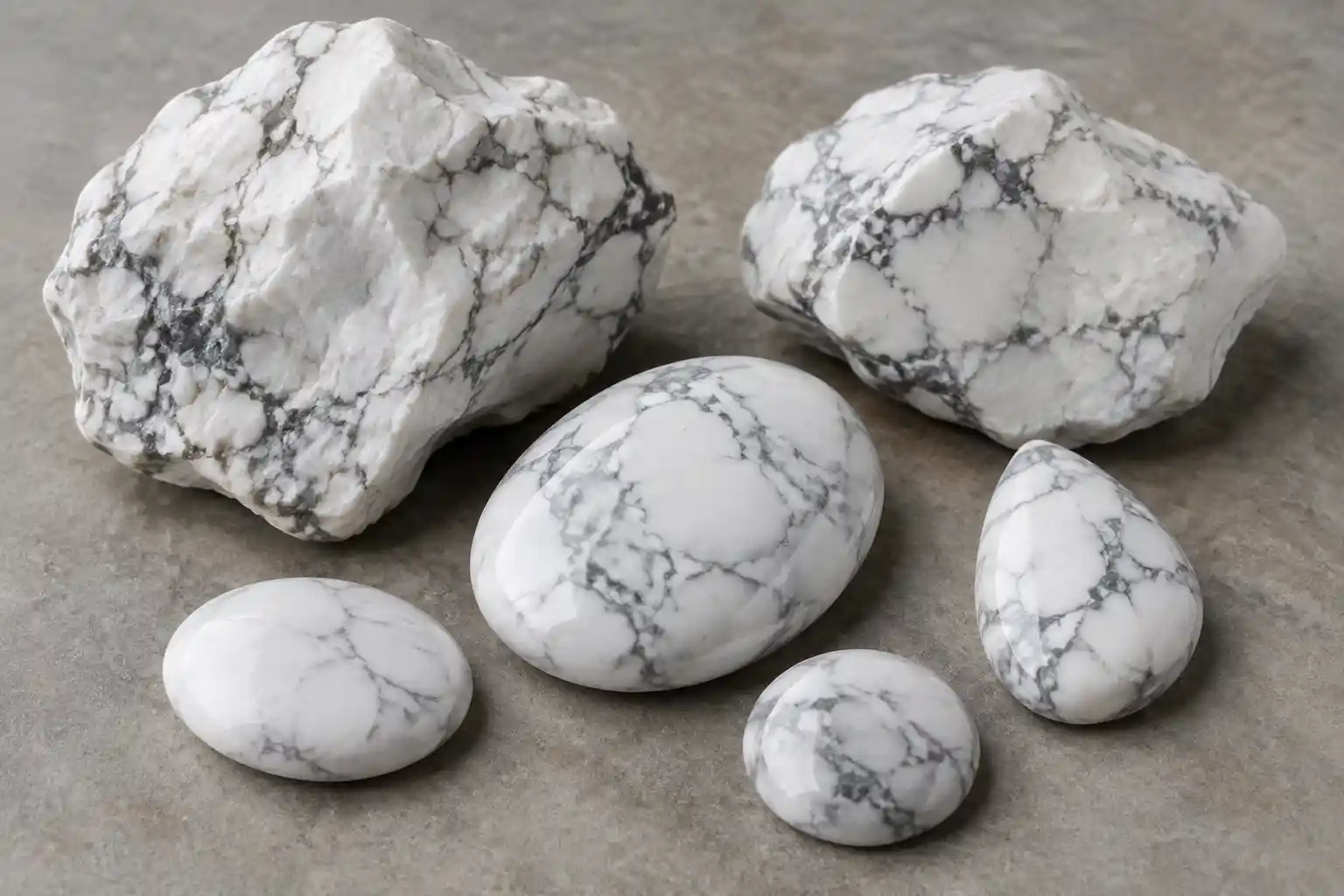
Howlite benefits begin with a distinctive appearance that makes the mineral easy to recognize in many polished forms: a white to creamy body crossed by gray, black, or brownish veining that can resemble marble or spiderweb patterns. Howlite is a calcium borosilicate hydroxide with the formula Ca₂B₅SiO₉(OH)₅, and it belongs to the monoclinic crystal system. It was first described from Nova Scotia by Henry How and later named in his honor, giving the stone a real mineralogical history that is more interesting than the vague spiritual stories often attached to it.
The mineral commonly occurs as compact nodular or earthy masses rather than as large transparent crystals. This texture explains many practical Howlite benefits because the stone can be cut, shaped, drilled, and polished into beads, cabochons, carvings, decorative objects, and inexpensive jewelry. Massive Howlite is relatively easy to work compared with many harder gemstones, while its pale body color also makes it receptive to dyes, especially blue dye used to imitate turquoise. That dye response has commercial usefulness, but it also creates one of the most important identification issues surrounding the stone.
Modern crystal traditions commonly associate Howlite benefits with calm, patience, sleep, emotional regulation, communication, or reduced stress. These themes can function as personal symbolism, particularly because the stone’s pale appearance feels visually quiet, but they are not established medical effects. Howlite does not clinically treat insomnia, anxiety disorders, anger problems, neurological conditions, or other health concerns through ordinary wearing or handling.
7 Howlite Benefits at a Glance
- Natural white color with dark veining gives Howlite a recognizable decorative appearance.
- Compact nodular forms make the stone practical for carving, beads, cabochons, and polished objects.
- Its porous surface can accept dye readily, providing an important lesson in gemstone treatment and imitation.
- Mineral identification helps distinguish genuine Howlite from magnesite, dyed substitutes, plastic, and turquoise imitations.
- Its Canadian discovery history gives Howlite a clear mineralogical and collecting identity.
- Natural nodules, polished stones, and dyed examples make Howlite useful for teaching how appearance changes through processing.
- Modern symbolism can represent patience, calm, or deliberate reflection when kept separate from medical claims.
Natural White Color and Gray Veining Give Howlite Its Distinctive Appearance
The most immediate Howlite benefits come from its appearance. Most familiar specimens show a white or cream-colored base with irregular gray, black, or brownish veins running through the stone. These veins vary considerably from piece to piece, so one cabochon may appear almost pure white while another contains a dense network of dark lines that becomes the dominant decorative feature.
This variability gives Howlite considerable design flexibility. Minimal-veined pieces can create a clean monochrome appearance in jewelry, while strongly veined examples look dramatic in larger beads, pendants, or carvings. The stone does not need transparency or high brilliance to remain visually interesting because texture and pattern provide the main appeal.
The veining also helps distinguish Howlite aesthetically from many white gemstones. It can resemble white turquoise, marble, magnesite, or veined jasper at first glance, yet closer inspection often reveals a characteristic porous or chalky-looking texture beneath the polish. These visual Howlite benefits are strongest when the natural pattern is allowed to remain part of the design rather than treated as a flaw.
Howlite Is Well Suited to Carving, Beads, and Decorative Lapidary Work
Compact massive Howlite is frequently fashioned into beads, skulls, animals, spheres, cabochons, palm stones, and ornamental objects because it can be worked more easily than harder silicate gems. This practical workability creates Howlite benefits for lapidaries who want a pale stone capable of taking a smooth finish without requiring the same effort involved in quartz, beryl, or corundum.
The stone’s softness still requires control during cutting and polishing. Sharp edges can wear quickly, drilled holes may chip if too much pressure is used, and thin sections can break more easily than their polished appearance suggests. A large carving should therefore be handled according to its actual mineral properties rather than assuming that size alone makes it durable.
These characteristics make Howlite especially suitable for low-impact jewelry and decorative objects. Pendants, earrings, beads, and display carvings are usually safer than exposed rings or bracelets worn during physical work. The best Howlite benefits appear when the intended use matches the stone’s real strength rather than asking a relatively soft ornamental mineral to behave like sapphire.
Dye Response Makes Howlite Useful for Learning About Gemstone Treatments
One of the most important Howlite benefits from an educational perspective is its ability to absorb dye. Commercially, white Howlite is often dyed blue or blue-green to create an inexpensive imitation of turquoise. The dark veining can remain visible after dyeing, which makes the result surprisingly convincing to inexperienced buyers.
This treatment is not inherently deceptive if it is disclosed accurately. Dyed Howlite can be attractive in its own right, and many buyers deliberately choose it because they like the color and pattern. The problem begins when treated Howlite is sold as natural turquoise or when the treatment is hidden from the buyer.
Color concentration around drill holes, unusually uniform blue tones, dye accumulation in fractures, and low pricing can sometimes provide clues, although appearance alone should not be treated as conclusive in every case. Howlite therefore offers a useful lesson in why treatment disclosure matters and why gemstone names should describe actual identity rather than visual resemblance.
Howlite Identification Helps Separate Natural Stone from Common Lookalikes
White veined ornamental stones can be difficult to separate in photographs, which makes identification another important part of Howlite benefits. Magnesite is one of the most common comparisons because it can also appear white, porous, and veined, and both stones are frequently dyed to imitate turquoise. Plastic and resin products can create similar patterns as well.
Howlite’s mineral identity can be evaluated through a combination of hardness, density, texture, luster, structure, and professional mineralogical testing when necessary. Natural Howlite is a calcium borosilicate hydroxide rather than a carbonate such as magnesite, so the two respond differently to several tests even when polished appearance overlaps.
Identification becomes particularly important when the stone is dyed. Once the surface turns turquoise-blue, visual clues associated with the original white color disappear, making seller disclosure and careful examination more important. Buyers should therefore value accurate naming over romantic trade descriptions.
Canadian Discovery History Gives Howlite Genuine Collector Interest
Howlite has a clear and documented mineralogical history. Henry How first described the mineral from Windsor, Nova Scotia, where it was initially referred to as silicoborocalcite before James Dwight Dana renamed it Howlite in honor of How. The type locality remains part of the mineral’s identity and distinguishes its history from ornamental stones whose commercial names have no single scientific starting point.
This background creates Howlite benefits for collectors interested in mineral history rather than only polished beads. Natural nodules, unusual crystal aggregates, and locality specimens can preserve more scientific information than mass-produced jewelry. Rare true crystals are particularly interesting because Howlite usually occurs in compact earthy masses rather than well-developed transparent crystal forms.
Collectors can therefore approach the stone at several levels. One person may enjoy inexpensive polished Howlite for pattern and color, while another may value a documented specimen because of morphology, locality, or historical significance. The mineral supports both interests without requiring inflated rarity claims.
Natural and Dyed Howlite Make Excellent Comparative Teaching Specimens
A small collection containing rough white Howlite, polished natural Howlite, and dyed blue Howlite can demonstrate several gemstone concepts at once. The viewer can compare how polishing changes luster, how veining becomes more pronounced on a smooth surface, and how dye can alter commercial identity without changing the underlying mineral.
These comparative Howlite benefits are particularly useful for beginning collectors because treatment becomes visible rather than abstract. Instead of merely reading that gemstones can be enhanced, a person can examine one mineral before and after color modification and understand why disclosure matters.
The exercise also demonstrates why color should never be the sole basis for identification. A blue stone may be dyed Howlite, turquoise, magnesite, glass, resin, or another substance entirely. Learning to separate color from identity is one of the most useful habits a new gemstone collector can develop.
Modern Calm and Patience Symbolism Can Remain Personal Rather Than Medical
Contemporary crystal culture frequently connects Howlite benefits with calmness, patience, emotional balance, improved sleep, reduced anger, or clearer communication. Its pale color and understated appearance make calm symbolism understandable, especially for people who prefer quiet visual cues over intensely colored gemstones.
A person may keep Howlite near a desk because the stone reminds them to pause before responding to a difficult message, wear a bracelet because it symbolizes patience during a demanding project, or keep a polished piece near a journal as part of a reflective routine. The meaningful element in these situations comes from the habit and personal association rather than from a demonstrated neurological effect of the mineral.
Beliefs surrounding Howlite healing properties may extend into insomnia treatment, anxiety relief, calcium absorption, emotional disorders, or physical healing. These interpretations belong to spiritual and wellness traditions rather than established clinical evidence. The stone can represent calm without functioning as a sedative or medical treatment.
Safe Use Means Respecting Softness, Dye, Dust, and Ingestion Limits
Howlite is commonly handled without difficulty in finished jewelry and carvings, but lapidary work should still use appropriate dust controls. Wet cutting, ventilation, eye protection, and suitable respiratory precautions reduce unnecessary exposure during sawing, drilling, or polishing.
Dyed stones require additional care because strong solvents, harsh cleaners, or prolonged soaking may affect color stability depending on the treatment. Lukewarm water, a soft cloth, and gentle cleaning are safer defaults for ordinary polished Howlite, particularly when treatment history is unknown.
The stone also should not be ground for ingestion or placed into homemade drinking remedies simply because its formula contains calcium or boron. Mineral chemistry does not turn a collector stone into a nutritional supplement. Responsible care allows the genuine Howlite benefits of pattern, carving, education, collecting, and symbolism to remain the focus.
Conclusion
Howlite benefits include distinctive white-and-gray patterning, carving versatility, treatment education, mineral identification, Canadian mineral history, collecting value, and meaningful modern symbolism. Its pale color and porous appearance make it visually recognizable, while its willingness to accept dye has made it especially important for understanding gemstone imitation and disclosure.
The strongest Howlite benefits come from appreciating the stone accurately. Natural Howlite does not need to imitate turquoise or carry medical promises to be useful and attractive. Its mineralogy, pattern, lapidary versatility, and history already provide enough substance for both collectors and jewelry buyers.
FAQs
What are the main Howlite benefits?
The most practical Howlite benefits include ornamental carving, bead and cabochon production, mineral collecting, treatment education, gemstone identification, and decorative use. Its pale white appearance can also support symbolic themes involving patience or calm, but those interpretations are personal rather than scientifically demonstrated effects on sleep, mood, or neurological function.
What is Howlite made of?
Howlite is a calcium borosilicate hydroxide with the formula Ca₂B₅SiO₉(OH)₅ and belongs to the monoclinic crystal system. It usually occurs as compact white nodules with gray or darker veining, while well-developed crystals are much less common than the earthy or massive forms familiar in commercial jewelry.
Why is Howlite often dyed blue?
Howlite’s pale, relatively porous surface can absorb dye effectively, and the remaining dark veining makes blue-dyed stones resemble turquoise. This treatment is acceptable when disclosed honestly, but dyed Howlite should not be represented as natural turquoise because the two have different mineral chemistry, geology, value, and durability.
Is Howlite the same as turquoise?
No. Howlite is a calcium borosilicate hydroxide, while turquoise is a hydrated copper aluminum phosphate with completely different chemistry and mineral structure. Dyed Howlite can imitate turquoise visually, especially in inexpensive beads, which makes accurate seller disclosure and identification important.
How hard is Howlite?
Howlite’s hardness is complicated by its form. Well-developed crystals can be considerably harder, while the compact earthy material commonly used for carvings and beads behaves much softer because the aggregate can separate along its fine-grained structure. This is one reason polished commercial Howlite should be treated as a relatively soft ornamental stone rather than as a high-durability gem.
Is Howlite suitable for everyday jewelry?
Howlite works well in pendants, earrings, necklaces, beads, and other low-impact jewelry, but exposed rings or bracelets can scratch and chip more readily during everyday wear. Gentle cleaning and separate storage are especially useful when the stone has been dyed because aggressive chemicals may affect both surface polish and treatment stability.
Does Howlite help with sleep or anxiety?
There is no established clinical evidence that Howlite directly treats insomnia, anxiety disorders, anger problems, or other psychological conditions through ordinary wearing or handling. Someone may use the stone as a visual cue during relaxation or journaling, but any practical benefit comes from the routine and personal association rather than a demonstrated medical effect of the mineral.
Can dyed Howlite fade?
Yes, some dyed Howlite can lose color or change appearance after exposure to harsh chemicals, solvents, prolonged soaking, abrasion, or strong light depending on the dye and treatment method. Gentle cleaning and realistic treatment disclosure are therefore important for maintaining appearance and setting appropriate expectations.
Does Howlite have healing powers?
There is no established clinical evidence that Howlite treats insomnia, anxiety, calcium deficiency, neurological conditions, pain, or other physical or mental-health concerns. Howlite benefits described as healing, calming, sleep-related, emotional, chakra, or energetic effects remain spiritual and personal beliefs and should not replace qualified medical or mental-health care.