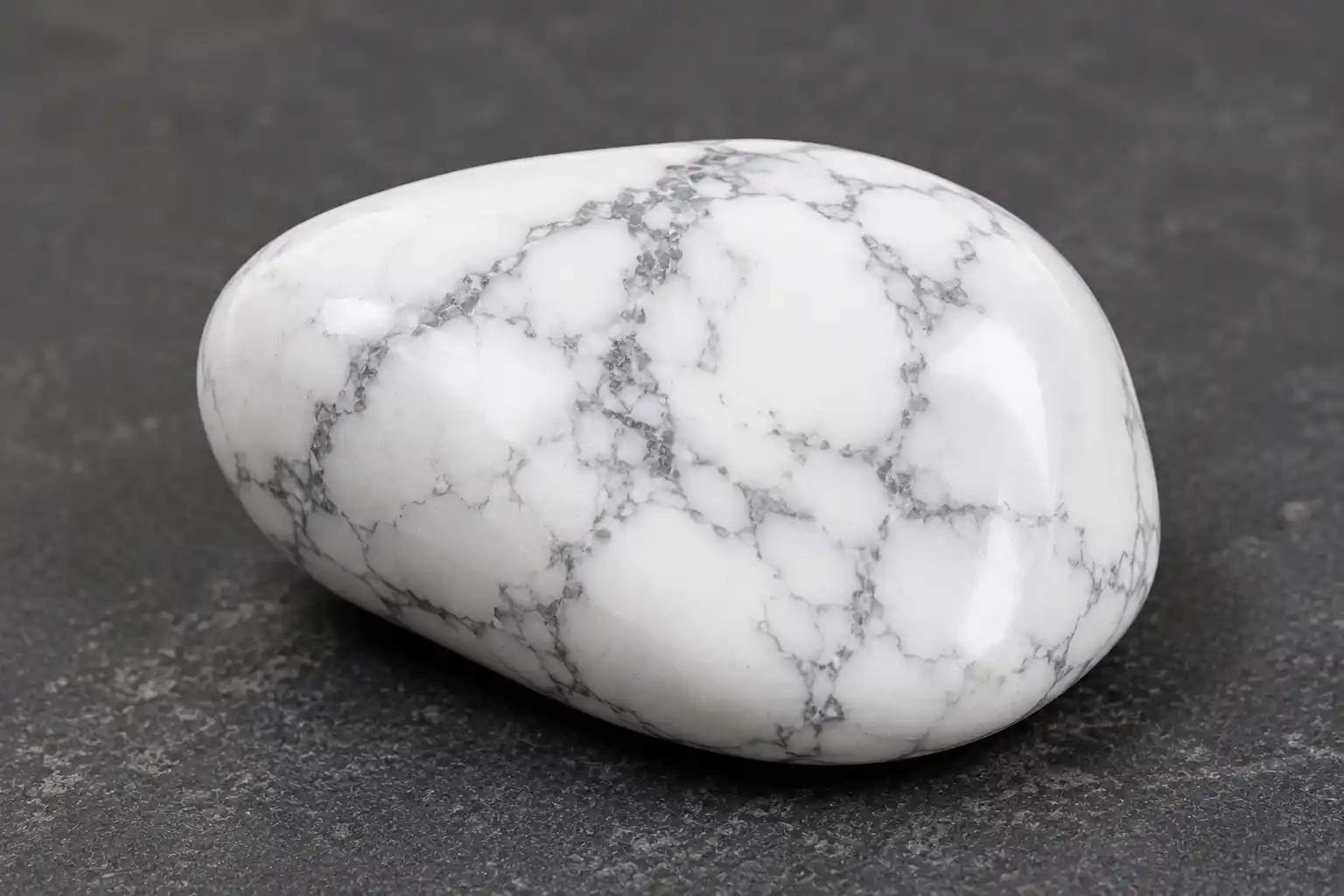
Howlite Healing Properties: 9 Important Claims, Gentle Traditions & Safe Limits
Howlite healing properties are commonly described through themes of calm, patience, emotional restraint, sleep preparation, concentration, communication, self-awareness, resilience, and spiritual reflection. Its white bodycolor with gray or black veining has made it popular as a visually quiet meditation stone, while its porous texture also makes it one of the most frequently dyed gemstones in the crystal market. These associations do not establish a therapeutic mechanism. Howlite has not been demonstrated to treat anxiety, insomnia, depression, anger disorders, high blood pressure, pain, hormonal problems, neurological disease, or other health conditions, and there is no evidence that wearing it sedates the nervous system. Scientifically, howlite is a calcium borosilicate borate with the formula Ca₂B₅SiO₉(OH)₅. It crystallizes in the monoclinic system, usually occurs as white nodular or compact masses, and only rarely forms distinct crystals. Its physical behavior varies noticeably between dense crystals and the porous massive howlite commonly cut into beads and carvings, which is one reason care advice should be specific rather than based on a single hardness number.
9 Howlite Claims Associated With Quiet Routines, Patience, and Mental Space
- Calm during stressful moments
- Patience before reacting
- Emotional restraint during conflict
- Better preparation for sleep
- Concentration and reduced distraction
- Clearer communication
- Self-awareness and reflection
- Resilience during frustrating periods
- Spiritual stillness and meditation
These nine themes can support distinct personal practices without becoming nine scientifically verified healing properties. The howlite benefits described in modern crystal culture make more practical sense when reframed as breathing pauses, nighttime routines, journaling, communication preparation, sensory grounding, or reminders to delay an impulsive response.
Howlite Mineral Science: Calcium Borosilicate Chemistry, Monoclinic Structure, and Variable Hardness
Howlite is a recognized mineral species with the formula Ca₂B₅SiO₉(OH)₅. Its chemistry contains calcium, boron, silicon, oxygen, and structural hydroxyl. The OH groups are an essential part of the formula, but howlite is not conventionally described as a water-rich hydrated mineral containing removable molecular H₂O.
The mineral crystallizes in the monoclinic system. True well-formed crystals are rare and can occur as flattened prismatic forms, while the far more familiar commercial howlite appears as irregular nodules, compact masses, or porcelain-like aggregates marked by gray, brown, or black veining.
Natural howlite is generally white, colorless, or occasionally brownish. Bright turquoise-blue, vivid green, purple, red, and other saturated colors in inexpensive beads commonly indicate dyeing. The white stone’s porosity makes it particularly receptive to color treatment, which is why dyed howlite is frequently sold as an imitation of turquoise and occasionally under misleading names.
Howlite hardness deserves careful explanation. Well-formed crystalline howlite can reach about Mohs 6.5, but the compact earthy or porous massive howlite commonly used in beads can behave much more softly, around 3.5 in practical testing because grains or porous aggregate structures separate more readily. Giving every howlite object a simple hardness of 6.5 therefore overstates the durability of most commercial pieces.
Luster is generally sub-vitreous on suitable surfaces and can appear dull, chalky, or porcelaneous on massive specimens. Streak is white. Massive howlite can feel relatively lightweight compared with dense opaque gemstones of similar size, although weight alone cannot establish authenticity.
Howlite Discovery, Nova Scotia Type Locality, and Modern Gemstone Identity
Howlite is a comparatively modern mineral discovery. Canadian chemist, geologist, and mineralogist Henry How described the mineral from Nova Scotia in 1868, originally calling it silicoborocalcite. James Dwight Dana later renamed it howlite in How’s honor.
The type locality is Black’s quarry near Windsor in Hants County, Nova Scotia, Canada. This documented nineteenth-century discovery means that modern howlite healing traditions cannot legitimately be presented as ancient traditions specific to the mineral under its present identity. White stones were certainly used throughout antiquity, but that does not prove those objects were howlite or that they carried today’s calming and sleep-related symbolism.
Howlite commonly forms in evaporite-associated geological environments, particularly in deposits involving gypsum and anhydrite where boron-bearing fluids or chemical conditions allow the mineral to develop. It often occurs as nodules rather than showy crystals, which explains why much commercial howlite is cut and polished from massive pieces.
Deposits are known from Canada, the United States, Turkey, Germany, and several other regions. California has supplied substantial commercial howlite, particularly from borate districts. Origin does not create different healing powers, but locality and treatment disclosure can matter to collectors and buyers.
One of the most important identification issues is dyed howlite sold as turquoise. Natural turquoise has entirely different chemistry as a hydrated copper aluminum phosphate. Howlite’s veined white texture can look convincing after blue dye is absorbed, especially in low-cost beads and carvings. Buyers should therefore treat vivid blue “turquoise” offered at unusually low prices with caution.
Calm, Patience, and Emotional Restraint Claims
1. Calm Through a Deliberate Pause
Howlite is frequently described as calming. There is no evidence that its calcium-borate-silicate chemistry lowers anxiety or sedates the nervous system. A useful ritual is to hold the stone while deliberately slowing the breathing and delaying an immediate response. The object provides a tactile cue, while the breathing and pause provide the plausible mechanism for feeling more settled.
2. Patience Before Reacting
Modern crystal practice often associates howlite with patience. The stone does not alter impulse control biologically. It can instead represent a simple behavioral rule: when irritation rises, wait before sending the message, making the decision, or continuing the argument. Ask whether the same response will still make sense after ten minutes. The delay is the intervention.
3. Emotional Restraint During Conflict
Howlite is also marketed for anger or emotional control. It has not been demonstrated to treat anger disorders or regulate stress hormones. A more grounded practice is to use it as a reminder to lower the intensity of a conversation, describe the specific behavior at issue, and avoid adding unrelated grievances. Emotional restraint comes from communication choices rather than from the stone.
Sleep Preparation, Concentration, and Communication Claims
4. Better Preparation for Sleep
Howlite is one of the crystals most frequently associated with sleep. There is no evidence that placing it under a pillow changes melatonin, sleep stages, or insomnia through a mineral effect. It can instead become part of a consistent wind-down routine: dim lights, reduce screen exposure, write tomorrow’s unresolved tasks down, keep a regular bedtime, and use the stone as the visual signal that work has ended. The routine may support sleep preparation, while the howlite remains symbolic.
5. Concentration and Reduced Distraction
Its quiet white appearance also leads to associations with focus and mental organization. The mineral does not improve attention span or memory biologically. A practical use is to place it beside one chosen task, silence notifications, and work for a predetermined interval. When unrelated tasks appear, write them down instead of switching immediately.
6. Clearer Communication
Some practitioners link howlite with calmer speech and thoughtful communication. A stone cannot make another person listen or improve language processing. Before a difficult conversation, use it as a prompt to decide what needs to be said, what question needs to be asked, and what boundary should remain clear. Preparation can make communication more deliberate.
Self-Awareness, Resilience, and Spiritual Stillness Claims
7. Self-Awareness Through Journaling
Howlite is sometimes described as helping people understand their emotions or patterns. It does not reveal hidden psychological information. A more useful ritual is to journal around a repeated situation and identify the trigger, automatic response, consequence, and alternative response. That makes self-awareness observable rather than mystical.
8. Resilience During Frustrating Periods
Patience symbolism naturally extends to resilience. Howlite cannot make someone neurologically tougher, but it can mark a moment of review after disappointment. Identify what happened, what remains under personal control, and what should change next time. The stone functions as a reminder that frustration does not require abandoning the goal.
9. Spiritual Stillness and Meditation
White howlite is widely used in meditation because its appearance is visually simple and understated. Someone can focus on the stone, breath, or a repeated phrase while noticing when attention wanders and gently returning. That is a genuine meditation practice without implying that howlite opens supernatural channels or changes consciousness through a measurable energy field.
Howlite Chakra Associations and Modern Crown-Chakra Symbolism
Howlite is most commonly associated with the crown chakra in contemporary crystal systems because of its white color. Themes usually include stillness, reflection, spiritual perspective, meditation, and awareness. Some practitioners also connect it with the third-eye chakra when emphasizing insight or self-observation.
Chakras are a spiritual framework rather than anatomical structures. Howlite has not been demonstrated to affect the brain, pineal gland, nervous system, sleep hormones, or another physiological system through chakra placement. Its white color can still function as spiritual symbolism without being treated as anatomy.
Howlite Physical Care: Porosity, Dye Stability, Water, Scratching, Heat, and Chemicals
Commercial howlite needs more careful handling than its occasional crystal-hardness figure suggests. Massive bead and carving material can be significantly softer and more porous than rare well-formed crystals. It may scratch, abrade, or chip more readily than quartz-based gemstones.
Separate storage is sensible, especially around quartz, topaz, sapphire, ruby, diamond, and other harder stones. Polished beads can also develop surface dulling when repeatedly rubbed against abrasive surfaces.
Brief contact with plain water is generally acceptable for untreated natural howlite, but prolonged soaking is unnecessary. The more important issue is treatment. Dyed howlite may release, fade, migrate, or unevenly change color after prolonged contact with water, detergents, alcohol, perfume, oils, or solvents. When treatment history is unknown, use the least aggressive cleaning method possible.
A soft dry cloth is often enough. If further cleaning is required, use a slightly damp cloth and dry the stone promptly. Avoid repeated soaking of brightly dyed pieces.
Strong acids and aggressive household chemicals are unsuitable. Steam cleaning adds heat that porous, dyed, glued, or fractured pieces do not need. Ultrasonic cleaning should also be avoided as a default because vibration and cleaning solution can exploit internal weaknesses or affect dye and adhesives.
High heat can alter treatments or damage mounted pieces, while prolonged strong sunlight may fade some dyes even if natural white howlite itself is not strongly photosensitive. Keep vividly colored dyed beads away from unnecessary heat and intense prolonged light.
Cutting and polishing create mineral dust containing boron-, calcium-, and silica-bearing particles. Ordinary intact howlite is safe to handle, but lapidary work should use wet cutting, extraction, eye protection, and appropriate respiratory precautions rather than dry grinding.
Ritual Cleansing Howlite Without Fading Dyed Stones
Howlite does not require water immersion for ritual cleansing. There is no scientifically demonstrated unwanted energy that needs to be physically extracted from the stone, and avoiding soaking is especially sensible because so much commercial howlite is dyed.
Sound, quiet reflection, intentional breathing, dry placement, or simply holding the stone while deciding what it will represent next are low-risk choices. Someone who uses howlite in a bedtime routine can make putting it back in the same place part of the symbolic reset.
Avoid saltwater, prolonged soaking, chemical sprays, perfumes, oils, steam, flame, and aggressive sunlight exposure. These methods provide no proven spiritual advantage and may damage dye, polish, glue, or surface texture.
Conclusion
Howlite’s quiet appearance makes calm, patience, and reflection understandable modern symbols, but its real mineral story is more specific. It is a calcium borosilicate first described in nineteenth-century Nova Scotia, commonly found as porous white nodules and frequently dyed to imitate turquoise. Its nine healing themes can support breathing pauses, better communication, journaling, study routines, and sleep preparation as long as those behaviors are not confused with therapeutic effects of the mineral.
Frequently Asked Questions About Howlite Healing Properties
What are the main howlite healing properties people claim?
Common claims include calm, patience, emotional restraint, sleep support, concentration, communication, self-awareness, resilience, and spiritual stillness. These are modern wellness or spiritual beliefs rather than scientifically proven therapeutic effects.
What is howlite made of?
Howlite is a calcium borosilicate borate with the formula Ca₂B₅SiO₉(OH)₅. It crystallizes in the monoclinic system.
How hard is howlite?
Rare well-formed crystals can reach about Mohs 6.5, while common massive porous howlite may behave closer to 3.5 because its aggregate structure separates more readily. Most commercial beads should therefore be treated gently.
Does howlite really help with sleep?
There is no evidence that howlite changes melatonin, sleep stages, or insomnia through a mineral-specific mechanism. It can be used as a cue for a consistent bedtime routine that reduces stimulation before sleep.
Is blue howlite natural?
Natural howlite is usually white, colorless, or occasionally brownish. Bright blue howlite is commonly dyed and is frequently used as a turquoise imitation.
Is howlite the same as turquoise?
No. Howlite is a calcium borosilicate, while turquoise is a hydrated copper aluminum phosphate. Dyed howlite can resemble turquoise visually but is mineralogically different.
Which chakra is howlite associated with?
Modern crystal systems most commonly associate white howlite with the crown chakra and sometimes the third-eye chakra. These are spiritual associations rather than anatomical relationships.
Can howlite go in water?
Brief contact with plain water is generally acceptable for untreated natural howlite, but soaking is unnecessary. Dyed howlite deserves more caution because water and cleaning products may affect the color.
How should howlite be cleaned?
Use a soft dry or slightly damp cloth and dry the stone promptly. Avoid harsh chemicals, long soaking, steam, ultrasonic cleaning, and solvents, especially when the piece is dyed.
What should buyers check when purchasing howlite?
Check whether the stone is natural white howlite or dyed, especially when it is blue, green, purple, or another vivid color. Treatment disclosure and accurate identification matter more than metaphysical claims.
Crystal healing claims are traditional or personal beliefs and should not replace qualified medical or mental health care.