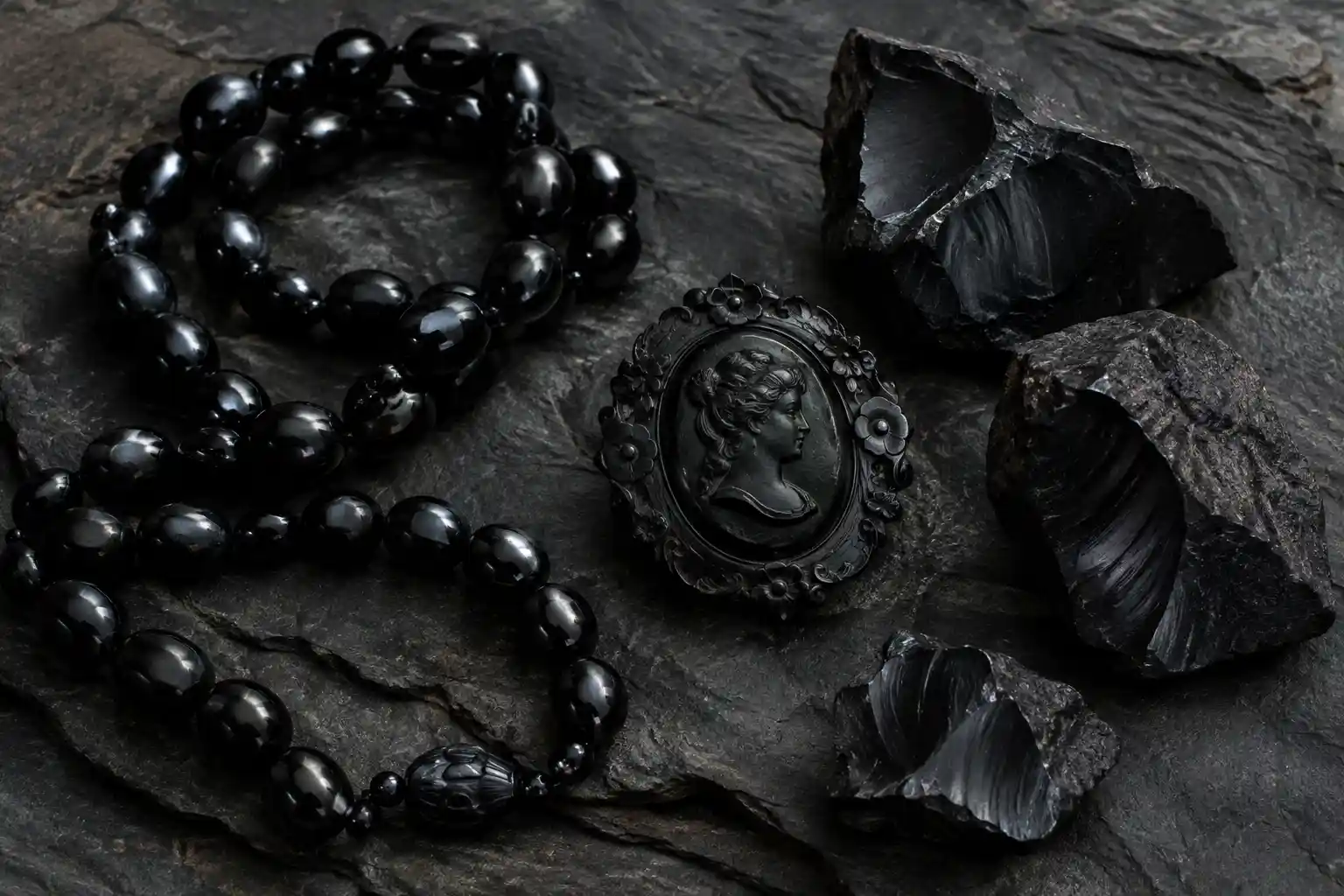
Jet Benefits: 11 Popular Uses, Helpful Symbolism & Verified Facts, Important Cautions
Jet benefits begin with an unusual geological identity. Unlike quartz, garnet, beryl, or most gemstones, true Jet is organic in origin and developed from ancient wood altered over geological time into a dense carbon-rich substance capable of taking an exceptionally smooth black polish. The famous material from Whitby in North Yorkshire formed from fossilized driftwood preserved within Jurassic sediments roughly 183 million years ago. Jet remains much lighter than most mineral gemstones, feels comparatively warm when first touched, and can be carved with far greater ease than hard crystalline gems.
These properties explain why Jet became important for beads, necklaces, bracelets, brooches, pendants, buttons, carved ornaments, archaeological artifacts, and especially mourning jewelry. Hard Whitby Jet can develop a mirror-like polish that produces the familiar expression “jet black,” while deliberately matte surfaces create a very different visual character. Its Mohs hardness of only about 3 to 4 means Jet benefits come with clear limits, however, because polished pieces can scratch and brittle examples may fracture if dropped or subjected to excessive pressure.
Jet also carries substantial historical symbolism. It has been used for personal adornment for thousands of years, was valued during Roman Britain, developed into an important craft industry around Whitby, and became closely associated with Victorian mourning jewelry. Modern spiritual traditions additionally describe protection, grounding, grief support, purification, or emotional healing, but these ideas should be distinguished from the stone’s documented cultural history. Wearing Jet does not clinically treat grief, anxiety, depression, pain, or other health concerns.
11 Jet Benefits at a Glance
- Very low density makes Jet comfortable in large necklaces, earrings, bracelets, and carved jewelry.
- Relative softness allows skilled artisans to carve detailed ornaments that would be difficult in harder gemstones.
- Fine hard Jet can develop a deep black mirror-like polish with exceptional visual richness.
- Matte and polished finishes allow designers to create dramatically different effects from the same organic gemstone.
- Ancient use gives Jet substantial archaeological value and a history extending far beyond modern crystal culture.
- Whitby Jet connects jewelry with distinctive Lower Jurassic geology and a major British craft tradition.
- Victorian mourning jewelry gives Jet an unusually well-documented role in dress, remembrance, and social history.
- Microscopic wood structure, brown streak, low density, and other properties help distinguish genuine Jet from common simulants.
- Natural Jet provides collectors with opportunities to study locality, condition, carving, historical workmanship, and provenance.
- Its organic origin offers an unusual educational comparison with amber, coal, fossil wood, glass, vulcanite, and mineral gemstones.
- Modern symbolism involving remembrance, protection, continuity, or reflection can remain meaningful when kept separate from medical claims.
Lightweight Structure Makes Jet Remarkably Comfortable in Large Jewelry
One of the most practical Jet benefits is its low density. Whitby Jet has a specific gravity around 1.3, making it dramatically lighter than most familiar gemstones and metals. A substantial strand of Jet beads can therefore appear visually imposing without producing the weight expected from an equally large necklace of hematite, garnet, quartz, or glass. This characteristic became especially useful in nineteenth-century jewelry, when long necklaces, multiple bead strands, large brooches, and carved pendants could be worn without becoming excessively heavy.
Low density also helps explain why genuine Jet feels different in the hand. It often seems unexpectedly light for a glossy black object and feels relatively warm when first touched because it conducts heat poorly compared with many mineral gemstones. Neither observation proves identity by itself, especially because plastics and other organic simulants can share similar sensations, but together they help explain why experienced collectors notice immediately when an object has the characteristic physical presence of Jet.
These Jet benefits remain relevant in contemporary jewelry. Large sculptural earrings, wide bead necklaces, and oversized carved pendants become easier to wear when the gemstone itself contributes little weight. Designers can therefore create visual scale without demanding the physical burden associated with many dense stones.
Relative Softness Allows Detailed Carving and Decorative Work
Jet’s Mohs hardness of approximately 3 to 4 makes it far softer than quartz, tourmaline, jadeite, or sapphire, but softness becomes an advantage when skilled carving is the goal. Historic Jet workers could saw, turn, carve, engrave, drill, and polish the substance into beads, crosses, floral brooches, plaques, chains, cameos, buttons, and intricate decorative forms. The craft required considerable skill because softness did not eliminate brittleness, and careless pressure could fracture a valuable piece of rough.
This workability is one of the most distinctive Jet benefits because the final object can preserve delicate surface details despite beginning as fossilized organic matter. Victorian examples include finely cut flowers, geometric patterns, portrait ornaments, and elaborate bead forms whose craftsmanship is as important as the Jet itself. A collector examining an antique piece is therefore evaluating not only geological substance but also design, carving technique, polish, condition, and historical workmanship.
Modern artisans can use the same qualities, although old carved pieces should not be repolished automatically. Original surfaces, tool marks, wear, repairs, and finish can all contribute to historical value, making conservation more appropriate than aggressive restoration in many antique objects.
High Polish Produces the Deep Black Appearance Associated with Jet
Fine hard Jet can take an unusually rich polish that creates one of its most recognizable visual qualities. Under good finishing, the surface can become glossy and intensely black while remaining visually softer than polished glass or faceted black gemstones. This deep finish contributed to the phrase “jet black,” linking the substance permanently with descriptions of exceptionally dark color.
The ability to control finish creates additional Jet benefits. A mirror-like polish emphasizes elegance and reflected light, while matte or subdued surfaces create a quieter appearance. Victorian mourning customs made use of such differences, with less reflective jewelry particularly appropriate during stricter phases of mourning and more polished pieces becoming acceptable as mourning conventions relaxed.
Surface quality also helps collectors examine condition. Scratches, chips, worn carving, replacement sections, and inappropriate modern polishing can all affect an antique object’s appearance and historical integrity. A naturally aged piece does not need to look newly manufactured to remain desirable.
Whitby Jet Preserves a Rare Form of Jurassic Organic History
The geology behind Jet benefits is as important as the finished jewelry. Whitby Jet occurs within Jurassic sedimentary rocks around the North York Moors and coast, particularly in strata associated with the Whitby Mudstone Formation. The material developed from driftwood preserved under unusual low-oxygen conditions and altered through a process often called jetonisation, with organic substances from the surrounding sediment contributing to its transformation.
Unlike petrified wood, where original tissues are largely replaced by minerals, Jet remains fundamentally carbon-rich organic substance. Microscopic examination can preserve recognizable woody structure even though compression and alteration have changed it extensively. This distinction makes Jet an unusual bridge between palaeobotany, sedimentary geology, fossil preservation, and gemology.
The geological story also deserves careful wording because simplistic statements that Whitby Jet is merely “fossilized monkey puzzle tree” are not reliable. Historic comparisons with araucarian wood led to a persistent popular story, but the exact botanical identity of jewelry-grade Jet cannot be assigned so casually. Accurate geology provides more value than repeating an attractive but uncertain trade legend.
Ancient and Roman Use Gives Jet Genuine Archaeological Importance
Jet benefits include an exceptionally long relationship with human adornment. Archaeological evidence shows that Jet and comparable black organic ornaments were used thousands of years before the Victorian period. In Britain, Jet objects became particularly significant during Roman occupation, when the substance was made into beads, bracelets, rings, pendants, pins, and other personal ornaments.
This ancient use matters because it provides genuine historical depth without relying on vague claims that Jet has always possessed one universal spiritual meaning. A Roman Jet bracelet, prehistoric bead, and Victorian mourning brooch were created in different social settings and should not be interpreted through the same modern metaphysical vocabulary.
Archaeological objects can also provide information about exchange, craftsmanship, status, fashion, and regional trade. Identifying the black substance correctly matters because cannel coal, shale, lignite, glass, and later manufactured substitutes can resemble Jet. Scientific examination therefore contributes to cultural interpretation rather than merely confirming a gemstone name.
Victorian Mourning Jewelry Gives Jet an Exceptional Social History
Few ornamental substances are associated as strongly with mourning as Jet. The Whitby industry expanded dramatically during the nineteenth century, and mourning conventions in Victorian Britain created enormous demand for black jewelry. Queen Victoria’s prolonged mourning after the death of Prince Albert strengthened the fashion, while Whitby’s workshops produced necklaces, brooches, earrings, bracelets, chains, crosses, buttons, and carved ornaments for a growing market.
This history gives Jet benefits a level of social documentation that many gemstones lack. Jewelry could communicate bereavement, respectability, fashion, and social convention simultaneously. Differences in finish, design, and ornament could suit different periods of mourning, making Jet part of a complex visual language rather than simply a black gemstone.
The relationship between Jet and grief also explains why Jet meaning remains strongly connected with remembrance today. That symbolism has a real cultural foundation, but it should not be converted into the clinical claim that wearing Jet treats grief. Historical mourning jewelry expressed loss; it did not function as evidence-based mental-health therapy.
Genuine Jet Can Be Distinguished from Many Black Simulants
Identification is one of the most useful Jet benefits for collectors because black jewelry has been made from numerous substances. Glass, vulcanite, ebonite, bog oak, cannel coal, shale, plastics, horn, dyed substances, and other materials have all been used to imitate or substitute for Jet at different times.
True Jet is notably lightweight and can show preserved organic structure under magnification. Whitby Jet typically gives a brown streak on unglazed porcelain rather than the black streak expected from some coal-like substances, while surface appearance, fracture, specific gravity, workmanship, and microscopy can provide additional evidence. Destructive tests such as burning, hot needles, or aggressive scratching are poor choices for valuable antiques because they can permanently damage the object and still produce uncertain results.
Experienced identification becomes especially important with Victorian jewelry because historical simulants can themselves be collectible. An old vulcanite brooch is not worthless simply because it is not Jet; it is a different historical object. Accurate naming improves appreciation rather than reducing every question to real versus worthless.
Jet Offers Collectors Provenance, Craftsmanship, and Locality Value
Collector interest creates another layer of Jet benefits. A piece can be valued according to whether the substance is genuine Jet, whether it comes from Whitby or another source, how well it was carved, its age, condition, maker attribution, design, provenance, and relationship with historical fashion. A natural rough specimen and an elaborate Victorian necklace therefore belong to very different collecting categories even though both contain Jet.
Whitby provenance carries particular significance because the town developed a famous specialized craft industry around locally sourced Jet. Workshop history, original cases, maker marks, documented family ownership, and period photographs can add context that mineral identification alone cannot provide.
Collectors should preserve such records carefully. Once labels, receipts, family histories, and acquisition information disappear, exact provenance may be impossible to reconstruct from appearance alone. Historical objects benefit especially from documentation because craftsmanship and context can matter as much as raw substance.
Jet Provides an Unusual Comparison with Mineral and Organic Gemstones
Jet benefits gemstone education because it sits outside the usual world of crystalline minerals. Diamond, quartz, sapphire, garnet, and tourmaline have ordered mineral structures and inorganic geological origins, whereas Jet is carbon-rich organic substance derived from ancient wood. Amber is also organic, yet it forms from fossilized plant resin rather than altered wood, giving the two substances entirely different origins.
This contrast helps explain why Jet is lightweight, relatively soft, combustible, and warm to the touch. Its properties are not defects measured against quartz; they result from a fundamentally different type of substance. Evaluating it according to mineral-gem standards alone misses much of what makes it important.
The comparison can also prevent confusion with ordinary coal. Jet shares a carbon-rich organic origin with coal-like substances, but gem-quality Jet has particular structural, chemical, and working properties that made it suitable for carving and high polish. Historical and modern research also shows that the formation of true Jet is more complicated than simply calling it one generic type of coal.
Jewelry Durability Is Useful but Requires Realistic Expectations
Hard Jet is tougher and more stable than softer Jet, yet the substance remains relatively soft and can be brittle. Earrings, necklaces, brooches, pendants, and beads suit it particularly well because they receive less direct impact than rings worn on the hand. Antique bead strands can survive for generations when treated carefully, demonstrating that softness does not prevent long-term preservation.
Scratches remain a concern because harder gemstones and even abrasive dust can mark polished surfaces. Jet should be stored separately in soft wrapping or a padded compartment, while heavy pressure on carved elements should be avoided. Sudden heat, harsh solvents, steam, ultrasonic cleaning, and unnecessary soaking are poor choices for historic or delicate pieces.
For antique jewelry, the safest approach often involves minimal intervention. Surface dirt can usually be managed gently, but repairs, restringing, polishing, or conservation work should respect the object’s age and construction. The best Jet benefits endure when preservation is valued more than making an old piece appear newly manufactured.
Remembrance and Protection Symbolism Can Remain Meaningful Without Medical Claims
Historical mourning jewelry gives remembrance a particularly strong foundation among modern Jet benefits. Someone may inherit a Jet brooch from a relative, choose black Jet to commemorate someone who died, or appreciate antique mourning jewelry because it provides a tangible connection with how earlier generations expressed grief.
Protection and grounding are also common modern spiritual associations. Dark color, ancient age, and the substance’s long history in amulets help explain why these themes continue, but symbolism and treatment should remain separate. A Jet pendant may remind someone of resilience or personal boundaries without creating a measurable protective field.
Beliefs surrounding Jet healing properties sometimes extend into anxiety, grief, depression, pain, purification, nightmares, or energetic protection. These belong to spiritual and personal traditions rather than established clinical medicine. Jet can commemorate loss without being presented as a substitute for mental-health support.
Important Cautions Include Softness, Heat, Destructive Tests, and Antique Conservation
Responsible use preserves both modern and antique Jet. Because the substance is relatively soft, abrasive compounds and hard brushes can damage polish. Its organic composition also makes high heat inappropriate, and because Jet is combustible, flame or heated-needle tests should never be performed on jewelry or collector pieces simply to establish authenticity.
Collectors should be equally cautious with aggressive chemical cleaners, steam, and ultrasonic systems. Antique pieces may contain old strings, glues, metal fittings, repairs, or composite components whose stability differs from Jet itself. When historically important jewelry requires intervention, professional conservation or specialist advice is safer than experimental home restoration.
The most valuable Jet benefits come from preservation, accurate identification, geology, craftsmanship, and history. None requires damaging an object to prove what it is.
Conclusion
Jet benefits include lightweight wear, exceptional carving potential, deep black polish, geological interest, archaeological history, Victorian mourning significance, identification education, collecting value, comfortable jewelry use, and meaningful remembrance symbolism. Its origin as altered ancient wood makes Jet fundamentally different from most mineral gemstones and explains the physical qualities that allowed generations of artisans to shape it into intricate ornaments.
The strongest Jet benefits appear when genuine history replaces myth. Whitby geology, ancient craftsmanship, Victorian social history, and careful conservation already give the stone exceptional depth. Protection or remembrance symbolism can remain personally meaningful, while medical and supernatural claims should be kept separate from what Jet is known to do.
FAQs
What are the main Jet benefits?
The most practical Jet benefits include very low weight, comfortable jewelry, easy carving compared with hard crystalline gems, a deep polish, archaeological interest, historical craftsmanship, and important connections with Whitby and Victorian mourning jewelry. Modern associations involving remembrance, grounding, or protection can add personal meaning, but these symbolic uses are separate from medical claims about grief, anxiety, pain, or emotional health.
What is Jet actually made from?
True Jet developed from ancient wood that underwent extensive geological alteration after burial in sediment, leaving a dense carbon-rich organic substance rather than a normal mineral crystal. Whitby Jet formed from Jurassic driftwood in unusual sedimentary conditions, and microscopic examination can preserve traces of woody structure even though the original tissue has been compressed and chemically transformed.
Is Jet the same as coal?
Jet is related to coal-like organic substances but should not be treated simply as an ordinary fuel-grade coal. True gem Jet developed through a distinctive alteration process involving ancient wood and surrounding organic-rich sediments, and high-quality varieties possess the toughness, workability, low density, and polishing characteristics that made them useful for jewelry rather than fuel.
Why is Whitby Jet so famous?
Whitby became internationally associated with Jet because high-quality material occurs in the surrounding North Yorkshire Jurassic rocks and supported a major carving and jewelry industry. Its reputation grew strongly during the nineteenth century, when Victorian mourning fashion created demand for elaborate black necklaces, brooches, earrings, bracelets, and other ornaments made by specialized Whitby craftsmen.
How hard is Jet?
Jet generally has a Mohs hardness around 3 to 4, making it much softer than quartz, sapphire, jade, or tourmaline. Hard Jet can nevertheless be durable enough for generations of jewelry use because hardness measures scratching rather than every aspect of toughness, although polished surfaces still require protection from abrasion, impacts, high heat, and aggressive cleaning.
How can genuine Jet be identified?
Identification considers several features together, including very low density, warm feel, carving characteristics, brown streak, microscopic organic structure, surface appearance, and historical construction. Valuable antique pieces should not be subjected to burning, hot-needle, or destructive scratch tests because such methods can permanently damage the object while still leaving uncertainty about the exact substance.
Is Jet suitable for everyday jewelry?
Jet works particularly well in earrings, necklaces, pendants, beads, and brooches because these forms take advantage of its low weight while limiting hard impacts. Rings and heavily exposed bracelets require more caution, while antique Jet deserves especially gentle wear because old carvings, drill holes, strings, fittings, and previous repairs may be more vulnerable than the polished surface suggests.
Why is Jet associated with mourning?
Jet became strongly linked with mourning through nineteenth-century British fashion, especially after Queen Victoria entered prolonged mourning following Prince Albert’s death. Black Jet suited mourning dress visually, and Whitby’s expanding industry produced enormous numbers of ornaments in both matte and highly polished finishes, creating a cultural association with remembrance that remains recognizable today.
Is Jet the same as black glass or vulcanite?
No. Black glass, vulcanite, ebonite, plastics, cannel coal, shale, and other substances have all been used as Jet substitutes or simulants, especially in historical jewelry. Some of these materials are collectible in their own right, so accurate identification is preferable to assuming every lightweight black Victorian ornament is genuine Jet or that every non-Jet substitute has no historical value.
Does Jet protect against negative energy?
There is no established scientific evidence that Jet creates a protective energy field, absorbs supernatural negativity, or prevents harmful events. Someone may wear it as a symbolic reminder of boundaries, resilience, remembrance, or cultural tradition, but physical safety and mental well-being continue to depend on practical actions, circumstances, and appropriate support.
Does Jet have healing powers?
There is no established clinical evidence that Jet treats grief, anxiety, depression, pain, nightmares, sleep disorders, or other physical or mental-health concerns through ordinary wearing or handling. Jet benefits described as healing, protective, grounding, cleansing, grief-related, or energetic effects remain spiritual and personal beliefs and should not replace qualified medical or mental-health care.