10 Jet Healing Claims: Traditions, Verified Facts & Safe Use
Jet healing properties are commonly associated with grounding, grief support, emotional protection, calm, boundaries, resilience, release, reflection, confidence, and spiritual remembrance. Unlike many modern crystal-shop names, jet has a genuinely deep cultural history. People in Britain were using jet for ornaments thousands of years ago, Roman-era objects show both decorative and symbolic use, and Whitby jet later became closely associated with mourning jewelry during the nineteenth century. Those traditions explain why grief, protection, and remembrance remain central to jet symbolism, but they do not demonstrate medical effects. Jet has not been shown to treat depression, anxiety, insomnia, pain, inflammation, neurological conditions, cardiovascular disease, or other illness, and there is no evidence that wearing carbon-rich fossilized wood absorbs harmful energy from the body. Jet is also not a crystal in the mineralogical sense. It is an organic gemstone derived from wood that underwent burial, chemical alteration, and coalification, producing a compact carbon-rich substance related to lignite. Because it has no ordered crystal lattice, it has no crystal system.
10 Jet Claims Connected With Grief, Protection, and Quiet Resilience
- Grounding and present-moment awareness
- Supportive symbolism during grief
- Emotional protection and stronger boundaries
- Calm during overwhelming moments
- Release of difficult memories or attachments
- Resilience through major life transitions
- Reflection and emotional perspective
- Confidence during periods of uncertainty
- Spiritual remembrance and ancestral reflection
- Protection rituals and symbolic closure
These ten themes have different emotional and ritual meanings without becoming ten scientifically verified healing effects. Many jet benefits become more useful when framed as behaviors such as pausing, journaling, honoring a memory, defining a boundary, preparing for a difficult day, or creating a deliberate ritual around transition and closure.
What Jet Actually Is: Fossilized Wood, Carbon-Rich Chemistry, Low Density, and Organic Gem Status
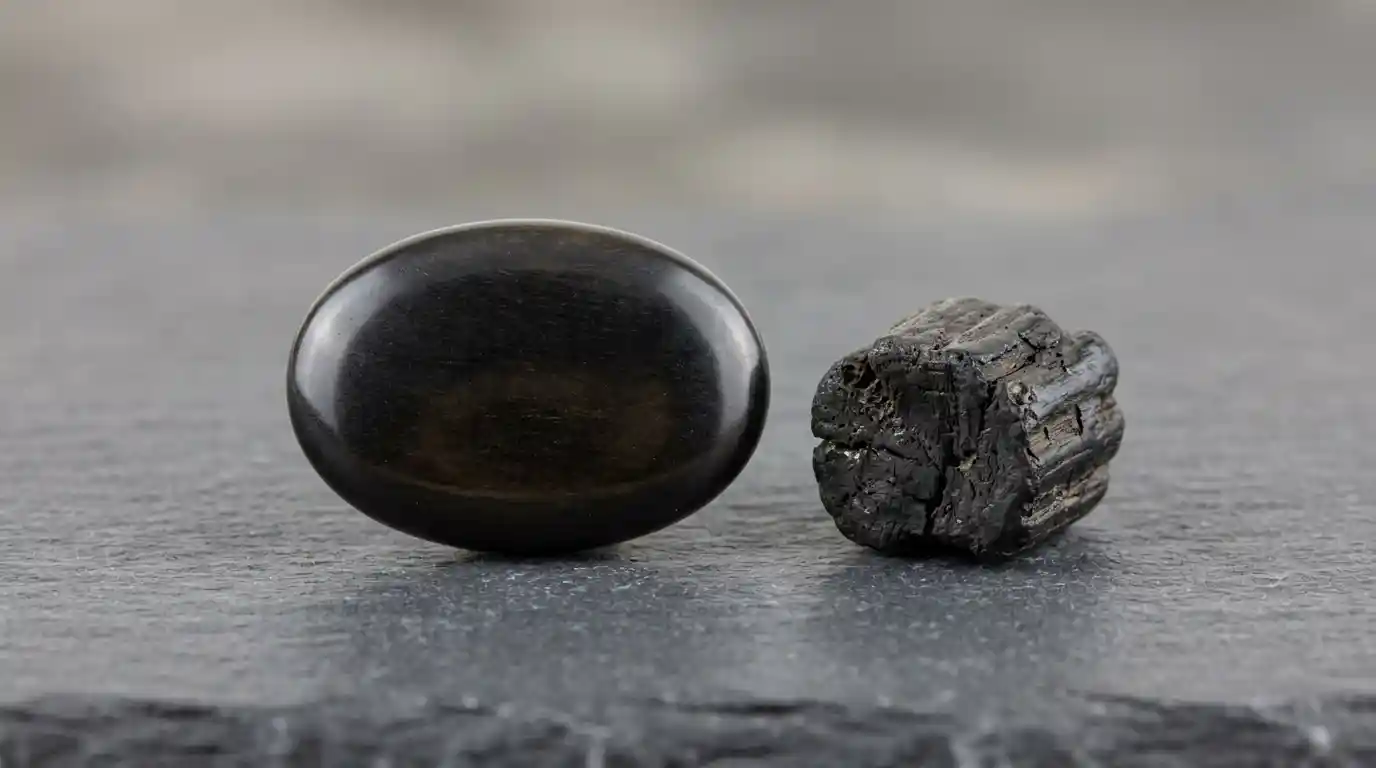
Jet is an organic gemstone rather than a mineral. It forms from buried woody plant remains that underwent chemical change and coalification over geological time. It is closely related to lignite, a low-rank coal, but good gem jet is compact enough to be carved and polished into beads, pendants, brooches, cameos, and other decorative objects.
Because jet is an organic geological substance, it does not have one fixed mineral formula. Carbon dominates its composition, but oxygen, hydrogen, sulfur, and trace elements vary with source and geological history. It also has no crystal system because its internal structure is not an ordered mineral lattice.
Whitby jet from North Yorkshire is especially famous. It formed from fossilized driftwood preserved in Jurassic sediments roughly 180 million years ago. Geological and museum research links its stability and high polish partly with its burial environment and impregnation by organic compounds from surrounding rocks.
Jet is remarkably light. Its specific gravity is only around 1.3, much lower than black glass, onyx, obsidian, or most black minerals. This low density can help distinguish genuine jet from common imitations because a substantial-looking jet bead may feel unexpectedly light in the hand.
Hardness is relatively low, commonly around Mohs 2.5 to 4 depending on source and testing method. Whitby jet is often near the upper end of that range. It can therefore be scratched more easily than quartz, glass, onyx, garnet, or most common gemstones. Despite its softness, good jet can take a remarkably bright, mirror-like polish.
Jet has no mineral cleavage. Harder compact pieces may show conchoidal fracture, while softer or poorer-quality jet can be more brittle or prone to flaking. Color is typically deep black to brownish black, and the gemstone gave English the familiar expression “jet black.”
Imitations include black glass, vulcanite, plastics, dyed horn, black chalcedony, obsidian, and synthetic products. Black glass is much denser and colder to the touch, while black chalcedony is far harder. Destructive hot-needle testing has historically been used to identify organic gems, but it should not be performed on valuable jewelry because it damages the piece and produces fumes.
Jet’s 5,000-Year Cultural History, Roman Use, Whitby Craft, and Victorian Mourning
Jet has one of the clearest deep histories among black organic gems. Archaeological finds show that jet was being carved and worn in Britain during Neolithic times, more than five thousand years ago. Beads, pendants, buttons, and other objects demonstrate that its smooth polish and intense black color were valued long before the modern gemstone trade.
Roman Britain also produced numerous jet objects, especially in and around Yorkshire. Jewelry, spindle whorls, bracelets, pendants, and amuletic objects show that jet served decorative and sometimes symbolic roles. Classical writers and later traditions attributed protective or unusual qualities to jet, but these beliefs should be reported as historical cultural ideas rather than scientific observations.
Whitby became especially important to the jet trade in the nineteenth century as a highly skilled carving and jewelry industry developed around local Jurassic jet. The town’s name became so strongly associated with the gemstone that “Whitby jet” remains an internationally recognized designation.
Jet’s most famous modern historical association is mourning. Queen Victoria’s long period of mourning after Prince Albert’s death strongly influenced nineteenth-century fashion, and black jet jewelry became highly desirable for mourning dress. Whitby’s jet industry expanded dramatically during this period, producing carved necklaces, brooches, earrings, bracelets, and other pieces.
That mourning history explains why today’s jet meaning often centers on grief, remembrance, protection, and transition. The symbolism has a genuine historical foundation, but wearing jet should not be presented as a treatment for clinical depression, complicated grief, trauma, or another mental health condition.
Grounding, Grief, and Emotional Protection Claims
1. Grounding Through Weight, Texture, and Touch
Jet is often described as grounding despite being surprisingly lightweight. A polished piece can still serve as a tactile anchor during a stressful moment. Notice its temperature, smooth surface, reflections, edges, breathing rhythm, and contact with the hand. The practice redirects attention toward immediate sensory experience, while the jet itself is not electrically grounding the body.
2. Supportive Symbolism During Grief
Jet’s long association with mourning makes grief one of its most historically understandable symbolic uses. A gemstone cannot shorten bereavement, remove grief biologically, or determine when someone should feel better. It can, however, represent remembrance. A pendant inherited from someone, a bead carried during a memorial, or a small object kept with photographs can provide a tangible focus for memory without being described as a treatment.
3. Emotional Protection Through Boundaries
Jet is frequently described as absorbing negative energy or protecting the wearer from emotional harm. No scientific evidence shows that carbon-rich jet absorbs hostile emotions or forms an energetic shield. A practical interpretation is to connect the stone with boundaries: identify which conversations you will leave, which requests you will decline, and where professional or social support is needed.
Calm, Release, and Resilience Claims
4. Calm During Overwhelming Moments
Black jet’s visual simplicity can make it a useful object during periods of sensory overload. It does not sedate the nervous system or lower anxiety biologically. Someone can use it as a cue to reduce stimulation, slow the breathing, sit somewhere quieter, and focus on one immediate task rather than several competing concerns.
5. Release of Difficult Memories or Attachments
Modern crystal practice often describes jet as helping people “release” grief, resentment, or emotional attachments. A gemstone cannot delete memories or remove trauma. A safer ritual is to write down what is being carried forward, what cannot be changed, and what action would mark a decision to stop repeating a particular behavior or pattern. Symbolic release can be meaningful without pretending the stone erases an emotion.
6. Resilience Through Major Life Transitions
Jet’s transformation from ancient wood into a dense black organic gemstone provides a natural metaphor for change over time. It does not create resilience biologically. During a transition, use it to identify what has ended, what remains valuable, and what new routine or responsibility needs to begin. The metaphor supports adaptation while the person’s actions create the transition.
Reflection, Confidence, Remembrance, and Closure Claims
7. Reflection and Emotional Perspective
Jet’s historical links with mourning and contemplation make it suitable for quiet reflective rituals. Someone can hold a piece while separating a difficult event from the meanings attached to it and asking what is known, what is uncertain, and what still requires action. Jet does not reveal hidden psychological information, but it can signal that it is time to reflect rather than react.
8. Confidence During Uncertainty
Some practitioners associate jet with strength and composure. The gemstone cannot biologically increase confidence. Before an unfamiliar situation, it can serve as a reminder to identify what has been prepared, what remains uncertain, and what first step is within personal control. Confidence grows from preparation and experience.
9. Spiritual Remembrance and Ancestral Reflection
Jet has been worn across generations and used in burial, mourning, and ceremonial contexts, making remembrance a natural spiritual theme. A person may use it during prayer, memorial observance, family storytelling, or reflection on ancestry. These practices can carry genuine cultural and personal significance without establishing a supernatural communication mechanism.
10. Protection Rituals and Symbolic Closure
Historical and modern traditions have both associated jet with protection. A contemporary ritual might involve carrying a piece during an emotionally difficult event and putting it away afterward as a marker that the experience has ended. The value lies in creating psychological closure, not in assuming the jet physically stored or neutralized harmful energy.
Jet Chakra Associations and Root-Centered Protection Symbolism
Modern crystal systems usually associate black jet with the root chakra because of its dark color and themes involving grounding, security, protection, boundaries, and connection with the physical world. Some practitioners also use it in rituals around ancestors, grief, or endings.
Chakras are a spiritual framework rather than anatomical structures. Jet has not been demonstrated to affect the spine, nervous system, adrenal glands, blood, or another physiological system through chakra placement. Its black color can still organize symbolic reflection without turning spiritual concepts into biological claims.
Jet Physical Care: Low Hardness, Brittleness, Water, Heat, Chemicals, and Antique Jewelry
Jet requires gentler care than quartz, jasper, garnet, or most mineral gemstones because it is relatively soft. With a hardness around Mohs 2.5 to 4, it can be scratched by glass, steel, quartz, and many jewelry stones. Store jet separately in a soft-lined compartment rather than allowing it to rub against harder gems.
Compact high-quality Whitby jet is more durable than soft or poorly consolidated jet, but all jet can chip or fracture after impact. Thin Victorian carvings, beads with drilled holes, cameos, and antique links deserve especially careful handling because age and previous repairs can add vulnerability.
Water should be used sparingly. Brief wiping with a slightly damp cloth is usually sufficient for sound jet, but prolonged soaking is unnecessary. Antique pieces may contain glue, thread, metal fittings, old repairs, or porous areas that respond poorly to immersion.
Heat is a significant concern because jet is organic and carbon-rich. Keep it away from flame, steam, soldering heat, hot water, radiators, and other high-temperature sources. Heating jet can damage the surface, produce odors, or permanently alter the gemstone.
Avoid alcohol, acetone, perfume, hairspray, strong detergents, bleach, acids, and abrasive jewelry cleaners. These substances may dull polished surfaces or damage antique assembly components. Put jet jewelry on after cosmetics and fragrances have dried.
Ultrasonic and steam cleaning should not be used. Gentle hand cleaning with a soft dry cloth is usually the best approach. For valuable antique Whitby jet, specialist conservation or jewelry advice is safer than experimental cleaning.
Do not use hot-needle identification tests on finished pieces. Although heating can distinguish some organic substances by smell or reaction, the method is destructive, can release fumes, and permanently damages the test area.
Ritual Cleansing Jet Without Heat, Smoke Residue, or Water Soaking
Jet’s long association with protection and mourning makes ritual cleansing a common modern practice, but the gemstone’s organic nature means harsh methods are especially unnecessary. There is no scientific evidence that negative energy accumulates inside jet and needs to be burned, washed, or chemically removed.
Sound, quiet reflection, prayer, dry placement, or gently wiping the surface while deciding what the piece will symbolize next are safer choices. For grief-related jewelry, simply placing it with a photograph or memory object may have more personal meaning than performing a generic cleansing routine.
Avoid flame, hot smoke, steam, prolonged sunlight, saltwater, chemical sprays, alcohol, essential oils, and damp soil. Antique pieces deserve even more caution because age, adhesives, stringing, and fragile carved details may not tolerate such exposure.
Conclusion
Jet combines an unusual geological origin with a genuine cultural history stretching back thousands of years. It began as wood, became a carbon-rich organic gemstone through burial and coalification, and later acquired strong associations with ornaments, protection, remembrance, and mourning. Its ten healing claims can still support grounding, grief rituals, boundaries, reflection, and closure, but those practices should not be mistaken for medical treatment or evidence that jet absorbs harmful energy.
Frequently Asked Questions About Jet Healing Properties
What are the main jet healing properties people claim?
Common claims include grounding, grief support, emotional protection, calm, release, resilience, reflection, confidence, spiritual remembrance, and symbolic protection. These are traditional or contemporary beliefs rather than scientifically proven therapeutic effects.
Is jet a crystal?
No. Jet is an organic gemstone derived from fossilized or coalified wood. It is not a mineral and has no crystal system.
What is jet made of?
Jet is a carbon-rich organic geological substance related to lignite. Its exact composition varies by source and can include carbon, oxygen, hydrogen, sulfur, and trace elements.
How hard is jet?
Jet is relatively soft, generally around Mohs 2.5 to 4. Whitby jet is often comparatively durable for jet but still scratches much more easily than quartz or jasper.
Does jet really help with grief?
Jet has a genuine historical association with mourning and remembrance, especially during the Victorian period. It can serve as a meaningful memory object, but it has not been shown to medically treat grief, depression, or trauma.
Does jet have deep historical traditions?
Yes. Jet ornaments have been used for thousands of years, including Neolithic and Roman examples. Whitby jet later became internationally famous through nineteenth-century jewelry production and mourning fashion.
Which chakra is jet associated with?
Modern crystal systems most commonly associate jet with the root chakra and themes involving grounding, protection, security, and boundaries. These are spiritual associations rather than anatomical effects.
Can jet go in water?
A brief wipe with a damp cloth is usually enough for sound jet. Prolonged soaking is not recommended, especially for antique jewelry, glued pieces, drilled beads, or specimens with uncertain stability.
How should jet jewelry be cleaned?
Use a soft dry or slightly damp cloth and handle it gently. Avoid steam, ultrasonic cleaning, solvents, strong detergents, alcohol, high heat, abrasive products, and destructive hot-needle testing.
How can genuine jet be distinguished from black glass or onyx?
Jet is unusually lightweight, relatively soft, and warm-feeling compared with glass or stone. Black glass and onyx are much denser and harder. Valuable pieces should be identified with non-destructive gemological methods rather than heated needles.
Crystal healing claims are traditional or personal beliefs and should not replace qualified medical or mental health care.