7 Real Kunzite Benefits: Meaningful Traditions, Verified Facts, Safe Limits
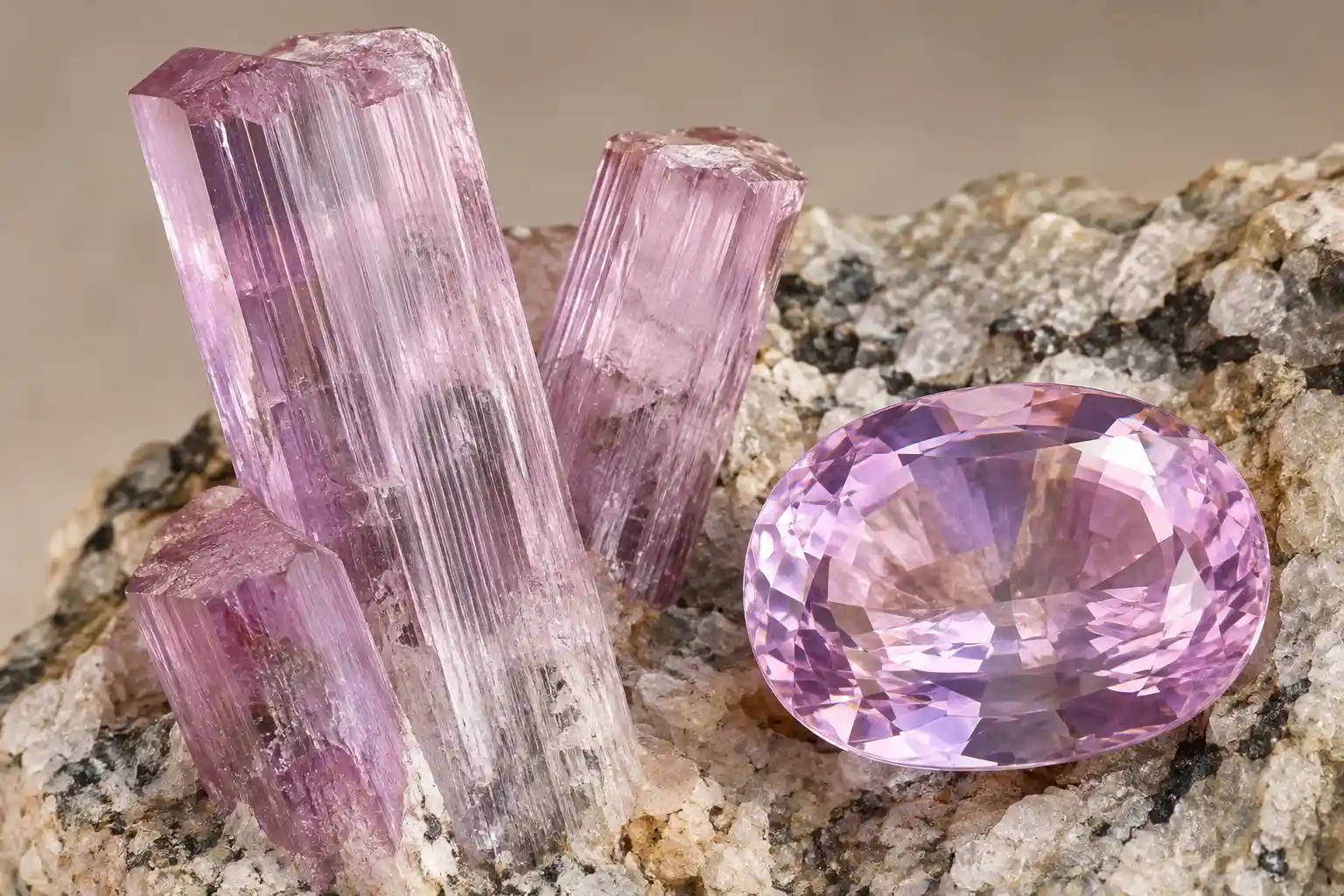
Kunzite benefits begin with an unusual combination of delicate color, dramatic pleochroism, large transparent crystals, and a genuine place within the spodumene mineral family. Kunzite is the pink to violet-purple gem variety of spodumene, LiAlSi₂O₆, a lithium aluminum silicate that also includes green Hiddenite and colorless-to-yellow varieties. Trace manganese is primarily responsible for Kunzite’s characteristic pink-to-violet coloration, while the monoclinic crystal structure creates strong directional differences in color that become especially important when a stone is cut.
The gemstone generally has a Mohs hardness around 6.5 to 7, which provides useful scratch resistance, but hardness tells only part of the durability story. Spodumene has two perfect cleavage directions, meaning a poorly directed impact or excessive pressure during cutting can split a crystal cleanly. Kunzite is also well known for possible fading after prolonged exposure to strong light, so its beauty comes with practical care requirements that distinguish it from many harder or more color-stable gems.
These physical properties create genuine Kunzite benefits for jewelry, gem collecting, mineralogy, lapidary study, pegmatite geology, and gemstone identification. Modern crystal traditions also connect Kunzite with affection, calm, emotional openness, compassion, and reflective practice. Those associations can remain meaningful as personal symbolism, but they should not be confused with evidence that Kunzite treats anxiety, heart conditions, trauma, depression, or other health concerns.
7 Kunzite Benefits at a Glance
- Pink to violet-purple color gives Kunzite a distinctive appearance within the spodumene family.
- Strong pleochroism creates noticeable directional color and makes skilled cutting especially important.
- Large transparent crystals can yield substantial faceted gems with comparatively clean interiors.
- Mohs hardness around 6.5 to 7 supports jewelry use when perfect cleavage is respected.
- Lithium-rich pegmatite occurrences connect Kunzite with important gem and mineral-forming environments.
- Identification and quality evaluation teach buyers to consider color, orientation, clarity, cleavage, fading risk, and treatment together.
- Modern symbolism involving affection, openness, reflection, or hopeful change can remain meaningful when kept separate from medical claims.
Pink and Violet Color Give Kunzite Its Strongest Visual Appeal
The most immediate Kunzite benefits come from color. Fine stones range from soft pastel pink through lilac, violet-pink, and stronger violet-purple, with the most attractive examples balancing saturation with enough brightness to remain lively. Manganese-related absorption is responsible for the familiar color, while differences in concentration, crystal orientation, and color centers help explain why specimens can vary substantially.
Kunzite often appeals to buyers who prefer gentle color rather than the dense saturation associated with ruby, sapphire, or some tourmalines. A large transparent stone can display an expansive field of pink or violet that remains elegant rather than visually heavy, making Kunzite particularly effective in pendants, cocktail rings, earrings, and statement pieces.
Color should still be judged under realistic lighting. Pale stones photographed against dark backgrounds can appear deeper than they do in ordinary conditions, while strongly pleochroic material may show a richer direction that is not fully visible face-up after cutting. Someone evaluating Kunzite quality should therefore consider actual face-up color, tone, saturation, pleochroism, cutting, and light stability together rather than relying only on one carefully lit photograph.
Strong Pleochroism Makes Kunzite an Excellent Optical Gemstone
Pleochroism is one of the most fascinating Kunzite benefits because the stone can show different color intensities according to viewing direction. Fine crystals may appear deeper pink or violet when viewed along one axis and much paler from another, creating a major challenge for gem cutters and an equally useful lesson for collectors.
The cutter must orient the rough so the strongest desirable color appears through the finished gem’s table. This is particularly important because Kunzite crystals often grow as elongated prisms, and the richest color commonly appears when looking along the length of the crystal. Maximizing carat weight without respecting orientation can produce a larger but less attractive finished stone.
Pleochroism also explains why loose Kunzite should be viewed from several angles before purchase. A stone that appears vivid from the side but weak face-up may have been oriented primarily to preserve weight. Fine cutting balances color direction, depth, symmetry, brilliance, cleavage, and finished size rather than maximizing any one characteristic.
Large Transparent Crystals Allow Impressive Faceted Gems
Spodumene crystals can grow to substantial dimensions, and Kunzite is often available in larger transparent sizes than many intensely colored gemstones. This creates important Kunzite benefits for collectors and jewelry designers who want visual scale without depending on a highly included or opaque stone.
Large size alone does not create quality. A substantial gem can still look pale, poorly proportioned, windowed, overly deep, chipped, or heavily fractured. The most attractive larger Kunzites maintain pleasing face-up color while retaining enough transparency and competent cutting to create a balanced appearance.
Relatively clean crystals are common enough that eye-clean finished Kunzite is not unusual. This allows inclusions to become a secondary factor in many stones, although individual crystals may contain fractures, tubes, needles, or other internal features. Because cleavage makes the stone vulnerable during faceting, a successfully cut large Kunzite also reflects considerable lapidary skill.
These characteristics give the gemstone a distinct niche: substantial pastel color combined with transparency, rather than rarity based solely on small sizes.
Useful Hardness Supports Jewelry While Perfect Cleavage Sets Clear Limits
Kunzite’s Mohs hardness around 6.5 to 7 provides reasonable resistance to ordinary surface scratching, which supports use in jewelry. Pendants, earrings, necklaces, brooches, and protected occasional-wear rings can all showcase the gem effectively when the setting is designed with its structure in mind.
Perfect cleavage is the more important concern. Spodumene can split along two directions, and a sharp impact can cause serious damage even when the surface has resisted abrasion. Cutters know this risk particularly well because excessive pressure against a faceting lap can cause a stone to separate unexpectedly.
Jewelry settings should therefore protect corners and exposed girdles without applying unnecessary pressure. Earrings and pendants offer lower-impact environments than daily rings, while rings should be removed during sports, gardening, construction, heavy cleaning, and other activities where the stone may strike a hard surface.
Someone preparing to buy Kunzite should consider structural condition and intended use alongside color and size. A beautifully saturated stone with a vulnerable fracture may be less practical than a slightly lighter gem with better integrity.
Pegmatite Geology Connects Kunzite with Lithium-Rich Mineral Systems
Kunzite forms in lithium-rich granitic pegmatites, geological environments famous for producing unusually large crystals and concentrating elements that occur only sparsely in ordinary igneous rocks. Such pegmatites may also contain quartz, feldspar, mica, lepidolite, tourmaline, beryl, phosphates, and other spodumene varieties.
This creates Kunzite benefits for mineral education because the gem is part of a much larger geological story involving late-stage magmatic fluids, volatile components, rare elements, and exceptional crystal growth. Large natural spodumene prisms can reveal striations, cleavage, color zoning, alteration, and associations that disappear after faceting.
The California discovery that brought Kunzite into gemological attention occurred in the Pala mining district, an area famous for complex pegmatites and colorful gem minerals. Kunzite was named for gemologist George Frederick Kunz after the new lilac-colored spodumene was brought to his attention.
Modern production has also come from Afghanistan, Brazil, Madagascar, and other important pegmatite regions. Locality can therefore add collector context even though geographic origin cannot usually be established confidently from color alone.
Light Sensitivity Makes Kunzite Care an Important Part of Ownership
One of the most important practical Kunzite benefits is also a caution: the gemstone teaches why color stability matters. Kunzite can fade after prolonged exposure to strong light, particularly intense sunlight, so jewelry should not be stored on a bright windowsill or left for extended periods in conditions where ultraviolet and visible light can gradually weaken color.
This sensitivity has contributed to the popular nickname “evening stone,” reflecting the idea that Kunzite is especially suitable for wear when intense daylight exposure is reduced. The nickname is memorable, but sensible care is more important than rigid rules. Wearing Kunzite during the day occasionally is not the same as leaving it continuously exposed to strong sunlight for long periods.
A closed jewelry box or dark storage case is a sensible choice when the gem is not being worn. Heat should also be approached cautiously, while steam cleaning is best avoided. Lukewarm water, mild soap, and gentle cleaning remain conservative choices for a structurally sound stone.
Light sensitivity does not make Kunzite unusable. It simply means color preservation should be part of ownership from the beginning.
Identification and Treatment Awareness Protect Kunzite Buyers
Pink gemstones overlap visually, making identification another important set of Kunzite benefits. Morganite, pink tourmaline, pink sapphire, rose quartz, glass, synthetic products, and other gems can resemble Kunzite in photographs, while large pale stones can be particularly difficult for inexperienced buyers to distinguish by color alone.
Gemological testing can consider refractive index, birefringence, specific gravity, optical character, pleochroism, cleavage, inclusions, and spectroscopy. Strong pleochroism and spodumene’s physical properties create a distinctive combination when examined properly.
Color treatment also deserves attention. Irradiation can alter or intensify color in spodumene, and color produced or modified through such processes may not always have the same stability as naturally occurring pink-to-violet coloration. Buyers should therefore value clear treatment disclosure, especially for unusually vivid stones.
Accurate identification protects both value and care decisions because the correct cleaning, durability expectations, and light precautions depend on knowing what the stone actually is.
Modern Affection and Emotional-Openness Symbolism Can Remain Personal
Pink and violet gemstones are frequently associated with affection, tenderness, compassion, emotional openness, and relationships, so these themes have become common among modern Kunzite benefits. The stone’s soft color makes the symbolism visually intuitive, particularly for people who prefer a quieter alternative to intense red or pink gems.
A person may select Kunzite to mark an engagement, friendship, family relationship, personal transition, or period when they are deliberately improving communication and emotional honesty. Over time, the gemstone can accumulate meaning because it becomes associated with actual experiences.
Beliefs surrounding Kunzite healing properties sometimes extend into anxiety relief, trauma recovery, cardiovascular health, sleep, depression, or energetic heart healing. Those interpretations belong to spiritual and wellness traditions rather than established clinical medicine. Kunzite can represent affection or reflection without functioning as a medical treatment.
Safe Limits Include Cleavage, Fading, Heat, Dust, and Ingestion Risks
Responsible Kunzite ownership requires more than protecting color. Spodumene’s perfect cleavage means impact and setting pressure deserve caution, while sudden temperature changes and aggressive mechanical cleaning can create unnecessary risks. Valuable specimens should also be stored separately from harder gems capable of scratching them.
Lapidary work should use wet methods, ventilation, eye protection, and appropriate respiratory controls because cutting or grinding mineral specimens produces fine dust. Kunzite should never be powdered for ingestion or treated as a source of lithium, manganese, aluminum, or other elements for the body. The presence of lithium in spodumene chemistry does not make the gemstone a substitute for prescription lithium compounds or nutritional products.
These limits do not reduce the genuine Kunzite benefits of color, optics, geology, collecting, jewelry, and symbolism. They simply define how those qualities can be enjoyed responsibly.
Conclusion
Kunzite benefits include delicate pink-to-violet color, strong pleochroism, availability in impressive transparent sizes, useful jewelry hardness, lithium-pegmatite geology, gemological education, and meaningful personal symbolism. Its perfect cleavage and potential light sensitivity require more thoughtful care than its polished beauty might initially suggest.
The strongest Kunzite benefits come from appreciating spodumene accurately. Fine color, skilled orientation, transparency, geological history, and competent care already make the gemstone distinctive. Modern symbolism involving affection or reflective growth can add personal value without turning Kunzite into a medical or psychological treatment.
FAQs
What are the main Kunzite benefits?
The most practical Kunzite benefits include attractive pink-to-violet color, strong pleochroism, impressive transparent sizes, jewelry use, mineral collecting, pegmatite education, and gemstone identification. Its delicate appearance also supports modern symbolism involving affection, emotional openness, or thoughtful change, but these meanings remain personal rather than scientifically demonstrated effects on health or psychology.
What is Kunzite made of?
Kunzite is the pink to violet-purple gem variety of spodumene, a lithium aluminum silicate with the formula LiAlSi₂O₆. Trace manganese contributes to its characteristic color, while the monoclinic structure produces strong pleochroism that can make the same crystal appear more or less saturated depending on viewing direction.
How hard is Kunzite?
Kunzite has a Mohs hardness around 6.5 to 7, giving it useful resistance to normal surface scratching. It also has two perfect cleavage directions, however, so a sharp impact or excessive setting pressure can split the gem even when the surface appears durable, making cleavage one of the most important considerations for jewelry care.
Is Kunzite suitable for everyday jewelry?
Kunzite works well in earrings, pendants, brooches, necklaces, and protected rings, but exposed daily-wear rings require more caution because hands regularly encounter hard surfaces. Perfect cleavage and possible light fading make Kunzite better suited to thoughtful wear and protected storage than to jewelry subjected routinely to impact, heat, and strong sunlight.
Why does Kunzite change color from different angles?
Kunzite is strongly pleochroic, meaning it absorbs light differently along different crystal directions. One direction may reveal a richer pink or violet while another appears considerably paler, which is why cutters study the rough carefully before deciding how to orient the finished gemstone.
Can Kunzite fade in sunlight?
Yes. Kunzite is known to be light-sensitive, and prolonged exposure to strong light can weaken its pink or violet coloration. Owners can reduce that risk by avoiding extended sunlight exposure and keeping jewelry in a closed box or dark storage area when it is not being worn.
Why are large Kunzite gemstones relatively common?
Spodumene can form large crystals in lithium-rich pegmatites, and transparent areas may provide enough rough for substantial faceted gems. Large size does not automatically indicate high quality, however, because color, pleochroic orientation, transparency, cleavage, cutting, and structural condition still determine how attractive the finished stone appears.
Is Kunzite usually treated?
Kunzite may be irradiated or otherwise color-modified, and treatment disclosure becomes especially important with unusually vivid stones. Treatment history can affect buyer expectations and potentially color stability, so a valuable gemstone should be evaluated according to actual identification and disclosure rather than assuming every intense pink or violet example is naturally colored.
Does Kunzite have healing powers?
There is no established clinical evidence that Kunzite treats anxiety, depression, trauma, cardiovascular conditions, insomnia, pain, or other physical or mental-health concerns. Kunzite benefits described as healing, heart-centered, calming, relationship-related, chakra, or energetic effects remain spiritual and personal beliefs and should not replace qualified medical or mental-health care.