Buy Kunzite: Smart Buying Tips & Red Flags
If you want to buy kunzite intelligently, do not begin with the largest carat weight or the photograph showing the deepest violet-pink color. Begin with face-up color orientation and structural condition, because kunzite combines two unusual buying challenges: pronounced pleochroism can make the same crystal look strongly pink-violet in one direction and much paler in another, while two perfect cleavage directions make an apparently clean gemstone vulnerable to splitting after an unfavorable impact or excessive setting pressure.
Kunzite is the pink-to-violet gem variety of spodumene, a lithium aluminum silicate whose color is associated primarily with manganese. Transparent crystals can grow to substantial dimensions and are often remarkably clean, which means large size and high clarity are not automatically rare enough to justify dramatic premiums. Fine value instead comes from attractive pink, lilac, violet-pink, or pinkish-purple color that remains visible under realistic lighting, intelligent orientation of the pleochroism, competent cutting, a structurally sound stone, and honest disclosure of any color enhancement.
Another issue deserves equal attention when you buy kunzite: its color can fade after prolonged exposure to intense light or heat. Irradiation followed by heating can also enhance kunzite color, yet treatment does not eliminate that sensitivity; both natural and enhanced colors can be vulnerable. A buying decision should therefore consider not just how the stone looks when purchased, but whether its color, treatment history, setting, and intended use are compatible with how you plan to wear and store it.
The strongest decision hierarchy when you buy kunzite is natural spodumene identity first, face-up color second, pleochroic orientation third, clarity and cleavage condition fourth, cut and dimensions fifth, treatment and color-stability disclosure sixth, jewelry suitability seventh, provenance eighth, and price last. Following that order prevents size, origin, exaggerated seller grades, and carefully controlled photography from obscuring the factors that actually determine whether the individual stone is a strong purchase.
What to Judge First When You Buy Kunzite
The wider kunzite properties guide explains spodumene mineralogy, composition, formation, colors, inclusions, sources, and physical properties. A purchase needs a narrower hierarchy because a pale commercial stone, a vivid collector gem, a large precision-cut center stone, and a natural crystal specimen should not be evaluated through one generic formula.
| Priority | What to evaluate | Why it matters |
|---|---|---|
| 1 | Natural kunzite identity | Morganite, pink tourmaline, glass, synthetic materials, and other pink gems can resemble it |
| 2 | Face-up color | Pink-to-violet saturation is usually the leading visible quality factor |
| 3 | Pleochroic orientation | Poor orientation can make the stone nearly colorless through the table |
| 4 | Clarity and fractures | Clean material is common, while cleavage-related cracks create serious risk |
| 5 | Cut performance | Deep cutting, windowing, extinction, and weak symmetry affect beauty and value |
| 6 | Millimeter dimensions | Heavy stones can hide substantial weight beneath the girdle |
| 7 | Treatment history | Irradiation and heating can strengthen color |
| 8 | Color stability | Natural and treated color can fade under intense light or heat |
| 9 | Jewelry construction | Cleavage requires protective setting choices |
| 10 | Provenance | Source usually matters less than visible quality |
| 11 | Documentation and price | Evidence should strengthen as the premium increases |
When you buy kunzite according to this hierarchy, the stone has to earn its price through visible and verifiable qualities rather than through a large weight or an elaborate description.
Color Is the First Visible Quality Factor
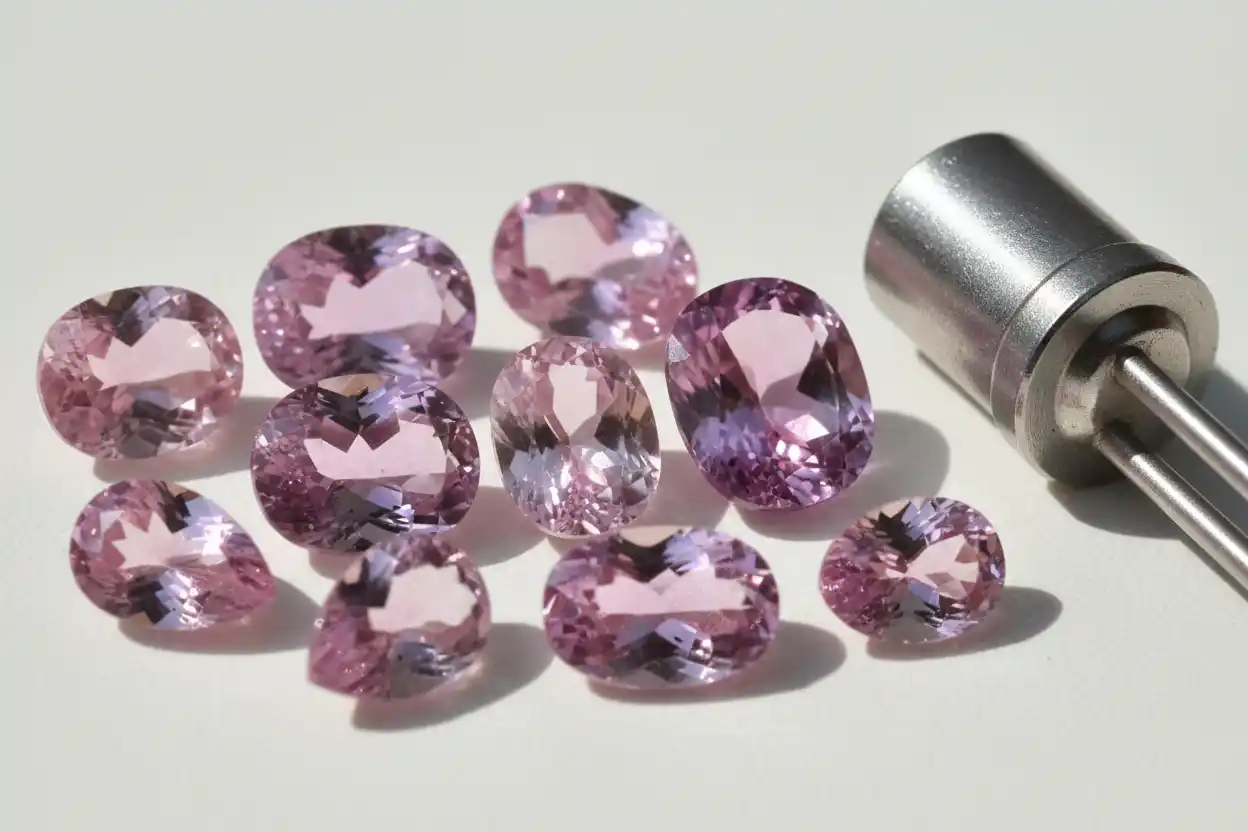
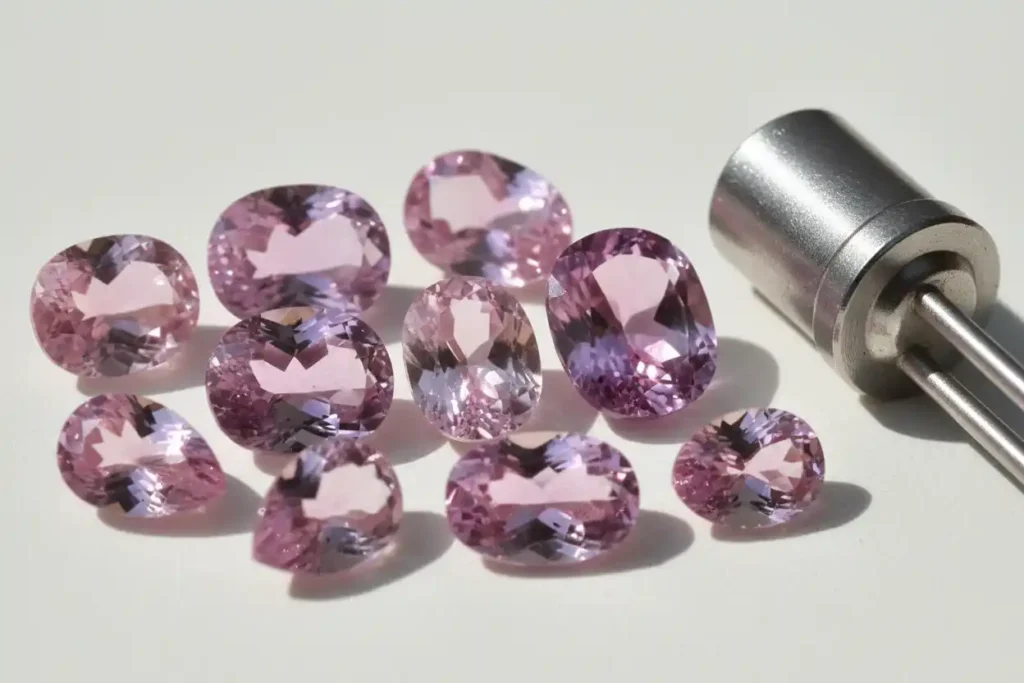
Fine kunzite can range from delicate pink and lilac through violetish pink, pinkish violet, and stronger purple-pink shades. Pale material is common, while more strongly saturated gems generally attract greater interest when they retain good transparency and brightness.
When you buy kunzite, separate four properties rather than treating “deep pink” as a complete grade.
Hue tells you whether the stone appears pink, lilac, violet-pink, or more strongly purple.
Tone describes how light or dark it appears.
Saturation describes the strength of the pink or violet coloration.
Brightness tells you whether the cut allows enough light to return through the face.
The strongest combination is not necessarily the darkest. A medium violetish-pink stone with lively reflections may be considerably more attractive than a deeper gem whose cut or orientation makes portions of the face look closed and dark.
Do Not Pay a Premium for Color That Exists Only Under Powerful Lighting
Pale transparent gemstones are particularly easy to improve photographically.
When you buy kunzite online, request the exact stone under broad neutral lighting and against both white and neutral-gray backgrounds. Strongly cool illumination can intensify violet components, while dark surroundings can make pale color look more saturated through contrast.
Look at the supposedly neutral objects in the image.
If white paper appears lavender or blue, the kunzite may also have been shifted by lighting or processing.
A second presentation under warmer indoor illumination can be useful, but it should supplement rather than replace the neutral view.
The stone should remain visibly pink or violet without depending on specialized display conditions.
Pleochroism Is Central to Kunzite Quality
Kunzite is strongly pleochroic, meaning different crystal directions can show substantially different color strengths. One direction may display attractive pink or violet, while another becomes pale pink or almost colorless.
That property directly affects cutting.
The most intense kunzite color is commonly observed along the length of the original crystal, so cutters attempt to orient the finished stone to present the strongest useful color through the table while simultaneously managing cleavage, rough shape, inclusions, and weight.
When you buy kunzite, this is why a stationary photograph is insufficient.
Request continuous rotation of the exact gemstone and watch whether the attractive color survives normal movement.
A well-oriented stone can shift naturally while remaining pink or violet.
A poorly oriented stone may look impressive in one precise position and become nearly colorless after a small tilt.
Pleochroism Should Add Character, Not Remove the Color
Directional variation is part of kunzite’s natural optical personality and should not be treated automatically as a defect.
The question is how the cutter used it.
When you buy kunzite, the face-up orientation should favor the strongest pink-violet direction without creating severe darkness, windowing, or an awkward outline merely to preserve that color.
A stone that moves between violet-pink and lighter lilac can be visually engaging.
A stone whose center becomes transparent or colorless through a large portion of ordinary viewing is less successful.
The quality judgment therefore belongs to the complete cut rather than to pleochroism alone.
Ask for a Full Rotation Video
A useful online video should show more than a few degrees of movement around the gemstone’s best angle.
When you buy kunzite remotely, ask the seller to rotate the stone through its long and short directions under consistent neutral lighting.
Watch the center.
Watch both ends.
Watch whether one side loses color.
Watch whether the stone becomes gray or nearly colorless.
Watch whether dark areas move or remain fixed.
This type of video also reveals windowing, extinction, color zoning, and some surface-reaching fractures that can disappear in still photographs.
The general transaction checks in the online gemstone buying guide remain useful, but kunzite particularly requires media that exposes its weaker orientations rather than presenting only its strongest one.
Larger Kunzite Can Show Color More Easily
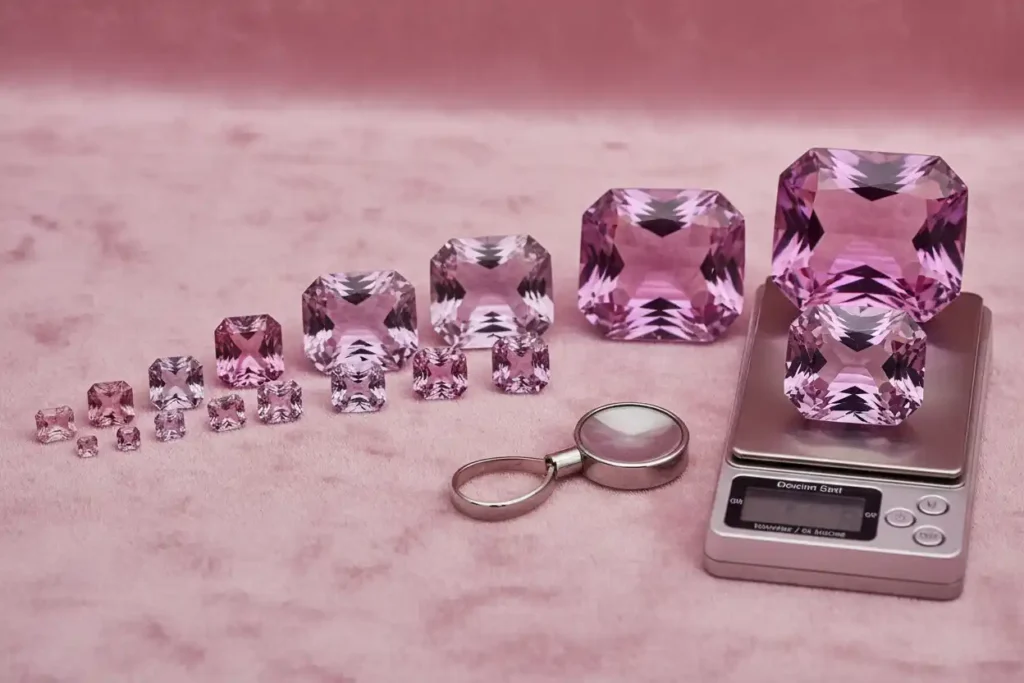
Kunzite often occurs in light tones, and a larger gemstone can display stronger apparent color because light travels through more material.
This is one reason substantial kunzites can look more saturated than small stones cut from similar rough.
When you buy kunzite, however, do not confuse this optical advantage with a simple size-rarity relationship.
Spodumene crystals can grow very large, and clean faceted kunzites in substantial sizes are far more obtainable than similarly sized fine ruby, sapphire, or several scarcer colored gemstones.
Large size can strengthen color.
It does not automatically make the gemstone rare.
Large Size Is Not an Automatic Premium
This is one of the most important value rules when you buy kunzite.
A seller may emphasize 20, 30, 50, or more carats as though every additional carat represents extraordinary scarcity. Yet spodumene can form large transparent crystals, and substantial faceted kunzite is well documented.
Large stones deserve a stronger price only when attractive color, good orientation, high transparency, cutting quality, and structural condition remain strong as size increases.
A huge pale stone with a broad window should not receive the same premium as a large vivid violet-pink gem whose color remains strong throughout the face.
The kunzite value guide provides the stone-specific pricing framework, but the practical rule is simple: buy the quality of the visible gemstone rather than the shock value of the carat number.
Expect Good Clarity
Kunzite commonly occurs in transparent crystals with relatively few inclusions, so buyers can generally expect a clean face-up appearance from ordinary faceted material.
When you buy kunzite, inspect for:
- bright reflective fractures;
- cleavage-related fissures;
- large central crystals;
- clouds;
- growth tubes;
- fluid inclusions;
- open cavities;
- chipped corners;
- girdle damage;
- and abraded facet junctions.
Minor microscopic inclusions are normal in natural gemstones and may have almost no effect on appearance.
A large central fracture is different.
Because clean material is reasonably available, sellers should not use ordinary eye cleanliness as evidence that a kunzite is extraordinarily rare.
Do Not Overpay for “Flawless” Kunzite
The word flawless sounds impressive, but its economic significance depends on how difficult that level of clarity is to obtain in the material.
When you buy kunzite, large clean gemstones are available often enough that microscopic perfection should generally rank below color, orientation, cutting, and structural safety.
Imagine two stones.
One is described as flawless but has weak pale color and a wide transparent center.
The other has a tiny natural inclusion near the girdle but shows vivid violet-pink face-up color, excellent orientation, and balanced light return.
The second stone may be considerably more desirable.
Buy visible beauty and structural quality before paying for a clarity distinction that requires strong magnification to notice.
Separate Harmless Inclusions From Cleavage Damage
This distinction is crucial when you buy kunzite.
A small enclosed crystal can be aesthetically insignificant and structurally harmless.
A thin surface-reaching fissure aligned unfavorably with the stone’s cleavage can be far more important, even when it is difficult to see face-up.
Inspect the gemstone from the side as well as from above.
Pay particular attention to:
the girdle, pointed ends, corners, prong-contact areas, pavilion edges, and any bright flat-looking internal line that reaches the surface.
Do not allow a seller to dismiss every fracture as an inclusion.
An inclusion describes something inside the material.
A surface-reaching cleavage crack can become a mechanical weakness.
Two Perfect Cleavage Directions Change the Jewelry Decision
Kunzite ranks approximately 6.5–7 on the Mohs scale, giving it moderate resistance to surface scratching, but it has two directions of perfect cleavage and poor toughness.
The distinction between these properties matters enormously.
The gemstone hardness chart explains scratch resistance, while gemstone toughness versus hardness explains why a gemstone can resist some abrasion yet still break from an impact. The gemstone cleavage guide is particularly relevant because pressure applied in an unfavorable direction can cause spodumene to split.
When you buy kunzite, never rely on its Mohs number alone to decide whether it is appropriate for your jewelry.
Cutters Have to Work Around Cleavage
Perfect cleavage also explains why kunzite cutting can be challenging.
A cutter must orient the strongest color while avoiding directions that make polishing or shaping dangerous. A poor decision can cause the rough to split during cutting, while a successful orientation may require deeper proportions or a shape that follows the original crystal.
When you buy kunzite, slight asymmetry or unusual depth can therefore have a legitimate reason.
The question is whether the compromise improves the finished gemstone enough to justify itself.
A stone does not need mathematically perfect symmetry.
It should still look balanced, intentional, and attractive.
Windowing Is a Common Buying Problem
Windowing occurs when pavilion proportions allow too much light to pass through the gemstone rather than reflecting back toward the viewer.
When you buy kunzite, pale body color makes this problem particularly visible.
Place the stone face-up over a neutral background.
If a large central region allows the background to remain clearly visible while the edges carry most of the pink or violet color, the stone probably has a significant window.
A little transparency is expected in a transparent gem.
A broad empty-looking center is different.
Windowing can make a large kunzite look visually weaker than a smaller stone with more effective proportions.
Deep Cutting Can Hide Weight
Kunzite can also be cut deeply to preserve weight or increase apparent saturation.
The deeper the light path through pale material, the stronger its color may appear, so extra depth can have a legitimate optical purpose.
However, depth still needs to be evaluated economically.
When you buy kunzite, request exact length, width, and depth in millimeters. The carat-versus-millimeter size guide helps reveal whether the extra carat weight contributes to face-up presence or remains largely hidden beneath the girdle.
A deeper stone can be the better gem if its color is substantially improved.
It should not automatically be the better value merely because it weighs more.
Compare Face-Up Spread, Not Weight Alone
Suppose two kunzites have similar face-up length and width, but one carries substantially more weight because of a much deeper pavilion.
If their color and brilliance are similar, you may be paying for material that will barely be visible once the stone is mounted.
When you buy kunzite, compare actual spread and optical performance before treating carat weight as a quality factor.
This is especially useful with large stones because the numerical difference can become substantial.
A lighter gemstone with a broader useful face and better cutting may provide more visual impact for less money.
Extinction Can Appear in Stronger Material
Excessively dark regions can also reduce kunzite quality.
Some contrast is necessary for scintillation, but broad black or gray areas that persist through ordinary movement are not the same as attractive depth of color.
When you buy kunzite, rotate the gemstone and watch whether the dark regions move naturally.
If much of the face remains dark from most positions, the cut may be suppressing the stone’s pink-violet character.
A richly saturated stone should still look alive.
Elongated Cuts Can Work Exceptionally Well
Spodumene commonly forms elongated crystals, so rectangular, emerald-style, oval, pear, and other length-oriented cuts can use the rough efficiently.
These shapes can also help cutters exploit the strongest pleochroic direction.
When you buy kunzite in an elongated shape, inspect both ends carefully.
One end may be darker.
One end may lose color.
A fracture may follow the length of the crystal.
The pavilion may become disproportionately deep.
A successful elongated cut should use the crystal form to improve color and visual elegance rather than merely preserve maximum rough weight.
Precision Cutting Can Be Worth Paying For
Kunzite’s relatively available large clean rough makes it an appealing material for precision faceting.
Complex step cuts, modified brilliants, fantasy designs, Portuguese-style faceting, and other custom work can transform pale material into a much more visually engaging gemstone.
When you buy kunzite with exceptional cutting, the premium may legitimately come from lapidary craftsmanship rather than from rough rarity.
That distinction is useful.
A named precision cutter, demonstrably accurate facet work, excellent polish, strong symmetry, and intelligent color orientation can justify a higher price.
“Rare 5A kunzite” without equivalent evidence cannot.
Treatment Is an Important Part of Kunzite Buying
Kunzite color can be strengthened through irradiation followed by heating.
This treatment does not make the gemstone artificial. The underlying material can remain naturally mined spodumene whose color was modified after extraction.
When you buy kunzite, therefore, separate two questions:
Is the material natural spodumene?
Is the visible pink-violet color untreated?
Those are not the same claim.
The wider gemstone treatments guide explains why irradiation, heating, filling, coating, and other processes need separate disclosure.
A treated kunzite can be an attractive purchase when represented accurately and priced accordingly.
Irradiation and Heating Should Be Asked About Directly
Do not rely on the word natural.
Ask whether the stone has been irradiated.
Ask whether it has been heated.
Ask whether its treatment history is known.
Ask whether the seller is charging an untreated-color premium.
A retailer may genuinely not know the complete treatment history of inexpensive commercial material. That uncertainty should be communicated honestly rather than converted into an unsupported “untreated” guarantee.
When you buy kunzite at a substantial premium for exceptional color, independent laboratory evaluation becomes more appropriate.
Kunzite Can Fade Even When Its Color Is Natural
This is one of the most important facts to understand before you buy kunzite.
Color fading is not exclusively evidence of treatment.
Naturally colored kunzite can also lose color after prolonged exposure to intense light or heat.
That means a seller should not claim that “natural kunzite never fades,” and a buyer should not assume that fading automatically proves irradiation.
The practical issue is stability.
The guide to crystals that fade in strong light places kunzite among other light-sensitive materials and explains why permanent bright-window display is inappropriate for certain colored gems.
When you buy kunzite, plan to preserve its color regardless of whether treatment has been established.
Do Not Test Kunzite by Trying to Fade It
Deliberately exposing the gemstone to intense natural light, high-output lamps, or heat is not a sensible treatment test.
If the color changes, you have damaged the appearance.
If it does not change during your experiment, you still have not proven that the color is untreated or indefinitely stable.
When you buy kunzite, use documentation and professional testing where treatment status matters financially.
Do not turn the purchased gemstone into the experiment.
The Current Color Should Match the Listing
Light sensitivity creates another online risk: older photographs may show a stronger color than the gemstone currently possesses.
When you buy kunzite remotely, request recent actual-stone video when the purchase is significant, especially if the listing photographs show unusually vivid material.
Compare the present stone with the advertised appearance.
A gemstone that has become noticeably paler should not continue to be sold according to its earlier stronger color.
Storage Conditions Should Influence the Purchase
Kunzite is better suited to buyers willing to store jewelry away from intense illumination and high heat.
A closed lined jewelry box, drawer, or opaque pouch is more appropriate than a permanent bright display area.
This is not an indication that the gemstone is unusable.
It is simply part of its physical stability profile.
When you buy kunzite for someone who wants jewelry requiring almost no environmental consideration, another pink gemstone may be more practical.
Compare Kunzite With Morganite Before Choosing
Kunzite and morganite overlap substantially in pale pink, pink, and purplish-pink appearances, but they are different minerals with materially different buying priorities.
Kunzite is spodumene.
Morganite is beryl.
Morganite is harder and generally better suited to frequent ring wear, while kunzite has stronger pleochroism, more important cleavage, and greater light-fading concerns.
The kunzite versus morganite comparison separates their color, density, optical properties, durability, treatment, and jewelry behavior.
When you buy kunzite, choose it because you appreciate its cooler violet-pink appearance, directional color, scale, and spodumene identity rather than simply because it resembles morganite.
Hiddenite Is the Green Spodumene Relative
Kunzite and hiddenite belong to the same mineral species but occupy very different color markets.
Kunzite is pink to violet.
Hiddenite is green spodumene, with stricter use of the hiddenite name often associated with stable chromium-related green material.
The hiddenite properties guide explains that distinction.
When you buy kunzite, the relationship is particularly relevant because both varieties share spodumene’s cleavage and strong pleochroism, although their color causes, treatment risks, and market terminology differ.
Do not assume that every care or value rule transfers perfectly from one color variety to another.
Pink Tourmaline Is Another Useful Comparison
Pink tourmaline can overlap visually with kunzite but belongs to a different mineral group and typically offers better practical toughness because it lacks spodumene’s two perfect cleavage directions.
Tourmaline can still contain fractures and requires appropriate care, but it may be a stronger option for buyers wanting pink color in a more frequently worn ring.
When you buy kunzite, comparing alternatives can clarify what you actually value.
If large size, transparency, violet-pink color, and pronounced pleochroism matter most, kunzite may be compelling.
If durability under frequent wear matters more, another pink gem may be worth considering.
The pink gemstones guide provides a broader comparison of the major options.
Pink Sapphire Occupies a Different Durability Category
Pink sapphire offers much greater scratch resistance and generally stronger suitability for frequent ring wear than kunzite.
Its price structure can also be considerably higher, particularly for attractive natural color and fine untreated material.
When you buy kunzite rather than pink sapphire, you may gain a much larger transparent gem for the budget, along with a softer lilac or violet-pink character.
The trade-off is increased care.
Buy the material whose strengths fit the intended use instead of treating one as universally superior.
Identification Should Not Depend on Color Alone
Kunzite can be confused visually with morganite, pink tourmaline, pink sapphire, rose-colored glass, synthetic materials, and other pale transparent gems.
Color provides clues.
It does not establish mineral identity.
Professional gemologists can use refractive index, specific gravity, pleochroism, optical character, microscopy, spectroscopy, and other methods to separate spodumene from lookalikes.
When you buy kunzite at modest cost, clear seller disclosure and return protection may be enough.
When the stone carries substantial value or its identity is disputed, independent testing is more rational than trying to identify it through improvised household methods.
Avoid Scratch, Heat, and Light Authenticity Tests
Do not scratch the gemstone with metal or another mineral.
Do not heat it.
Do not deliberately expose it to intense light.
Do not drop it.
Do not rely on a fog test.
Do not use a simple diamond tester as complete identification.
When you buy kunzite, the stone’s cleavage and color sensitivity make destructive experiments particularly inappropriate.
Professional non-destructive testing provides stronger evidence while preserving the gemstone.
Seller Grades Such as AAA Are Not Universal
Kunzite does not have one universal quality-grading scale in which A, AA, AAA, AAAA, or 5A means the same thing from every seller.
When you buy kunzite carrying one of these labels, translate the grade into observable characteristics.
How strong is the face-up pink-violet color?
How much gray is present?
How well is the pleochroism oriented?
Is the stone eye-clean?
Are cleavage cracks present?
How efficient is the cut?
What are the dimensions?
Has treatment been addressed?
Does the current color match the listing?
If the seller cannot explain those factors, the alphabetic grade has little practical value.
“Investment Grade” Needs Equal Skepticism
Kunzite can be beautiful, collectible, and historically interesting, but its large-crystal availability and relatively specialized resale market make guaranteed financial claims inappropriate.
When you buy kunzite because you enjoy the gemstone, fine color and exceptional cutting can justify a premium.
When the seller promises inevitable appreciation, ask how that claim is supported.
Retail asking prices, replacement appraisals, dealer buy-back offers, auction results, and private resale values are different.
The gemstone should justify the purchase even if no future price increase occurs.
Origin Usually Matters Less Than Color and Cutting
Commercial kunzite has been associated with important pegmatite regions in Afghanistan, Brazil, Madagascar, Pakistan, and California, among other sources.
When you buy kunzite, geographic origin generally contributes less to value than color, orientation, transparency, cutting, treatment disclosure, and condition.
A beautifully cut Pakistani stone can outperform a pale gem from a historically famous California locality.
A vivid Afghan kunzite can be more desirable than a poorly oriented Brazilian stone.
Origin becomes more significant when you are buying a documented mineral specimen, historically important crystal, or piece with credible mine provenance.
For ordinary faceted jewelry, prioritize the stone.
Pakistan and Afghanistan Produce Important Spodumene
Pegmatite regions in Pakistan and Afghanistan have produced impressive pink-to-violet spodumene crystals and faceting rough.
When you buy kunzite represented as coming from one of these regions, remember that rough can pass through multiple trading centers before cutting.
A general regional attribution may be plausible without proving a specific mine.
If a precise mine name materially increases the price, ask for the provenance trail supporting it.
Color alone cannot establish locality.
California Provenance Has Historical Appeal
California has an important place in kunzite history and mineral collecting, particularly material associated with pegmatites in the Pala district.
When you buy kunzite as a mineral specimen, credible historical locality can add collector value alongside crystal form, termination, color, luster, transparency, and damage.
That does not mean every California faceted stone is automatically superior to material from elsewhere.
Geological history and gem quality are different value categories.
Natural Crystal Specimens Need Different Evaluation
A faceted kunzite and an intact spodumene crystal should not be judged through exactly the same hierarchy.
When you buy kunzite as a specimen, evaluate:
natural crystal form, termination, striations, etching, transparency, color zoning, damage, contacts, repairs, matrix association, locality, and provenance.
A crystal can contain cleavage surfaces or natural growth irregularities without being badly damaged.
Likewise, a repaired termination can still produce an attractive specimen when disclosed.
Do not calculate specimen value merely by estimating how many carats could theoretically be cut from it.
A fine intact crystal may be more desirable left exactly as it formed.
Repairs and Reconstructed Specimens Must Be Disclosed
Spodumene’s cleavage makes crystals vulnerable during mining, transport, and handling.
When you buy kunzite specimens, inspect suspicious junctions, terminations, matrix contacts, and areas where a broken crystal may have been reattached.
Glue, filler, reconstruction, or artificial matrix attachment should be disclosed.
A professionally repaired specimen can still be collectible.
It simply belongs to a different condition category from an untouched crystal.
When a Laboratory Report Is Worth Paying For
Not every kunzite needs a laboratory report.
A modest pale stone may cost too little for sophisticated testing to be economically useful.
Independent documentation becomes more appropriate when you buy kunzite that is:
- unusually vivid;
- expensive;
- exceptionally large and fine;
- represented as untreated at a premium;
- difficult to distinguish from another pink gemstone;
- part of an important jewel;
- associated with a valuable provenance claim;
- or disputed in treatment or identity.
The gemstone certification guide explains why laboratory identification, treatment findings, seller-issued cards, and monetary appraisals answer different questions.
The stronger the financial consequences of misidentification, the stronger the case for independent evidence.
What a Laboratory Report Can and Cannot Tell You
A suitable colored-stone identification report can establish material identity, record measurements, shape, cutting style, color, natural or laboratory-grown status, and detectable treatments within the service offered.
It does not create a universal kunzite quality grade.
When you buy kunzite with documentation, use the report to answer factual questions.
Use your eyes to evaluate color and cutting.
Use market comparisons to decide whether the price is reasonable.
These functions should remain separate.
Match the Report to the Exact Stone
A valid report is useful only when it describes the gemstone you are buying.
Compare:
carat weight, length, width, depth, shape, cutting style, color description, photograph where supplied, and recognizable inclusion features.
When you buy kunzite, a visible tube, crystal, fracture, color zone, or distinctive facet pattern can help connect the physical gem with the document.
If measurements differ materially, resolve the discrepancy before payment.
Do not accept one report for a representative gem from a parcel as though it identifies every stone in that parcel.
A Report Is Not an Appraisal
A gemological report addresses gemstone identity and detectable treatment.
An appraisal provides a monetary opinion for a particular valuation purpose.
When you buy kunzite, a high appraisal amount does not prove untreated color, superior quality, or a bargain purchase.
Likewise, an independent report identifying natural kunzite does not guarantee that the seller’s price is competitive.
A gemstone can be authentic and overpriced at the same time.
Online Photography Should Include Side and Pavilion Views
Face-up photographs are only part of the evidence.
When you buy kunzite online, request side views showing the complete pavilion, girdle, corners, and profile.
These images can reveal:
excessive depth, cleavage-related cracks, hidden chips, surface-reaching fissures, thick girdles, color zoning, poor polish, and unusual asymmetry.
A stone shown through many beautiful front photographs but no side profile remains incompletely represented.
Ask for Realistic Scale
Macro photography can make an ordinary gemstone appear enormous.
Kunzite is particularly susceptible to this presentation because very large stones are available and listings often emphasize size.
When you buy kunzite, compare the stated dimensions with a ruler or a true-scale outline.
Do not infer physical size from the screen.
A 10 mm stone and a 20 mm stone can both fill the same product-image frame.
Return Terms Are Part of Quality Control
A meaningful return period allows you to evaluate color under your own lighting and verify whether the pleochroism, windowing, clarity, and condition match the listing.
When you buy kunzite at significant value, confirm whether non-destructive independent examination is permitted before the return period ends.
Do not deliberately expose the stone to intense light or heat.
Do not resize, repolish, reset, engrave, or otherwise alter it before making the final decision.
The goal of inspection is verification, not experimentation.
The Invoice Should Preserve Important Claims
For a meaningful purchase, useful invoice wording can include natural kunzite or natural spodumene, carat weight, dimensions, disclosed treatment, claimed untreated status when supported, geographic provenance where material to value, and laboratory report number.
When you buy kunzite because the seller repeatedly emphasizes untreated vivid color, that representation should not disappear into vague wording such as “pink stone” after payment.
The more specific the premium-bearing claim, the more useful precise written documentation becomes.
Match Kunzite to the Right Jewelry Type
Kunzite’s combination of moderate hardness, poor toughness, perfect cleavage, and light sensitivity should influence how the stone is worn.
Pendants and earrings are generally lower-risk choices because they receive fewer sharp impacts.
Brooches can also display large stones effectively when stored carefully.
Rings require significantly more consideration.
When you buy kunzite for jewelry, the best format depends not only on beauty but also on how much physical exposure the gemstone will receive.
Rings Require Protective Construction
A kunzite ring can be beautiful, but it should not be treated as though the center stone were sapphire.
When you buy kunzite for a ring, inspect the girdle and every proposed setting point for cleavage-related fractures.
A low protective setting can reduce impact exposure.
A well-designed bezel or partial bezel can protect the edges when the stone is structurally suitable and the jeweler understands spodumene.
Substantial prongs can also work when they do not concentrate excessive pressure across a vulnerable direction.
Very high exposed settings and tension-style designs are generally poor matches for a cleavage-sensitive gemstone.
The pink engagement-ring gemstone comparison helps buyers compare kunzite with tougher pink alternatives when frequent hand wear is the priority.
Pointed Shapes Need Extra Protection
Pears, marquises, and other shapes with exposed points concentrate impact force into small areas.
When you buy kunzite in one of these shapes, inspect the tip carefully for chips or internal cracks.
The setting should protect the point with a suitable metal element rather than leaving it completely exposed.
A beautiful elongated stone with a fragile tip can be a poor ring candidate even when the rest of the gemstone is flawless.
Earrings Are a Strong Kunzite Choice
Earrings expose kunzite to relatively little impact and allow the stone’s pleochroic movement to remain visible.
For a pair, however, matching involves more than equal carat weight.
When you buy kunzite earrings, compare:
face-up hue, tone, saturation, pleochroic orientation, dimensions, cut style, and brightness.
Two stones may look individually attractive but shift differently when moved.
A well-matched pair should remain visually harmonious under the same lighting.
Pendants Work Well for Large Stones
Large kunzites can be impressive in pendants because the format allows generous dimensions without placing the stone on the hand.
When you buy kunzite for a pendant, evaluate bail strength, metal support, setting depth, and whether the gemstone can strike hard neighboring elements.
An extremely heavy center requires a chain and bail designed for its physical mass.
Large size should be supported structurally rather than treated only as a visual feature.
Jewelry Repair Requires Heat Awareness
Kunzite should be protected from strong heat and sudden temperature changes.
When a piece requires soldering, retipping, or substantial metal repair, the jeweler should know that the center stone is kunzite and understand its cleavage and color sensitivity.
The stone may need to be removed before high-temperature work depending on the construction.
When you buy kunzite already mounted, retain treatment and identity documentation so future jewelers do not have to guess what material they are handling.
Clean Kunzite Conservatively
The safest routine method for a sound kunzite is gentle hand cleaning with lukewarm water, mild soap, and a very soft brush.
The kunzite jewelry cleaning guide explains the process in detail.
Avoid steam.
Avoid ultrasonic equipment.
Avoid abrupt temperature changes.
Avoid drying beneath strong light or concentrated heat.
These precautions protect both cleavage-sensitive structure and color stability.
Major Red Flags When You Buy Kunzite
| Red flag | Why it matters |
|---|---|
| Stone looks vivid only under cool intense lighting | Actual saturation may be much weaker |
| One perfect viewing angle shown repeatedly | Pleochroism may hide a pale direction |
| Backlighting used for every image | Normal face-up color may be disappointing |
| Large size marketed as automatically rare | Kunzite can occur in substantial clean crystals |
| “Flawless” used to justify an extreme premium | High clarity is relatively common |
| Broad central window | Weak proportions can make the stone look washed out |
| Very deep pavilion with modest face-up size | Extra weight may be hidden |
| Bright linear fracture reaching the girdle | Cleavage-related structural weakness deserves attention |
| Seller says Mohs 7 makes kunzite highly durable | Hardness does not eliminate poor toughness |
| “Natural” used as proof of untreated color | Natural spodumene can still be irradiated and heated |
| Seller says only treated kunzite fades | Natural color can also fade under intense light or heat |
| Intense-light exposure recommended as an authenticity test | The test can alter the gemstone |
| Current stone looks paler than listing images | Color may have changed or photography may be misleading |
| AAAA presented as a universal grade | Kunzite has no single standardized AAA system |
| Untreated status used to create a large premium without evidence | Treatment may be difficult to establish visually |
| Country name used as a universal quality grade | Origin usually matters less than color and cut |
| Seller certificate used as independent proof | It may simply repeat the seller’s description |
| High appraisal used as proof of fair price | Valuation and identification are different |
| Report measurements do not match the stone | Documentation may belong to another gem |
| Final-sale terms despite treatment or identity uncertainty | Independent verification becomes difficult |
Several of these warning signs appearing together are a strong reason not to buy kunzite until the seller supplies clearer evidence.
A Practical Buy Kunzite Decision Matrix
Strong purchase: The stone is confidently identified as natural kunzite, shows attractive pink-to-violet color under neutral lighting, remains well colored through normal pleochroic movement, is eye-clean at ordinary distance, has no serious cleavage damage, is competently cut, and comes with treatment disclosure appropriate to the price.
Strong value purchase: The gemstone is slightly lighter, somewhat lilac rather than vivid pink, contains one harmless inclusion, or lacks famous provenance, yet offers excellent orientation, transparency, useful dimensions, and safe structural condition.
Color-priority purchase: The stone has noticeably stronger saturation and attractive violet influence, but you accept somewhat greater depth or slightly smaller spread because those cutting choices preserve better face-up color.
Precision-cut purchase: The raw material itself is not extraordinarily rare, but exceptional faceting, polish, symmetry, and orientation make the finished gemstone distinctive. The premium is being paid for genuine craftsmanship.
Treatment-dependent purchase: Irradiation and heating are disclosed clearly, the current color is attractive, you understand the fading risk, and the price does not imply rare untreated color.
Collector purchase: Fine saturation, significant size, excellent orientation, strong clarity, precision cutting, documented locality, or an exceptional natural crystal occurs in a combination difficult to replace.
Documentation-dependent purchase: A substantial part of the price depends on untreated color, exceptional saturation, unusual provenance, disputed identity, or another claim that ordinary photographs cannot establish confidently.
Poor purchase: The stone is large but pale, severely windowed, excessively deep, badly oriented, heavily fractured, or promoted mainly through seller-created grading.
Walk away: A major cleavage crack is concealed, treatment representations conflict, current color differs materially from the listing, documentation cannot be matched, or the seller refuses reasonable independent inspection.
Where the Best Value Often Appears
The strongest value when you buy kunzite often appears in medium-color stones with excellent orientation rather than the deepest or largest examples.
A slightly lighter violet-pink gemstone that remains lively through the full face can outperform a darker stone whose pavilion hides much of its weight. A tiny harmless inclusion can reduce price without affecting visible beauty, while a stone just below an arbitrary size threshold may provide almost identical face-up presence for less money.
Likewise, ordinary provenance can offer better value than paying for a famous source when the two stones have comparable color and cutting.
The most rational buy kunzite decision is usually the one that spends money on characteristics you can actually appreciate: face-up color, transparency, intelligent pleochroic orientation, good cutting, and sound condition.
Final Buying Method
The smartest way to buy kunzite is to remember that color orientation and stability matter more than raw size.
First establish that the material is natural pink-to-violet spodumene. Then examine its face-up color under neutral lighting and rotate the gemstone enough to understand how strongly pleochroism changes the appearance. The best pink-violet direction should dominate normal viewing rather than existing only in one carefully selected angle.
Next, inspect clarity and structural condition separately. Expect good transparency, but pay much greater attention to surface-reaching cracks, cleavage-related fissures, chips, and vulnerable corners than to tiny harmless inclusions.
Then assess cutting. Look for windowing, extinction, excessive pavilion depth, weak polish, poor orientation, and dimensions that do not justify the stated weight.
After the visible gemstone passes those tests, investigate irradiation, heating, color stability, provenance, independent documentation, return rights, setting suitability, and price.
When you buy kunzite through this hierarchy, a large carat number becomes a bonus rather than the reason for the purchase. The strongest stone is the one whose pink-violet color, pleochroic orientation, transparency, structural condition, cutting, treatment disclosure, dimensions, and intended jewelry use work together convincingly.
The broader Buying & Value section connects these principles with additional gemstone pricing, identification, treatment, and purchasing guidance.
Frequently Asked Questions
What should I check first when I buy kunzite?
Check the face-up pink-to-violet color and pleochroic orientation first, then inspect the stone for cleavage-related fractures. A large clean gemstone is not automatically fine if it becomes nearly colorless when moved or contains a dangerous structural crack.
What is the best kunzite color?
Fine kunzite can show attractive pink, lilac, violetish pink, pinkish violet, and purple-pink hues. Stronger saturation generally attracts more interest when the stone remains bright, transparent, and well oriented.
Is darker kunzite always more valuable?
No. Strong color can be desirable, but excessive darkness, poor orientation, or weak cutting can reduce brilliance. A somewhat lighter stone with better face-up color and light return may be the stronger purchase.
Why does kunzite look different when rotated?
Kunzite is strongly pleochroic, so different crystal directions absorb light differently. One direction can show strong pink or violet while another appears much paler or nearly colorless.
Does pleochroism make kunzite lower quality?
No. Pleochroism is an inherent feature of the gemstone. Quality depends on whether the cutter has oriented the strongest desirable color effectively through the face.
Should kunzite be eye-clean?
Most faceted kunzite should look eye-clean under normal viewing because transparent clean material is relatively available. Tiny inclusions are usually less important than color, cut, and cleavage condition.
Are large kunzites rare?
Large transparent kunzite can occur because spodumene forms substantial crystals. Large stones become more significant when strong color, excellent orientation, clarity, sound condition, and fine cutting occur together.
Why should I check millimeter dimensions?
Carat weight measures mass rather than visible size. A deep kunzite can carry considerable weight below the girdle, so length, width, and depth reveal whether those carats provide useful face-up presence.
What is windowing in kunzite?
Windowing is a broad transparent area through the center created by inefficient pavilion proportions. It can make pale kunzite look nearly colorless through the table and should reduce the value placed on cutting.
What is extinction in kunzite?
Extinction describes dark areas that return little visible light. Some contrast is normal, but large persistent dark regions can suppress the gemstone’s pink or violet color.
Is kunzite usually treated?
Some kunzite is irradiated and then heated to enhance its color. Treatment does not change the stone into another mineral, but it should be disclosed when known because it affects how the gemstone is represented and valued.
Does natural kunzite fade?
Yes. Natural kunzite color can fade after prolonged exposure to intense light or heat, and treatment-enhanced color can also be vulnerable. Fading is therefore not proof by itself that the stone was treated.
Can I test kunzite by putting it in strong light?
No. Deliberately exposing kunzite to intense light can alter the very color you are trying to evaluate and does not provide a reliable treatment diagnosis.
Is irradiated kunzite fake?
No. A naturally mined spodumene can remain genuine kunzite while its color has been enhanced through irradiation and heating. The treatment should simply be represented accurately.
Is kunzite the same as morganite?
No. Kunzite is spodumene, while morganite is beryl. They can overlap in pink color, but kunzite has stronger pleochroism, lower hardness, two perfect cleavage directions, and more important fading concerns.
Is kunzite the same as hiddenite?
No. Both are varieties of spodumene, but kunzite is pink to violet while hiddenite is green. Their color causes and market terminology differ even though they share several physical properties.
Can pink tourmaline look like kunzite?
Yes. Pink tourmaline can overlap in color, especially in photographs. Their optical properties, density, crystal structure, and cleavage behavior differ, allowing professional identification.
Does kunzite have good hardness?
Kunzite ranks approximately 6.5–7 on the Mohs scale, providing moderate scratch resistance. However, its two perfect cleavage directions give it poor toughness and make impact protection important.
Why is kunzite easy to break despite its hardness?
Hardness measures resistance to scratching, while cleavage describes preferred directions of splitting. Kunzite can therefore resist some surface abrasion yet split after concentrated pressure or impact.
Is kunzite suitable for a ring?
It can be used in a protected ring, but it is better suited to careful or occasional wear than to an exposed ring subjected to frequent impact. Low settings and protected edges reduce risk.
Is kunzite suitable for earrings and pendants?
Yes. Earrings and pendants are generally excellent choices because they expose the gemstone to fewer impacts while allowing large transparent stones and pleochroic color to remain visible.
Does kunzite need a laboratory report?
A modest commercial stone may not justify testing, but a report becomes more useful when you buy kunzite at substantial value or when untreated status, unusual color, identity, provenance, or exceptional quality materially affects the price.
Can a laboratory report grade kunzite as AAA?
There is no single universal AAA kunzite grading system. Independent reports are more useful for mineral identity, measurements, natural or laboratory-grown status, and detectable treatment than for retailer-style alphabetic grades.
Is a seller certificate enough for expensive kunzite?
A seller certificate records the seller’s representation but is not automatically equivalent to independent laboratory analysis. When a major premium depends on identity or treatment, independent documentation provides stronger evidence.
How should kunzite be stored?
Keep kunzite in a padded, light-blocking jewelry box, drawer, or opaque pouch away from intense illumination and high heat. Separate it from harder gemstones that could abrade its polished surfaces.
How should kunzite be cleaned?
Use lukewarm water, mild soap, and a very soft brush for a sound gemstone. Avoid steam, ultrasonic cleaning, strong heat, abrupt temperature changes, and aggressive chemicals.
What is the biggest mistake when you buy kunzite?
The biggest mistake is paying for a huge, intensely photographed stone before checking its real face-up color and cleavage condition. When you buy kunzite, prioritize natural identity, pink-violet color, pleochroic orientation, structural safety, cutting, dimensions, treatment disclosure, and color stability before carat weight or seller-created grades.