10 Popular Mangano Calcite Benefits: Helpful Uses, Evidence, Safe Use & Clear Limits
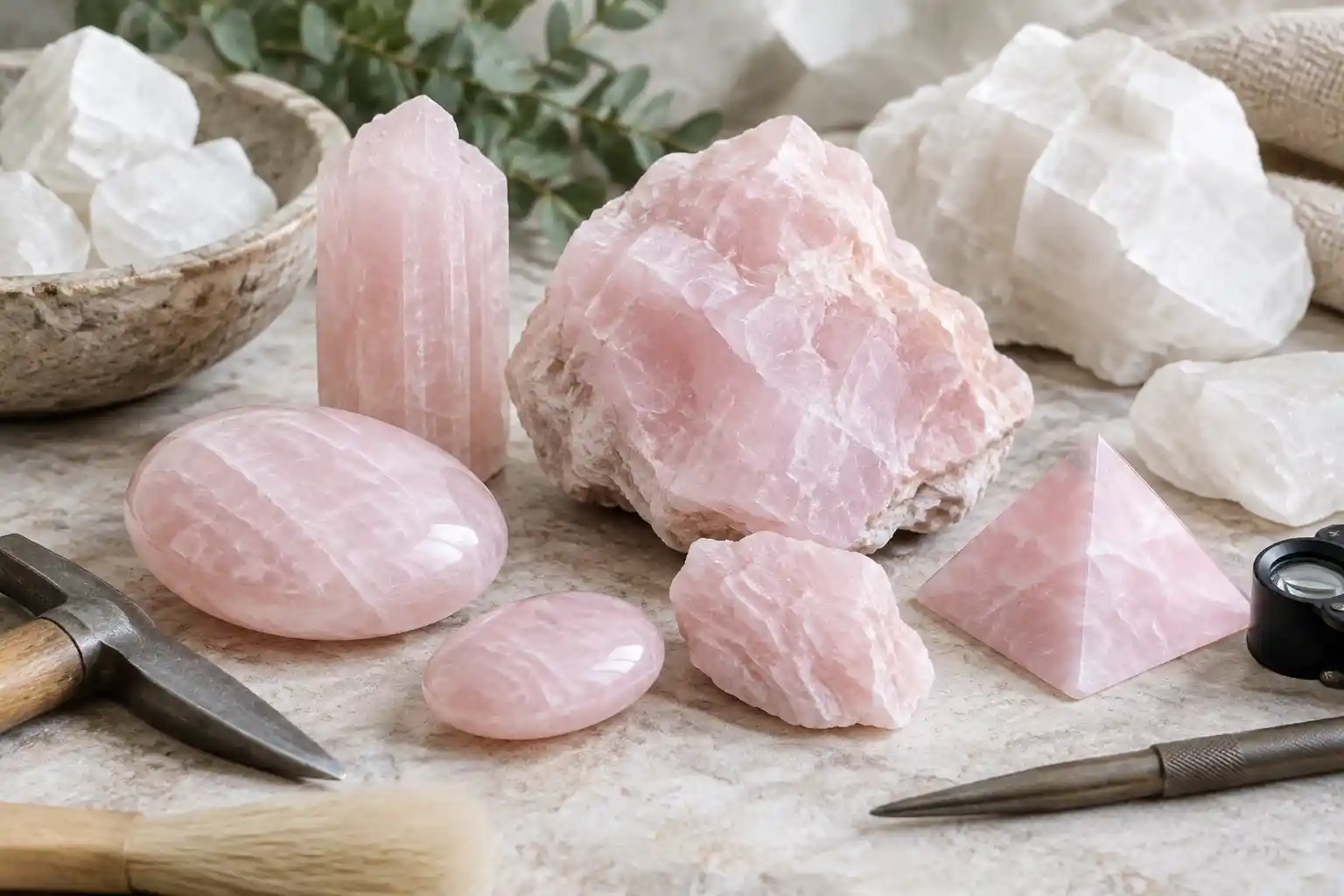
Mangano Calcite benefits begin with a real mineralogical distinction. Mangano Calcite is generally understood as manganese-bearing calcite rather than a separate mineral species. Its basic crystal structure remains calcite, CaCO₃, while some calcium positions are occupied by manganese. This substitution can give the mineral soft pink, peach, rose, or occasionally stronger reddish tones that distinguish it from ordinary white or colorless calcite.
The stone retains the physical characteristics associated with calcite. It belongs to the trigonal crystal system, has perfect rhombohedral cleavage, reacts readily with acids, and has a Mohs hardness of only 3. These properties make Mangano Calcite useful for mineral collections, geological education, decorative pieces, polished stones, and careful lapidary work, but they also mean the stone scratches easily and is not a practical choice for demanding daily-wear jewelry.
Modern discussions of Mangano Calcite benefits often focus on emotional comfort, compassion, relationships, calmness, or heart-centered spiritual symbolism. These ideas can be meaningful as personal or cultural interpretations, especially because pink has strong emotional associations in contemporary gemstone traditions. They are not evidence that manganese-bearing calcite medically changes mood, hormones, heart function, circulation, or mental-health conditions.
10 Mangano Calcite Benefits at a Glance
- Pale pink to rose coloration gives manganese-bearing calcite a distinctive visual identity.
- Calcite mineralogy provides real educational value for studying carbonate chemistry and crystal structure.
- Manganese substitution demonstrates how small compositional changes can alter mineral color.
- Some specimens show attractive fluorescence, adding collector and teaching interest.
- Mineral specimens can display rhombohedral crystals, cleavage surfaces, massive forms, or association with other minerals.
- Softness makes the stone workable for polished objects, carvings, palm stones, and protected decorative pieces.
- Collector appeal comes from color, transparency, fluorescence, crystal form, locality, and mineral association.
- Pink color makes compassion, gentleness, affection, and reflection intuitive modern symbolic themes.
- Meditation or journaling use can provide a consistent personal focus without requiring therapeutic claims.
- Responsible handling teaches useful lessons about calcite softness, cleavage, acid sensitivity, and appropriate care.
Pink Color Is One of the Most Visible Mangano Calcite Benefits
Color is central to Mangano Calcite benefits. Typical specimens range from very pale blush pink to peach, rose, or slightly stronger pink-red tones. Manganese substituting into calcite’s structure is responsible for much of this coloration, although exact appearance varies with concentration, associated impurities, inclusions, crystal quality, and lighting.
The visual effect is usually softer than the intense pinks or reds associated with some other manganese minerals. Many pieces appear milky, translucent, or gently colored rather than highly saturated. This makes Mangano Calcite visually distinct from rhodochrosite, even though both contain manganese and can occur in pink shades.
The comparison is mineralogically important. Calcite is fundamentally calcium carbonate, while rhodochrosite is manganese carbonate, MnCO₃. Mangano Calcite contains manganese replacing part of the calcium in calcite rather than being compositionally identical to rhodochrosite. That difference matters even when the stones look superficially similar.
Anyone comparing pink carbonate stones should therefore focus on identification rather than color alone. The properties and uses described for rhodochrosite benefits belong to a different mineral species, even though overlapping colors can create confusion in the gemstone trade.
Calcite Mineralogy Gives Mangano Calcite Educational Value
One of the most useful Mangano Calcite benefits is its ability to demonstrate how mineral chemistry changes appearance without creating an entirely different crystal structure. Calcite has the formula CaCO₃, but natural minerals rarely behave as perfectly pure textbook substances. Other elements can substitute into crystal sites when their size and charge are compatible with the structure.
Manganese can replace some calcium, producing manganese-bearing calcite. This substitution may influence color and fluorescence while leaving the specimen fundamentally within the calcite structure. The result provides a clear example of solid-solution behavior and minor-element substitution.
The stone also demonstrates classic calcite properties. Perfect cleavage produces rhombohedral fragments rather than irregular glass-like breaks. Its low hardness makes it easy to scratch compared with quartz. Dilute acids cause visible effervescence as carbonate reacts and releases carbon dioxide.
These characteristics make Mangano Calcite useful in classrooms and mineral collections because several important geological concepts can be observed in one specimen. The practical calcite benefits similarly come from the mineral’s abundance, carbonate chemistry, crystal forms, optical properties, and geological importance rather than from therapeutic claims.
Fluorescence Can Add Significant Collector Interest
Some Mangano Calcite specimens fluoresce strongly under ultraviolet light. Pink or orange-red fluorescence may occur when manganese acts as an activator within calcite, although intensity depends on chemistry and other trace elements. Not every specimen fluoresces equally, and some may show little response.
This variation makes ultraviolet testing especially interesting to mineral collectors. A pale specimen that looks relatively subdued under ordinary light can become dramatically luminous under shortwave or longwave ultraviolet illumination, depending on its chemistry.
Fluorescence also teaches an important lesson about trace elements. Manganese can influence how the crystal interacts with ultraviolet energy, but the response depends on concentration, crystal environment, and other activators or quenchers. The presence of manganese does not guarantee one fixed fluorescent color or intensity.
Collectors should therefore evaluate the actual specimen rather than assuming that all Mangano Calcite behaves identically. Color under daylight, transparency, fluorescence, crystal form, association, locality, and condition can all contribute to interest.
Crystal Form and Cleavage Make Mangano Calcite Useful for Mineral Collections
Mangano Calcite may occur as crystalline masses, rhombohedral forms, cleavage fragments, compact aggregates, or specimens associated with other minerals. Transparent or translucent crystals can be particularly attractive when pink coloration remains visible through the specimen.
Calcite’s perfect cleavage is both a diagnostic feature and a weakness. A blow can cause the stone to split along predictable planes, sometimes revealing fresh rhombohedral surfaces. This makes individual crystals interesting for study but vulnerable to rough handling.
Specimen associations can add considerable collector value. Mangano Calcite may occur with quartz, sulfide minerals, other carbonates, or minerals formed in hydrothermal veins and ore deposits. A well-documented association can provide more geological information than a polished stone removed from its original context.
Locality also matters. Manganese-bearing calcite occurs in multiple mining regions around the world, and some localities are known for particularly attractive pink crystals or fluorescent specimens. Reliable provenance therefore adds both scientific and collector value.
Lapidary and Decorative Use Works Best With Protected Pieces
Mangano Calcite benefits include decorative and lapidary potential, but the mineral’s hardness of 3 imposes obvious limits. A polished palm stone, sphere, carving, cabochon, decorative object, or pendant can display the soft pink color beautifully, yet exposed surfaces can scratch easily.
Faceting is technically possible with some calcite, but extreme cleavage and softness make the process challenging and the finished gem delicate. Transparent collector-quality crystals are often more valuable left intact than cut.
Cabochons and carvings can work well when the stone is sufficiently coherent. The soft mineral cuts readily, allowing lapidaries to shape curves and smooth surfaces, but polishing requires care because cleavage, fractures, and uneven texture can create chips or undercut areas.
Jewelry should be chosen with similar caution. Earrings and pendants generally experience less abrasion than rings or bracelets. A Mangano Calcite ring worn every day would be much more vulnerable to scratches, chips, and cleavage damage than a harder gemstone.
Modern Symbolism Focuses on Gentleness and Compassion
The pink color strongly influences contemporary Mangano Calcite benefits. Pink gemstones are often associated with affection, compassion, gentleness, patience, emotional openness, forgiveness, or supportive relationships. These meanings appear frequently in modern crystal culture.
Such symbolism can be personally useful when treated as interpretation. Someone may keep a pink calcite stone beside a journal as a reminder to respond less harshly during conflict. Another person may associate the mineral with a meaningful friendship or family relationship. A pendant might represent a commitment to communicate with greater patience.
The stone does not chemically produce compassion. Rather, its color and personal associations create a visual cue connected with a value the owner already wants to practice.
This distinction allows emotional symbolism to remain useful without claiming that manganese-bearing calcite treats psychological disorders or directly changes brain chemistry.
Meditation and Reflection Can Use Mangano Calcite Safely
Meditation, journaling, and personal ritual are common contexts for Mangano Calcite benefits in modern spiritual practice. The soft pink color can make the stone visually suitable for routines centered on compassion, gratitude, relationships, or self-reflection.
A person may hold a polished piece while breathing slowly, place one nearby during journaling, or use the stone as a cue to begin a reflective practice. The usefulness of that routine comes from focused attention, repeated association, and personal intention.
Contemporary practitioners may also connect Mangano Calcite with heart chakra symbolism or emotional healing. Chakras belong to spiritual frameworks rather than anatomical science, and these interpretations should not be converted into claims about heart function, blood circulation, hormones, or neurological processes.
Beliefs grouped under Mangano Calcite healing properties therefore require clear limits. The stone can be meaningful within a spiritual practice while remaining separate from medical or mental-health treatment.
Softness and Cleavage Make Care Awareness Essential
Care is one of the most practical areas of Mangano Calcite benefits because understanding the stone’s limitations prevents avoidable damage. Mohs hardness 3 means the surface can be scratched by many objects encountered in ordinary life, including harder gemstones, household dust containing quartz, and abrasive cleaning products.
Perfect cleavage makes impact another concern. A drop onto tile or stone can split or chip a specimen. Thin edges, sharp corners, and already fractured areas are particularly vulnerable.
Acids should be avoided because calcite reacts readily with acidic substances. Vinegar, citrus-based cleaners, acid jewelry solutions, and similar products can etch or dissolve the surface. Even prolonged exposure to acidic sweat or household substances may damage a polished finish over time.
Warm or room-temperature water, a soft cloth, and minimal mild soap are safer for uncomplicated pieces. Steam, harsh ultrasonic cleaning, strong chemicals, and abrasive powders should generally be avoided.
Manganese Content Does Not Create a Nutritional or Medical Benefit
Manganese is an essential trace nutrient in human biology, but this fact should not be used to promote Mangano Calcite benefits as a nutritional treatment. Manganese inside a calcite crystal is chemically bound within the mineral structure and does not become a controlled supplement simply because the stone touches the skin.
Wearing or holding Mangano Calcite has not been shown to treat manganese deficiency or provide a useful dietary dose. The stone should not be powdered, consumed, placed in drinking water for ingestion, or used to make homemade mineral remedies.
This distinction is similar to other minerals containing biologically relevant elements. Chemical composition and medical nutrition are separate subjects. A mineral specimen can contain calcium, manganese, iron, copper, or another element without serving as a safe delivery system for the human body.
The genuine value of Mangano Calcite remains in its color, mineralogy, fluorescence, crystal structure, collecting interest, decoration, and symbolism.
What Mangano Calcite Benefits Do Not Include
Mangano Calcite benefits do not include established treatment for depression, anxiety disorders, grief, heart disease, circulatory problems, trauma, hormonal conditions, pain, sleep disorders, immune problems, or other medical concerns.
Modern descriptions involving emotional soothing, heart healing, forgiveness, or energetic balance belong to spiritual and symbolic traditions. A person may find a personal ritual meaningful, but that experience should not be turned into a medical claim about the mineral.
The stone’s pink color and manganese chemistry are interesting enough without implying therapeutic action. Mineralogical facts can coexist with spiritual interpretation as long as the two are clearly separated.
Conclusion
Mangano Calcite benefits include delicate pink color, manganese-bearing calcite chemistry, attractive fluorescence in some specimens, collector appeal, geological education, decorative use, and meaningful modern symbolism. The stone provides an excellent example of how minor chemical substitution can influence mineral appearance while preserving calcite’s basic structure.
Its softness, perfect cleavage, and acid sensitivity require careful handling. Compassion, gentleness, reflection, and emotional openness can remain personal symbolic themes, but manganese-bearing calcite should not be presented as a medical or nutritional treatment.
FAQs
What are the main Mangano Calcite benefits?
The strongest Mangano Calcite benefits include attractive pink coloration, mineralogical interest, collector value, fluorescence in some specimens, educational usefulness, and decorative or lapidary potential. Modern traditions also connect the stone with compassion, gentleness, emotional reflection, and relationships. These symbolic uses are separate from established medical effects.
Is Mangano Calcite a separate mineral species?
Mangano Calcite is generally manganese-bearing calcite rather than a separate formal mineral species. Calcite remains the basic mineral, with CaCO₃ chemistry and some manganese substituting for calcium. The amount of manganese can vary, influencing color and other properties without changing the specimen into rhodochrosite.
Is Mangano Calcite the same as rhodochrosite?
No. Mangano Calcite is calcite containing some manganese, while rhodochrosite is manganese carbonate with the formula MnCO₃. Both can be pink and belong to the carbonate mineral family, which can cause visual confusion. Mineralogical identification should rely on chemistry and physical properties rather than color alone.
Why is Mangano Calcite pink?
Manganese substituting into the calcite structure is responsible for much of the pale pink, peach, or rose coloration. Exact shade varies according to manganese concentration, impurities, crystal quality, and other chemical factors. Color intensity alone does not provide a precise measurement of manganese content.
Does Mangano Calcite fluoresce?
Some specimens fluoresce strongly, commonly in pink, red, or orange-red tones under ultraviolet light. Manganese can act as a fluorescent activator within calcite, but the response depends on chemistry and other trace elements. Not every specimen will fluoresce with the same intensity or under the same ultraviolet wavelength.
Is Mangano Calcite suitable for jewelry?
It can be used in pendants, earrings, beads, carvings, or carefully protected jewelry, but it is relatively soft at Mohs hardness 3 and has perfect cleavage. These properties make it vulnerable to scratches and impact. Rings and bracelets intended for frequent wear require much more caution than protected pieces.
Can Mangano Calcite help with emotional healing?
Emotional healing is a common modern crystal association, particularly because pink stones are often linked symbolically with compassion and relationships. There is no established scientific evidence that Mangano Calcite treats depression, anxiety disorders, trauma, grief, or other mental-health conditions. It may still function as a personally meaningful reminder during reflection or meditation.
Does the manganese in Mangano Calcite benefit the body?
There is no evidence that wearing or holding Mangano Calcite provides a useful nutritional dose of manganese. The element is chemically bound within the mineral structure. Dietary manganese and medically relevant exposure involve entirely different biological pathways and controlled amounts, so the gemstone should not be used as a supplement.
How should Mangano Calcite be cleaned?
Gentle cleaning is best. A soft cloth and small amount of mild soap with water are safer than acidic or abrasive products. Vinegar, citrus cleaners, strong chemicals, steam, aggressive ultrasonic cleaning, and abrasive powders can damage calcite. The stone should also be protected from impact because of its perfect cleavage.
Mangano Calcite benefits involving emotional healing, heart-centered energy, chakras, or manganese-related wellness describe modern symbolic or spiritual interpretations and should not replace qualified physical or mental-health care.