11 Real Rhodochrosite Benefits: Inner Child Healing & Manganese Safety Limits
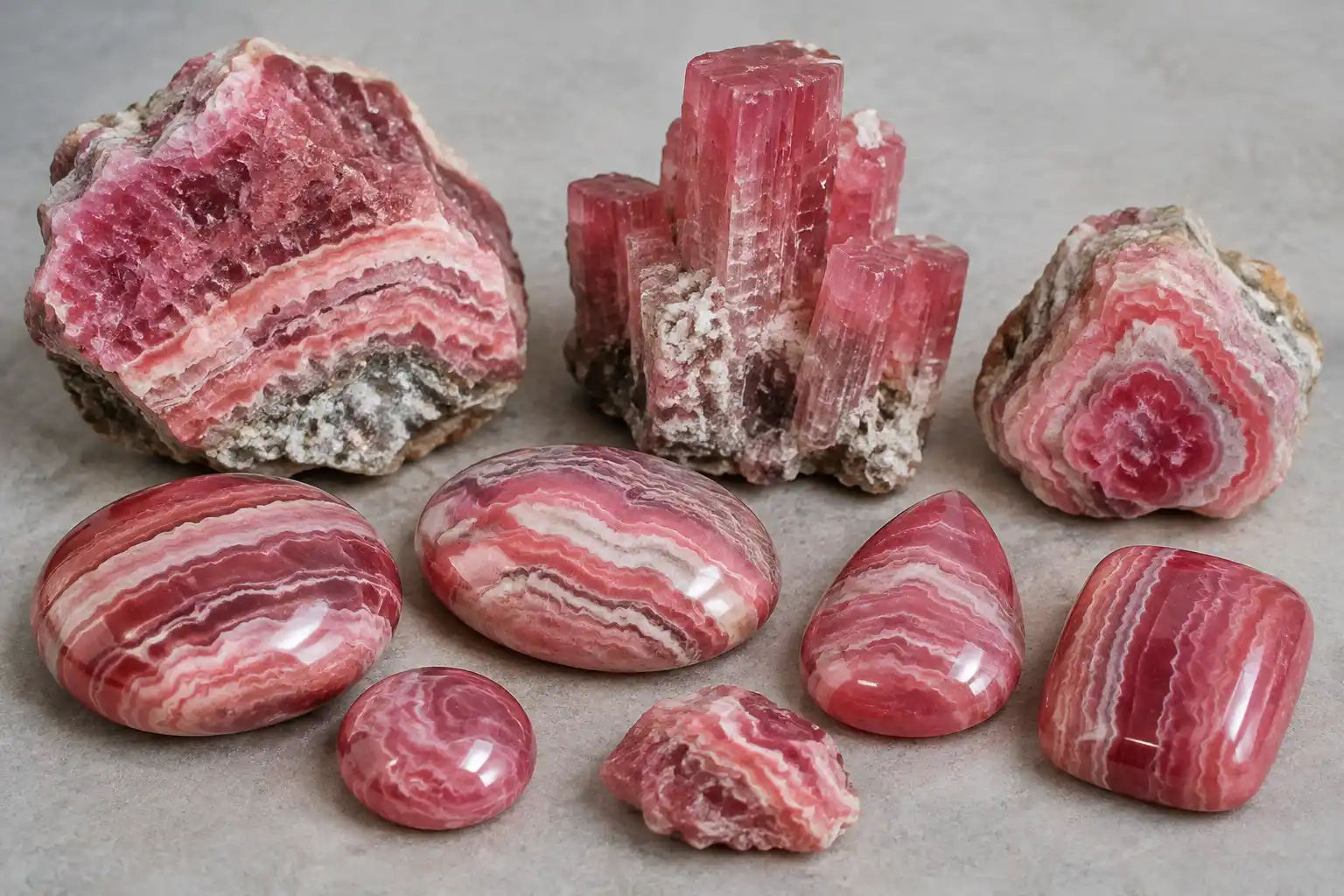
Rhodochrosite benefits begin with a distinctive manganese carbonate mineral prized for pink to intense raspberry-red color, attractive banding, rare transparent crystals, and important mineral specimens. Rhodochrosite has the chemical formula MnCO3, belongs to the calcite group, crystallizes in the trigonal system, and typically measures only about 3.5 to 4 on the Mohs scale.
These properties give rhodochrosite benefits in mineral collecting, lapidary work, geological study, gem identification, and decorative use, but they also impose meaningful durability limits. Rhodochrosite has perfect rhombohedral cleavage and relatively low hardness, making fine transparent crystals and faceted gems far more delicate than quartz, garnet, sapphire, or diamond.
Modern spiritual traditions associate rhodochrosite benefits with compassion, self-reflection, emotional openness, heart chakra practice, and so-called inner child healing. These ideas can be used symbolically during journaling or meditation, but rhodochrosite has not been scientifically shown to treat trauma, depression, anxiety, childhood psychological injuries, heart disease, or another medical condition.
11 Rhodochrosite Benefits at a Glance
- Pink to deep raspberry-red color gives rhodochrosite exceptional collector, jewelry, and decorative appeal.
- MnCO3 chemistry makes it an excellent mineral for studying manganese-bearing carbonate systems.
- Trigonal crystal structure and rhombohedral cleavage provide useful examples for crystallography and mineral identification.
- Banded massive rhodochrosite works well for cabochons, beads, carvings, boxes, and ornamental objects.
- Rare transparent crystals can produce striking faceted gems when handled by skilled cutters.
- Hydrothermal veins and manganese-rich deposits give rhodochrosite substantial geological and locality interest.
- Famous specimens from Colorado, South Africa, Argentina, Romania, and Peru have significant collector and historical importance.
- Its physical resemblance to other pink stones makes rhodochrosite useful for learning practical identification techniques.
- Modern heart chakra and inner child traditions use the stone symbolically for compassion, reflection, and personal growth.
- Its manganese content provides an opportunity to distinguish safe handling of intact stones from occupational exposure to manganese-bearing dust.
- Understanding low hardness, perfect cleavage, acid sensitivity, water exposure, and cleaning limits supports safer ownership.
Rhodochrosite Benefits Begin With Manganese Carbonate Mineralogy
One of the strongest rhodochrosite benefits is its mineralogical distinctiveness. Rhodochrosite is manganese carbonate, MnCO3, and belongs to the calcite group alongside minerals such as calcite, magnesite, siderite, and smithsonite-related carbonate systems.
Its trigonal crystal structure can produce rhombohedral or scalenohedral crystals, although massive, granular, crust-like, botryoidal, and banded forms are also common. Transparent well-formed crystals are far less common than opaque to translucent pink banded specimens.
Manganese is primarily responsible for the characteristic pink to red coloration. Variations in iron, calcium, magnesium, zinc, oxidation, and crystal chemistry can shift the appearance toward pale pink, orange-pink, brownish red, gray, or other tones.
These rhodochrosite benefits make the mineral particularly useful for studying the relationship between chemistry, crystal structure, color, and geological formation.
Why Rhodochrosite Color Is Gemologically Important
Color is one of the most obvious rhodochrosite benefits. Fine transparent crystals can display intense strawberry, raspberry, or cherry-red coloration, while massive material commonly shows pink and white bands created by successive stages of mineral deposition.
Color alone does not prove identity. Rhodonite, pink calcite, dyed carbonate stones, glass, and other pink gems can resemble rhodochrosite, especially when fashioned into polished cabochons or beads.
The distinction between rhodochrosite and rhodonite is particularly useful because their names and colors are easily confused. Rhodochrosite is a manganese carbonate, while rhodonite is primarily a manganese silicate, giving the two stones different hardness, cleavage, chemistry, and geological behavior.
Strong pink or red color can increase collector appeal, but quality should still consider transparency, crystal form, banding, damage, locality, polish, and cutting.
Rhodochrosite Benefits for Collectors
Collector interest is one of the most substantial rhodochrosite benefits. Fine crystals can combine saturated red color, high transparency, sharp rhombohedral form, contrasting quartz or sulfide matrix, and traceable provenance from famous mines.
Colorado’s Sweet Home mine became particularly celebrated for transparent, deep pink to red crystals and world-class mineral specimens. South Africa’s Kalahari manganese fields have also produced notable gem-quality crystals, while Argentina is famous for banded stalactitic rhodochrosite widely used for carvings and decorative objects.
Knowing where rhodochrosite is found helps explain why specimens from different deposits can look dramatically different. Hydrothermal chemistry, host rock, associated minerals, temperature, fluid composition, and manganese availability influence crystal form and appearance.
Provenance matters because a documented specimen represents a specific geological occurrence rather than an anonymous pink stone. Classic-locality examples can therefore be valued for scientific and historical reasons as well as beauty.
Transparent Rhodochrosite and Faceting
Faceting is another important but specialized area of rhodochrosite benefits. Transparent red crystals can produce exceptionally attractive gems, but the stone is challenging to cut because it combines low hardness with perfect rhombohedral cleavage.
A cutter must orient rough carefully to reduce the chance of a cleavage fracture developing during sawing, preforming, faceting, or polishing. Excessive pressure, heat, vibration, or an unfortunate facet orientation can damage valuable rough.
Finished faceted rhodochrosite is therefore usually regarded as collector jewelry rather than an everyday hard-wearing gem. Pendants, earrings, protected brooches, and display pieces generally create less mechanical risk than exposed rings.
The rarity of clean transparent rough also contributes to its appeal. Much rhodochrosite in the gem trade is opaque or translucent banded stone rather than transparent faceting quality.
Banded Rhodochrosite for Carvings and Cabochons
Massive banded rhodochrosite provides different practical rhodochrosite benefits. Pink and white layers can form visually striking patterns when cut across stalactitic, vein, or layered growth structures.
Lapidaries use this stone for cabochons, beads, carvings, small boxes, spheres, decorative slabs, and ornamental objects. The patterns can range from subtle parallel bands to concentric formations with strong contrasts.
Low hardness still requires care. Polished surfaces can scratch more easily than quartz-based gems, and thin carvings or projecting edges may chip if struck.
For display and occasional jewelry use, however, the combination of color and banding gives rhodochrosite a visual character that is difficult to reproduce with harder pink gems.
Geological Formation Provides Scientific Value
Rhodochrosite benefits geology because the mineral occurs in several important manganese-rich environments. It commonly forms as a gangue mineral in moderate- to low-temperature hydrothermal veins, particularly alongside sulfides and other carbonate minerals.
It can also occur in sedimentary manganese deposits, metasomatic systems, and as a late-stage hydrothermal mineral in some pegmatites. Associated minerals may include quartz, calcite, fluorite, sphalerite, galena, tetrahedrite, pyrite, and other manganese-bearing species.
These mineral associations help geologists reconstruct the chemistry of the fluids and rocks involved in mineralization. Crystal habits, zoning, inclusions, trace-element chemistry, and isotopic measurements can reveal different stages of hydrothermal activity.
A rhodochrosite specimen is therefore more than an attractive pink object. It can preserve evidence about fluid movement, manganese transport, mineral deposition, and ore-forming processes.
Rhodochrosite History Adds Collector Significance
The history of rhodochrosite adds another layer of practical value. The mineral was formally described in the early nineteenth century, with its name derived from Greek roots referring to rose coloration.
Later discoveries transformed its gemological reputation. Banded material from Argentina became important for ornamental carvings, while transparent crystals from Colorado and South Africa showed that rhodochrosite could also produce exceptional faceted gems and museum-quality specimens.
Historical claims still require care. Stories connecting rhodochrosite with the Inca world are common, particularly around Argentine banded deposits, but romanticized legends should be distinguished from well-documented archaeological or mining evidence.
The strongest historical rhodochrosite benefits come from traceable mineral discovery, mining history, famous specimens, lapidary development, and documented localities.
Inner Child Healing as a Modern Symbolic Practice
Inner child healing is one of the most repeated spiritual rhodochrosite benefits. In modern wellness and crystal traditions, the phrase usually refers to reflecting on childhood experiences, unmet emotional needs, learned behaviors, or recurring patterns that may continue into adult life.
A pink stone can become a gentle visual symbol for compassion toward oneself. Someone may hold rhodochrosite while journaling about family experiences, emotional triggers, or patterns they want to understand more clearly.
The stone itself does not recover suppressed memories, repair trauma, alter the nervous system, or perform psychological treatment. Serious trauma, persistent depression, anxiety, self-harm thoughts, abuse histories, or disabling emotional symptoms require qualified professional support.
Rhodochrosite benefits are therefore more defensible when the stone functions as a symbolic object within reflection rather than being described as a treatment.
Heart Chakra Symbolism Without Anatomical Claims
Modern crystal traditions frequently associate rhodochrosite with the heart chakra because of its pink and red coloration. The symbolism often includes compassion, self-respect, relationships, forgiveness, emotional openness, and affection.
These themes can be incorporated into meditation or journaling. Someone may use a rhodochrosite cabochon while reflecting on a relationship or deciding how to communicate more thoughtfully.
Chakras are spiritual frameworks, not anatomical structures. Rhodochrosite does not physiologically activate the heart, improve circulation, alter blood pressure, or change cardiovascular function.
The spiritual symbolism can remain meaningful when clearly separated from medicine. The stone acts as a focal object, while the reflection and behavior come from the person.
Manganese Safety Limits Explained Accurately
Manganese is essential to understanding rhodochrosite because MnCO3 defines the mineral’s chemistry. The presence of manganese does not mean wearing rhodochrosite provides the body with a nutritional manganese supplement.
Ordinary handling of an intact polished stone is very different from occupational exposure to manganese-containing dust or fumes. Health concerns associated with excessive manganese exposure are particularly important when fine airborne particles are repeatedly inhaled at elevated concentrations.
Cutting, drilling, sanding, or grinding rhodochrosite can create mineral dust. Lapidaries should therefore use appropriate wet-working practices, extraction, ventilation, and respiratory controls suited to the operation.
Rhodochrosite should not be powdered, swallowed, or dissolved intentionally for wellness purposes. There is no proven health benefit from trying to extract manganese from a gemstone.
Water, Acids, and Cleaning Cautions
Rhodochrosite is a carbonate mineral, making conservative cleaning particularly important. Its softness and perfect cleavage already limit durability, while acidic chemicals can attack carbonate minerals.
Questions about whether rhodochrosite is safe in water should distinguish a brief gentle rinse from prolonged soaking, hot water, acidic solutions, saltwater rituals, ultrasonic cleaning, or repeated immersion.
For ordinary jewelry care, a soft damp cloth is often sufficient. If washing is required, use mild soap, lukewarm water, minimal exposure, and careful drying.
Avoid acids, harsh chemical cleaners, steam, severe temperature changes, and aggressive ultrasonic cleaning. Valuable transparent crystals or specimens with cleavage fractures deserve especially cautious treatment.
Rhodochrosite Benefits for Gem Identification
Rhodochrosite benefits students of gemology because its properties differ clearly from many other pink stones when examined systematically. Hardness around 3.5 to 4, high birefringence, carbonate chemistry, specific gravity, cleavage, refractive behavior, and crystal habit can all contribute to identification.
Visual color is only a starting point. Rhodonite is harder and chemically a manganese silicate, rose quartz has very different hardness and optical characteristics, and pink calcite may resemble pale rhodochrosite but differs in detailed testing.
Scratch testing should not be performed on finished gems or valuable specimens simply to confirm hardness. Professional gemological testing is less destructive and more appropriate for high-value pieces.
Identification skill is one of the most practical rhodochrosite benefits because it replaces assumptions based on pink color with measurable properties.
How to Evaluate Rhodochrosite Quality
Quality depends strongly on whether the piece is a crystal specimen, faceted gem, cabochon, carving, or banded ornamental stone. Transparent faceting rough may be evaluated for color saturation, clarity, cleavage fractures, cut quality, and rarity.
Mineral specimens are judged differently. Crystal form, matrix association, locality, provenance, damage, repairs, color, transparency, and overall aesthetics may matter more than conventional gemstone clarity.
Banded stones often benefit from strong pattern definition and attractive cutting orientation. A skilled cutter can position concentric or parallel bands so that the natural growth structure becomes the focal feature.
Spiritual descriptions should not influence identification or gemological quality. Rhodochrosite benefits are strongest when beauty, geological information, workmanship, and personal symbolism are evaluated independently.
Conclusion
Rhodochrosite benefits include exceptional pink to red color, rare transparent crystals, banded lapidary use, geological significance, collector value, and educational insight into manganese carbonate mineralogy. Inner child and heart chakra practices can provide personal symbolism, while low hardness, perfect cleavage, carbonate chemistry, and manganese-bearing dust require realistic care and safety limits.
FAQs
What are the main rhodochrosite benefits?
The main rhodochrosite benefits include attractive pink to red coloration, collector value, lapidary use, geological importance, rare faceting potential, and educational value for studying manganese carbonate minerals. Modern spiritual traditions also connect it with compassion, emotional reflection, and inner child practices, but those uses are symbolic.
What is rhodochrosite made of?
Rhodochrosite is manganese carbonate with the chemical formula MnCO3. It belongs to the calcite group and crystallizes in the trigonal system.
Why is rhodochrosite pink or red?
Manganese is primarily responsible for its characteristic pink to red coloration. Iron, calcium, magnesium, zinc, crystal chemistry, and geological conditions can influence the exact shade.
Is rhodochrosite a hard gemstone?
No. Rhodochrosite measures only about 3.5 to 4 on the Mohs scale and has perfect rhombohedral cleavage. It requires considerably more care than quartz, garnet, sapphire, or diamond.
Can rhodochrosite be faceted?
Yes. Transparent gem-quality crystals can be faceted and may produce striking pink to deep red stones. Cutting is difficult because of low hardness and perfect cleavage, so faceted rhodochrosite is usually best treated as collector or occasional-wear jewelry.
Does rhodochrosite heal childhood trauma?
There is no scientific evidence that rhodochrosite treats trauma or other psychological conditions. It may be used as a symbolic focus during journaling, meditation, or reflection, while significant trauma should be addressed with appropriate professional support.
Is the manganese in rhodochrosite dangerous?
Ordinary handling of an intact polished stone is very different from occupational exposure to airborne manganese. Greater precautions are appropriate when cutting, grinding, drilling, or sanding because those activities can generate manganese-bearing mineral dust.
Can rhodochrosite go in water?
Brief gentle contact with clean water differs from prolonged soaking. Because rhodochrosite is soft, cleavable, and chemically a carbonate, extended immersion, acids, harsh cleaners, steam, and aggressive ultrasonic cleaning are best avoided.
What is the difference between rhodochrosite and rhodonite?
Rhodochrosite is manganese carbonate, MnCO3, while rhodonite is primarily manganese silicate. They differ in hardness, cleavage, crystal structure, chemistry, geological occurrence, and typical appearance even though both can be pink.
Where does high-quality rhodochrosite come from?
Important sources include Colorado in the United States, the Kalahari manganese fields of South Africa, Argentina, Peru, Romania, and other manganese-rich mineral districts. Different localities are known for transparent crystals, banded ornamental stone, or distinctive mineral specimens.
Is rhodochrosite suitable for everyday rings?
It is generally a poor choice for an exposed everyday ring because Mohs hardness 3.5 to 4 and perfect cleavage make it vulnerable to scratches, chips, and breakage. Pendants, earrings, protected settings, or occasional-wear pieces are safer choices.
Disclaimer: Inner child, heart chakra, emotional, compassionate, and energetic descriptions of rhodochrosite reflect spiritual beliefs and personal practices. Rhodochrosite is not a medical or psychological treatment, and its manganese content does not provide a health benefit through ordinary skin contact.