11 Hidden Mookaite Benefits: Meaningful Uses, Verified Facts, Important Cautions
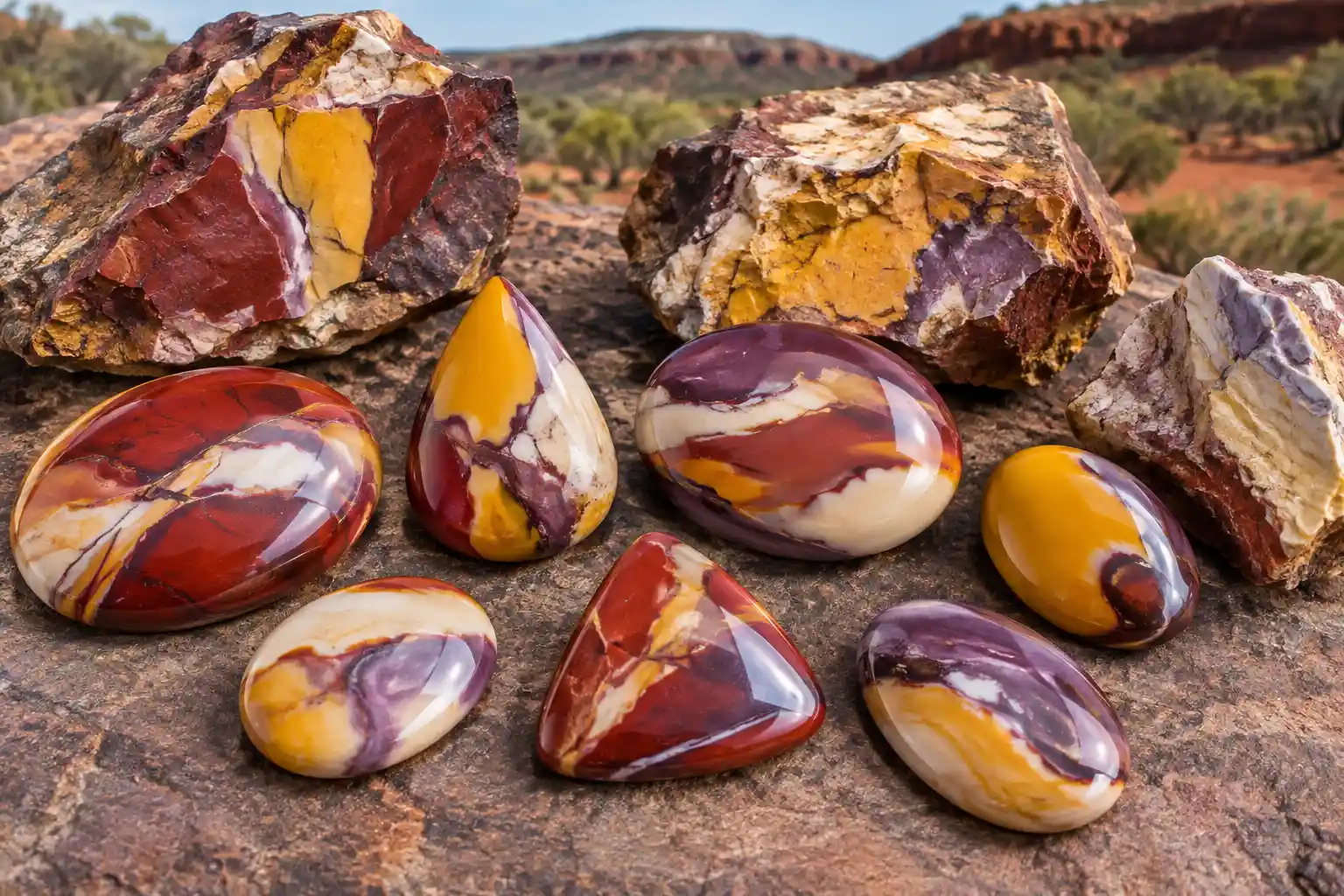
Mookaite benefits begin with one of Australia’s most recognizable ornamental stones. Mookaite, also written mookite in some references and trade usage, comes from the Mooka Creek region of Western Australia. It is a silica-rich rock associated with the Windalia Radiolarite and is known for striking combinations of mustard yellow, cream, white, red, burgundy, brown, pink, and purple.
The stone is often marketed casually as a form of jasper, but its geology deserves a more careful explanation. Mookaite formed from siliceous marine sediment containing microscopic skeletal remains, particularly radiolarians, that accumulated on an ancient seafloor and were later silicified. Depending on the specimen and degree of alteration, its silica can occur in microcrystalline quartz, chalcedony, and related forms, while iron minerals contribute much of the red, yellow, brown, and purple coloration.
These characteristics give Mookaite benefits that are practical as well as aesthetic. The stone can take an attractive polish, works well in cabochons and carvings, has useful quartz-family hardness in strongly silicified pieces, provides an educational connection with ancient marine sediments, and carries a strong geographic identity tied to Western Australia. Modern symbolism involving confidence, adaptability, decision-making, adventure, and connection with place can add personal meaning when kept separate from unsupported medical claims.
11 Mookaite Benefits at a Glance
- Multicolored red, yellow, cream, burgundy, and purple patterns create strong visual appeal.
- Western Australian origin gives Mookaite a distinctive geographic identity.
- Ancient marine sedimentary origins provide geological and paleontological interest.
- Silicification can produce durable stone suitable for cabochons, beads, carvings, and decorative objects.
- Lapidary cutting can reveal dramatic patterns that are difficult to predict from rough pieces.
- Collector value comes from color combinations, pattern, polish, locality, size, and geological context.
- Jewelry offers a warm earthy appearance that works with many metals and design styles.
- Modern symbolism can connect the stone with adaptability, confidence, decision-making, and exploration.
- Travel or Australian connections can give Mookaite particularly strong personal meaning.
- Meditation and journaling can use the stone as a visual focus without assigning medical effects.
- Appropriate care preserves polish while avoiding confusion between symbolic wellness claims and real mineral properties.
Color Variety Is One of the Strongest Mookaite Benefits
Few ornamental stones combine such a recognizable range of warm colors in one piece. Mookaite may include cream, mustard yellow, ochre, brick red, deep burgundy, brown, pink, mauve, white, and purple, sometimes arranged in sweeping zones or irregular patches.
Iron compounds are important contributors to many of these colors. Differences in oxidation state, mineral distribution, sedimentary chemistry, and later alteration can produce contrasting red and yellow zones within the same stone.
This range gives lapidaries unusual freedom. A single slab may produce several cabochons that look almost unrelated because each cut captures a different area of pattern. One stone may be predominantly mustard yellow with a cream streak, while another from the same rough piece may be burgundy and purple.
For jewelry buyers, that variability makes Mookaite benefits highly personal. There is no requirement that the finest-looking piece have one particular combination. Some people prefer saturated reds, others seek contrasting mustard and cream, while collectors may value unusual purple or multicolored patterns.
Western Australian Origin Gives Mookaite a Strong Sense of Place
Geographic identity is central to Mookaite benefits. The stone is associated with the Mooka Creek area near the Kennedy Ranges in Western Australia, and its name derives from this locality.
This gives Mookaite a more specific origin story than many commercial jasper names that are applied loosely to visually similar stones from several countries. A genuine locality connection adds geological context and makes the stone particularly appealing to collectors interested in Australian rocks and gemstones.
For travelers or people with personal connections to Western Australia, this sense of place can become as important as color. A pendant may function as a memory of a journey, while a specimen in a geological collection can represent a distinctive Australian sedimentary unit.
Geographic identity should still be supported by reliable sourcing. Similar red, yellow, cream, and brown siliceous rocks occur elsewhere, so appearance alone does not prove that a stone came from the Mooka Creek region.
Ancient Marine Origins Add Geological Mookaite Benefits
One of the most fascinating Mookaite benefits is its connection with ancient marine sediments. The host rock is associated with the Windalia Radiolarite, a geological formation containing silica-rich sediments originally deposited in a marine environment.
Radiolarians are microscopic marine organisms that produce silica-rich skeletal structures. When large numbers accumulated on the seafloor, their remains contributed to siliceous sediment. Compaction, chemical alteration, replacement, and silicification later transformed these deposits into hard rock.
This origin means a polished Mookaite cabochon carries evidence of a landscape dramatically different from present-day inland Western Australia. The region containing the stone today was once connected with an ancient marine environment.
For geology students, this transforms the stone from decoration into a teaching object. Mookaite can introduce concepts involving sedimentation, microfossils, silicification, diagenesis, iron coloration, and changes in environment through geological time.
Silicification Supports Useful Lapidary Durability
Mookaite is widely cut because strongly silicified pieces can take an excellent polish and withstand normal jewelry use reasonably well. The dominant microcrystalline silica components commonly place suitable Mookaite in a hardness range comparable with jasper and chalcedony, approximately around 6.5 to 7 on the Mohs scale.
Actual performance can vary because Mookaite is a rock rather than one perfectly uniform mineral crystal. Porosity, fractures, softer zones, incomplete silicification, and iron-rich areas may affect individual pieces.
Sound rough can be shaped into cabochons, beads, pendants, bracelets, spheres, carvings, palm stones, knife handles, decorative slabs, and many other objects. A smooth polish emphasizes color boundaries and can make subtle cream or mauve zones much more visible.
The practical durability is therefore one of the strongest Mookaite benefits, but it should not be simplified into a guarantee that every specimen will behave exactly like pure quartz.
Lapidary Cutting Reveals Hidden Patterns
Mookaite rough can be deceptive. An unremarkable exterior may conceal dramatic interior patterns, making cutting part of the discovery process.
Lapidaries often examine exposed faces, fractures, color lines, and sawn slabs before deciding how to orient cabochons. A broad color boundary can become the central feature of a pendant, while several smaller zones might be arranged across a matched pair of earrings.
Freeform shapes can be especially effective because the cutter can follow attractive color transitions rather than forcing the rough into standardized dimensions. This approach preserves unusual patterns and may reduce unnecessary waste.
The unpredictability contributes significantly to Mookaite benefits for hobbyists. Cutting becomes more than simply producing a polished surface because each slice can reveal a different combination of geological color and pattern.
Mookaite Jewelry Combines Earthy Color With Practical Wearability
Mookaite works well in jewelry because warm reds, yellows, burgundies, creams, and browns complement many metal colors. Yellow gold can emphasize warm mustard tones, silver provides contrast with red and purple areas, while copper-colored designs can reinforce the stone’s earthy appearance.
Cabochons are common because opacity and pattern matter more than faceted brilliance. Pendants, earrings, beads, rings, cuffs, and statement pieces can all use the stone effectively.
Durability is generally suitable for many jewelry applications when the piece is well silicified and free from major structural weakness. Rings still deserve normal gemstone care because even quartz-rich stones can chip at thin edges or fracture when struck forcefully.
Pattern selection can also make jewelry highly individual. Two cabochons of the same size may look completely different, allowing buyers to choose stones according to color rather than standardized grading.
Collecting Mookaite Rewards Pattern and Geological Context
Collector interest is another practical area of Mookaite benefits. Polished slices can display color transitions clearly, while rough pieces retain natural surfaces and provide more geological context.
Collectors may value pieces for unusual combinations such as cream and burgundy, purple and mustard, or sharply divided red and yellow zones. Large slabs are particularly useful for showing how patterns continue through the rock.
Locality documentation strengthens a collection because Mookaite’s name is closely tied to Western Australia. A specimen with reliable source information carries more scientific and geographic meaning than an unidentified multicolored siliceous stone sold only under a commercial label.
Some collectors may also appreciate the relationship between Mookaite and radiolarian sedimentation. This gives specimens value in both ornamental-stone collections and educational geological displays.
Mookaite Symbolism Often Centers on Adaptability and Confidence
Modern crystal traditions commonly associate Mookaite benefits with adaptability, confidence, decision-making, courage, adventure, and balancing caution with willingness to try something new.
These meanings are contemporary symbolic interpretations rather than established physical effects. The stone’s multicolored appearance may contribute to themes of flexibility because one specimen can move dramatically from cream to yellow, red, burgundy, and purple.
Someone facing a career decision might keep a polished stone nearby as a reminder to evaluate choices calmly. A traveler may associate Mookaite with exploration because of its Australian origin. Another person might connect it with confidence after carrying the stone during a personally important period.
The symbolism described within Mookaite meaning becomes most useful when it remains personal rather than being presented as a force that automatically changes behavior.
Travel and Exploration Can Give Mookaite Personal Meaning
Mookaite’s geographic identity makes travel symbolism particularly intuitive. Someone who has visited Western Australia may value the stone as a physical reminder of landscape, distance, geology, and experience.
Even without visiting the locality, a collector may connect Mookaite with curiosity about unfamiliar places. Its colors resemble desert landscapes, cliffs, soils, sunsets, and weathered rock, which can reinforce associations with exploration and outdoor environments.
The connection is symbolic rather than predictive. Carrying Mookaite does not make travel safer, guarantee confidence, or prevent accidents.
A stone can still represent the intention to remain curious, prepare carefully, and engage with new experiences. In that sense, exploration becomes one of the more natural modern Mookaite benefits because it connects the physical locality with personal aspiration.
Meditation and Decision-Making Rituals Can Use Mookaite Responsibly
Mookaite is sometimes used during meditation, journaling, or decision-making rituals. The varied color patterns can provide an engaging visual focus, while the stone’s modern symbolism may encourage someone to think about alternatives before making a choice.
A person might place the stone beside a notebook and write advantages and disadvantages of several options. Another may hold it during a period of quiet reflection before making a decision. The process can feel useful because it creates structure and deliberate attention.
The stone itself does not supply correct answers. Decision quality depends on information, consequences, experience, expert advice when appropriate, and the person’s values.
Beliefs discussed under Mookaite healing properties should likewise remain separate from medical claims. Meditation can be meaningful, but Mookaite has not been demonstrated to treat anxiety disorders, depression, pain, hormonal conditions, or other illnesses.
Color Does Not Prove One Exact Mineral Composition
Because Mookaite is a rock composed of silica-rich components and associated impurities rather than a single transparent mineral crystal, two pieces can differ chemically and texturally while sharing the same trade name.
Red and yellow areas often reflect different iron-bearing phases or oxidation conditions, while white and cream areas contain less strongly colored components. Microcrystalline quartz, chalcedony, and related silica phases can contribute to the hard silicified structure.
This complexity is part of the stone’s educational value. It demonstrates why ornamental rocks should not always be assigned one simple mineral formula merely because they are sold as gemstones.
Mookaite benefits therefore include a useful reminder that geology can be more complex than commercial terminology suggests. A gemstone name may describe an attractive rock from a particular locality rather than one pure mineral species.
Care Is Straightforward for Sound Silicified Mookaite
Sound Mookaite is generally easier to care for than soft minerals such as calcite, malachite, or lepidolite. Mild soap, lukewarm water, and a soft cloth or brush are suitable for many uncomplicated polished pieces.
Care should still reflect the individual stone. Fractures, porous zones, coatings, dyes, adhesives, or composite jewelry construction can require greater caution. Strong impact can chip a cabochon even when the surface is reasonably scratch resistant.
Storage away from harder gemstones helps preserve polish, particularly on pieces that contain slightly softer or less completely silicified zones.
No special energetic cleansing method is required for physical preservation. Jewelry care should be based on the stone’s actual structure and construction rather than metaphysical rules.
What Mookaite Benefits Do Not Include
Mookaite benefits do not include proven treatment for disease, anxiety, depression, hormonal conditions, immune problems, circulation disorders, digestive illness, pain, sleep problems, or aging.
Modern claims involving vitality, courage, anti-aging effects, energetic protection, or physical healing belong to crystal belief traditions rather than established medical science.
The stone’s iron-related colors should not be interpreted as nutritional iron being delivered through the skin. Likewise, its silica content does not create a therapeutic silica treatment by ordinary contact.
Mookaite is already valuable as an Australian ornamental rock, geological teaching specimen, lapidary stone, collectible object, and personal symbol. Those real qualities do not need unsupported health claims.
Conclusion
Mookaite benefits combine vivid natural color, Australian geographic identity, ancient marine sedimentary history, strong silicification, lapidary versatility, collector interest, and practical jewelry use. Its connection with radiolarian-rich deposits adds scientific depth that is often overlooked when the stone is described only as colorful jasper.
Modern themes involving adaptability, confidence, exploration, and decision-making can add personal significance when treated as symbolism. Mookaite works best as a geological object and meaningful personal stone, not as a substitute for medical treatment or a guaranteed source of courage or certainty.
FAQs
What are the main Mookaite benefits?
The strongest Mookaite benefits include colorful red, yellow, cream, burgundy, and purple patterns, good lapidary potential, Australian geographic identity, geological interest, collecting value, and suitability for many forms of jewelry. Modern symbolism also connects Mookaite with adaptability, confidence, exploration, and decision-making, although these are personal interpretations rather than scientifically demonstrated effects.
What exactly is Mookaite?
Mookaite is an ornamental silica-rich rock from Western Australia associated with the Windalia Radiolarite near Mooka Creek. It developed from ancient marine siliceous sediments that were later altered and silicified. Although frequently marketed as jasper, its geology can include microcrystalline quartz, chalcedony, related silica phases, iron minerals, and remnants of radiolarian-rich sedimentary textures.
Why does Mookaite have so many colors?
Iron-bearing minerals and different oxidation conditions contribute strongly to its red, yellow, brown, and burgundy colors. Cream, white, pink, and purple zones can occur as sediment composition and later alteration vary. Because the stone is a multicomponent rock, different areas of the same slab may show very different colors.
Is Mookaite actually jasper?
Mookaite is often called Mookaite Jasper in the gemstone trade because it is opaque, silica-rich, colorful, and can take a jasper-like polish. Geologically, describing it simply as a pure jasper can oversimplify its origin. It is closely tied to silicified radiolarian sediment within the Windalia Radiolarite of Western Australia.
Is Mookaite good for jewelry?
Yes. Strongly silicified Mookaite can take an attractive polish and is commonly made into cabochons, beads, pendants, rings, earrings, and bracelets. Individual pieces can contain fractures or variable zones, so normal protection from hard impacts remains sensible. Cabochons are especially effective because broad surfaces display the multicolored patterns clearly.
Does Mookaite contain fossils?
Mookaite’s geological origin is connected with ancient siliceous marine sediments containing microscopic radiolarian skeletal remains. Extensive silicification and alteration mean those original biological structures are not necessarily obvious in every polished stone. The relationship with radiolarian sedimentation is nevertheless central to understanding the geological formation.
Why is Mookaite associated with adventure?
Adventure and exploration are modern symbolic themes influenced partly by the stone’s distinctive Western Australian origin and earthy multicolored appearance. A person may use Mookaite as a reminder to approach new experiences with curiosity or confidence. There is no evidence that carrying the stone physically causes courage or protects someone during travel.
Can Mookaite help with decisions?
A Mookaite stone can be used as a symbolic focus during journaling or reflection, but it does not provide objectively correct answers. Someone might associate it with adaptability and thoughtful decision-making and use that symbolism to create a deliberate pause before choosing. Important decisions should still rely on relevant evidence, consequences, expertise, and personal priorities.
How hard is Mookaite?
Strongly silicified Mookaite commonly behaves similarly to other microcrystalline silica-rich ornamental stones, with hardness often around 6.5 to 7 on the Mohs scale. Because it is a rock rather than one perfectly uniform mineral crystal, individual areas can vary. Fractures and less-silicified zones may reduce practical durability.
How should Mookaite be cleaned?
Mild soap, lukewarm water, and a soft cloth or brush are appropriate for many untreated polished pieces. Harsh chemicals and unnecessary aggressive cleaning should be avoided, particularly if a stone contains fractures, coatings, adhesives, or porous areas. Normal care and protection from strong impacts help preserve the polish.
Are Mookaite healing benefits scientifically proven?
No. Mookaite has not been shown to diagnose, treat, cure, or prevent physical or mental-health conditions. Claims involving vitality, emotional healing, anti-aging effects, hormones, immunity, pain relief, or energetic protection belong to modern spiritual traditions rather than established medical evidence.
Mookaite benefits involving healing energy, vitality, anti-aging, confidence, or emotional wellness reflect modern spiritual and personal interpretations and should not replace qualified physical or mental-health care.