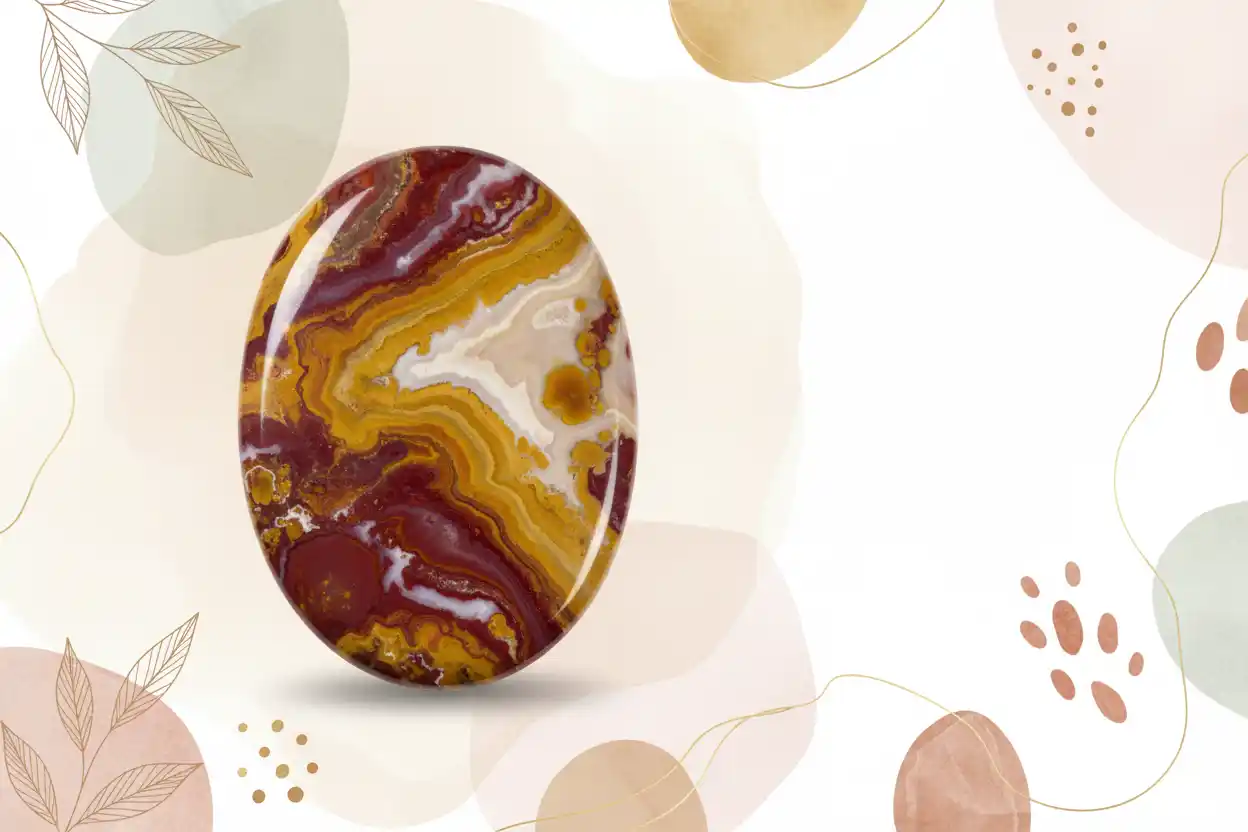
Mookaite: Meaning, Properties & Symbolism
Mookaite is a colorful silica-rich ornamental rock from the Mooka Creek area of Western Australia. Its saturated combinations of burgundy red, mustard yellow, cream, pink, brown, gray, and purple make it especially recognizable in cabochons, beads, carvings, slabs, and polished display pieces.
Gem dealers frequently call the material “mookaite jasper” or “Australian jasper.” However, its most specific geological description is a silicified porcelanite associated with the weathered Windalia Radiolarite rather than a single mineral or universally defined jasper variety.
Mookaite at a Glance
| Property | Mookaite |
|---|---|
| Material type | Silicified sedimentary rock and lapidary trade material |
| Geological description | Silicified porcelanite associated with the Windalia Radiolarite |
| Main composition | Predominantly fine-grained silica, with variable opaline, microcrystalline quartz, iron-rich, and other sedimentary components |
| Common colors | Red, burgundy, yellow, ochre, cream, white, pink, purple, gray, brown, and multicolored |
| Crystal system | No single crystal system applies to the whole rock |
| Texture | Dense, fine-grained, massive, patterned, brecciated, or locally fossiliferous |
| Luster | Dull to waxy when rough; vitreous to waxy after polishing |
| Transparency | Usually opaque; thin pale edges may be slightly translucent |
| Mohs hardness | Variable; dense silica-rich areas are commonly around 6–7, while opaline, porous, or weathered zones may be softer |
| Cleavage | None for the whole rock |
| Fracture | Commonly conchoidal to uneven |
| Tenacity | Brittle but generally suitable for lapidary use |
| Common uses | Cabochons, beads, pendants, spheres, carvings, knife handles, inlay, and display slabs |
| Main care concern | Edge chipping, hidden fractures, undercutting between differently silicified zones, and silica dust during cutting |
What Mookaite Really Is
Mookaite is not an approved mineral species because it does not have one fixed chemical composition or crystal structure. Instead, the name identifies ornamental material from a particular geological setting in Western Australia.
Current mineral references describe mookaite as an unofficial local name for silicified porcelanite developed in the weathering profile of the Windalia Radiolarite. Porcelanite is a hard, fine-grained siliceous sedimentary rock with a porcelain-like texture.
The gem trade commonly groups mookaite with jasper because it is opaque, silica-rich, colorful, and suitable for polishing. That trade usage is understandable, although it should not erase the material’s more specific geological origin.
For the same reason, labels such as jasper, chert, chalcedony, opalite, or radiolarite may appear in different descriptions. Mookaite can contain characteristics associated with several fine-grained silica materials, but those words are not automatically interchangeable.
The types of jasper guide places mookaite within its commercial lapidary context while allowing the present article to retain the stricter geological distinction.
How Mookaite Forms
Mookaite’s story begins with the Windalia Radiolarite, a Lower Cretaceous sedimentary unit in the Carnarvon Basin. The original marine sediments accumulated in an ancient sea and contained abundant microscopic organisms, including radiolarians and other microfossils.
Radiolarians produce tiny silica-based skeletons. As generations of these organisms died, their remains contributed to silica-rich sediment on the seafloor alongside clay, carbonate material, and other particles.
Burial compacted and altered the sediment. Silica dissolved, migrated, and recrystallized during diagenesis, gradually producing dense siliceous rock.
Later weathering changed parts of the Windalia unit near the surface. Groundwater movement, oxidation, and further silica redistribution helped produce the dense, brightly colored porcelanite now cut as mookaite.
This process did not create a uniform material. Some areas became thoroughly silicified and hard, while others retained opaline, porous, fractured, or differently mineralized zones.
Consequently, two pieces from the same deposit may behave differently during sawing and polishing. One may take a mirror-like finish, while an adjacent section may undercut along a softer cream or weathered band.
The Mooka Creek Locality
Genuine mookaite is associated with Mooka Creek and Mooka Station in the Carnarvon region of Western Australia, west of the Kennedy Range.
The locality is central to the name. Therefore, sellers should not use “mookaite” merely for any red-and-yellow jasper-like material from another country.
Commercial rough may be distributed, cut, or sold through India, China, the United States, or other countries. Those processing locations do not change the stone’s expected geological source.
A description such as “Indian mookaite,” for example, may mean that Australian rough was cut in India. However, it may also indicate an incorrectly labeled local material. Buyers should ask whether the stated country refers to origin or manufacture.
Verified locality carries greater importance for collectors and rough buyers than for inexpensive mass-produced beads. Still, a seller making a specific Western Australian claim should be able to explain their supply chain.
What Causes Mookaite’s Colors?
Iron-bearing minerals and their oxidation products create much of mookaite’s warm palette. Hematite-rich material contributes red and burgundy, while goethite and related iron compounds can produce yellow, ochre, orange, and brown.
Cream and white zones contain less visible iron staining or differ in porosity, silica form, and sedimentary composition. Gray areas may contain fine mineral impurities or less oxidized material.
Purple and mauve colors can develop where red iron-rich zones combine optically with gray, brown, or dark mineral components. These colors may also follow subtle chemical differences within the weathering profile.
The boundaries between colors can be sharp, flowing, spotted, folded, or brecciated. Some pieces show broad solid areas, while others contain complex angular fragments joined by contrasting silica-rich material.
Mookaite’s red should not be confused automatically with red jasper, and its yellow zones do not make it yellow jasper. Those pages own their respective color-specific materials, while mookaite is identified through its combined geology, palette, and source.
Patterns and Commercial Varieties
Standard multicolor mookaite combines two or more red, yellow, cream, purple, pink, brown, or gray zones. High-contrast pieces are particularly popular for cabochons and display objects.
Brecciated mookaite contains angular fragments separated or cemented by later silica-rich material. A stable natural breccia can polish beautifully, although open seams and crumbly boundaries reduce durability.
“Pink opal” is a local commercial label used for bright pink opalized material associated with the broader mookaite deposits. It should not be assumed to have the same structure or gemological behavior as every other pink opal sold internationally.
Landscape-pattern pieces may resemble picture jasper, but the resemblance is visual rather than proof of identical geology. Likewise, the red, yellow, and cream geometry of Noreena jasper can look similar in photographs even though Noreena comes from a different Australian deposit.
Because mookaite is a natural rock with variable zones, commercial grade names such as AAA, premium, royal, or old stock have no universal standard.
How to Identify Mookaite
The most convincing mookaite combines an appropriate Western Australian origin with its characteristic fine-grained texture and earthy multicolor palette. However, color alone cannot confirm identity.
Polished mookaite usually has a smooth waxy-to-vitreous surface. Dense areas lack visible crystals, although magnification may reveal pores, microfractures, iron-rich spots, or subtle sedimentary textures.
Freshly broken dense material often shows conchoidal or curved fracture. Nevertheless, brecciated or weathered pieces may break irregularly along seams.
Quartz-rich sections resist scratching by an ordinary steel point and can approach a Mohs hardness of 7. Softer opaline or altered bands may scratch more easily, so one measurement should not be assigned to every area.
Specific gravity is normally lower than many metallic or carbonate minerals but varies with porosity and inclusions. Refractive-index testing can also be difficult on a mixed opaque rock.
Professional identification may combine microscopy, Raman spectroscopy, infrared spectroscopy, X-ray diffraction, and elemental analysis. The step-by-step principles in how to identify crystals help separate observations from tests that could damage a finished piece.
Mookaite Lookalikes
Dyed jasper, dyed agate, ceramic, resin, and other patterned rocks can imitate mookaite’s colors. Some sellers also apply the name to unrelated red-and-yellow material from Africa, India, or China.
Artificial dye may concentrate in cracks, pits, drill holes, or unusually porous areas. Highly saturated blue, emerald green, or neon purple is not characteristic of ordinary natural mookaite.
Repeated identical patterns can indicate printed resin or manufactured composite material. Natural mookaite patterns should vary from one bead or cabochon to another.
Resin imitation may feel unusually light or warm and can show mold seams or round bubbles. However, destructive heat or scratch tests should not be used on finished jewelry.
Other Australian patterned rocks may also create confusion. Reliable identification requires more than a geographic story or the word “jasper” in a product title.
The broader fake-crystal buying guide covers signs of dye, resin, glass, ceramic, reconstructed stone, and misleading origin claims.
Lapidary Behavior
Dense mookaite generally saws, shapes, sands, and polishes well. Its lack of cleavage allows cutters to orient cabochons around color and pattern rather than crystal direction.
Nevertheless, internal variability requires careful inspection. Soft cream zones may undercut, while brecciated seams can open during grinding.
A cutter may stabilize fractured rough with resin before shaping. Stabilization can prevent sections from separating, but it should be disclosed when it materially changes durability.
Rounded cabochons distribute stress more effectively than thin points or sharp corners. A substantial girdle also gives the setting enough material to hold securely.
Mookaite works especially well for freeforms because the cutter can follow natural color boundaries. Calibrated ovals may waste more rough or place the most attractive pattern off-center.
Slabs should be checked from both sides before cutting. A dramatic surface pattern may disappear after grinding if the color zone is shallow.
Jewelry Suitability
Well-silicified mookaite is suitable for pendants, earrings, brooches, beads, bracelets, cufflinks, and protected rings.
Its silica-rich areas resist ordinary wear better than softer ornamental stones. Even so, brittleness and natural seams leave it vulnerable to sharp impact.
A bezel setting protects cabochon edges more effectively than widely spaced prongs. Meanwhile, high-domed or irregular pieces should not sit so far above the setting that they strike surrounding objects.
Bracelet beads experience repeated contact with desks, metal spacers, and harder stones. Larger beads benefit from knots or softer separators.
The gemstone hardness chart provides a useful comparison for dense silica-rich areas, while gemstone toughness versus hardness explains why a hard surface can still break along a hidden seam.
Mookaite is not usually faceted because its appeal comes from opaque color fields and patterns. Cabochons and carvings reveal the material more effectively.
Treatments and Imitations
Most good-quality mookaite needs only cutting and polishing. However, treatment should never be assumed absent solely because the material is inexpensive.
Resin impregnation can strengthen brecciated, porous, or fractured rough. Surface filling may conceal pits or open seams.
Wax and oil can deepen colors temporarily or improve the appearance of a dull polish. Clear coatings can create artificial gloss and may scratch or peel.
Dyeing is possible, particularly in pale or porous material. Although mookaite already occurs in strong natural colors, dye may intensify red, purple, black, or yellow areas.
Reconstituted products can combine stone fragments or powder with resin. Such material may contain genuine mookaite but is not a solid natural piece.
The processes behind impregnation, filling, coating, and dyeing are described in gemstone treatments explained.
Current Mookaite Asking Prices
Mookaite is generally affordable, although exceptional patterning, large Australian rough, and skilled lapidary work can command higher prices.
| Mookaite product | Broad retail asking range |
|---|---|
| Small tumbled stone | About $2–$8 |
| Common bead strand | About $5–$25 |
| Small cabochon | About $4–$20 |
| Large or strongly patterned cabochon | About $15–$60 |
| Matching cabochon pair | About $15–$75 |
| Simple pendant or earrings | About $20–$100 |
| Palm stone or small freeform | About $10–$50 |
| Medium sphere or tower | About $30–$120 |
| Large sphere, polished slab, or carving | About $100–$400 or more |
| Selected old-stock or exceptional rough | Highly variable |
These figures represent broad July 2026 asking prices rather than appraisals or expected resale values. Discount marketplaces often use inflated original prices or unclear grading language, so the final sale price provides more useful context than a crossed-out figure.
What Gives Mookaite Value?
Color combination matters more than one preferred hue. Many buyers favor pieces that balance red, burgundy, mustard yellow, cream, and purple rather than showing only one plain color.
Pattern can raise value when it creates a striking landscape, plume, geometric breccia, or clean division between contrasting areas.
Cutting quality remains equally important. A well-centered pattern, symmetrical outline, even dome, secure girdle, and high polish improve both appearance and setting durability.
Large flawless areas are harder to obtain because natural mookaite often contains seams, cavities, or variable silicification. Therefore, a large clean cabochon may command more per piece than common small beads.
Verified Western Australian origin increases confidence. However, locality does not compensate for poor polish, unstable fractures, or extensive filling.
Designer metalwork can contribute far more to a finished jewel’s price than the raw stone. Buyers should evaluate the craftsmanship and metal separately from the mookaite.
Buying Mookaite
Ask whether the material is Australian mookaite or simply a mookaite-like jasper. The answer should identify Mooka Creek or Western Australia rather than rely on a generic country-of-sale label.
Inspect photographs under neutral light. Strong filters can shift cream to yellow, red to purple, and gray to blue.
Look closely at cracks, drill holes, pits, and the back of cabochons. Concentrated color or glossy resin in those areas may reveal treatment.
For brecciated pieces, confirm that the angular fragments remain firmly bonded. Open seams can collect dirt or break during setting.
Avoid paying a large premium for unsupported grades such as museum, collector, or AAAA. Pattern, finish, size, treatment, and provenance provide more meaningful criteria.
Detailed seller checks and imitation warnings belong on the dedicated guide to buying real mookaite.
Mookaite is indexed in both the crystals beginning with M directory and the gemstones beginning with M directory.
Cleaning and Storage
Clean intact mookaite with lukewarm water, mild soap, and a soft cloth or brush. Rinse briefly and dry the piece thoroughly.
Avoid prolonged soaking when the stone contains open seams, dye, resin filling, glue, or a porous matrix. The guide to which crystals can and cannot go in water explains why treatment and construction matter alongside mineral composition.
Do not use steam or ultrasonic equipment on brecciated, repaired, or heavily fractured material. Vibration may enlarge a weak seam.
Bleach, strong acids, and abrasive household cleaners can damage polish, treatment, metal, or adhesive. Toothpaste can also leave fine scratches.
Store mookaite separately from diamond, corundum, topaz, and other hard stones. A fabric pouch or divided box protects both the polish and cabochon edges.
Mookaite Meaning and Symbolism
Modern crystal traditions associate mookaite with adaptability, grounded decision-making, confidence during change, and balancing caution with curiosity.
Its mixture of warm and neutral colors has inspired symbolic connections with vitality, stability, practical action, and a willingness to consider several possible paths.
Some interpretations connect its ancient marine sedimentary origin with deep time, perspective, and awareness that change unfolds gradually.
Claims that mookaite has one universal ancient Indigenous spiritual meaning should be approached cautiously unless supported by a specific community and source. Commercial crystal narratives often repeat cultural statements without reliable attribution.
These meanings remain personal, cultural, or spiritual interpretations. Scientific evidence does not show that mookaite treats illness, slows aging, strengthens immunity, or guarantees emotional change.
Frequently Asked Questions
Is mookaite actually jasper?
The gem trade commonly calls it mookaite jasper, but mineral references more specifically describe it as silicified porcelanite associated with the Windalia Radiolarite.
Is mookaite made from fossils?
Its precursor sediment contained abundant marine microfossils, including silica-bearing radiolarians. However, not every polished piece displays visible fossil structures.
Where is genuine mookaite found?
The recognized material comes from the Mooka Creek and Mooka Station area of Western Australia near the Kennedy Range.
What causes mookaite’s red and yellow colors?
Iron oxides and oxyhydroxides create much of the red, burgundy, yellow, ochre, orange, and brown coloration.
How hard is mookaite?
Dense silica-rich areas commonly approach 6–7 on the Mohs scale. Opaline, porous, altered, or weathered zones may be softer.
Can mookaite be worn every day?
A sound cabochon can tolerate regular wear, especially in a protective setting. Rings and bracelets remain more vulnerable to impact than pendants or earrings.
Is mookaite normally treated?
Much commercial material is untreated apart from polishing, but resin stabilization, filling, coating, waxing, oiling, and dyeing can occur.
How can I distinguish mookaite from dyed jasper?
Check for characteristic natural color variation, internal rather than surface-only patterns, dye in cracks, and a credible Western Australian origin.
Can mookaite go in water?
Brief washing is generally suitable for intact untreated material. Avoid soaking fractured, dyed, filled, coated, or glued pieces.
Is brecciated mookaite natural?
Natural brecciation occurs, although fragments can also be resin-stabilized or assembled. Treatment disclosure is therefore important.
What makes a mookaite cabochon valuable?
Color contrast, pattern, size, stability, polish, symmetry, cutting orientation, treatment status, and verified origin all affect value.
Is mookaite rare?
Its recognized deposit is geographically restricted, but substantial commercial material exists. Fine patterns and large stable rough are less common than ordinary beads and small cabochons.
Mookaite’s strongest designs come from cutters who work with its natural color boundaries rather than forcing every piece into the same shape. That makes it particularly relevant to the techniques and materials discussed in the guide to gemstones for carving and cabochons.
Sawing, grinding, drilling, or sanding mookaite can release respirable silica-rich dust. Use wet lapidary methods, effective local extraction, eye protection, and suitable respiratory protection rather than dry cutting.