10 Real Moss Agate Benefits: Deep Traditions, Verified Facts, Important Cautions
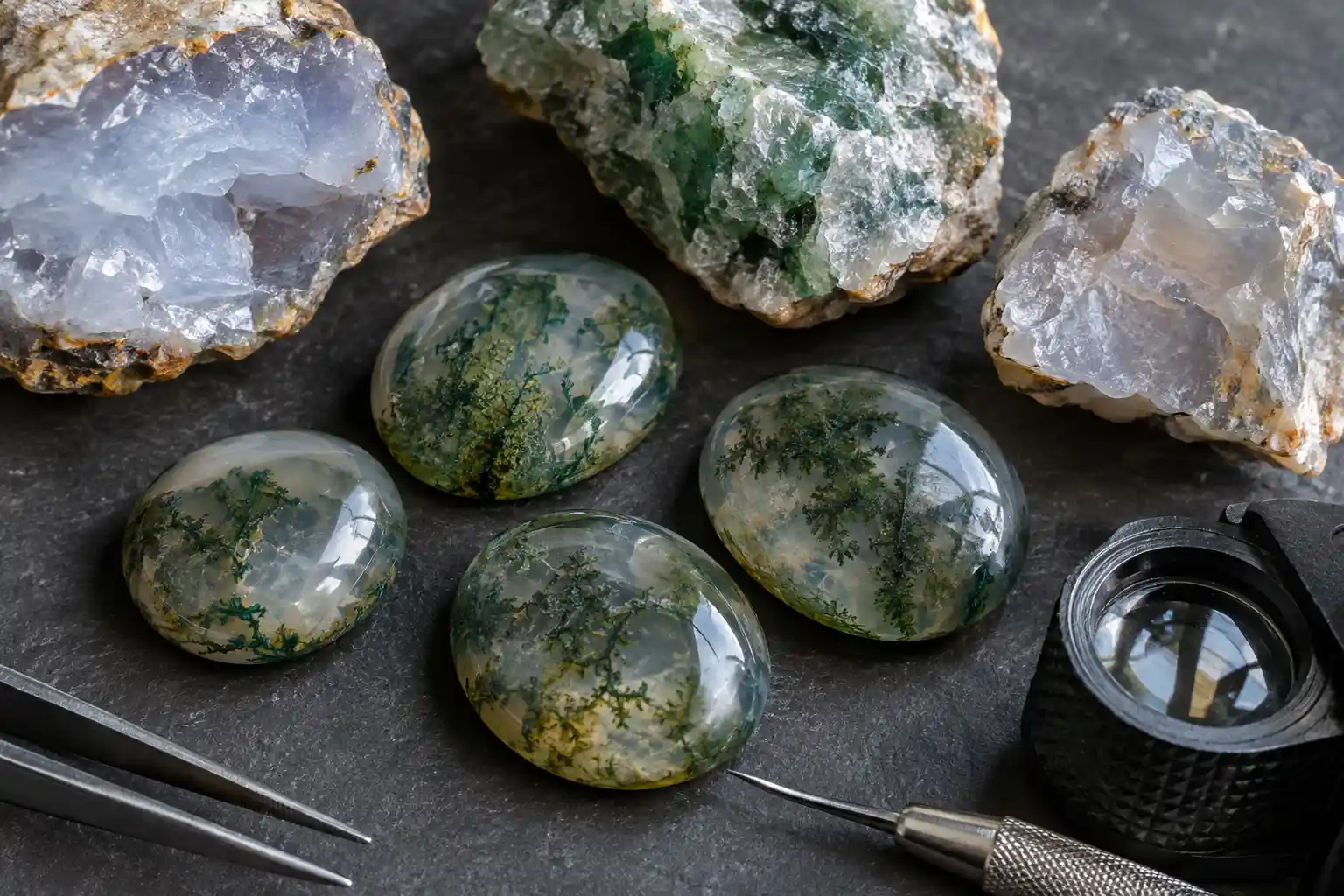
Moss Agate benefits begin with an appearance that resembles tiny landscapes trapped inside stone. Moss Agate is a variety of chalcedony, the microcrystalline form of quartz, and usually consists of translucent to milky silica containing branching, filamentous, plume-like, or mossy mineral inclusions. These patterns may be green, brown, black, red, or mixed, creating scenes that resemble moss, forests, roots, ferns, underwater plants, or distant hills.
Despite the name, Moss Agate does not normally contain fossilized moss. The plant-like patterns are inorganic mineral inclusions, commonly involving minerals such as chlorite, hornblende, iron oxides, manganese oxides, or other phases depending on the specimen. The visual resemblance to vegetation explains the trade name and much of the symbolism that later developed around the stone.
The chalcedony base gives Moss Agate benefits that are practical as well as decorative. It has useful quartz-family hardness, can take a good polish, works well in cabochons and beads, provides collector interest through highly individual inclusion patterns, and can be used to teach how inclusions influence gemstone appearance. Modern associations with nature, gardening, growth, stability, abundance, and renewal can add personal meaning without implying that the stone makes plants grow or treats human health conditions.
10 Moss Agate Benefits at a Glance
- Moss-like mineral inclusions create highly individual natural patterns.
- Chalcedony composition provides useful durability for jewelry and decorative use.
- Cabochons and freeform cuts can turn internal inclusions into miniature landscape-like scenes.
- Collector interest comes from unusual pattern, transparency, color, locality, and inclusion type.
- Mineralogy provides educational value because plant-like appearances form without actual moss.
- Nature symbolism makes Moss Agate especially appealing to gardeners, hikers, and outdoor enthusiasts.
- Jewelry combines earthy appearance with practical quartz-family hardness.
- Personal symbolism can connect the stone with patience, growth, renewal, stability, or connection with landscape.
- Meditation and journaling can use natural patterns as a visual focus without therapeutic claims.
- Straightforward care helps polished Moss Agate remain attractive through regular wear.
Moss-Like Inclusions Are the Most Distinctive Moss Agate Benefit
The defining visual feature behind Moss Agate benefits is the network of inclusions suspended inside translucent chalcedony. Fine green filaments can resemble moss spreading across stone, while thicker structures may look like branches, miniature forests, underwater vegetation, or distant landscapes.
These shapes are mineral growths rather than trapped plants. Depending on the specimen, green inclusions can involve minerals such as chlorite or amphibole-group minerals, while brown, red, or black areas may reflect iron or manganese compounds and other mineral phases.
The precise identification of extremely fine inclusions can be difficult without analytical testing. It is therefore safer to describe visible features according to appearance unless the included mineral has been identified reliably.
This natural variability ensures that no two stones need look identical. A transparent cabochon with a few delicate green branches creates a completely different effect from a milky stone filled with dense dark moss patterns.
Moss Agate Is Chalcedony Rather Than Fossilized Vegetation
One of the most useful Moss Agate benefits is educational because the stone demonstrates how mineral inclusions can imitate organic forms. The word moss encourages a common misconception that the green patterns are preserved vegetation.
Moss Agate is actually chalcedony, composed predominantly of silica, SiO₂, arranged in extremely fine intergrowths of quartz and related silica structures. Mineral inclusions developed within cavities, fractures, or growth spaces and created branching patterns that happen to resemble plants.
This distinction matters when the stone is marketed using terms such as fossil moss, ancient plant matter, or preserved vegetation. Unless a specific specimen has independent paleontological evidence, ordinary Moss Agate should not be described that way.
The resemblance is still remarkable. Human perception naturally recognizes familiar shapes in random or semi-organized natural structures, and that landscape-like appearance is a major reason Moss Agate remains popular.
Quartz-Family Hardness Supports Jewelry Use
Durability is one of the most practical Moss Agate benefits. Chalcedony typically has a Mohs hardness around 6.5 to 7, giving it much better scratch resistance than softer stones such as calcite, fluorite, malachite, or gypsum.
This makes Moss Agate useful in rings, pendants, earrings, bracelets, beads, brooches, and other jewelry. Cabochons are especially common because broad polished surfaces reveal internal patterns more effectively than conventional faceting.
Hardness still does not make the stone indestructible. A strongly fractured cabochon can chip under impact, and thin edges can be damaged by hard blows. Some specimens may also contain inclusions or voids that create local weaknesses.
Jewelry durability therefore depends on the individual stone as well as the chalcedony base. Sound, well-cut pieces generally perform well with ordinary care.
Cabochon Cutting Can Create Natural Landscape Scenes
Lapidary work is one of the most rewarding Moss Agate benefits because cutting orientation can turn an ordinary-looking piece of rough into a miniature scene.
A cutter may examine the rough under strong light to locate translucent areas and interesting moss patterns before deciding where to slice. One direction may produce an open scene with a single branching plume, while another reveals dense green networks across the entire surface.
Cabochons allow light to enter the chalcedony while keeping enough depth for inclusions to appear suspended within the stone. Freeform shapes can be particularly effective because the outline can follow the natural pattern instead of forcing every piece into a standardized oval.
Landscape interpretation remains subjective. One viewer may see a forest, another may see seaweed, mountains, roots, or abstract branching structures. That ambiguity contributes to the artistic appeal.
Collector Value Comes From Pattern Rather Than Uniformity
Moss Agate benefits collectors because each specimen can show a different internal arrangement. Attractive pieces may contain fine green filaments, black dendrites, reddish areas, translucent windows, milky zones, or several colors together.
Unlike gemstones where uniform color is often a major quality goal, Moss Agate may become more interesting as its pattern becomes more complex or pictorial. A collector may value a piece that resembles a tree line or underwater garden precisely because it is unusual.
Transparency is another factor. Clearer chalcedony can make internal inclusions appear three-dimensional, while opaque areas may provide contrast. A combination of transparent and cloudy zones can create a stronger landscape effect than perfectly uniform clarity.
Locality information can add scientific value when available. Moss Agate occurs in several regions worldwide, and inclusion chemistry and host geology may differ from one deposit to another.
Moss Agate Has Strong Nature-Based Symbolism
Nature is the most intuitive symbolic theme among Moss Agate benefits. The name, green branching inclusions, earthy colors, and resemblance to plants naturally connect the stone with forests, gardening, growth, landscapes, and outdoor life.
A gardener may wear Moss Agate simply because the internal patterns resemble vegetation. A hiker may associate the stone with time spent outdoors. Someone moving from a city to a rural area may choose it as a personal symbol of connection with landscape.
These associations do not require supernatural claims. The visual resemblance itself is enough to create meaningful symbolism.
The distinction is especially important because some crystal traditions claim the stone physically improves plant health or agricultural productivity. There is no established scientific evidence that placing Moss Agate near crops, houseplants, or gardens changes plant growth through a gemstone energy field.
Growth and Renewal Are Modern Personal Themes
Growth is another common symbolic interpretation because the inclusions resemble living branches or moss. A person may use Moss Agate as a reminder of gradual progress in education, work, relationships, or personal projects.
The metaphor works particularly well because natural growth is rarely instantaneous. Plants develop over time, and the stone’s organic-looking patterns can visually reinforce the idea of patient, incremental change.
Renewal can be interpreted similarly. Someone beginning a new routine or rebuilding after a setback may associate a green stone with fresh starts and returning energy.
These meanings are personal rather than therapeutic. Moss Agate does not biologically produce motivation or alter emotional disorders, but it can represent goals that the owner has chosen consciously.
Jewelry Gives Nature-Like Patterns a Wearable Form
Moss Agate jewelry often emphasizes the inclusions rather than brilliance. A large cabochon pendant can display an entire internal landscape, while smaller earrings may show simplified green or brown patterns.
Silver settings create strong contrast with green inclusions, while yellow or rose gold can warm brown and reddish areas. Minimal bezels often work well because elaborate metalwork can compete with the internal scene.
Rings are practical when the cabochon is sound and adequately protected. Moss Agate’s chalcedony base provides good hardness, although high settings and exposed edges can still be damaged under heavy use.
The stone is especially suitable for one-of-a-kind jewelry because matching two pieces exactly can be difficult. Rather than a disadvantage, this individuality is one of the more appealing Moss Agate benefits.
Moss Agate Connects Gemology With Inclusion Study
Inclusions are often described negatively in transparent gemstones, but Moss Agate demonstrates that they can be the entire reason a stone is desirable. Without the branching mineral features, the specimen might simply be ordinary translucent chalcedony.
This reverses the usual clarity expectation and provides useful gemological education. Beauty can depend on inclusions rather than their absence, and identification requires understanding both the silica host and the included phases.
The relationship with general agate benefits also helps place Moss Agate within the larger chalcedony family. Conventional agates are often defined by visible banding, whereas Moss Agate is valued primarily for moss-like inclusions and may lack obvious banding.
Commercial terminology can vary, but the distinction explains why Moss Agate has such a different appearance from classic striped agate.
Meditation and Reflection Can Use Moss Agate Responsibly
Moss Agate is sometimes used during meditation, journaling, gardening rituals, or nature-centered spiritual practices. Its internal patterns provide an engaging visual focus because the eye can follow branching structures and translucent areas in detail.
Someone might keep a polished stone beside a journal while reflecting on a long-term goal. Another person may carry one during outdoor walks because it has become associated with nature and quiet observation.
Such practices may feel personally grounding because of attention, ritual, and environmental context. They do not demonstrate that the gemstone medically alters the nervous system or produces a measurable energetic connection with the Earth.
Claims discussed in Moss Agate healing properties should remain separate from treatment for anxiety, depression, immune disorders, circulation problems, pain, or other health conditions.
Historical Agriculture Claims Need Careful Interpretation
Moss Agate has acquired traditional associations with agriculture, abundance, gardens, and fertility in various modern and historical gemstone accounts. Its plant-like appearance makes these themes intuitive, but historical claims should be handled carefully.
An old association with farmers or gardens does not demonstrate that the stone physically increases crop yields. Agricultural success depends on soil, water, climate, nutrients, genetics, pest management, and farming practices.
A farmer or gardener may still enjoy Moss Agate as a symbol of cultivated growth. A stone in a greenhouse can represent patience and seasonal cycles without functioning as a treatment for plants.
This distinction preserves the cultural symbolism while keeping biological claims evidence-based.
Moss Agate Care Is Usually Straightforward
Moss Agate is relatively easy to maintain because chalcedony is durable and chemically stable under ordinary jewelry conditions. Warm water, mild soap, and a soft cloth or brush are suitable for many uncomplicated untreated pieces.
Harsh household chemicals are unnecessary, and strong impacts should still be avoided. Fractures, cavities, coatings, dyes, fillings, or composite construction can alter what cleaning methods are appropriate.
Storage away from harder gemstones helps preserve polished surfaces. Diamond, corundum, and some other hard gems can scratch chalcedony if jewelry pieces rub together repeatedly.
A polished Moss Agate ring can tolerate normal wear better than many soft ornamental stones, but sensible removal during construction work, sports, or heavy manual activity remains useful.
What Moss Agate Benefits Do Not Include
Moss Agate benefits do not include scientifically established treatment for infection, inflammation, circulation disorders, pregnancy, fertility, anxiety, depression, pain, immune conditions, or other health concerns.
Its green inclusions do not provide botanical or nutritional effects simply because they resemble plants. The stone also does not contain actual living moss that transfers biological vitality to the wearer.
Similarly, placing Moss Agate in a garden has not been shown to increase plant growth through crystal energy. Any gardening symbolism should remain symbolic.
The gemstone already offers abundant real value through chalcedony mineralogy, distinctive inclusions, jewelry use, collecting, lapidary art, durability, and personal connection with nature.
Conclusion
Moss Agate benefits come from a durable chalcedony base filled with distinctive mineral inclusions that resemble moss, branches, forests, and miniature landscapes. These patterns make the stone valuable for jewelry, collecting, lapidary work, inclusion study, and geological education.
Nature, growth, renewal, gardening, and patience are intuitive symbolic themes because they arise directly from the stone’s appearance. They should remain personal or cultural interpretations rather than claims that Moss Agate medically heals people or physically improves plant growth.
FAQs
What are the main Moss Agate benefits?
The strongest Moss Agate benefits include unique moss-like inclusion patterns, chalcedony durability, jewelry suitability, collector appeal, lapidary versatility, and educational value. Modern traditions also connect the stone with nature, growth, renewal, abundance, and gardening, but these themes are symbolic rather than scientifically demonstrated effects.
Does Moss Agate contain real moss?
No. Ordinary Moss Agate does not contain living or fossilized moss. The plant-like shapes are mineral inclusions within chalcedony. Green inclusions can involve minerals such as chlorite or amphibole-group minerals, while darker dendrites and patches may involve iron or manganese compounds.
Is Moss Agate really agate?
Moss Agate is a variety of chalcedony and is traditionally included within the agate trade category. Unlike classic agate, it may show little or no obvious banding. Its defining appeal comes primarily from moss-like inclusions rather than regular concentric or parallel bands.
How hard is Moss Agate?
Because the host is chalcedony, Moss Agate generally has hardness around 6.5 to 7 on the Mohs scale. This gives it good resistance to everyday scratches compared with softer ornamental stones. Fractures, cavities, and inclusion-rich zones can still affect the durability of individual pieces.
Is Moss Agate good for jewelry?
Yes. Its quartz-family hardness and attractive internal patterns make it suitable for pendants, earrings, rings, bracelets, beads, and brooches. Cabochons are particularly common because broad polished surfaces display the inclusions clearly. Pieces with large fractures or cavities deserve additional protection.
Why does Moss Agate look like plants?
Branching and filamentous mineral inclusions naturally develop shapes that resemble moss, roots, ferns, or trees. Human perception recognizes these familiar patterns even though they are inorganic. Their resemblance to vegetation is the reason the stone acquired its name and much of its nature symbolism.
Does Moss Agate help plants grow?
There is no established scientific evidence that placing Moss Agate near plants or gardens increases growth, yield, rooting, flowering, or disease resistance. Gardeners may still use the stone symbolically because its internal patterns resemble vegetation. Actual plant health depends on biological and environmental factors.
Is Moss Agate associated with abundance?
Abundance is a common traditional and modern symbolic theme, particularly because Moss Agate is often associated with agriculture, gardens, and natural growth. The meaning can represent gradual progress, productivity, or appreciation for nature. It does not guarantee financial gain or agricultural success.
Can Moss Agate be used for meditation?
Yes. Its detailed internal patterns can serve as a visual focus during meditation, journaling, or nature-centered reflection. A person may associate the stone with patience, growth, or stability. Such use is symbolic and does not demonstrate treatment of mental or physical health conditions.
Are Moss Agate healing benefits scientifically proven?
No. Moss Agate has not been shown to diagnose, treat, cure, or prevent physical or mental-health conditions. Claims involving immunity, circulation, fertility, emotional healing, pain relief, or other medical effects belong to spiritual or cultural belief traditions rather than established evidence.
Moss Agate benefits involving healing, abundance, plant growth, emotional wellness, or energetic connection with nature reflect traditional, spiritual, or personal interpretations and should not replace qualified physical or mental-health care.