Moss Agate Healing Properties: 9 Claims, Chalcedony Facts & Safe Use
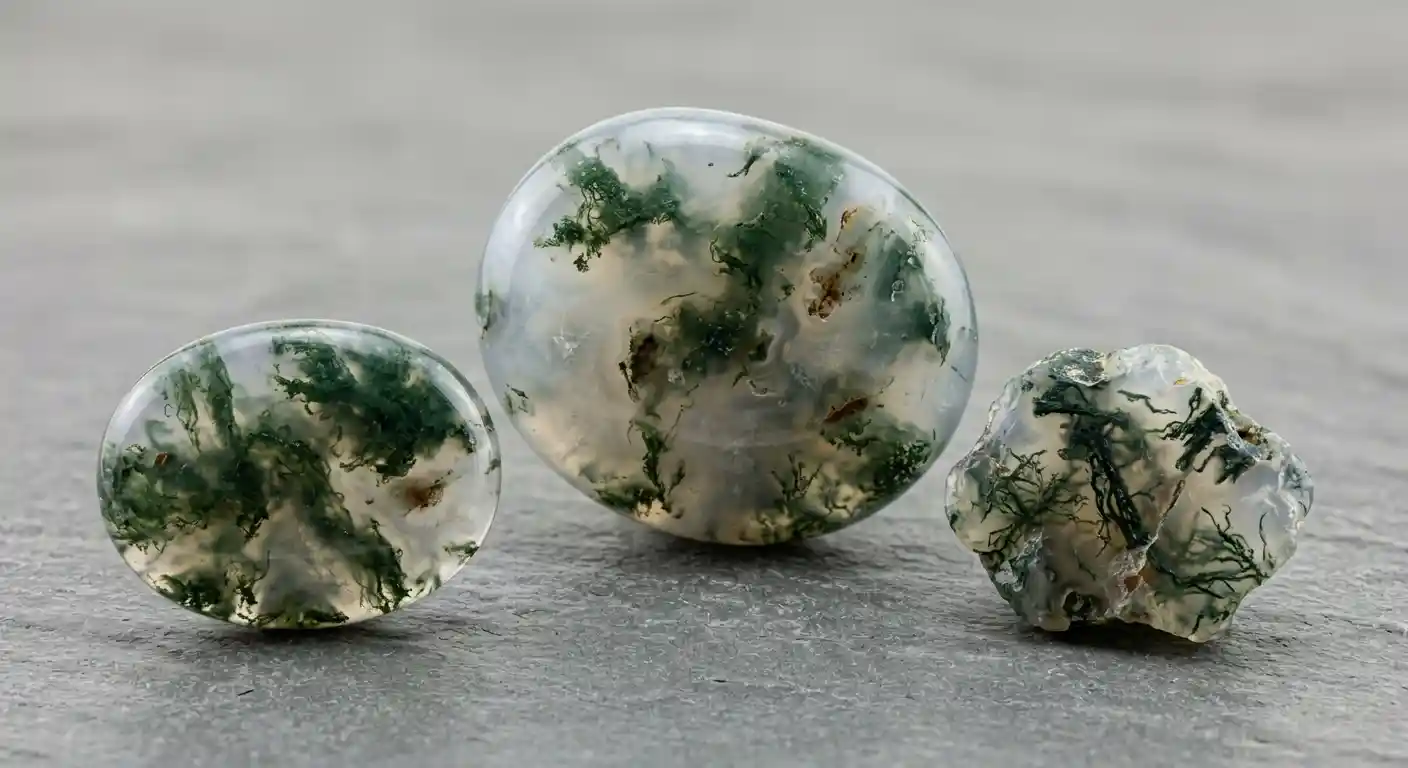
Moss agate healing properties are commonly associated with grounding, patience, emotional steadiness, personal growth, resilience, confidence, creativity, connection with nature, and spiritual reflection. Its translucent chalcedony base filled with branching green, brown, or black inclusions can look remarkably like moss, ferns, roots, forests, or miniature landscapes, which naturally encourages symbolism around growth and the natural world. Those structures are mineral inclusions, not preserved vegetation, and they do not create a therapeutic mechanism. Moss agate has not been demonstrated to treat anxiety, depression, inflammation, immune disorders, plant fertility, human fertility, cardiovascular disease, pain, or another medical condition. Scientifically, it is a variety of chalcedony, SiO₂, containing green minerals such as chlorite or hornblende and darker dendritic inclusions commonly formed by iron or manganese oxides. It usually measures about Mohs 6.5 to 7, lacks useful cleavage, and is durable enough for many jewelry and decorative uses.
9 Moss Agate Healing Claims
- Grounding and present-moment awareness
- Patience with gradual progress
- Emotional steadiness during stress
- Personal growth and habit change
- Resilience after setbacks
- Confidence through steady action
- Creativity and visual imagination
- Connection with nature
- Spiritual reflection on growth and renewal
These nine themes can support separate personal practices without becoming nine scientifically verified effects. Many Moss Agate benefits become more useful when translated into actions such as slowing down, tracking long-term progress, working consistently on one habit, spending time outdoors, or using the stone as a visual cue for reflection.
Moss Agate Mineral Facts
Moss agate is a variety of chalcedony, the microcrystalline form of quartz, with the chemical formula SiO₂. It contains fine quartz and moganite components at microscopic scale, although ordinary gemstone descriptions generally refer to it simply as chalcedony.
The “moss” is not biological. Green inclusions can include chlorite, hornblende or related amphiboles, and other iron- or magnesium-bearing silicates. Brown, reddish, or black branching patterns may involve iron and manganese oxides.
These inclusions can form dendritic, filamentary, cloud-like, or plume-like shapes. Because mineral growth follows branching pathways through fractures, pores, or silica-rich environments, the resulting forms can look uncannily like plants.
Moss agate is often grouped with agates in the gemstone trade, but it differs from classic banded agate. Traditional agate typically shows visible concentric or layered banding, while moss agate is defined mainly by suspended or branching inclusions within a translucent chalcedony base.
The underlying quartz structure is trigonal at the microscopic level. Moss agate itself usually occurs as massive nodules, vein fillings, rounded pebbles, or cut pieces rather than visible quartz crystals.
Hardness is generally around Mohs 6.5 to 7. It has no useful cleavage and normally breaks with conchoidal to uneven fracture. This gives it good practical durability for cabochons, beads, rings, pendants, carvings, and polished specimens.
How Moss Agate Forms
Moss agate commonly develops when silica-rich fluids enter cavities, fractures, or porous zones in volcanic and other rocks. Silica gradually precipitates as chalcedony, while other dissolved minerals can crystallize or precipitate inside the developing silica.
Green chlorite or amphibole-rich growths can create mossy internal landscapes. Iron and manganese oxides may form brown, red, or black dendrites. Changes in fluid chemistry, oxidation conditions, temperature, and mineral concentration help produce the variety seen from one stone to another.
The patterns do not represent fossilized moss, trees, algae, or ferns. Their resemblance to vegetation is a product of branching mineral growth.
Moss agate occurs in many countries, including India, Brazil, Uruguay, the United States, and parts of Europe. Montana is famous for translucent chalcedony containing dark manganese and iron patterns collected from gravels associated with the Yellowstone River system.
Historically, some dendritic agate was known as “Mocha stone,” a name associated with the port of Mocha in present-day Yemen. The name reflects an old commercial and locality tradition rather than proof of an ancient standardized moss agate healing system.
Grounding and Patience
Grounding Through Sensory Detail
Moss agate is frequently described as grounding because it resembles miniature landscapes. The stone does not electrically ground the nervous system or create a measurable connection with the Earth. It can still provide a useful sensory anchor. Notice the pattern depth, translucency, temperature, polished surface, breathing rhythm, and physical surroundings. The attention exercise provides the practical effect.
Patience With Slow Progress
Its plant-like patterns make growth and patience natural symbolic themes. Moss agate cannot biologically increase patience. A useful ritual is to review a long-term goal on an appropriate timescale. Instead of judging progress every day, compare weeks or months and identify what is gradually improving.
Emotional Steadiness and Growth
Emotional Steadiness Through a Pause
Some practitioners describe moss agate as stabilizing emotions. Chalcedony has not been shown to regulate neurotransmitters or stress hormones through contact with the skin. A practical interpretation is to use the stone as a cue to pause before reacting, slow the breathing, and distinguish the facts of a situation from the assumptions surrounding them.
Personal Growth Through Habit Change
Moss agate is strongly associated with growth because its inclusions resemble plants and roots. It cannot cause personal development automatically. A person can instead assign the stone to one habit and keep it where that behavior begins. Seeing the stone then becomes the cue to perform the actual action.
Resilience and Confidence
Resilience After Setbacks
The growth symbolism also supports themes of recovery. Moss agate cannot create psychological resilience through mineral energy. After disappointment, use it to identify what failed, what remains intact, and what can be changed before the next attempt. Resilience develops through adaptation.
Confidence Through Steady Action
Moss agate is sometimes associated with quiet confidence rather than dramatic courage. The stone does not biologically increase self-esteem. A more realistic practice is to track evidence of progress, preparation, and follow-through. Confidence grows when repeated behavior demonstrates capability.
Creativity and Nature Connection
Creativity Through Natural Patterns
Every moss agate cabochon contains different branching structures, making the stone an effective visual prompt for drawing, writing, photography, design, or brainstorming. There is no evidence that chalcedony directly increases creative cognition, but looking closely at complex natural patterns can provide useful inspiration.
Connection With Nature
The resemblance to landscapes and vegetation is one of moss agate’s strongest symbolic qualities. The stone cannot substitute for actual experience outdoors. It can serve as a reminder to walk, garden, observe plants, learn local geology, or spend uninterrupted time away from screens.
Claims that moss agate makes crops grow faster or directly increases plant fertility are not scientifically established. Good soil, suitable light, water, nutrients, temperature, and species-specific care have far stronger evidence.
Spiritual Growth and Renewal
The ninth major claim connects moss agate with spiritual growth, renewal, and appreciation of natural cycles. A person may use the stone during meditation or prayer while reflecting on patience, seasonal change, persistence, or the relationship between effort and gradual progress.
The mineral patterns can support those themes without being treated as stored plant energy or evidence that the stone transmits a measurable spiritual frequency.
Moss Agate Chakra Meaning
Moss agate is most commonly associated with the heart chakra in modern crystal systems because of its green inclusions. Themes often include compassion, emotional renewal, connection with nature, relationships, growth, and gratitude.
Some practitioners also connect its earthy tones with root-centered grounding themes.
Chakras are a spiritual framework rather than anatomical structures. Moss agate has not been demonstrated to affect the physical heart, circulation, lungs, nervous system, endocrine glands, or another physiological system through chakra placement.
Moss Agate Care
Moss agate is relatively durable because chalcedony has Mohs hardness around 6.5 to 7 and lacks strong cleavage. It can tolerate regular use in many forms of jewelry, although hard impacts can still chip edges or propagate existing fractures.
Store it separately from topaz, sapphire, ruby, diamond, and other harder gemstones. Moss agate itself can scratch softer gems such as calcite, fluorite, opal, and many feldspars.
Warm water, mild soap, and a soft cloth or brush are generally suitable for routine cleaning. Brief water exposure is safe for sound untreated chalcedony. Long soaking is unnecessary, particularly when a stone has open fractures, dye, coatings, resin, glued settings, or other treatments.
Steam and ultrasonic cleaning can be tolerated by some sound untreated chalcedony, but they are unnecessary defaults. Fractures, inclusions, treatments, and unknown repairs make gentle hand cleaning the safer general approach.
Strong chemicals and abrasive cleaners should be avoided. Hydrofluoric acid attacks silica aggressively and is extremely hazardous.
Some agates and chalcedonies are dyed to alter or intensify color. If a moss agate shows unusually saturated or unnatural-looking green, blue, pink, or other coloration, treatment disclosure is worth requesting.
Cutting, grinding, or drilling moss agate produces respirable crystalline silica dust. Lapidary work should use wet methods, effective extraction, eye protection, and appropriate respiratory controls. The stone should never be intentionally powdered or ingested as part of a healing practice.
Safe Ritual Cleansing
Moss agate does not require soil burial, saltwater, heat, or chemicals for ritual cleansing. There is no scientifically demonstrated negative energy that must be extracted from chalcedony.
Sound, intention-setting, quiet reflection, a brief gentle wash, or dry placement on a clean surface are low-risk choices. A nature-centered ritual can involve taking the stone outdoors while observing the surrounding landscape rather than physically burying it.
Avoid harsh chemicals, abrasive salt, flame, extreme heat, and unnecessary prolonged soaking. Simple practices protect both natural inclusions and polished surfaces.
Conclusion
Moss agate is distinctive because mineral inclusions create landscapes that resemble moss, forests, roots, and ferns inside translucent chalcedony. Those patterns are geological rather than botanical, but they provide an understandable symbolic foundation for themes of growth, patience, nature, and resilience. Its nine healing claims can support reflection and habit-building when the useful effect comes from deliberate action rather than an unproven therapeutic property.
FAQs
What are the main moss agate healing properties?
Common claims include grounding, patience, emotional steadiness, personal growth, resilience, confidence, creativity, connection with nature, and spiritual renewal. These are traditional or contemporary beliefs rather than scientifically proven therapeutic effects.
Is moss agate really agate?
It is a variety of chalcedony traditionally grouped with agates, but it usually lacks the concentric banding characteristic of classic true agate.
What is moss agate made of?
The host is chalcedony, SiO₂, containing green mineral inclusions such as chlorite or hornblende and brown, black, or reddish iron and manganese oxide growths.
Does moss agate contain real moss?
No. The moss-like patterns are mineral inclusions and dendritic growths, not fossilized plants.
How hard is moss agate?
It generally measures about Mohs 6.5 to 7, giving it good scratch resistance for many jewelry applications.
Does moss agate help plants grow?
There is no reliable evidence that placing moss agate near a plant directly improves plant growth. Light, water, soil chemistry, nutrients, temperature, and appropriate care are much more important.
Which chakra is moss agate associated with?
Modern crystal practice most commonly associates moss agate with the heart chakra because of its green coloration. This is a spiritual correspondence rather than an anatomical effect.
Can moss agate go in water?
Brief washing with clean lukewarm water is generally safe for sound untreated moss agate. Mild soap and gentle hand cleaning are suitable for routine care.
What is the difference between moss agate and tree agate?
Moss agate usually has a translucent chalcedony base with inclusions appearing suspended inside it. Tree agate is typically more opaque and white with green branching patterns.
Is moss agate suitable for everyday jewelry?
Yes. Its Mohs 6.5 to 7 hardness and lack of strong cleavage make it suitable for many everyday pieces, although rings and bracelets should still be protected from hard impacts and harder gemstones.
Crystal healing claims are traditional or personal beliefs and should not replace qualified medical or mental health care.