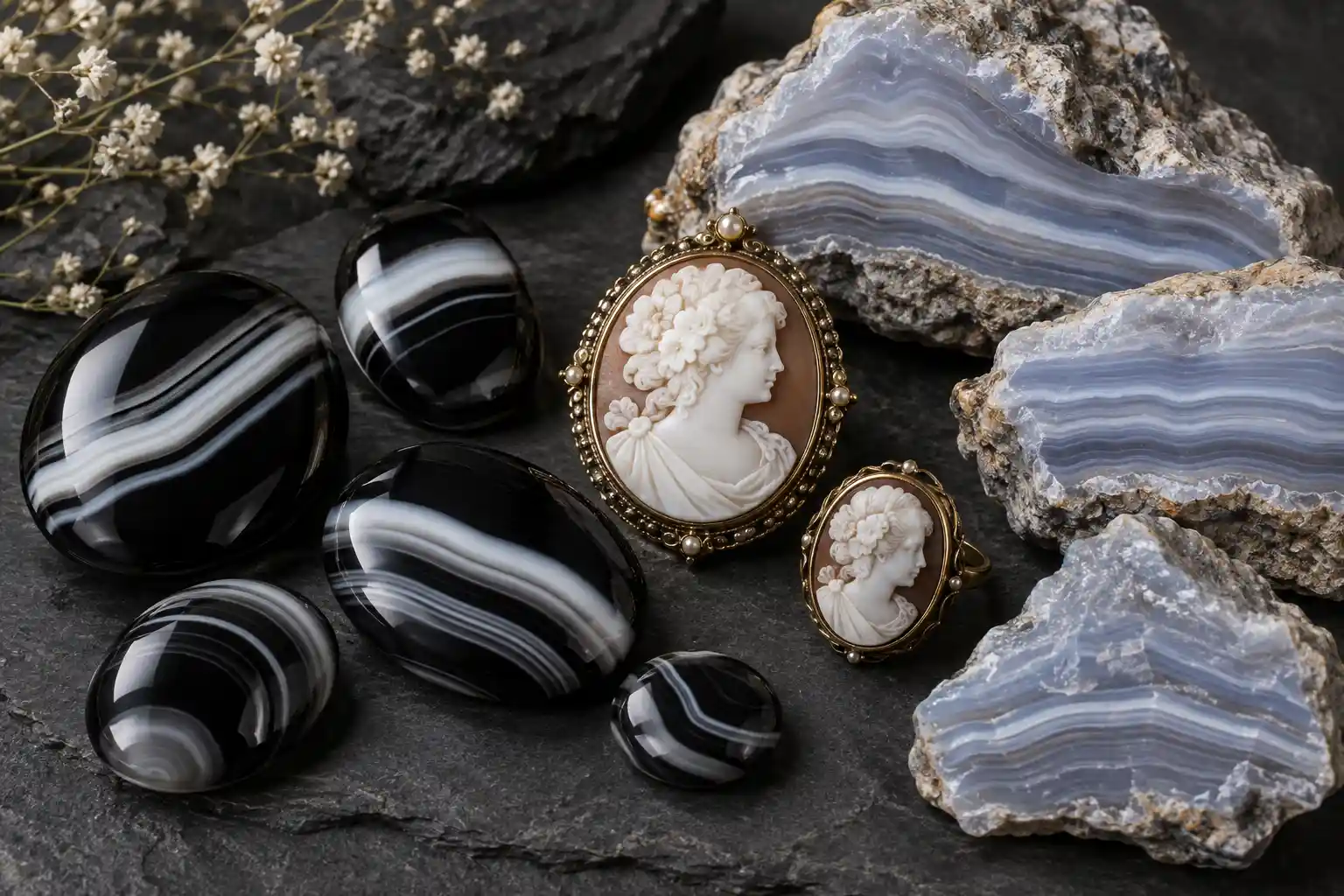
11 Real Onyx Benefits: Meaningful Traditions, Verified Facts, Important Cautions
Onyx benefits begin with layered chalcedony and a long history of decorative carving. Mineralogically, onyx is traditionally defined as chalcedony showing relatively straight, parallel bands, often contrasting white with black, brown, red, or other colors. This distinguishes classic onyx from agates whose banding is usually curved, irregular, or concentric, even though both belong to the microcrystalline quartz family.
Natural black-and-white onyx is less common than the abundance of uniformly black jewelry sold under the onyx name might suggest. Chalcedony has been dyed for centuries, and black onyx in the commercial market is often produced by treating pale or banded chalcedony until it develops a dark uniform appearance. Such treatment does not necessarily make the stone unsuitable for jewelry, but disclosure is important because treatment history affects accurate identification and purchasing expectations.
Real Onyx benefits include quartz-family durability, excellent polish, jewelry use, carving, cameo production, collecting, ornamental design, and extensive cultural history. Modern traditions also connect onyx with discipline, protection, stability, confidence, boundaries, and perseverance. These themes can provide meaningful personal symbolism while remaining separate from unsupported claims about anxiety, pain, hormones, circulation, fertility, digestion, or other medical conditions.
11 Onyx Benefits at a Glance
- Parallel chalcedony banding creates a distinctive natural appearance.
- Quartz-family hardness makes sound onyx suitable for many jewelry applications.
- Contrasting layers are ideal for cameos, intaglios, seals, and relief carving.
- Fine microcrystalline structure allows a smooth, attractive polish.
- Historical carving and jewelry use provide significant cultural and artistic value.
- Rings, pendants, earrings, beads, cufflinks, and brooches offer wide design versatility.
- Natural banding provides geological and gemological educational value.
- Identification teaches buyers the difference between natural banded onyx, dyed chalcedony, and unrelated calcite products sold under similar names.
- Modern symbolism can connect onyx with discipline, boundaries, commitment, and resilience.
- Proper care is straightforward because chalcedony is durable under ordinary conditions.
- Treatment disclosure helps buyers appreciate black onyx realistically without assuming every uniformly dark stone is naturally black.
Parallel Banding Is the Defining Natural Onyx Benefit
The most important geological characteristic behind Onyx benefits is its parallel banding. Traditional onyx consists of fine-grained chalcedony layers deposited in relatively straight, alternating bands.
Black and white is the classic combination, but natural onyx may also show brown, reddish, cream, or other contrasting layers. Related stones with red-brown and white bands are commonly known as sardonyx.
This layered appearance is more than decorative. It records changing conditions during the deposition of silica within cavities or fractures. Slight variations in impurities and growth conditions can produce contrasting layers as chalcedony develops.
The distinction from common agate is based largely on band geometry rather than an entirely different chemical composition. Both are silica-rich chalcedony, but the straighter parallel layers of onyx create a particularly useful structure for carving.
Onyx Benefits Cameo and Intaglio Carving
Layered carving is one of the most historically important Onyx benefits. When two differently colored bands occur one above another, a skilled carver can remove selected areas of the upper layer while leaving the lower color exposed as a background.
This technique is ideal for cameos, where a raised design contrasts with the layer beneath it. Intaglio carving reverses the visual approach by cutting a recessed image into the stone.
Faces, mythological scenes, symbols, portraits, initials, seals, and ornamental patterns have all been carved into banded chalcedony. The ability to use natural color boundaries gives the finished design a visual contrast that paint or surface coloring cannot reproduce in quite the same way.
Sardonyx has historically been especially important in carved objects because its reddish-brown and pale layers can create strong contrast. The practical Sardonyx benefits share this connection with layered carving while preserving a more specific color-based identity within the chalcedony family.
Quartz-Family Hardness Makes Onyx Practical for Jewelry
Onyx is composed primarily of microcrystalline quartz and therefore typically falls around 6.5 to 7 on the Mohs hardness scale. This gives it good resistance to everyday scratching compared with softer stones such as calcite, fluorite, malachite, or pearl.
The stone works well in rings, pendants, earrings, beads, cufflinks, bracelets, brooches, tie accessories, and carved jewelry. Its opaque to translucent appearance means polish and form matter more than faceted brilliance.
Onyx can still chip or crack under strong impact, especially when carved thinly. Cameos, intaglios, and pieces with delicate projecting details deserve more protection than a thick simple cabochon.
For ordinary jewelry, however, the combination of hardness, polish, availability, and dark color makes onyx practical as well as visually versatile.
A Smooth Polish Is One of the Most Useful Onyx Benefits
Microcrystalline silica can accept an excellent polish. This is especially important for black onyx because scratches, dull areas, and poorly polished surfaces become highly visible against a uniform dark background.
A smooth polish can give the stone a deep glassy to waxy appearance without requiring transparency. This makes onyx particularly effective in minimalist jewelry where form and surface dominate the design.
Large polished surfaces are also useful in cufflinks, signet rings, brooches, beads, and decorative objects. The dark backdrop can contrast strongly with gold, silver, platinum, enamel, diamonds, or colored gemstones.
Good craftsmanship matters because the simplicity of black onyx exposes imperfections. A poorly shaped cabochon cannot hide behind strong facet fire or complicated color zoning.
Onyx Has a Long History in Jewelry and Decorative Arts
Historical use is among the strongest Onyx benefits because banded chalcedony has been carved and worn across many periods and regions. Ancient craftspeople valued its layered structure for seals, engraved gems, amulets, cameos, beads, and ornaments.
Greek and Roman glyptic traditions made extensive use of layered chalcedony and related stones, while later European carving continued to exploit contrasting bands in cameos and decorative objects.
Cultural meanings differed across time and place. An engraved seal may have functioned as a practical mark of identity, a status object, an artistic piece, or an amulet depending on the context.
This historical diversity should be preserved rather than reduced to one universal claim that onyx always meant protection or strength. The documented carving tradition itself provides substantial cultural depth.
Jewelry Design Can Range From Minimalist to Highly Ornamental
Onyx benefits designers because dark chalcedony works in both simple and elaborate settings. A polished black signet ring can look restrained and architectural, while a carved cameo can be highly detailed and historically inspired.
White metals produce a sharp contemporary contrast against black onyx. Yellow gold creates a warmer traditional appearance, while rose gold can soften the effect. Small diamonds or colored gems can stand out strongly against an opaque dark background.
Men’s jewelry has historically used black onyx extensively in rings, cufflinks, and formal accessories, but the gemstone is not inherently gender-specific. Modern designs span every jewelry category.
Banded natural onyx also creates opportunities that uniform black material cannot. Designers can orient layers deliberately so that stripes become part of the finished composition.
Natural Black Onyx and Dyed Chalcedony Require Clear Disclosure
One of the most important practical Onyx benefits is the identification knowledge the stone encourages. Uniformly black chalcedony is common in jewelry, but intense even black color is frequently created or improved through traditional dyeing or other treatment.
Treatment itself is not automatically a problem. Dyed chalcedony can be durable, attractive, and suitable for jewelry. The issue is accurate description.
Buyers should not assume that every jet-black stone owes its appearance entirely to natural geological color. Seller disclosure and, for valuable pieces, gemological examination can clarify what has been done.
The future identification of real vs fake Onyx depends on more than one visual clue because imitation glass, dyed chalcedony, synthetic products, and unrelated stones can overlap in appearance. No single shade of black proves authenticity.
Calcite “Onyx” Is Not the Same as Chalcedony Onyx
Commercial naming can create additional confusion. Decorative banded calcite or aragonite is sometimes sold as onyx marble, Mexican onyx, Pakistan onyx, or another ornamental onyx name.
These stones can be beautiful but differ significantly from true chalcedony onyx. Calcite has a Mohs hardness around 3, reacts readily with acids, has prominent cleavage, and is chemically calcium carbonate rather than silicon dioxide.
This difference matters for jewelry and care. A chalcedony cabochon that tolerates ordinary wear reasonably well may behave very differently from a soft calcite object sold under an ornamental onyx trade name.
Accurate identification therefore improves both buying and maintenance. Commercial names should never replace basic gemological understanding.
Discipline and Stability Are Common Modern Onyx Symbols
Modern crystal traditions often describe Onyx benefits in terms of discipline, stability, self-control, resilience, boundaries, or perseverance. Dark color and durable polished surfaces probably contribute strongly to these interpretations.
Someone preparing for a demanding course or professional examination may wear an onyx ring as a reminder to follow a consistent study routine. A person building a business could associate the stone with persistence through slow progress.
The stone does not biologically create discipline. It can function as a symbolic cue linked with actions the owner has already decided to take.
This interpretation is particularly useful because it keeps responsibility with the person rather than suggesting that motivation is transferred automatically from the gemstone.
Protection Symbolism Can Represent Personal Boundaries
Protection is another familiar modern Onyx benefit. Contemporary spiritual practices may describe the stone as absorbing negativity, blocking harmful energy, or creating an energetic shield.
There is no established scientific evidence for such a physical field. Protection can instead be understood symbolically as maintaining boundaries, avoiding unsafe situations, protecting time, or deciding which obligations deserve attention.
A ring may remind someone not to agree automatically to every request. A pendant may symbolize a commitment to leave a damaging environment. In both examples, the person performs the protective action while the stone represents the intention.
Beliefs described under Onyx healing properties should remain within the same evidence limits. Spiritual symbolism does not make onyx a medical or psychological treatment.
Onyx Is Easy to Care for Compared With Softer Gems
Sound chalcedony onyx is generally straightforward to maintain. Mild soap, lukewarm water, and a soft cloth or brush are sufficient for routine cleaning of many uncomplicated pieces.
Strong chemicals are unnecessary, particularly if treatment history is unknown. Dyed stones may warrant additional caution, and jewelry containing adhesives, coatings, pearls, or other delicate components should be cleaned according to the most sensitive part of the piece.
Separate storage prevents abrasion from harder gemstones such as sapphire and diamond. Although onyx itself is reasonably hard, polished black surfaces can reveal fine scratches easily.
Carved cameos require extra care because thin relief areas can chip under direct impact even when the underlying chalcedony is hard.
What Onyx Benefits Do Not Include
Onyx benefits do not include scientifically established treatment for anxiety, depression, trauma, fertility problems, circulation disorders, digestive illness, pain, neurological conditions, hormonal imbalance, or other medical concerns.
The stone does not detoxify the body or absorb harmful physical substances through contact. Its dark color likewise does not prove an ability to remove negative energy.
Traditional and modern symbolism can still be culturally interesting and personally valuable. Onyx already offers real benefits through chalcedony durability, layered geology, carving history, jewelry versatility, artistic value, and distinctive appearance.
Conclusion
Onyx benefits include parallel chalcedony banding, good quartz-family hardness, excellent polish, carving potential, historical use, jewelry versatility, and substantial gemological interest. Layered stones are especially important for cameos and intaglios, while uniform black onyx remains a popular choice for contemporary jewelry.
Treatment disclosure and correct identification matter because dyed chalcedony and calcite products can both appear under onyx-related trade names. Discipline, protection, boundaries, stability, and perseverance can remain meaningful modern symbols when clearly separated from unsupported medical or energetic claims.
FAQs
What are the main Onyx benefits?
The strongest Onyx benefits include good durability, attractive polish, parallel banding, carving potential, jewelry versatility, historical importance, and gemological interest. Modern traditions also associate Onyx with discipline, stability, protection, boundaries, and resilience. These symbolic ideas are not scientifically demonstrated medical effects.
Is Onyx a type of quartz?
Yes. Traditional gemstone Onyx is a variety of chalcedony, which is composed predominantly of microcrystalline quartz. It is generally distinguished from common agate by relatively straight, parallel banding. Commercial calcite products sold under names such as onyx marble are chemically different.
Is black Onyx naturally black?
Some chalcedony can be naturally dark, but uniformly intense black Onyx in the jewelry market is frequently dyed or otherwise treated. Dyeing has a long commercial history and does not necessarily make the stone unsuitable for jewelry. Treatment should simply be disclosed accurately.
How hard is Onyx?
Chalcedony Onyx generally measures around 6.5 to 7 on the Mohs scale. This provides good resistance to everyday scratches compared with many softer ornamental stones. Carved or thin pieces can still chip when struck strongly.
Why is Onyx good for cameos?
Parallel layers of contrasting colors allow a carver to use one band for a raised design and another as the background. This produces strong natural contrast without paint. Sardonyx and other layered chalcedonies have therefore been especially important in cameo and intaglio carving.
Is Onyx suitable for rings?
Yes. Its quartz-family hardness makes it suitable for many ring styles. Signet rings and polished cabochons are particularly common. Strong impact should still be avoided, and treated stones should be cleaned conservatively when their enhancement history is uncertain.
Is calcite Onyx the same as real Onyx?
No. Banded calcite products marketed as onyx marble or similar names are calcium carbonate and are much softer than chalcedony Onyx. They also react readily with acids and have different cleavage behavior. Both can be decorative, but they require different care and should be identified accurately.
Why is Onyx associated with protection?
Dark color and historical amulet use have contributed to protection symbolism in different contexts. Modern wearers may use an onyx piece as a reminder to maintain boundaries or protect personal time. There is no established evidence that the stone creates an invisible protective energy field.
Can Onyx improve discipline or confidence?
There is no scientific evidence that Onyx directly changes motivation, discipline, or confidence. A person can use the jewelry as a symbolic cue connected with a chosen routine or personal commitment. Improvement still depends on preparation, behavior, practice, and experience.
How should Onyx be cleaned?
Mild soap, lukewarm water, and a soft cloth are suitable for many chalcedony Onyx pieces. Harsh chemicals and aggressive cleaning are unnecessary, especially when treatment status is uncertain. Carved pieces should be handled gently to protect thin relief areas.
Does Onyx have healing powers?
There is no established scientific evidence that Onyx diagnoses, treats, cures, or prevents physical or mental-health conditions. Claims involving emotional healing, pain relief, detoxification, circulation, fertility, or energy protection belong to spiritual belief traditions rather than established medicine.
Onyx benefits involving healing energy, emotional treatment, physical protection, or medical wellness reflect cultural, spiritual, or personal interpretations and should not replace qualified physical or mental-health care.