Real vs Fake Onyx: How to Tell the Difference
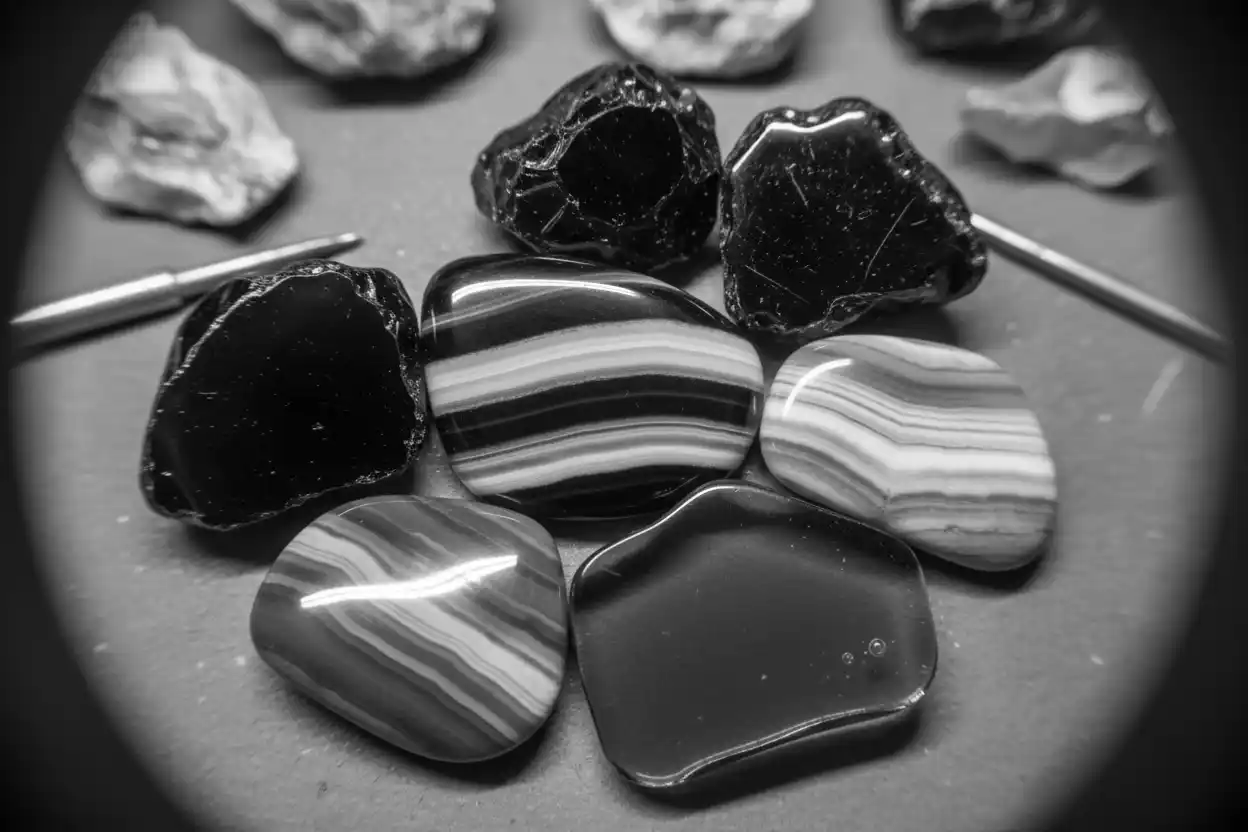
Mineralogical onyx is a variety of chalcedony characterized by relatively straight, parallel bands. Traditional material may alternate black and white, while sardonyx combines brownish-red, orange-brown, or sard layers with white or black chalcedony.
Modern commercial use is broader. Much jewelry sold as black onyx consists of natural chalcedony dyed uniformly black. The base is genuine microcrystalline quartz, but the black color is treated and the original banding may be invisible.
Imitations and substitutes include black glass, resin, plastic, dyed howlite, dyed magnesite, obsidian, black spinel, black tourmaline, quartzite, and carbonate rock sold as Mexican onyx or onyx marble.
Therefore, identification requires precise language. A dyed chalcedony cabochon is treated natural stone. Obsidian is natural volcanic glass but not onyx. Banded calcite may be a decorative trade material but is not chalcedony onyx.
This page owns the direct real-versus-fake workflow. The completed treated and synthetic onyx guide retains the full dyeing, coating, filling, and reconstruction boundaries.
Genuine Onyx vs Common Alternatives
| Feature | Parallel-banded natural onyx | Dyed black chalcedony | Obsidian | Black glass or resin | Calcite “onyx marble” |
|---|---|---|---|---|---|
| Material | Banded chalcedony | Natural chalcedony with treated color | Natural volcanic glass | Manufactured glass or polymer | Banded carbonate rock |
| Defining structure | Straight or nearly parallel chalcedony bands | Bands may be concealed by dye | Homogeneous or flow-banded glass | Molded, cast, or homogeneous | Broad translucent carbonate bands |
| Mohs hardness | About 6.5–7 | About 6.5–7 | About 5–5.5 | Variable | About 3 |
| Specific gravity | Commonly near 2.60 | Near 2.60 | Commonly around 2.35–2.60 | Variable | About 2.7 |
| Refractive behavior | Aggregate chalcedony response near 1.53–1.54 | Same base-material behavior | Isotropic glass | Material-dependent | Calcite response and strong birefringence |
| Common internal clues | Fine fibrous texture and parallel layering | Dye around pores, drill holes, and fractures | Flow lines, microlites, and glass fracture | Bubbles, seams, or casting structures | Cleavage, broad layers, and granular texture |
| Common treatment | Dye, wax, coating, or filling | Dye is expected in much black material | Coating possible | Color introduced during manufacture | Dye, resin, or coating possible |
| Best confirmation | Microscopy, spot RI, density, Raman, or XRD | Same methods plus dye analysis | Optical and Raman testing | Material testing | Carbonate identification |
The everyday black-onyx trade category often includes dyed chalcedony that does not display obvious parallel bands. That commercial convention should not erase treatment disclosure.
What Is Genuine Onyx?
The completed onyx meaning guide owns the stone’s history, symbolism, and general properties.
Onyx belongs to the wider chalcedony family. Chalcedony consists of microscopic quartz and moganite structures intergrown into a dense aggregate.
Classic onyx has straight, approximately parallel layers rather than the curved fortification bands common in many agates.
The completed types-of-onyx guide owns black-and-white, sardonyx, green trade material, and other commercial categories.
Because modern retail terminology is inconsistent, the seller should describe both material and treatment rather than relying on onyx alone.
Onyx Versus Agate
Onyx and agate are both chalcedony varieties.
Classic onyx has relatively flat, parallel bands. Agate commonly has curved, concentric, fortification, mossy, plume, or other patterns.
The boundaries are not always sharp because commercial names evolved through history and trade practice.
The completed types-of-agate guide explains the wider pattern family. The recently drafted real-versus-fake agate guide owns agate-specific glass, dye, and resin identification.
A banded chalcedony can remain genuine even when a seller chooses a broader agate label instead of onyx.
Natural Black Onyx
Naturally dark chalcedony exists, but uniformly deep black material is uncommon.
Most commercial black onyx has been produced by darkening suitable chalcedony. Treatments may penetrate porous layers and create a stable black appearance.
A black stone’s treated color does not mean the base is glass or plastic.
However, a seller should not describe dyed chalcedony as rare untreated natural black onyx. The treatment changes its rarity and value expectations.
Thin edges of dyed material may transmit brown, gray, or dark blue light. Others remain nearly opaque because of thickness and dye concentration.
How Black Chalcedony Is Dyed
Traditional processes may introduce sugar or another carbon-bearing substance into porous chalcedony and then darken it chemically.
Modern methods can use organic dyes, inorganic pigments, or combinations of treatments.
Different chalcedony layers absorb treatment at different rates. This can strengthen hidden banding or produce uneven color around pores.
Dye may remain concentrated near drill holes, fractures, pits, and less dense layers.
A stable modern treatment may show few visible clues. Failure to detect surface dye does not prove natural black color.
Signs of Dyed Onyx
Inspect drill holes and accidental chips first.
A paler gray, white, or brown interior beneath a black surface suggests shallow penetration, coating, or dye concentration.
Black color may collect in surface-reaching fractures and granular areas. Under magnification, those regions can look darker than dense surrounding chalcedony.
Some dyed stones remain black throughout because the treatment penetrated deeply or the original material was already dark.
Solvent testing is unreliable. A stable dye may not transfer, while acetone can damage glue, coatings, resin, stringing material, or metal finishes.
Sardonyx
Sardonyx combines sard-colored layers with onyx-style chalcedony bands.
The brownish-red, orange-brown, white, and black layers make it useful for cameos and intaglios. A carver can remove one layer selectively to create a contrasting design.
Natural color and dyed material both occur.
A perfectly sharp color boundary may be natural because separate chalcedony layers can differ strongly. However, paint or assembled layers can imitate the effect.
Inspect whether the bands continue through the edge and back rather than existing only on a carved surface.
Green Onyx
The name green onyx is used inconsistently.
It may describe green-dyed chalcedony, naturally green chalcedony, banded calcite, or another decorative green stone.
The completed green onyx meaning guide owns its trade-name boundaries and symbolism.
A seller should identify whether the material is chalcedony, calcite, or another mineral. The color green and the word onyx do not establish quartz identity.
Mexican Onyx and Onyx Marble
Mexican onyx, Pakistan onyx, cave onyx, and onyx marble commonly refer to banded calcite or aragonite used for carvings and architectural objects.
These carbonate materials can be beautiful and naturally banded, but they are not chalcedony onyx.
Calcite is much softer and has perfect cleavage. It may show broad translucent bands in cream, honey, green, brown, or orange.
Acid would react with carbonate, but acid testing is destructive and should not be used on finished objects.
Raman spectroscopy, refractive properties, density, and microscopic cleavage separate calcite safely.
Black Onyx Versus Obsidian
Obsidian is natural volcanic glass.
It usually lacks chalcedony’s fine fibrous aggregate structure and parallel bands. Flow lines, microlites, bubbles, or sheen effects may appear instead.
Obsidian is softer and can fracture into extremely sharp glass-like edges.
The completed onyx-versus-obsidian guide owns the direct comparison.
A smooth uniform black cabochon could be either material by appearance alone. Refractive behavior and microscopy provide the stronger conclusion.
Onyx, Obsidian, and Black Tourmaline
Black tourmaline commonly forms striated prismatic crystals and has a different density, hardness, and optical structure.
Raw onyx generally does not grow as a large single prismatic crystal because it is an aggregate chalcedony material.
The planned black tourmaline versus obsidian versus onyx guide owns the three-way comparison.
Retailers sometimes use black crystal as though it identifies all three. Exact material naming remains necessary.
Black Glass
Manufactured black glass is a common onyx imitation.
Thin edges may transmit brown, green, blue, or purple light according to the glass formulation.
Round bubbles, curved flow lines, mold seams, and homogeneous structure support glass identification when present.
High-quality opaque glass can contain few visible bubbles. Therefore, their absence does not prove chalcedony.
Glass generally has different hardness and aggregate optical behavior, although destructive scratch tests should be avoided.
Resin and Plastic
Resin can imitate opaque black onyx easily.
Mold seams, casting bubbles, soft scratches, low weight, repeated shapes, and an unusually warm touch provide clues.
Dense mineral powder may be added to resin, reducing the value of hand-weight comparisons.
Some reconstructed products contain genuine chalcedony fragments bonded with polymer.
A hot needle or flame test damages the item and can release fumes. Microscopy and spectroscopy are safer.
Dyed Howlite and Magnesite
Howlite and magnesite are porous pale minerals that accept dye readily.
Black-dyed material may be sold as onyx beads or carvings.
Howlite often retains gray vein patterns, while magnesite may show granular or chalky structure. Strong dye can conceal many of these clues.
Both are softer than chalcedony.
Dye may accumulate in pores, drill holes, and veins, creating an appearance different from fine chalcedony texture.
Black Spinel and Other Natural Black Gems
Black spinel, black tourmaline, hematite, jet, and other dark materials can resemble onyx.
Black spinel is harder, denser, and more refractive. Hematite has a metallic to submetallic appearance and much greater density.
Jet is organic, lightweight, and much softer.
These are genuine gem materials when identified correctly. They become onyx imitations only when marketed under the wrong name.
Reconstructed and Composite Onyx
Chalcedony powder or chips can be combined with resin and molded into beads, carvings, and slabs.
Magnification may reveal fragment boundaries, transparent binder, bubbles, and irregular patches of different luster.
Layered composites may also imitate banded onyx through separate black and white materials bonded together.
The gemstone doublets-and-triplets guide explains assembled construction across gems.
A reconstructed object can contain genuine chalcedony while not being one continuous natural piece.
Does Synthetic Onyx Exist?
Quartz and chalcedony-like silica materials can be produced or assembled industrially.
However, ordinary products marketed as synthetic onyx are more commonly glass, resin, ceramic, reconstructed stone, or dyed natural material rather than a laboratory-grown equivalent of natural parallel-banded chalcedony.
The actual composition should be stated.
Synthetic should not function as an upscale word for any manufactured black imitation.
Hardness
Chalcedony onyx has Mohs hardness around 6.5–7.
It is harder than calcite, howlite, most glass, resin, and plastic. Obsidian is also generally softer.
The gemstone hardness chart provides comparative context.
Deliberate scratch testing can ruin the polish and cannot detect dye or reconstruction reliably.
The completed gemstone toughness-versus-hardness guide explains why impact and existing fractures remain separate concerns.
Refractive Index and Density
Chalcedony commonly produces an aggregate spot reading around 1.53–1.54 and specific gravity near 2.60.
Obsidian, calcite, spinel, glass, resin, and tourmaline provide different combinations of measurements.
Dyed chalcedony retains ordinary chalcedony values because treatment changes color rather than mineral identity.
A curved opaque cabochon may allow only a spot reading. Mounted jewelry complicates density measurement.
Transmitted-Light Examination
Hold a thin edge over a diffused white light.
Dyed chalcedony may reveal brown, gray, or unevenly dark regions. Natural banding can appear where reflected light showed a uniform black surface.
Glass may reveal bubbles or flow, while resin can show casting swirls.
An opaque thick piece may transmit no light regardless of identity. A negative result therefore proves little.
Avoid high-powered lasers or intense heat-producing lights.
Magnification
Inspect drill holes, edges, chips, pale bands, and transitions between black and white areas.
Look for dye accumulation, glass bubbles, mold lines, polymer binder, coatings, and assembly planes.
Fine chalcedony may appear slightly fibrous, granular, or cloudy beneath the polish.
Clean the object gently first because polishing compound and dirt can resemble white mineral grains.
Ultraviolet Light
Chalcedony responses vary according to trace elements, dye, associated minerals, and treatment.
Fillers, resin, glass, and coatings can fluoresce or remain inert.
Ultraviolet examination may reveal inconsistent construction but cannot provide a universal onyx test.
Use eye protection and interpret UV only as part of a larger dataset.
Raman and X-Ray Identification
Raman spectroscopy can confirm quartz-based chalcedony and distinguish obsidian, calcite, spinel, tourmaline, glass, and polymer.
X-ray diffraction can identify crystalline phases in opaque or reconstructed materials.
Infrared spectroscopy may reveal resin, wax, or organic dye.
The completed gemstone-certification guide explains when formal testing is worthwhile. Use how to read a gem-lab report to determine whether the document addresses treatment as well as basic material identity.
A Safe Home Inspection Sequence
Observe the object in neutral reflected and transmitted light.
Check whether any bands are parallel, curved, painted, or assembled.
Use a loupe around holes and edges to look for dye, bubbles, mold seams, chips, and binder.
Compare the stone’s dimensions and weight only when similar reference materials are available.
Review whether the seller means chalcedony onyx, dyed black chalcedony, green-dyed stone, or calcite onyx marble.
Do not scratch, burn, acid-test, or soak the object in solvents.
The completed crystal-identification guide provides the broader non-destructive workflow.
Buying Genuine Onyx
The planned where-to-buy-real-onyx guide owns seller and marketplace selection.
A listing should state whether the object is chalcedony, whether black or green color is dyed, and whether the piece is solid or reconstructed.
For online transactions, follow how to buy gemstones online and request photographs of the back, edges, and drill holes.
Do not pay an untreated-natural-black premium without independent evidence.
Onyx Jewelry and Care
An onyx ring can perform well with ordinary chalcedony precautions.
An onyx bracelet faces greater impact and surface contact than onyx earrings or an onyx necklace.
Use the completed onyx jewelry cleaning guide because dyes, fillers, glue, and coatings may react differently from untreated chalcedony.
Avoid steam, ultrasonic cleaning, solvents, and prolonged soaking when treatment is unknown.
Frequently Asked Questions
1. What is genuine onyx?
Mineralogical onyx is chalcedony with relatively straight, parallel bands.
2. Is most black onyx dyed?
Yes. Much commercial black onyx is natural chalcedony that has been darkened because uniformly natural black material is uncommon.
3. Is dyed black onyx fake?
No. The base can be genuine chalcedony, but the black color is treated and should be disclosed.
4. Does real onyx always show bands?
Classic mineralogical onyx does, but commercial black onyx may be dyed so deeply that its original structure is difficult to see.
5. Is obsidian the same as black onyx?
No. Obsidian is volcanic glass, while onyx is microcrystalline quartz.
6. Is Mexican onyx real chalcedony onyx?
It usually refers to banded calcite or aragonite rather than chalcedony.
7. Can black glass imitate onyx?
Yes. Opaque glass can reproduce its color and polish, sometimes without obvious bubbles.
8. Can I use acetone to test black onyx?
The test is unreliable and can damage dye, resin, coating, glue, or metal finishes.
9. Can onyx scratch glass?
Chalcedony is hard enough to scratch many common glasses, but scratch testing damages the piece and does not detect treatment reliably.
10. Does synthetic onyx exist?
Manufactured onyx-like products exist, but many are glass, resin, ceramic, or reconstructed material rather than a true laboratory-grown equivalent.
11. Which tests confirm chalcedony onyx?
Spot refractive index, density, microscopy, Raman spectroscopy, and X-ray diffraction can establish material identity.
12. When should onyx be professionally tested?
Testing is useful for expensive carvings, claimed untreated black material, antique cameos, suspected composites, or confusion with another valuable black gem.
Real onyx is best identified through chalcedony structure rather than black color alone. Dyed black chalcedony dominates the jewelry market, while obsidian, glass, resin, calcite, and other dark stones can reproduce the appearance. An accurate description should identify the base material first and then state whether its color or construction has been altered.
Onyx appears in Crystals That Start With O and Gemstones That Start With O.