11 Hidden Peach Moonstone Benefits: Meaningful Traditions, Verified Facts, Important Cautions
Peach Moonstone benefits begin with the same feldspar optical phenomenon that gives traditional moonstone its famous floating glow. Moonstone belongs to the feldspar family, and classic examples consist of closely intergrown feldspar structures whose microscopic layers scatter and diffract light. The resulting sheen, called adularescence, appears to move beneath the polished surface as the stone or light source changes position.
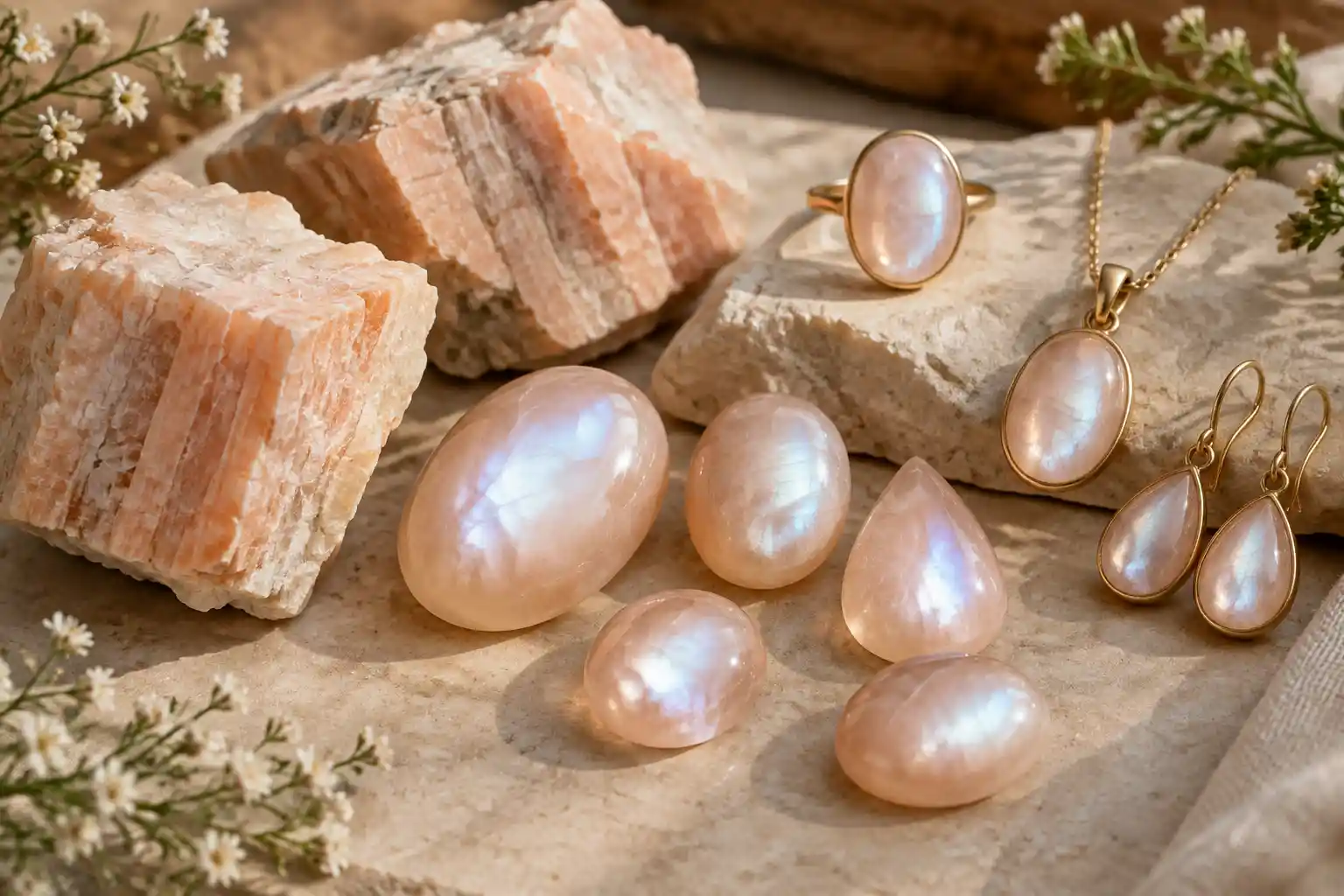
Peach Moonstone adds a warm peach, cream, tan, pinkish-orange, or apricot body color to this familiar effect. Some pieces show a gentle white or silvery sheen, while others are valued more for warm body color and translucency than for dramatic adularescence. Fine stones combine appealing peach coloration with good translucency, attractive optical sheen, careful cutting, and relatively few distracting fractures or inclusions.
Real Peach Moonstone benefits include jewelry versatility, feldspar mineralogy, adularescence, lapidary interest, collector appeal, warm color symbolism, and accessibility in several sizes and shapes. Its Mohs hardness of approximately 6 to 6.5 and feldspar cleavage require more careful wear than sapphire or diamond. Modern traditions may associate Peach Moonstone with emotional warmth, new beginnings, nurturing, creativity, or relationships, but the gemstone has not been shown to treat fertility concerns, hormonal conditions, pregnancy problems, anxiety, depression, or other health conditions.
11 Peach Moonstone Benefits at a Glance
- Warm peach and apricot body colors create a softer appearance than colorless traditional moonstone.
- Adularescence can produce a floating white or silvery glow beneath the stone’s surface.
- Feldspar mineralogy provides educational value through crystal structure, intergrowths, cleavage, and optical behavior.
- Cabochon cutting can reveal adularescence more effectively than many faceted designs.
- Pendants, earrings, beads, bracelets, and protected rings provide substantial jewelry versatility.
- Mohs hardness around 6 to 6.5 gives moderate scratch resistance when worn sensibly.
- Individual color zoning, sheen, transparency, and inclusions make each stone visually distinctive.
- Collectors can compare Peach Moonstone with colorless, gray, green, brown, and other moonstone varieties.
- Modern symbolism can connect the warm color with affection, comfort, optimism, creativity, and gentle beginnings.
- Meditation or journaling can use the stone as a personal focus without converting symbolism into medical treatment.
- Correct care protects Peach Moonstone from cleavage damage, hard impact, scratching, and unnecessary thermal stress.
Warm Peach Color Is the Most Obvious Peach Moonstone Benefit
Color is the most immediate difference behind Peach Moonstone benefits. Instead of the colorless or white body associated with many classic moonstones, these stones show warm peach, apricot, cream, tan, or pinkish-orange tones.
The body color can range from extremely pale to moderately saturated, and slight variations may occur within a single stone. Some cabochons show cloudy white areas or subtle internal structures that create additional visual texture.
Warm color affects jewelry appearance significantly. Rose gold can strengthen pink and peach tones, yellow gold can create an especially warm combination, while silver, platinum, or white gold produces cooler contrast.
Color preference is subjective. A pale transparent peach stone with strong adularescence may appeal to one buyer, while another may prefer a richer orange-peach cabochon whose main attraction is body color rather than intense sheen.
Adularescence Gives Peach Moonstone Its Characteristic Glow
Adularescence is one of the most important Peach Moonstone benefits because it distinguishes true moonstone from ordinary peach-colored feldspar lacking the characteristic optical effect.
Classic moonstone consists of feldspar structures with fine layers that interact with light. When those layers are on a scale comparable with wavelengths of visible light, the scattered light can produce a floating sheen that seems to move underneath the surface.
Peach Moonstone commonly displays white or silvery adularescence rather than the highly prized blue sheen associated with top colorless moonstone. The softer glow can complement warm body color without dominating it.
The effect is directional, which means cutting orientation matters. A rough stone may contain excellent potential yet show a weak sheen if the dome is positioned incorrectly relative to its internal structures.
For this reason, experienced lapidaries examine rough carefully before cutting.
Cabochon Cutting Makes the Most of Peach Moonstone Benefits
Most moonstone is cut as a cabochon because a smooth domed surface displays adularescence effectively. The curved top allows the moving sheen to travel visibly as the stone turns.
A cabochon with poor orientation may show the light effect only near an edge, while a well-oriented stone can center the glow across the dome. Dome height and base thickness also influence appearance.
Peach Moonstone is sometimes faceted, particularly when transparency and body color are attractive enough to justify a different style. Faceting can add sparkle, but it may make the traditional floating sheen less obvious depending on the stone.
Carvings, beads, spheres, and freeforms provide additional options, especially when the specimen has attractive warm color but irregular internal features that make precision faceting less useful.
Feldspar Mineralogy Adds Scientific Peach Moonstone Benefits
One of the less visible Peach Moonstone benefits is its value for understanding the feldspar group. Feldspars are among the most abundant minerals in Earth’s crust, yet only particular structural relationships produce the optical effect associated with moonstone.
Classic moonstone is associated with intergrowths traditionally described in terms of orthoclase and albite feldspar. Fine microscopic layering scatters incoming light and creates adularescence.
This makes Peach Moonstone useful for comparing ordinary feldspar with feldspar that exhibits special optical phenomena. Students can also compare it with labradorite, sunstone, and other feldspar gems whose visual effects have different structural causes.
The general Moonstone benefits provide useful context because the fundamental optical behavior, moderate hardness, cleavage, and feldspar identity apply across moonstone colors even though body color and sheen vary.
Peach Moonstone Has Moderate Durability Rather Than Extreme Toughness
Moonstone has a Mohs hardness around 6 to 6.5, giving Peach Moonstone benefits adequate durability for many jewelry applications when the stone is treated thoughtfully.
It resists scratches better than calcite, fluorite, and many very soft ornamental stones, but quartz, topaz, sapphire, and diamond are harder. Loose storage beside these gems can gradually scratch a polished moonstone surface.
Cleavage is an equally important concern. Feldspar has cleavage directions that can make the stone vulnerable to chipping or splitting under a severe impact.
Pendants and earrings are relatively protected choices. Rings are possible, but low-profile settings, bezels, or well-designed prongs reduce exposure to accidental blows.
Someone who works regularly with tools, machinery, hard surfaces, or sports equipment should remove a Peach Moonstone ring before those activities.
Warm Peach Color Creates Strong Jewelry Versatility
Peach Moonstone benefits designers because warm, muted coloration can work with both casual and formal jewelry.
Rose gold often creates a soft tonal combination, while yellow gold emphasizes honey and apricot shades. White metals provide contrast and may make the peach color appear warmer by comparison.
Small diamonds or colorless gems can frame a Moonstone without overwhelming its soft sheen. Alternatively, designers may pair it with other pastel gems for a more understated palette.
Because Moonstone often appears best in larger smooth cabochons, even relatively simple settings can create visual impact. A single oval pendant can display both peach body color and moving adularescence without requiring complicated design.
This versatility makes the gemstone attractive to people who prefer subtle optical effects rather than intense brilliance.
Collectors Benefit From the Variety Within the Moonstone Family
Peach Moonstone benefits collectors by providing another expression of a highly variable feldspar gemstone. Moonstone can occur in colorless, white, gray, green, peach, brown, and related tones, with blue, silver, white, or rainbow-like sheen depending on the specimen and trade terminology.
A collection containing several colors demonstrates how body color and adularescence can vary independently. One stone may be nearly colorless with strong blue sheen, while another may be richly peach with a softer white glow.
The contrast also helps buyers understand that the most valuable appearance in one moonstone category is not necessarily the most personally attractive. Peach Moonstone has its own aesthetic identity even when it lacks intense blue adularescence.
Locality, transparency, pattern, cutting, inclusions, and optical performance can add further collector interest.
Peach Moonstone Price Depends on More Than Color
Peach Moonstone is often more accessible than top transparent moonstone with intense blue sheen, but quality differences can still create substantial variation in price.
Color attractiveness, adularescence, transparency, clarity, cutting, size, surface condition, fractures, origin claims, and overall appearance all matter.
The factors behind Moonstone price provide useful context because a large cabochon is not automatically valuable if it has poor orientation, weak sheen, heavy fractures, or unattractive color.
Similarly, a smaller stone with strong centered adularescence and appealing peach body color may be visually superior to a larger but dull specimen.
Buyers should therefore evaluate the actual stone rather than relying solely on carat weight or a descriptive color name.
Modern Symbolism Often Centers on Warmth and New Beginnings
Modern Peach Moonstone benefits frequently include symbolism involving warmth, nurturing, affection, creativity, new beginnings, optimism, or emotional gentleness.
The warm peach color helps explain these associations. It can evoke sunrise, skin tones, flowers, fruit, soft light, or other familiar imagery that feels less cool than colorless moonstone.
Someone beginning a new job may use the stone as a reminder to approach the transition patiently. A parent might choose a pendant to represent affection. An artist may associate the warm color with creativity.
These meanings remain personal. Peach Moonstone does not biologically produce emotional security or guarantee a successful new beginning.
Moon Symbolism Can Be Meaningful Without Controlling Biology
The name Moonstone has encouraged symbolic links with the Moon, cycles, intuition, femininity, dreams, and changing phases for centuries in different cultural and commercial contexts.
Peach Moonstone inherits some of these themes because it belongs to the same gemstone family, but poetic resemblance should not be confused with physical influence.
A floating white sheen may resemble moonlight on clouds or water, making lunar imagery visually intuitive. Someone can use that comparison during meditation or personal reflection.
There is no established evidence that wearing Peach Moonstone controls menstrual cycles, fertility, hormones, pregnancy, sleep, or other bodily processes through lunar or gemstone energy.
Modern beliefs described within Peach Moonstone healing properties should therefore remain spiritual interpretations rather than medical guidance.
Peach Moonstone Can Support Reflection Without Treating Emotions
Some people use Peach Moonstone during meditation, journaling, or quiet routines because the soft body color and moving sheen provide a gentle visual focus.
A stone kept beside a journal may become associated with reflecting on relationships or transitions. Someone may hold a cabochon while considering a difficult decision because the object helps mark intentional quiet time.
The usefulness comes from ritual, attention, and personal association rather than a proven therapeutic property of feldspar.
If anxiety, depression, trauma, sleep disturbance, or another mental-health condition is present, Peach Moonstone should not replace qualified care.
The stone can represent emotional themes without functioning as clinical treatment.
Peach Moonstone Needs Gentle and Practical Care
Care is an important part of Peach Moonstone benefits because the gemstone can remain attractive for years when its feldspar properties are respected.
Warm water, mild soap, and a soft cloth or brush are suitable for many uncomplicated stones. Steam and ultrasonic cleaning should generally be avoided because fractures, cleavage, and sudden temperature changes can create unnecessary risk.
Separate storage protects polished surfaces from harder jewelry. A soft pouch or lined compartment is preferable to allowing Moonstone pieces to rub against sapphire, diamond, quartz, or topaz.
Rings should be removed during strenuous exercise, gardening, construction work, or heavy household tasks.
These precautions are simple and make more practical sense than elaborate cleansing rituals that expose the stone to salt, heat, harsh chemicals, or prolonged soaking.
What Peach Moonstone Benefits Do Not Include
Peach Moonstone benefits do not include scientifically established treatment for fertility problems, hormonal disorders, pregnancy complications, menstrual conditions, anxiety, depression, sleep disorders, digestive disease, or other health concerns.
Its feldspar composition does not transfer medically useful elements through ordinary skin contact. Adularescence is an optical phenomenon rather than therapeutic radiation or energy.
The gemstone already provides substantial real value through feldspar mineralogy, warm color, adularescence, jewelry versatility, collecting, lapidary interest, and personal symbolism.
Conclusion
Peach Moonstone benefits combine warm peach coloration, soft adularescence, fascinating feldspar structure, cabochon beauty, jewelry versatility, collector appeal, and meaningful modern symbolism. Its Mohs hardness of about 6 to 6.5 makes it wearable, but cleavage and moderate scratch resistance require thoughtful care.
Affection, creativity, optimism, lunar imagery, nurturing, and new beginnings can remain meaningful personal themes when separated from medical claims. Peach Moonstone is most compelling when its genuine optical beauty and mineralogical identity are allowed to stand on their own.
FAQs
What are the main Peach Moonstone benefits?
The strongest Peach Moonstone benefits include warm peach coloration, soft adularescence, feldspar mineralogy, jewelry versatility, collector appeal, cabochon cutting potential, and personal symbolism. Modern traditions also connect the gemstone with affection, creativity, nurturing, optimism, and new beginnings, but these are symbolic rather than medical effects.
What causes Peach Moonstone’s glow?
Moonstone adularescence results from light interacting with fine feldspar layers inside the stone. These microscopic structures scatter light so that a white or silvery sheen appears to float beneath the surface and move as the viewing angle changes.
How hard is Peach Moonstone?
Peach Moonstone generally has Mohs hardness around 6 to 6.5. This provides moderate scratch resistance, but the stone is softer than quartz, topaz, sapphire, and diamond. Feldspar cleavage also makes severe impact an important concern.
Is Peach Moonstone good for jewelry?
Yes. It works particularly well in pendants, earrings, beads, brooches, and protected rings. Cabochons are popular because they display adularescence effectively. Frequently worn rings should use secure settings and be removed during heavy manual activity.
Is Peach Moonstone the same as regular Moonstone?
Peach Moonstone belongs to the moonstone category but has a warm peach, apricot, cream, or pinkish-orange body color. The fundamental feldspar optical phenomenon is related to that of traditional colorless or white Moonstone, although color and sheen can differ.
Why is Peach Moonstone associated with new beginnings?
Warm peach tones and lunar symbolism have encouraged modern associations with sunrise, transitions, cycles, and gentle beginnings. A person may use the gemstone to mark a new job, relationship, creative project, or other milestone. The stone represents the transition rather than causing it.
Does Peach Moonstone help fertility or hormones?
There is no established scientific evidence that Peach Moonstone improves fertility, regulates hormones, changes menstrual cycles, supports pregnancy outcomes, or treats reproductive conditions. These claims belong to spiritual traditions rather than established medicine.
Can Peach Moonstone help with anxiety or sleep?
A person may find the gemstone visually calming or use it during a relaxing routine, but Peach Moonstone has not been shown to treat anxiety disorders, insomnia, depression, or neurological conditions. Persistent symptoms require appropriate professional care.
How should Peach Moonstone be cleaned?
Use lukewarm water, mild soap, and a soft cloth or brush. Avoid hard impacts, harsh chemicals, steam, aggressive ultrasonic cleaning, and sudden temperature changes. Separate storage also prevents harder gemstones from scratching its polished surface.
Is adularescence a healing energy?
No. Adularescence is an optical phenomenon produced by light interacting with microscopic feldspar structures. Its moving glow may inspire spiritual symbolism, but it is not evidence that the gemstone emits medically therapeutic energy.
Are Peach Moonstone healing benefits scientifically proven?
No. Peach Moonstone has not been shown to diagnose, treat, cure, or prevent physical or mental-health conditions. Claims involving fertility, emotional healing, hormones, sleep, anxiety, or reproductive wellness belong to metaphysical traditions rather than established medical evidence.
Peach Moonstone benefits involving healing energy, fertility, hormonal wellness, emotional treatment, or lunar physical effects reflect modern spiritual and personal interpretation and should not replace qualified physical or mental-health care.