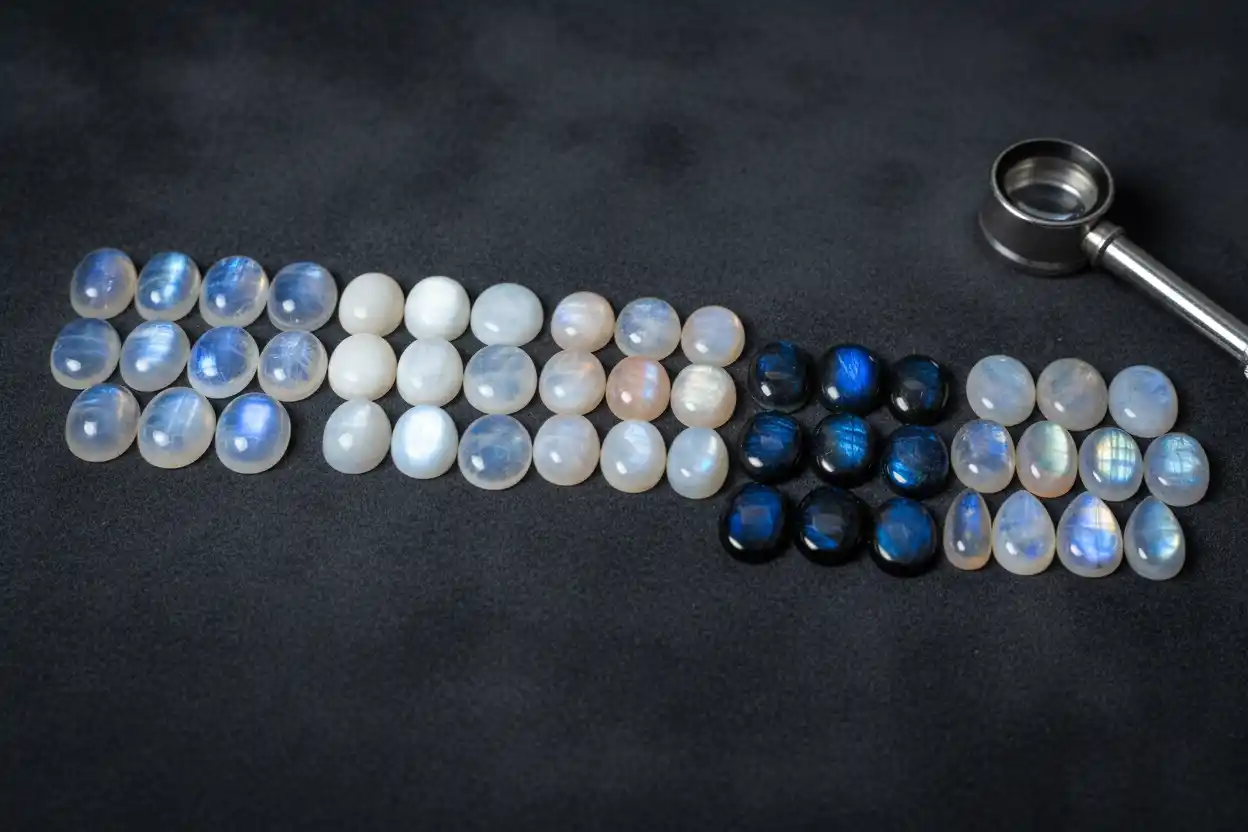
Moonstone Price Guide: Value and Cost in 2026
Moonstone prices in 2026 commonly range from approximately $5 to $100 per carat. Ordinary white, peach, gray and commercial material may cost below $30 per carat, while transparent Moonstone with strong centered blue adularescence can reach $100 to $500 per carat.
Exceptional blue-sheen stones with high transparency, broad viewing angles and rare larger sizes may exceed $500 per carat. Rainbow Moonstone, Black Moonstone and Peach Moonstone follow related but distinct commercial markets.
Moonstone Price per Carat in 2026
The following ranges represent broad U.S. retail expectations for loose natural Moonstone cabochons.
| Moonstone quality | Typical characteristics | Approximate 2026 retail price |
|---|---|---|
| Entry commercial | Milky or opaque, weak sheen, poorly centered effect or abundant inclusions | $3–$15 per carat |
| Good commercial | Visible white or silver adularescence and acceptable cutting | $15–$40 per carat |
| Fine | Strong floating sheen, good coverage, clean surface and attractive body color | $40–$100 per carat |
| Premium blue Moonstone | Transparent to highly translucent, centered blue sheen and broad viewing range | $100–$300 per carat |
| Exceptional collector quality | Strong electric-blue adularescence, high transparency, rare size and superior cutting | $300–$500+ per carat |
Rainbow Moonstone commonly ranges from approximately $20 to $100 per carat, although top transparent stones with intense multicolor flash can exceed that level.
Peach, gray and Black Moonstone often occupy the $5-to-$50-per-carat market. Rare pattern, unusual size and designer cutting can create higher prices.
The broader relationship among phenomenon, transparency, cutting and demand appears in How Gemstone Prices Are Determined.
What Is Moonstone?
Traditional Moonstone is a feldspar displaying adularescence, a floating glow caused when light scatters between microscopic internal layers.
Orthoclase and albite intergrowths are classically associated with Moonstone. However, the commercial market also includes related feldspar materials under names such as Rainbow Moonstone and Black Moonstone.
The moving light effect distinguishes fine Moonstone from ordinary white or peach feldspar. The sheen should appear to float beneath the surface rather than sit as a static coating.
The completed Moonstone guide owns the material’s geological background and traditional beliefs. The completed Feldspar guide provides family context.
The complete variety structure belongs to Types of Moonstone.
Adularescence Is the Main Value Factor
Fine adularescence should appear bright, centered and visible across a broad range of viewing angles.
A narrow flash that appears only when the stone is tilted precisely has less jewelry value because the effect can disappear during normal wear.
The sheen should also move smoothly as the gem turns. A patchy or stationary white area may result from cloudiness rather than fine adularescence.
Blue adularescence receives the strongest general premium. Silver and white sheen remain attractive but are more widely available.
The body should support the phenomenon. Transparent or slightly translucent material allows the blue glow to appear suspended within the stone, creating a stronger sense of depth.
Why Blue Moonstone Is Expensive
Top blue Moonstone combines several uncommon qualities: near-colorless body, strong transparency, intense blue sheen, centered orientation and sufficient thickness for a bright effect.
Improving one factor can weaken another. A highly transparent stone may show a narrow flash, while a milky stone can produce a broad but less vivid glow.
Large crystals rarely preserve all premium qualities together. Therefore, fine blue Moonstone receives steep price increases above five or ten carats.
The market uses terms such as royal blue, electric blue and adularia. These descriptions are not standardized grades.
A seller should show the stone moving under neutral light. One perfect photograph cannot establish how consistently the adularescence performs.
Transparency and Body Color
Colorless to nearly colorless body material generally receives the highest premium when combined with blue sheen.
White or milky Moonstone remains popular for silver jewelry and is much more affordable. Moderate translucency can enhance white adularescence, even when the stone is not transparent.
Peach Moonstone ranges from pale blush and cream to stronger orange-peach. Fine color should appear even and warm rather than muddy or brown.
Gray and Black Moonstone can display silver, white, blue or peach-toned internal effects. These varieties are valued more for pattern and atmosphere than transparent blue-sheen rarity.
Green, yellow and brown Moonstone also occur. Their value depends on clarity, sheen and visual appeal rather than color name alone.
Cut Orientation and Centering
Moonstone is normally cut as a cabochon because the curved surface displays adularescence more effectively than conventional faceting.
The cutter must orient the internal layers so the sheen sits near the center of the finished dome. Poor orientation can push the flash toward one edge or hide it entirely.
An overly high dome may add weight without improving the effect. A very flat cabochon can appear broad but may lack depth or durability.
The best cut balances:
- Centered adularescence
- A smooth moving effect
- Useful face-up dimensions
- Sufficient dome height
- Even polish
- Safe girdle thickness
Freeforms may preserve a stronger optical plane than calibrated shapes. Therefore, a well-oriented irregular stone can be more valuable than a poorly performing oval.
Detailed selection belongs to the Moonstone Buying Guide.
Clarity and Inclusions
Fine transparent Moonstone is generally preferred with minimal visible inclusions.
Centipede-like stress cracks, fissures and internal fractures are common identifying features. They can also weaken transparency and durability.
A small inclusion may be acceptable when the blue sheen is exceptional. Dense fractures, clouds and open surface breaks reduce value substantially.
Black spots and mineral inclusions can become more visible against colorless body material. Their position therefore matters.
Some Black and Peach Moonstones are naturally more included or opaque. Their clarity expectations should not be confused with the standards applied to premium transparent blue Moonstone.
Moonstone Size Premiums
Commercial Moonstone is available in moderate and large sizes. Fine transparent blue-sheen material becomes much rarer as weight increases.
| Example stone | Approximate price per carat | Approximate total price |
|---|---|---|
| 2 ct commercial white Moonstone | $5–$25 | $10–$50 |
| 5 ct good white or peach Moonstone | $15–$50 | $75–$250 |
| 5 ct fine blue-sheen Moonstone | $75–$200 | $375–$1,000 |
| 10 ct premium transparent blue Moonstone | $150–$400 | $1,500–$4,000 |
| Exceptional large collector stone | $300–$500+ | Individually evaluated |
A twenty-carat milky stone can cost less than a transparent five-carat gem with vivid blue adularescence.
Dimensions, dome height and optical coverage should be compared with weight. Deep cabochons can carry substantial hidden carats.
Sri Lankan Moonstone Prices
Sri Lanka has a strong historical association with fine transparent Moonstone, including colorless material with blue adularescence.
High-quality Sri Lankan stones can command strong premiums when origin accompanies excellent appearance.
However, Sri Lankan origin alone does not guarantee premium quality. Commercial white and included material also reaches the market.
A laboratory may identify feldspar and sometimes provide useful origin information, but geographic conclusions are not available for every stone.
Visible transparency, blue sheen and cut orientation remain more important than an unsupported locality name.
Indian Moonstone
India supplies large quantities of white, peach, gray, Black and Rainbow Moonstone used in cabochons, beads and silver jewelry.
Broad production keeps commercial prices accessible. Small white or peach cabochons may cost only a few dollars.
Fine Indian material can still be valuable, particularly when it shows strong blue or multicolor effects, attractive pattern and clean cutting.
The term “Indian Moonstone” should not be treated as a low-quality grade. Material from the country covers a wide range of commercial and fine qualities.
Rainbow Moonstone Prices
Rainbow Moonstone is commonly transparent to translucent white Labradorite displaying blue or multicolor labradorescence.
Despite the name, much Rainbow Moonstone is not the same feldspar composition as traditional orthoclase Moonstone.
Commercial stones may cost $10 to $40 per carat. Fine transparent material with strong blue, green, yellow or multicolor flash commonly ranges from $40 to $100 per carat.
Exceptional clean stones with broad electric-blue flash can exceed $100 per carat, particularly in rare larger sizes.
The completed Rainbow Moonstone guide owns the material identity. Seller screening belongs to Where to Buy Real Rainbow Moonstone.
The family-level distinction appears in Labradorite vs Moonstone.
Peach Moonstone Prices
Peach Moonstone generally costs approximately $5 to $40 per carat. Fine saturated material with a soft glow and good polish may reach $40 to $80 per carat.
The market favors warm peach, blush and cream colors without excessive brown or gray.
Many stones are opaque or translucent, so clarity receives less emphasis than even color and internal glow.
Large pieces are readily available, which keeps price per carat relatively stable. Carvings, beads and palm stones may sell for much lower per-carat equivalents than jewelry cabochons.
The completed Peach Moonstone guide owns its variety context, while Where to Buy Real Peach Moonstone owns seller-selection intent.
Black Moonstone Prices
Black Moonstone commonly shows charcoal, dark gray, brown or nearly black body color with silver, peach or white internal effects.
Commercial cabochons may cost $5 to $30 per carat. Fine pieces with broad sheen, strong contrast and attractive pattern can reach $30 to $75 per carat.
The material is generally more opaque and included than premium blue Moonstone. Consequently, pattern and visual contrast matter more than transparency.
“Black” is sometimes used loosely for dark Labradorite or other feldspar. Correct identification should precede high pricing.
The completed Black Moonstone guide owns material context. Purchasing intent belongs to Where to Buy Real Black Moonstone.
White Moonstone
White Moonstone may display white, silver or blue adularescence against a milky body.
Commercial material commonly costs $5 to $30 per carat. Stronger centered sheen and improved translucency can move prices to $30 to $100 per carat.
The term is broad and can overlap with colorless Moonstone, milky orthoclase and white feldspar sold with weak phenomenon.
The completed White Moonstone guide owns the variety’s identity rather than its current pricing.
Moonstone vs Opal Price
Opal displays play-of-color produced by ordered silica structures, while Moonstone shows adularescence from feldspar layering.
Commercial Moonstone and common Opal can overlap in price. Fine Black Opal and rare patterned Opal can cost far more than even exceptional Moonstone.
The complete identification comparison belongs to Moonstone vs Opal.
Current family-level Opal pricing appears in the Opal Price Guide, while Black, Boulder, Ethiopian and Fire Opal retain separate price pages.
Moonstone vs Labradorite Price
Labradorite commonly shows stronger blue, green and multicolor labradorescence against a darker body. Most commercial Labradorite costs less than fine transparent blue Moonstone.
Exceptional Spectrolite and premium full-spectrum Labradorite can reach higher price categories, though their markets remain separate.
The complete physical comparison belongs to Labradorite vs Moonstone. Current Labradorite pricing appears in the Labradorite Price Guide.
Moonstone Jewelry Prices in 2026
| Jewelry type | Broad U.S. retail range | Main price drivers |
|---|---|---|
| Silver earrings or pendant | $30–$300 | Commercial Moonstone, silver and production |
| Silver statement ring | $75–$600 | Stone size, sheen and setting |
| Gold earrings or pendant | $400–$2,500 | Gold, matched stones and adularescence |
| Gold Moonstone ring | $500–$4,000 | Center quality, protective construction and diamonds |
| Fine transparent blue-Moonstone jewel | $2,000–$15,000+ | Rare gem, gold or platinum, provenance and design |
| Antique or signed Moonstone jewelry | Highly variable | Maker, age, condition and exceptional stones |
Matched earrings can command strong premiums because both cabochons must show similar body color, dimensions and moving sheen.
Style-specific selection belongs to the Moonstone Ring Guide, Moonstone Earrings Guide, Moonstone Necklace Guide and Moonstone Bracelet Guide.
Moonstone’s birthstone role appears in the June Birthstone Guide.
Treatments and Imitations
Moonstone treatments are less central than treatments in Emerald or Sapphire, but coatings, fracture filling and assembled products can occur.
Blue coatings may create an artificial surface flash. Filled fractures can improve apparent clarity while altering durability and care requirements.
Glass, Opalite and synthetic materials can imitate a floating glow. Rainbow Moonstone can also be confused with glass products displaying foil-like color.
A natural-looking glow should move beneath the surface and relate to the stone’s internal structure rather than remain fixed on top.
The complete authenticity process belongs to Real vs Fake Moonstone. The general composite framework appears in Gemstone Doublets and Triplets.
Durability and Condition
Moonstone has a Mohs hardness of approximately 6 to 6.5 and distinct cleavage. It can scratch or chip more easily than Quartz, Sapphire and Diamond.
Surface abrasion weakens polish and makes the adularescence appear duller. Edge chips, fractures and poorly repaired breaks reduce value.
Rings and bracelets expose Moonstone to greater risk than earrings and pendants. A bezel or low protective setting can shield vulnerable edges.
Steam and ultrasonic cleaning should generally be avoided, particularly when fractures or treatment are present.
Complete maintenance guidance belongs to How to Clean Moonstone Jewelry Safely.
Certification and Appraisal
Most commercial Moonstone does not need an expensive laboratory report. The testing fee may exceed the loose stone’s value.
A report becomes more useful when:
- The stone is represented as premium Sri Lankan blue Moonstone
- A large transparent gem carries a substantial price
- The material may be Rainbow Moonstone, Labradorite or glass
- Coating, filling or assembly is suspected
- An antique or designer jewel requires formal documentation
A laboratory can identify the feldspar material and disclose detectable treatments. It does not assign a universal adularescence grade or guarantee the retail price.
The Gemstone Certification Labs comparison explains report scope.
Does Moonstone Hold Its Value?
Commercial white, peach and Rainbow Moonstone generally resell below retail because new material remains available.
Fine transparent blue Moonstone has stronger collector potential. Rare large stones with centered sheen, good provenance and minimal inclusions can attract specialist demand.
Antique Arts and Crafts, Art Nouveau and signed designer pieces may derive substantial value from maker, period and design rather than the Moonstone alone.
The secondary market remains smaller than those for Sapphire, Ruby or Emerald. The general resale framework appears in Do Gemstones Hold Their Value?.
Price Guide vs Buying Guide
This page owns Moonstone’s 2026 price ranges and value factors. Detailed variety identification, optical inspection and seller questions belong to the dedicated buying guide.
Online buyers should request videos showing the adularescence from several angles under ordinary light. The broader seller-verification process appears in How to Buy Gemstones Online Without Getting Scammed.
The completed Gemstones That Start With M and Crystals That Start With M directories connect Moonstone to the alphabetical site structure.
The Buying & Value hub connects this guide with Labradorite, Opal, certification and resale pages.
Frequently Asked Questions
1. How much is Moonstone worth per carat in 2026?
Most commercial Moonstone costs approximately $5 to $100 per carat. Fine transparent blue-sheen stones can reach $100 to $500 per carat or more.
2. What type of Moonstone is most valuable?
Transparent, nearly colorless Moonstone with strong centered blue adularescence generally commands the highest price.
3. Why is blue Moonstone expensive?
The finest stones combine rare transparency, intense blue sheen, broad viewing angles, good cutting and limited inclusions.
4. How much is Rainbow Moonstone worth?
Commercial Rainbow Moonstone may cost $10 to $40 per carat, while fine transparent stones commonly range from $40 to $100 per carat or more.
5. How much is Peach Moonstone worth?
Most Peach Moonstone costs approximately $5 to $40 per carat. Strong color, glow and cutting can raise the price.
6. Is Black Moonstone valuable?
Fine Black Moonstone with broad silver, peach or blue sheen can reach $30 to $75 per carat, although ordinary material costs less.
7. Does Moonstone become more valuable at larger sizes?
Only when strong adularescence, transparency and clean condition continue into the larger gem.
8. Should Moonstone be transparent?
Premium blue Moonstone is usually transparent to highly translucent. White, peach and Black Moonstone can be valuable with lower transparency.
9. Is Rainbow Moonstone true Moonstone?
It is commonly white Labradorite displaying labradorescence rather than the traditional orthoclase-albite material associated with classic Moonstone.
10. Can Moonstone be coated?
Yes. Surface coatings and other treatments can imitate or strengthen blue appearance and should be disclosed.
11. Does Moonstone need a laboratory report?
Commercial stones usually do not. A report is useful for expensive blue Moonstone, uncertain feldspar identity or suspected treatment.
12. Is Moonstone a good investment?
Exceptional transparent blue stones and signed antique jewelry may retain collector interest, but ordinary Moonstone is not a reliable investment.
Moonstone Value Is Measured by Moving Light
Moonstone should not be valued from a static photograph or body color alone. Its strongest quality appears when a centered glow moves smoothly across the cabochon and remains visible through ordinary changes in angle.
In 2026, attractive commercial material commonly falls between $15 and $100 per carat. Prices above that range should correspond to transparent body material, intense blue adularescence, rare size or provenance that clearly separates the stone from ordinary milky feldspar.