Pink Opal Benefits: 9 Popular Uses, Deep Symbolism & Hidden Facts, Responsible Use
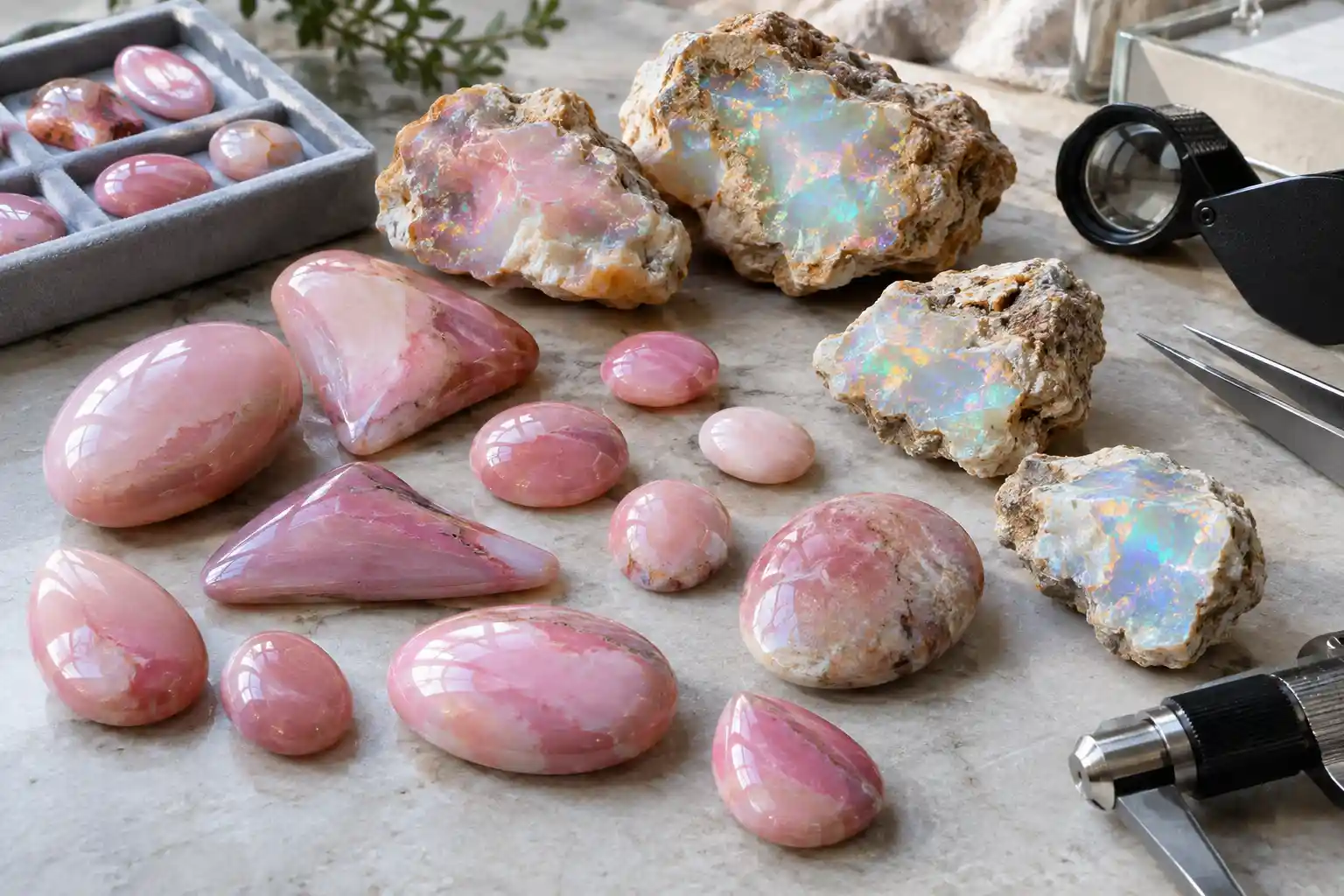
Pink Opal benefits begin with gentle body color rather than the rainbow play-of-color associated with precious opal. Pink Opal is generally a common opal variety whose attraction comes from pink, peach-pink, rose, cream-pink, or related body colors. Like other opal, it is hydrated silica commonly represented as SiO₂·nH₂O, but many Pink Opal specimens lack the ordered microscopic silica-sphere arrangement necessary to create precious play-of-color.
The pink appearance can result from very fine mineral inclusions, trace constituents, structural features, or associated compounds depending on locality and specimen. Commercial Pink Opal from Peru is particularly well known, while pink opaline stones are also reported from other regions. Because opal can vary considerably in porosity, water content, inclusions, stability, and associated minerals, individual stones should be judged on their actual characteristics rather than assuming every pink specimen behaves identically.
Real Pink Opal benefits include attractive natural color, smooth polish, jewelry use, carving, collecting, geological interest, individual patterning, and personal symbolism. Its relative softness and variable stability demand more care than quartz, sapphire, or diamond. Modern spiritual traditions may associate Pink Opal with affection, emotional gentleness, compassion, relationships, or calm reflection, but these ideas should remain symbolic rather than becoming claims that the gemstone treats anxiety, depression, trauma, heart disease, hormonal problems, or other health conditions.
9 Pink Opal Benefits at a Glance
- Natural pink, rose, peach, and cream colors provide a softer appearance than many precious opal varieties.
- Hydrated silica composition gives Pink Opal real mineralogical and geological interest.
- Smooth cabochons, beads, carvings, and freeforms showcase color without requiring play-of-color.
- Individual color zoning, matrix, inclusions, and translucency make each specimen visually distinctive.
- Jewelry use allows Pink Opal to work especially well in pendants, earrings, brooches, and protected rings.
- Collector appeal can come from locality, color saturation, stability, texture, pattern, and provenance.
- Lapidary cutting can reveal attractive internal color distribution that rough surfaces may hide.
- Modern symbolism can connect Pink Opal with affection, kindness, reflection, compassion, and meaningful relationships.
- Responsible care protects the gem from scratching, impact, excessive heat, and inappropriate cleaning methods.
Natural Pink Color Is the Most Immediate Pink Opal Benefit
Color is the feature responsible for most Pink Opal benefits. Unlike precious opal, which is often valued primarily for shifting spectral flashes, Pink Opal can be beautiful even when it displays no play-of-color at all.
Its appeal comes from body color. Pale blush, dusty rose, peach-pink, cream, salmon, and deeper pink tones can appear alone or in combination with white, brown, gray, or host-rock areas.
This gives the stone a softer visual character than many vivid transparent gemstones.
The best color is partly a matter of preference. One buyer may prefer an even pastel pink, while another may value natural mottling or contrasting matrix because it gives the stone more individual character.
Color should also be evaluated under ordinary neutral lighting. Highly warm photography can make a pale stone appear much richer than it looks in person.
Pink Opal Shows That Opal Does Not Need Play-of-Color to Be Attractive
One important Pink Opal benefit is educational: it demonstrates the difference between precious and common opal.
Precious opal displays play-of-color because its microscopic silica structures are ordered in a way that diffracts visible light. Common opal lacks sufficiently regular ordering to produce the same effect.
Pink Opal is commonly valued as common opal because body color becomes the principal attraction.
This does not make it inferior in every sense. A stone can be visually appealing, historically interesting, collectible, or personally meaningful without showing spectral flashes.
The wider Opal benefits provide useful context because hydrated silica chemistry, variable water content, moderate hardness, and careful handling apply across the opal family even though appearance differs greatly.
Understanding that distinction also helps buyers avoid expecting rainbow flashes in a stone whose beauty is primarily color-based.
Pink Opal Can Polish Into Attractive Cabochons and Carvings
Lapidary versatility is another practical Pink Opal benefit. Opaque to translucent stones can be cut into cabochons, beads, spheres, carvings, palm stones, freeforms, and decorative objects.
A polished surface intensifies body color and can reveal zoning, subtle clouds, matrix, inclusions, and texture that are difficult to appreciate on rough specimens.
Cabochons are especially suitable because they preserve weight while creating a broad smooth surface for displaying color. Freeform shapes can follow attractive natural areas rather than forcing rough stone into standardized outlines.
Large carving rough can also produce decorative pieces, although cutters must consider fractures, porosity, variable hardness, and unstable zones.
The softer character of opal makes cutting easier than harder gems in some respects, but it also demands greater care because excessive heat or aggressive grinding can create damage.
Pink Opal Jewelry Works Best When Durability Is Respected
Opal generally falls around Mohs hardness 5 to 6.5, although exact characteristics vary among types. Pink Opal therefore requires more thoughtful wear than quartz, sapphire, ruby, or diamond.
Pendants, earrings, brooches, and necklaces place the gemstone in relatively protected positions. Rings can also use Pink Opal, but low-profile settings and careful wear reduce impact risk.
Scratching is one concern because common household dust may contain quartz grains harder than opal. Separate storage is therefore important.
Impact is another concern. A polished cabochon can chip or fracture if struck against tile, stone, metal, or another hard surface.
These limitations do not prevent jewelry use. They simply mean the design and wearing habits should match the gemstone’s actual physical properties.
Pink Opal Provides Interesting Geological and Locality Value
Pink Opal benefits collectors because specimens can vary significantly according to source.
Peru is especially associated commercially with attractive pastel Pink Opal, but pink opaline silica occurs in other geological settings as well. Locality can influence color, associated minerals, texture, translucency, matrix, and stability.
A specimen with reliable provenance therefore provides more information than a stone labeled only by color.
Collectors may seek rough pieces showing natural host-rock relationships, while jewelry buyers may prefer clean polished stones with even color. Both forms can be valuable for different reasons.
Source documentation also protects against unsupported locality claims. A stone should not be called Peruvian merely because it is pink.
The actual geological origin deserves verification when locality contributes to price or collector interest.
Color Zoning and Matrix Give Pink Opal Individual Character
Uniformity is not always necessary for strong Pink Opal benefits. Some stones contain white patches, brown host rock, veins, darker pink areas, or subtle color transitions.
These natural variations can become part of the design.
A cutter may position a contrasting matrix section along one side of a cabochon or shape a freeform around an especially attractive pink zone. This makes the finished piece less standardized and potentially more distinctive.
Buyers should distinguish desirable natural variation from structural weakness. A brown line may be attractive matrix, or it may follow a fracture that affects durability.
Close inspection can therefore be more useful than judging color alone.
Individuality is one reason common opal varieties remain appealing even without play-of-color.
Pink Opal Symbolism Often Centers on Affection and Compassion
Modern Pink Opal benefits frequently include symbolic themes involving affection, kindness, compassion, tenderness, friendship, or emotional openness.
These associations are understandable because pink has accumulated strong cultural connections with affection and care.
Someone may give Pink Opal jewelry to a close friend, partner, parent, or child because the color fits the relationship. Another person may buy a stone after an important personal transition because it represents treating themselves with greater patience.
The symbolism gains strength through the event attached to the object.
Pink Opal does not automatically make someone more compassionate or improve a relationship. Those qualities depend on behavior, communication, empathy, and boundaries.
The future Pink Opal meaning can explore these themes in greater depth while keeping color symbolism separate from medical or psychological claims.
Calm Reflection Can Be a Personal Practice Rather Than a Healing Effect
Pink Opal is often marketed as a calming or emotionally soothing stone. A more responsible interpretation treats calmness as an association or ritual rather than a scientifically demonstrated effect.
Someone may hold a polished Pink Opal while journaling because the color feels gentle. Another person may keep one near a reading chair as part of a quiet evening routine.
The routine itself can create a useful pause.
This does not demonstrate that hydrated silica changes neurotransmitters, reduces clinical anxiety, or treats trauma.
Modern claims discussed under Pink Opal healing properties should therefore remain clearly identified as spiritual or personal beliefs rather than clinical guidance.
A beautiful object can support intentional reflection without becoming a medical device.
Pink Opal Can Have Collector Appeal Beyond Jewelry
Collectors may value Pink Opal for several reasons that have little to do with metaphysical symbolism.
Unusual locality, rich natural color, interesting matrix, large stable rough, distinctive inclusions, association with other minerals, or exceptional polish can all increase interest.
A complete natural specimen may preserve geological information that would be lost if it were cut. Conversely, polished stones can reveal color and translucency more clearly.
Both approaches are legitimate.
Collector value should also be separated from commercial hype. The phrase “rare Pink Opal” does not establish rarity by itself. The exact variety, locality, size, stability, color, and availability all matter.
Documentation is especially useful when claims involve a famous deposit or unusual composition.
Pink Opal Treatments and Imitations Require Sensible Buying
Opal can be treated, dyed, impregnated, assembled, or imitated in various ways. Pink stones are not exempt from these possibilities.
Color that appears unusually intense or perfectly uniform may warrant questions about treatment, especially when the seller provides little provenance.
Imitation products can include glass, resin, plastic, or other substances that reproduce a smooth pastel appearance.
This does not mean every inexpensive Pink Opal is suspicious. Common opal can be affordable naturally.
The important point is disclosure. Buyers should know whether they are purchasing natural opal, treated opal, synthetic opal, an assembled product, or an imitation when that information affects value and expectations.
Care Is One of the Most Important Practical Pink Opal Benefits
Pink Opal should be protected from scratches, hard knocks, strong heat, and sudden temperature changes.
For many solid uncomplicated pieces, lukewarm water, mild soap, and a soft cloth provide a conservative cleaning approach. Steam and ultrasonic cleaning are generally unnecessary risks.
Prolonged soaking should be approached cautiously because different opals vary in porosity and water behavior. Treatments, matrix, adhesives, or fracture filling can create additional concerns.
Storage in a lined compartment or soft pouch keeps the gemstone away from harder jewelry.
The practical principle is simple: opal should be treated as a moderately soft hydrated silica gem rather than as an indestructible stone.
What Pink Opal Benefits Do Not Include
Pink Opal benefits do not include scientifically established treatment for anxiety, depression, trauma, heart disease, reproductive disorders, hormonal problems, sleep conditions, circulation issues, or other illnesses.
Pink color does not medically affect the heart or emotions, and silica does not become a therapeutic supplement through ordinary skin contact.
The gemstone already offers real value through natural body color, opal mineralogy, jewelry use, collecting, lapidary versatility, locality, and personal symbolism.
There is no need to exaggerate those qualities with unsupported health claims.
Conclusion
Pink Opal benefits combine soft natural color, hydrated silica geology, lapidary versatility, jewelry potential, collector individuality, and meaningful modern symbolism. Its beauty depends primarily on pink body color rather than precious play-of-color, making it an excellent example of how common opal can be visually compelling in its own right.
Affection, kindness, compassion, reflection, and emotional gentleness can remain useful personal themes when clearly separated from medical claims. Responsible care, accurate identification, and realistic durability expectations allow Pink Opal to be appreciated for what it actually is.
FAQs
What are the main Pink Opal benefits?
The strongest Pink Opal benefits include attractive pink body color, hydrated silica mineralogy, cabochon and carving potential, jewelry versatility, collector appeal, locality interest, and personal symbolism involving affection or compassion. Medical healing claims are not scientifically established.
Does Pink Opal have play-of-color?
Many Pink Opal stones are common opal and do not display precious play-of-color. Their appeal comes primarily from pink, peach, rose, cream, or related body colors. Individual specimens can vary.
What is Pink Opal made of?
Pink Opal is hydrated silica, generally represented as SiO₂·nH₂O. Its pink appearance can result from inclusions, trace constituents, structural factors, or associated compounds depending on the deposit.
How hard is Pink Opal?
Opal generally falls around Mohs hardness 5 to 6.5. This makes Pink Opal softer than quartz, sapphire, and diamond, so it should be protected from scratches, impacts, and aggressive cleaning.
Is Pink Opal suitable for jewelry?
Yes. It works especially well in pendants, earrings, brooches, beads, necklaces, and protected rings. Because opal is moderately soft and can be fracture-sensitive, careful settings and wearing habits are important.
Why is Pink Opal associated with love and compassion?
Pink has strong modern cultural associations with affection, tenderness, friendship, and care. Those color associations influence Pink Opal symbolism, but the gemstone has not been shown to biologically create love or compassion.
Can Pink Opal help with anxiety?
A person may find the color calming or use the stone during meditation or journaling, but there is no established scientific evidence that Pink Opal treats anxiety disorders, trauma, depression, or other mental-health conditions.
How should Pink Opal be cleaned?
For many solid untreated pieces, lukewarm water, mild soap, and a soft cloth are appropriate. Avoid harsh chemicals, high heat, steam cleaning, strong impacts, and unnecessary prolonged soaking.
Does Pink Opal have healing powers?
There is no established scientific evidence that Pink Opal diagnoses, treats, cures, or prevents physical or mental-health conditions. Claims involving emotional healing, heart health, hormonal balance, trauma, sleep, or reproductive wellness belong to metaphysical interpretation rather than established medicine.
Pink Opal benefits involving healing energy, emotional therapy, heart wellness, hormonal effects, or physical treatment reflect modern spiritual and personal interpretation and should not replace qualified physical or mental-health care.