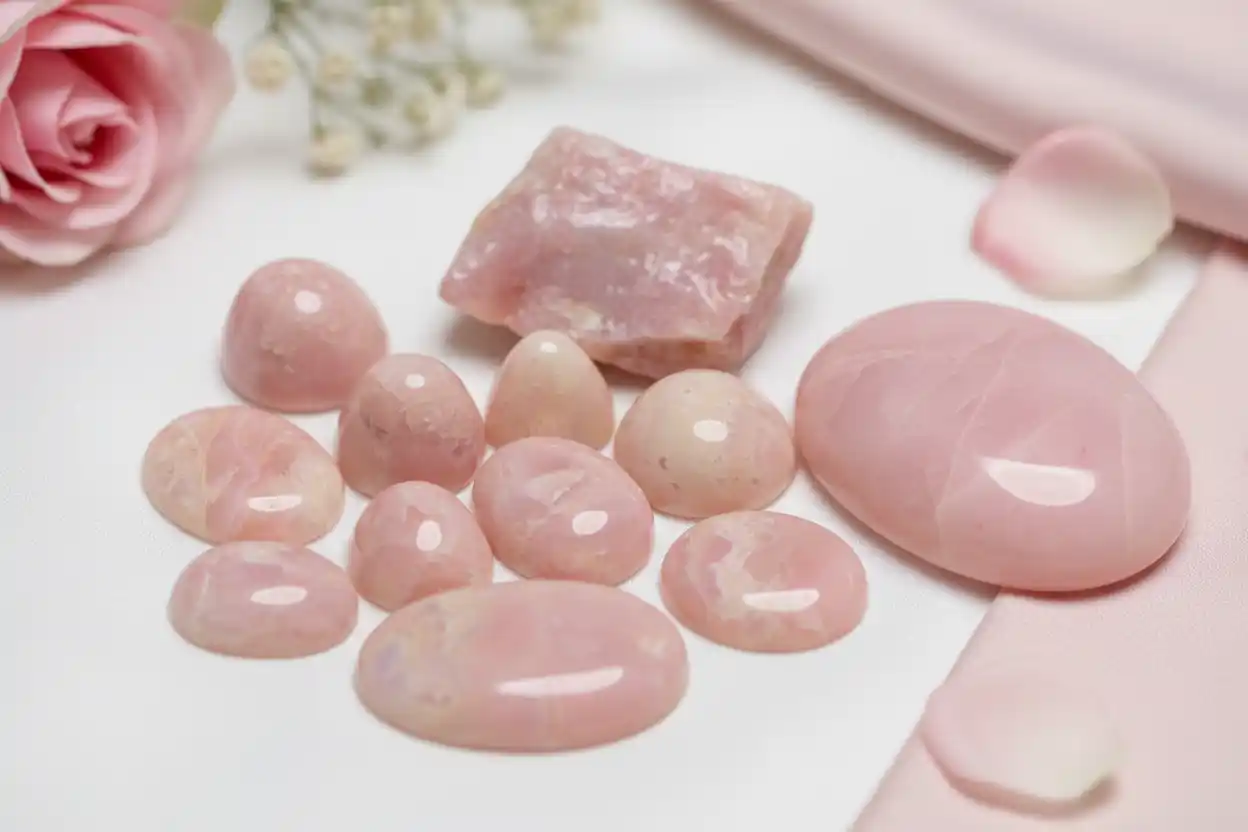
Pink Opal: Meaning, Properties & Symbolism
Pink Opal is a pink, rose, peach, or mauve variety of common opal that is usually valued for bodycolor rather than spectral play-of-color. Much of the best-known lapidary material comes from Peru, where opal occurs with palygorskite-rich clay minerals, quartz-related phases, water, and organic color-producing compounds.
The name can also be applied to pink common opal from Mexico, Australia, the United States, and other sources. Because composition and structure vary by deposit, not every Pink Opal has the same hardness, porosity, color mechanism, or treatment risk.
Pink Opal at a Glance
| Property | Pink Opal |
|---|---|
| Material type | Pink common opal and opal-rich lapidary material |
| General composition | Hydrated silica, commonly written SiO₂·nH₂O, often mixed with palygorskite, quartz, chalcedony, clay, and other deposit-specific phases |
| Common colors | Pale blush, rose, peach, salmon, mauve, cream-pink, brownish pink, and white-pink |
| Optical effect | Usually no play-of-color; may show soft opalescence, translucency, banding, or dendritic patterns |
| Structure | Amorphous or poorly crystalline opal phases mixed with other minerals |
| Typical habit | Massive seams, nodules, veins, blocks, cabochons, beads, carvings, and polished freeforms |
| Luster | Waxy to subvitreous; vitreous after a fine polish |
| Transparency | Translucent to opaque |
| Mohs hardness | Commonly about 5–6; may vary according to quartz, chalcedony, clay, and porosity |
| Cleavage | None |
| Tenacity | Brittle |
| Fracture | Conchoidal to uneven |
| Common uses | Cabochons, beads, pendants, earrings, bracelets, carvings, palm stones, inlay, and decorative objects |
| Main care concern | Scratching, crazing, porosity, dye, resin, prolonged soaking, heat, and confusion with glass, calcite, or dyed hydrophane opal |
Pink Opal Is Usually Common Opal
The parent Opal guide explains opal as hydrated silica with variable water content and internal structure.
Precious opal contains sufficiently ordered microscopic silica arrangements to produce play-of-color.
Common opal lacks that organized spectral display. It may still show strong bodycolor, translucency, opalescence, dendrites, and attractive polish.
Most Pink Opal belongs to this common-opal category. A stone does not need rainbow flashes to be genuine opal.
The broader distinction among precious, common, fire, crystal, boulder, and locality materials appears in types of opal.
The specific relationship between bodycolor and moving spectral color appears in opal color meaning.
Peruvian Pink Opal
Peru is the best-known modern source of Pink Opal.
Important material is associated with the Acari mining district near Nazca in southern Peru and related Andean deposits.
Peruvian stones range from pale pastel pink to stronger rose, salmon, mauve, and brownish pink.
White quartz lines, dark dendrites, cream matrix, and uneven color zones are common.
Material quality varies substantially. Some rough is porous, fractured, chalky, or mixed heavily with clay, while finer sections are compact enough for cabochons, beads, carvings, and inlay.
The phrase Andean Pink Opal is a commercial geographic description rather than a separate mineral species.
A seller should distinguish genuine Peruvian material from dyed Ethiopian opal, pink glass, dyed calcite, or generic imported stone.
Palygorskite and Opal-CT
Scientific studies of Peruvian Pink Opal identify opal-CT, palygorskite, quartz, and water among its principal components.
Opal-CT contains disordered cristobalite- and tridymite-like silica structures rather than being completely noncrystalline.
Palygorskite is a fibrous magnesium-aluminum clay mineral capable of holding water and organic molecules within its structure.
The amount of palygorskite can vary significantly. Therefore, some Pink Opal behaves more like compact silica-rich gem material, while clay-rich pieces may be softer, more porous, and more difficult to polish.
Sharp quartz or chalcedony veins can increase local hardness. A cabochon may consequently contain areas that abrade at different rates.
This mixed composition explains why one universal physical-property number cannot describe every Peruvian specimen perfectly.
What Causes the Pink Color?
Well-studied Peruvian and Mexican Pink Opals contain palygorskite associated with organic color-producing compounds.
Research has linked the pink absorption to quinone-related molecules and, in some samples, carotenoid-related compounds.
These organic chromophores can be held or stabilized by the fibrous clay-mineral structure.
Manganese and other trace elements may also influence certain samples, but one trace-element explanation should not be applied universally.
The color can range from cool mauve-pink to warm peach or salmon depending on chromophore concentration, associated minerals, oxidation, and light scattering.
White zones contain less visible pink material or higher proportions of pale silica and clay.
Brown and black markings commonly result from iron or manganese compounds introduced into fractures and pores.
The geological color mechanism remains separate from the symbolic meanings assigned to pink in modern crystal culture.
Pink Opal and Precious Opal
Pink Opal usually lacks play-of-color.
A pink body with moving red, green, or blue spectral flashes would be precious pink opal, a much less common product that should be described according to both bodycolor and play-of-color.
Ordinary Peruvian Pink Opal is valued for soft bodycolor and pattern rather than fire.
This distinction affects price. A seller should not use images of precious opal to imply that every opaque pink cabochon contains hidden rainbow flashes.
Lighting can create surface reflections that resemble fire in photographs. Rotating the stone under a single light reveals whether the color actually moves inside it.
Pink Opal and White Opal
White Opal has a white, cream, or light-gray body and may be common or precious.
Pink Opal commonly contains white bands, clouds, or matrix. Those areas can represent cleaner silica, quartz veins, lower chromophore concentration, or another growth phase.
A pale stone can sit near the commercial boundary between white and pink.
The dominant face-up color should guide the name. Digital enhancement and warm lighting should not convert a nearly white opal into a premium pink product.
Pink Opal and Dendritic Opal
Dendritic Opal contains branching manganese- or iron-rich inclusions resembling moss, trees, or ferns.
Pink Peruvian material can contain similar black or brown dendrites.
A stone may therefore be both pink common opal and dendritic opal.
The pink name describes bodycolor, while the dendritic name describes inclusion pattern.
Dendrites are mineral growths rather than fossil plants. Their branching appearance developed through mineral precipitation in cracks and porous zones.
Pink Opal and Owyhee Opal
Owyhee Opal is a blue-to-blue-gray common opal associated with eastern Oregon.
Both varieties usually lack play-of-color and are cut as cabochons, beads, and freeforms.
Their colors arise through different combinations of scattering structures, impurities, associated minerals, and deposit conditions.
A stone cannot be identified as Peruvian or Oregon material from softness or opalescence alone.
Pink Opal and Yellow Opal
Yellow Opal ranges from cream-yellow and lemon to honey, ochre, and brownish yellow.
Some peach Pink Opal sits close to the commercial boundary with orange or yellow common opal.
No standardized hue boundary separates pink, peach, salmon, and yellow-orange products.
A precise description should state the visible color rather than relying on one emotionally appealing name.
Pink Opal Lookalikes
Pink calcite and mangano calcite can resemble opaque Pink Opal. They are softer, have strong cleavage, and react with acid.
Pink chalcedony is usually harder and may show different luster, translucency, and refractive behavior.
Rose quartz can overlap in pale pink color but has crystalline quartz structure and greater hardness.
Rhodochrosite commonly displays stronger banding, carbonate cleavage, and lower hardness.
Opalescent glass can imitate smooth translucent pink material and may contain round bubbles or flow lines.
Dyed white opal, dyed hydrophane opal, dyed marble, resin, ceramic, and plastic also occur.
The general comparison among pink materials appears in the pink gemstone directory, while belief-oriented listings are separated in pink crystals.
How to Identify Pink Opal
Natural Pink Opal should display internal color variation, fine pores, mineral lines, dendrites, inclusions, or subtle structural irregularity when examined closely.
A completely uniform appearance is not proof of imitation, but it warrants closer inspection.
Magnification may reveal quartz veins, clay-rich areas, fractures, pits, dye concentrations, resin, polishing drag, and surface coating.
Refractive index commonly falls within the opal range, although mixed mineral composition can complicate readings.
Specific gravity varies according to porosity, water content, and included minerals.
Raman spectroscopy, infrared spectroscopy, X-ray diffraction, microscopy, and chemical analysis can identify opal phases, palygorskite, quartz, dye, and other components.
A laboratory may report the material as natural common opal while describing detectable treatment. Geographic origin may remain undetermined unless reference data and provenance support it.
The practical workflow in how to identify crystals helps separate basic observations from conclusive testing.
Dye and Dyed Hydrophane Opal
Dye represents one of the most important Pink Opal treatments.
Pale or colorless porous opal can absorb pink, purple, red, orange, blue, or black dye.
Ethiopian hydrophane opal is particularly capable of absorbing liquids. Dyed material may retain play-of-color beneath an artificial pink body.
Color concentrated around pits, scratches, drill holes, fractures, and porous areas suggests treatment.
Uneven blotchy zones may become more visible under transmitted light.
Some dyes can fade or bleed when exposed to chemicals, heat, prolonged water contact, or strong light.
A dyed stone remains opal, but it should not be sold as naturally pink Peruvian material.
Detailed indicators belong on treated-opal identification.
Resin, Wax, and Other Treatments
Resin impregnation can strengthen porous or fractured material and improve polish.
Transparent filler may reduce the visibility of cracks. Bubbles, glossy fracture surfaces, or a different response under magnification can reveal it.
Wax and oil deepen color and temporarily conceal a dry or chalky surface.
Clear coating adds gloss but may scratch, yellow, or peel.
Backing can strengthen a thin slice or intensify color. An assembled cabochon should be disclosed.
Composite products may combine opal powder or fragments with resin.
The distinction among natural, synthetic, assembled, and imitation products appears in real versus fake opal.
Durability and Jewelry Suitability
Pink Opal commonly has a Mohs hardness around 5–6, although quartz-rich areas may be harder and clay-rich zones softer.
Its position is shown on the gemstone hardness chart.
Opal is brittle and can craze, chip, or fracture after impact or environmental stress.
The difference between hardness and resistance to structural damage appears in gemstone toughness versus hardness.
Pendants, earrings, brooches, and necklaces are safer than exposed daily-wear rings.
A bezel supports cabochon edges and protects softer material from impact.
Bracelet beads receive frequent abrasion and should be inspected for cracks around drill holes.
Pink Opal can be considered for a carefully worn ring, but buyers should compare its limitations with alternatives in pink engagement-ring stones.
Crazing, Porosity, and Stability
Crazing is a network of fine cracks that develops when internal stress exceeds the opal’s strength.
Water loss, heat, rapid temperature change, cutting stress, unstable structure, and natural fractures can contribute.
Not every Pink Opal crazes. Compact Peruvian material can remain stable for many years when handled conservatively.
Porosity varies. A dense polished cabochon may respond differently from chalky rough or dyed hydrophane material.
Immersion tests should not be performed on finished stones. Water can temporarily change transparency, reveal porosity, weaken glue, or transport contaminants into the material.
A seller promising that every Pink Opal is completely water safe or permanently crack proof is making an unsupported claim.
Current Pink Opal Asking Prices
Pink Opal remains moderately priced compared with fine precious opal, but attractive Peruvian color and good polish can command premiums.
| Pink Opal product | Broad July 2026 retail asking range |
|---|---|
| Small tumbled stone | About $3–$12 |
| Rough piece or small slice | About $5–$30 |
| Standard commercial cabochon | About $15–$45 |
| Large or strongly colored cabochon | About $35–$120 |
| Fine translucent, dendritic, or designer cabochon | About $75–$250 or more |
| Bead strand | About $15–$100 |
| Palm stone or small carving | About $15–$75 |
| Sphere or substantial freeform | About $50–$300 |
| Sterling-silver jewelry | About $50–$300 |
| Gold or designer jewelry | About $300–$2,000 or more |
These are broad current retail asking ranges rather than appraisals or resale guarantees.
Current untreated cabochon listings show common sizes around $22–$42, while finer artist-cut material and finished jewelry occupy higher price tiers.
Detailed opal-wide market factors belong on the opal price guide.
What Gives Pink Opal Value?
Natural bodycolor is the principal factor.
Fine material shows an attractive blush, rose, mauve, or peach color without excessive chalkiness or muddy brown.
Even color suits calibrated jewelry, while distinctive white lines, dendrites, and matrix can raise value in designer cabochons.
Translucency adds visual depth but should not come at the cost of structural stability.
Polish should be smooth and consistent. Pits, drag marks, flat spots, resin pools, and chipped edges lower quality.
Size increases value when the material remains compact and evenly colored.
Peruvian provenance can add market confidence when supported by a traceable supplier.
Treatment disclosure is essential. Dyed or stabilized material can remain useful, but it should not receive an untreated natural-color premium.
Craftsmanship, setting metal, and brand may exceed the loose stone’s value in finished jewelry.
Buying Pink Opal
Ask whether the stone is natural common opal and whether the pink color is natural.
Request photographs against white, gray, and dark backgrounds. Bodycolor and translucency can change significantly with the surface beneath the stone.
A transmitted-light image may reveal dye concentrations, fractures, backing, and uneven porosity.
Inspect drill holes and surface pits for concentrated pink pigment.
Ask about resin stabilization, filling, wax, oil, coating, glue, and assembled construction.
Confirm whether Peru refers to geological origin or merely to a commercial name.
Avoid unregulated grades such as AAAA, royal pink, therapeutic grade, and museum quality unless the seller explains measurable criteria.
Product-specific seller checks belong on where to buy real Pink Opal.
Pink Opal appears in both the crystals beginning with P directory and the gemstones beginning with P directory.
Cleaning and Storage
Clean Pink Opal with a soft damp cloth or brief exposure to lukewarm water and mild soap.
Avoid prolonged soaking.
Do not use steam or ultrasonic cleaning. Heat and vibration can aggravate crazing, fractures, filling, or glued construction.
Avoid bleach, alcohol, ammonia, acids, abrasive powders, cosmetics, and solvent-based cleaners.
Remove Pink Opal rings and bracelets before bathing, swimming, exercise, cleaning, and food preparation.
Store the stone separately from quartz, topaz, sapphire, ruby, and diamond.
Keep it away from radiators, hot windows, intense display lamps, and rapid temperature changes.
Complete jewelry guidance appears in how to clean opal jewelry.
Pink Opal Meaning and Symbolism
Modern crystal traditions associate Pink Opal with affection, emotional openness, gentleness, supportive communication, and allowing vulnerability without abandoning boundaries.
Its soft bodycolor inspires connections with friendship, care, reconciliation, and self-respect.
White lines within pink material can symbolize clarity developing within an emotional situation.
Dendritic patterns may represent relationships, family branches, or experiences growing in several directions.
Because Pink Opal comes from several deposits and the trade category is modern, it does not carry one universal ancient spiritual meaning.
These interpretations remain personal, artistic, cultural, or spiritual. Scientific evidence does not show that Pink Opal treats heart disease, heals trauma, alters hormones, or guarantees emotional change.
Frequently Asked Questions
Is Pink Opal a real opal?
Yes. Natural Pink Opal is usually common opal or an opal-rich material containing hydrated silica and deposit-specific associated minerals.
Does Pink Opal show play-of-color?
Most Pink Opal does not. It is valued primarily for its pink bodycolor, translucency, veins, and dendrites.
Where does Pink Opal come from?
Peru is the best-known source, while pink common opal also occurs in Mexico, Australia, the United States, and other regions.
What causes Peruvian Pink Opal’s color?
Palygorskite-rich material contains organic chromophores, including quinone-related compounds, that contribute to the pink color. Other components may also influence individual samples.
Is Pink Opal a mixture rather than pure silica?
Many Peruvian stones contain opal-CT, palygorskite, quartz, water, and additional minerals, so they are not chemically uniform pure silica.
Is Pink Opal the same as rose quartz?
No. Rose quartz is crystalline quartz with greater hardness, while Pink Opal is hydrated silica or an opal-rich mixed material.
How can I recognize dyed Pink Opal?
Look for concentrated color around pits, scratches, fractures, and drill holes, along with blotchy color visible under transmitted light.
Can Ethiopian opal be dyed pink?
Yes. Porous hydrophane opal can absorb pink dye and may still display play-of-color beneath the treatment.
Is Pink Opal suitable for rings?
It can be used in a protected occasional-wear ring, but pendants and earrings expose it to less abrasion and impact.
Can Pink Opal go in water?
Brief gentle cleaning is usually acceptable for stable untreated material. Avoid soaking dyed, porous, fractured, filled, glued, or backed pieces.
Can Pink Opal craze?
Yes. Some material can develop fine cracks because of internal stress, heat, drying, temperature change, or unstable structure.
What makes Pink Opal valuable?
Natural color, translucency, pattern, structural stability, polish, size, Peruvian provenance, treatment disclosure, and craftsmanship determine value.
Pink Opal’s identity becomes clearest when its natural bodycolor, associated clay minerals, structural condition, and treatment status are evaluated separately. A pale pink appearance alone cannot distinguish compact Peruvian common opal from dyed hydrophane material, glass, or softer carbonate imitations.
Cutting, drilling, sanding, or grinding Pink Opal can release fine silica- and clay-mineral dust. Use wet methods, effective local extraction, eye protection, and suitable respiratory protection. Do not ingest the material or use it in drinking-water preparations.