9 Real Prehnite Benefits: Heart Chakra Traditions & Gemological Safety
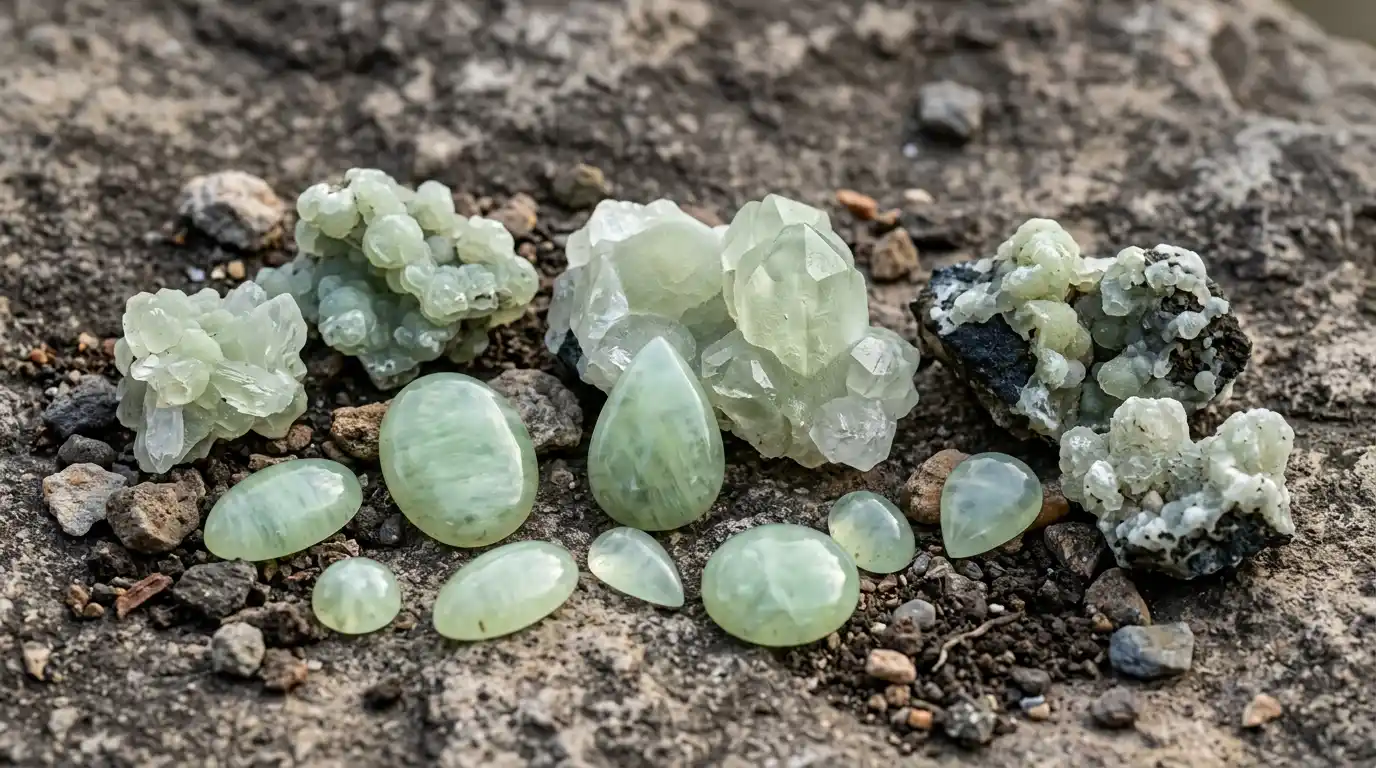
Prehnite benefits are most useful when they are separated into qualities that can be observed and claims that belong to modern spiritual practice. Prehnite is a calcium-aluminum silicate mineral with the formula Ca2Al2Si3O10(OH)2. It usually appears pale green, yellow-green, white, gray, or nearly colorless, and its translucent appearance can produce the soft, luminous look that makes the gem attractive for cabochons, beads, carvings, mineral collections, and occasional faceted stones.
From a gemological perspective, important prehnite benefits include moderate scratch resistance, distinctive color, attractive translucency, interesting geological associations, collector appeal, and suitability for several forms of lapidary work. Prehnite has a Mohs hardness of about 6 to 6.5, so it is harder than fluorite, calcite, and many decorative minerals, although its brittle tenacity and cleavage mean that hardness alone should not be treated as proof of exceptional durability.
Spiritual traditions add another layer to discussions of prehnite benefits. Pale green prehnite is frequently connected with the heart chakra, emotional reflection, compassion, calmness, and intentional living in modern crystal practices. These associations may be personally meaningful during meditation or journaling, but they are symbolic practices rather than scientifically established effects of the mineral.
9 Prehnite Benefits at a Glance
- Attractive pale green to yellow-green color creates a distinctive jewelry and collection stone.
- Mohs hardness of about 6 to 6.5 gives prehnite reasonable resistance to everyday scratching when handled carefully.
- Translucent prehnite works especially well in cabochons, beads, carvings, and polished decorative pieces.
- Occasional transparent specimens can be faceted, adding interest for gem collectors and lapidaries.
- Natural crystal habits and geological associations make prehnite useful for mineral study and specimen collecting.
- Some prehnite can display chatoyancy, giving certain cabochons an unusual cat’s-eye effect.
- Its recognizable physical and optical characteristics offer practical value for learning gem identification.
- Modern heart chakra traditions use prehnite as a symbolic focus for compassion, reflection, and emotional intention.
- Prehnite can be kept safely for jewelry and collecting when its cleavage, brittle nature, cleaning limits, and setting style are respected.
Why Prehnite Benefits Begin With Real Mineral Properties
Many prehnite benefits come directly from the mineral’s physical characteristics. Prehnite crystallizes primarily in the orthorhombic system and commonly forms rounded, botryoidal, reniform, stalactitic, fan-shaped, or crust-like aggregates. Well-developed individual crystals occur, but the rounded and clustered forms familiar to mineral collectors are especially characteristic. This natural habit gives prehnite specimens a visual identity that is quite different from gems valued mainly for transparent faceted rough.
Prehnite normally has a vitreous to pearly luster and is usually translucent. The combination of pale color, internal cloudiness, and soft light transmission can produce an almost glowing visual appearance without requiring any supernatural explanation. This is one reason prehnite benefits lapidary artists who want a polished gem with a gentle appearance rather than the sharp brilliance expected from diamond, zircon, or highly transparent quartz.
Its hardness of approximately 6 to 6.5 is another practical advantage. Prehnite can resist light scratching better than many softer collector minerals. However, hardness measures resistance to scratching, not resistance to breaking. Prehnite is brittle and has good cleavage in one direction, so an impact at an unfavorable angle can still chip or split a stone. Understanding that distinction is essential when evaluating prehnite benefits for jewelry.
Prehnite Benefits for Jewelry, Cabochons, and Lapidary Work
Among the most visible prehnite benefits is its usefulness as a cabochon gem. Translucent rough often responds well to a smooth domed cut because the shape emphasizes color and the stone’s soft internal glow. Cabochons also avoid some of the vulnerable sharp corners found on heavily faceted gems, although no cutting style makes a brittle stone immune to damage.
Prehnite is also fashioned into beads, pendants, earrings, carvings, polished stones, and decorative objects. Transparent rough is less common, but suitable pieces can be faceted. Faceted prehnite generally attracts interest because transparency itself is unusual enough to make a fine example distinctive. Chatoyant prehnite is another specialty form. When correctly oriented inclusions or internal structures concentrate reflected light into a narrow band, a properly cut cabochon may show a cat’s-eye effect.
These prehnite benefits do not mean the gem is ideal for every jewelry situation. Earrings, pendants, brooches, and necklaces usually expose the stone to fewer impacts than an unprotected everyday ring. A prehnite ring can still be worn, but protective settings and conscious handling become important, especially for pieces that project above the mounting.
Geological and Educational Value of Prehnite
Prehnite also has scientific value that is easy to overlook when discussions focus only on crystal symbolism. It can form through relatively low-temperature hydrothermal or metamorphic processes and is commonly associated with altered basaltic rocks, cavities, veins, zeolites, calcite, quartz, and related minerals. Its presence may therefore provide useful clues about the geological conditions that affected a rock after its original formation.
Knowing where prehnite is found also adds context to a specimen. Prehnite occurs in numerous regions around the world, including historically important occurrences in South Africa as well as deposits in Australia, North America, Europe, Pakistan, and other mineral-producing regions. Locality information can matter to collectors when crystal habit, associated minerals, appearance, or documented provenance distinguishes one occurrence from another.
One of the most interesting prehnite benefits for students is that a specimen can support practical mineral identification. Color alone is never sufficient because many green stones can resemble one another. A combination of crystal habit, hardness, luster, specific gravity, refractive properties, inclusions, and geological association gives a much stronger basis for identification. Laboratory testing becomes particularly valuable for valuable or ambiguous cut stones.
The history of prehnite also gives the mineral unusual significance in European mineralogical naming. It was named in honor of Hendrik von Prehn, who was associated with specimens brought from the Cape of Good Hope region. That documented history is more defensible than claims assigning the stone to unspecified ancient civilizations or traditions without reliable evidence.
Heart Chakra Traditions and Symbolic Prehnite Benefits
Modern crystal traditions often describe prehnite benefits in terms of compassion, emotional openness, peaceful reflection, and the heart chakra. The connection is understandable symbolically because green has become strongly associated with the heart chakra in many contemporary chakra systems. A polished green prehnite may therefore be used as a visual focus during meditation, prayer, journaling, or quiet reflection.
Chakras, however, are spiritual concepts rather than anatomical structures. Holding prehnite over the chest does not establish a physiological interaction with the heart, nervous system, hormones, circulation, or any other body system. A person may still value the ritual because objects can serve as reminders of an intention. Someone might associate a prehnite pendant with patience, kindness, or a commitment to communicate more thoughtfully, for example, without claiming that the gemstone itself produces those outcomes.
Claims associated with prehnite healing properties sometimes go considerably further, including statements about emotional disorders, sleep, physical organs, immunity, detoxification, or other medical outcomes. Such claims are not established by clinical evidence. The safest way to interpret spiritual prehnite benefits is as symbolism, mindfulness practice, personal ritual, or cultural belief rather than medical treatment.
This distinction does not make symbolic use meaningless. A physical object can become personally significant because of the memories, intentions, relationships, or routines attached to it. The benefit comes from the person’s reflective practice and interpretation, not from proven therapeutic energy emitted by the crystal.
Gemological Safety, Water, and Everyday Care
Responsible care is one of the most important parts of understanding prehnite benefits. Its Mohs hardness gives it moderate scratch resistance, but the mineral remains brittle and has cleavage. Loose stones should therefore be stored away from harder gems that could scratch them, while finished jewelry should be protected from forceful impact.
Questions about whether prehnite is safe in water also need practical context. Brief contact with clean water is not the same as prolonged soaking, repeated immersion, ultrasonic cleaning, exposure to harsh detergents, or placing an entire jewelry setting in liquid. Fractures, inclusions, surface treatments, adhesives, metal components, and accumulated damage can all change what cleaning method is appropriate.
For ordinary prehnite jewelry, gentle cleaning with a soft cloth and, when necessary, a small amount of mild soapy water is usually more sensible than aggressive cleaning. Avoid sudden temperature changes, rough scrubbing, steam, and strong chemicals. Ultrasonic cleaning is best avoided when the stone contains visible fractures, significant inclusions, unknown treatments, or delicate settings.
Prehnite should also never be ground, intentionally dissolved, swallowed, or used to prepare ingestible crystal water. Its mineral composition does not provide nutritional calcium, aluminum, silicon, or other elements through normal skin contact, and there is no health advantage to trying to extract chemical components from a gemstone.
Collecting and Evaluating Prehnite
Collector-oriented prehnite benefits depend heavily on the quality and character of the individual specimen. For polished gems, buyers often value attractive green or yellow-green color, pleasing translucency, an even polish, interesting inclusions, and a cut that suits the rough. Transparent faceted prehnite is less common and may attract additional interest, but transparency alone should not replace careful examination of workmanship, damage, or authenticity.
Mineral specimens are evaluated differently. Crystal form, associated species, locality, specimen aesthetics, damage, provenance, and whether the specimen has been repaired or enhanced may matter more than gem-style clarity. Botryoidal prehnite coatings with contrasting minerals can be especially appealing because the combination preserves geological context rather than reducing the specimen to a polished stone.
A responsible seller should describe treatments or repairs when known. Buyers should also be cautious when color, locality, rarity, or metaphysical claims are used to justify unusually high prices without evidence. The practical prehnite benefits of a specimen come from what can actually be examined, documented, appreciated, worn, studied, or collected.
Conclusion
Prehnite benefits extend well beyond modern crystal symbolism. Its pale green color, translucent appearance, moderate hardness, cabochon potential, occasional chatoyancy, distinctive crystal habits, geological associations, and educational value make it a genuinely interesting gemstone and collector mineral. Heart chakra traditions can add personal symbolism, but they should remain clearly separated from medical or scientific claims.
FAQs
What are the main prehnite benefits?
The most defensible prehnite benefits include its attractive color, suitability for cabochons and beads, moderate scratch resistance, mineral-collecting value, occasional chatoyancy, distinctive geological occurrence, and usefulness for studying gem identification. Modern spiritual traditions also associate prehnite with heart chakra symbolism, compassion, and reflection, but those meanings are belief-based rather than scientifically demonstrated effects.
Is prehnite durable enough for everyday jewelry?
Prehnite has a Mohs hardness of about 6 to 6.5, giving it reasonable resistance to light scratching, but it is brittle and has cleavage. Pendants and earrings are generally easier environments for the gem than exposed everyday rings. Rings can still be worn when the setting protects the stone and the wearer avoids impacts, abrasive work, and harsh cleaning.
Are prehnite benefits scientifically proven?
Some prehnite benefits are directly observable, including its gemological properties, lapidary uses, geological significance, and collector appeal. Claims that prehnite changes emotions, chakras, organs, energy fields, sleep, hormones, or health have not been established scientifically. Meditation or reflection with a gemstone may still have personal meaning, but the mineral itself should not be presented as a medical treatment.
Why is prehnite associated with the heart chakra?
The heart chakra association comes primarily from modern spiritual systems in which green stones are commonly connected with compassion, emotional openness, harmony, and relationship themes. Prehnite’s pale green color fits that symbolic framework. The association is spiritual and interpretive, not evidence that prehnite physically interacts with the heart or another anatomical structure.
What makes prehnite valuable to mineral collectors?
Collectors may value prehnite for attractive botryoidal aggregates, unusual crystal forms, contrasting associated minerals, locality, provenance, translucency, color, specimen size, and overall aesthetics. Transparent facetable rough and chatoyant examples can also be interesting to gem collectors. Condition and accurate identification remain important because damage, repairs, or unsupported locality claims can affect desirability.
Can prehnite go in drinking water or crystal elixirs?
Prehnite should not be placed in drinking water for the purpose of making an ingestible crystal elixir. There is no proven health benefit from transferring mineral components into water, and contamination, treatments, surface residues, or associated minerals may introduce unnecessary risks. Using the stone externally as a decorative or symbolic object avoids those concerns.
Evidence-safe note: Spiritual, chakra, emotional, and energetic descriptions of prehnite reflect belief systems and personal practices. Prehnite is not a medical treatment and should not replace professional healthcare.