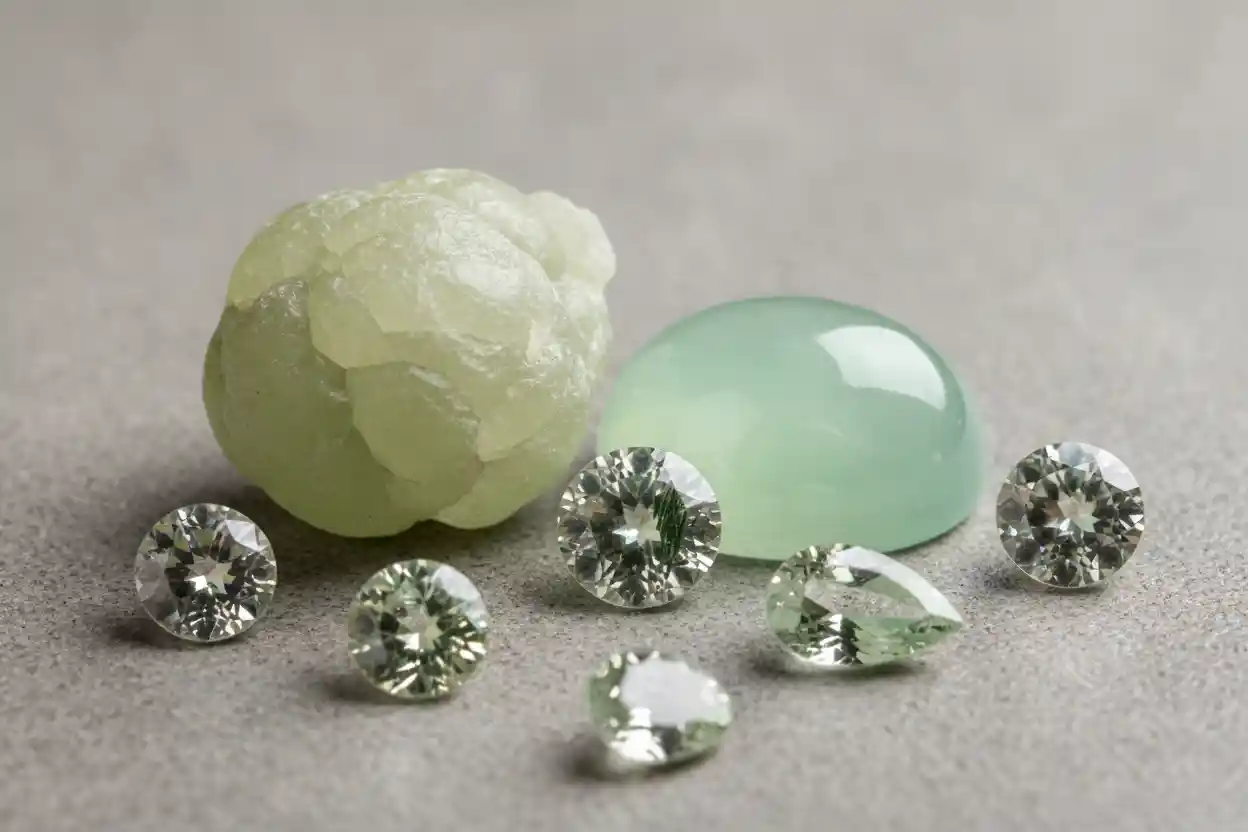
Prehnite Healing Properties: 11 Claims, Mineral Facts & Safe Use
Prehnite healing properties are commonly associated with emotional calm, grounding, self-reflection, preparedness, healthy boundaries, confidence, concentration, patience, resilience, meditation, and spiritual awareness. Pale green to yellow-green color, translucent botryoidal forms, and frequent associations with dark epidote needles give the gemstone a distinctive appearance that naturally encourages themes of nature, order, and quiet focus. Those qualities do not establish a therapeutic mechanism. Prehnite has not been demonstrated to treat anxiety, depression, nightmares, cardiovascular disease, digestive problems, hormonal conditions, pain, inflammation, sleep disorders, or another medical condition. Scientifically, prehnite is a calcium-aluminum silicate hydroxide with the formula Ca₂Al₂Si₃O₁₀(OH)₂. It is a recognized mineral species, generally orthorhombic, with Mohs hardness around 6 to 6.5 and colors ranging from colorless and white through yellow, yellow-green, gray, brownish, and rarely pale blue.
11 Prehnite Healing Claims
- Emotional calm during stressful periods
- Grounding and present awareness
- Self-reflection and pattern recognition
- Preparedness and practical organization
- Healthy emotional boundaries
- Confidence during uncertainty
- Concentration and sustained focus
- Patience with gradual progress
- Resilience after setbacks
- Meditation and quiet attention
- Spiritual reflection and intuition
These eleven themes can support useful reflective practices without becoming eleven scientifically proven healing effects. Many Prehnite benefits become more practical when translated into actions such as organizing unfinished tasks, slowing down before reacting, defining a boundary, reviewing repeated behavior, or setting aside uninterrupted time for reflection.
Prehnite Mineral Facts
Prehnite has the ideal formula Ca₂Al₂Si₃O₁₀(OH)₂ and contains calcium, aluminum, silicon, oxygen, and hydroxyl as essential components. Iron, magnesium, sodium, potassium, water, and other minor constituents can occur as impurities.
The mineral is generally classified in the orthorhombic crystal system. Its internal crystallography can be more complex than a simple introductory description suggests, with fine-scale twinning and domains reported in structural studies, but orthorhombic remains the practical mineralogical classification.
Prehnite commonly occurs as botryoidal, globular, reniform, stalactitic, fan-like, granular, or compact aggregates. Distinct crystals can form but are less familiar in jewelry than rounded aggregates and cabochons. Mindat lists blocky to thin tabular crystals as well as the more characteristic rounded aggregate habits.
Color typically ranges from very pale green through yellow-green, apple green, yellow, white, gray, and nearly colorless. Iron substitution and inclusions can influence green or yellow tones, while associated epidote may create dark needles, fans, or branching patterns inside transparent or translucent stones.
Luster varies from vitreous to pearly, and transparency ranges from transparent to translucent. Some fibrous prehnite can show cat’s-eye effects or soft directional sheen when cut correctly.
Hardness is around Mohs 6 to 6.5, making it harder than fluorite, apatite, calcite, and opal but softer than quartz, topaz, sapphire, and ruby.
How Prehnite Forms
Prehnite commonly develops in low-temperature hydrothermal and low-grade metamorphic environments. It is especially associated with altered basaltic and other calcium-rich rocks, where circulating fluids transform earlier minerals and create veins, cavities, and fracture fillings.
Its name is also familiar from the prehnite-pumpellyite metamorphic facies, a geological term describing particular pressure-temperature conditions in low-grade metamorphism. The mineral can occur with pumpellyite, epidote, calcite, zeolites, quartz, datolite, and other secondary minerals.
Rounded pale green masses can line cavities in volcanic rocks, while mineralized fractures may produce veins of prehnite. In some deposits, epidote grows with or through prehnite, producing the attractive green-and-black cabochons widely sold in the gem trade.
Important specimens have come from South Africa, Australia, Mali, Namibia, India, China, Scotland, and the United States. Mali became particularly notable for gem-quality material and specimens associated with epidote, while Australian deposits have produced translucent yellow-green stones cut into cabochons and faceted gems. GIA has documented both faceted and cabochon-quality prehnite from Mali and Australia.
Prehnite Discovery and Name
Prehnite has an unusually important naming history. The mineral was named in 1788 by Abraham Gottlieb Werner in honor of Hendrik von Prehn, a Dutch military officer and mineral collector associated with the Cape of Good Hope. Prehn is credited with bringing early specimens from southern Africa to Europe.
The exact historical source of the original specimens is less secure than some older references suggest. Modern historical discussion has questioned traditional claims that one specific South African district can be treated confidently as the original locality.
Prehnite is often cited as the first mineral named after a person, although the historical details around early mineral naming deserve some caution. What is clear is that the name entered mineralogical literature centuries before modern crystal-healing culture developed.
That timeline matters. Eighteenth-century mineralogical recognition does not establish an ancient Prehnite healing system. Modern claims involving intuition, decluttering, dreams, or chakra work developed much later.
Calm and Grounding
Emotional Calm
Prehnite is frequently described as soothing or peaceful because of its pale green color and rounded growth forms. The mineral has not been shown to regulate neurotransmitters, stress hormones, or heart rate through contact. A practical use is to make the stone a cue to stop multitasking, slow the breathing, and identify what needs attention first.
Grounding Through Sensory Focus
Although green gemstones are often described as uplifting rather than grounding, Prehnite is also used for present-moment awareness. It does not electrically ground the body. A person can instead notice its weight, temperature, translucent surface, inclusions, breathing rhythm, and physical surroundings. The useful mechanism is deliberate sensory attention.
Reflection and Preparedness
Self-Reflection
Prehnite is often linked with inner knowledge or self-awareness. A stone cannot uncover hidden psychological information automatically. Keeping it near a journal can still create a repeatable cue to record triggers, emotional reactions, assumptions, and consequences. Repeated observation reveals patterns more reliably than expecting the gemstone to do so.
Preparedness and Organization
One distinctive modern Prehnite theme involves preparation, order, and reducing clutter. The mineral cannot organize a home or schedule. It can become a practical reminder to complete one unfinished task, clear one physical area, or decide which commitments no longer deserve time.
This interpretation gives the symbolism an observable outcome rather than treating organization as an energetic effect.
Boundaries and Confidence
Healthy Boundaries
Some practitioners associate Prehnite with emotional protection and relationships. There is no evidence that the mineral forms an energetic shield. A more useful interpretation connects protection with boundaries: decide what behavior is acceptable, what requests should be declined, and what consequence follows when a limit is repeatedly ignored.
Confidence During Uncertainty
Prehnite is also used when people want to feel composed during unfamiliar situations. It cannot biologically increase self-esteem. Before a difficult conversation or decision, use it as a reminder to identify what has already been prepared, what remains uncertain, and what first action remains under your control.
Focus and Patience
Concentration With Fewer Distractions
Prehnite is sometimes marketed as a focus stone. No evidence shows that calcium-aluminum silicate improves memory or attention through skin contact. Pairing the stone with one active task, a quieter environment, and a fixed work interval creates a more realistic focus practice.
Patience With Slow Progress
Botryoidal mineral growth and low-temperature geological formation make gradual development an intuitive metaphor. Prehnite cannot biologically increase patience. Use it instead as a cue to measure progress over an appropriate timescale rather than expecting immediate results.
Resilience and Meditation
Resilience After Setbacks
Prehnite forms through geological alteration and changing fluid conditions, making adaptation an understandable symbolic theme. The mineral cannot transfer resilience to a person. After disappointment, identify what failed, what remains usable, what lesson matters, and what should change in the next attempt.
Meditation and Quiet Attention
Translucent Prehnite, especially stones with epidote inclusions, can provide an effective visual meditation focus. Observe internal needles, color gradients, curved surfaces, or light transmission while repeatedly returning attention to the gemstone or the breath. This is a genuine concentration exercise without demonstrating a mineral-specific change in consciousness.
Spiritual Reflection and Intuition
The eleventh common claim connects Prehnite with intuition, dreams, spiritual awareness, or anticipation of future events. There is no evidence that the mineral predicts events or improves extrasensory perception.
A more grounded approach is to record an instinctive reaction to a decision and then compare it with evidence, realistic consequences, uncertainty, and reversibility. Spiritual reflection can remain meaningful without turning intuition into certainty.
Prehnite Chakra Meaning
Prehnite is most commonly associated with the heart chakra because of its pale green color. Contemporary crystal systems connect it with compassion, emotional openness, relationships, forgiveness, and calm.
Some practitioners also connect yellow-green stones with solar plexus themes or use Prehnite for third-eye meditation because of its modern reputation for intuition.
Chakras are a spiritual framework rather than anatomical structures. Prehnite has not been demonstrated to affect the physical heart, digestive organs, brain, endocrine glands, nervous system, or another physiological structure through chakra placement.
Prehnite Inclusions and Appearance
Epidote inclusions are especially familiar in gem-quality Prehnite. Dark green to nearly black epidote needles or sprays can create attractive contrast inside a lighter Prehnite body.
Not every dark inclusion is epidote, however, and appearance alone does not guarantee mineral identity. Professional gemological or mineralogical testing may be necessary when an exact inclusion species matters.
Some fibrous Prehnite can display chatoyancy or a soft moonstone-like sheen when cut as cabochons. GIA documented Australian material showing radial fibrous patterns and optical effects in polished stones.
These effects result from internal structure rather than from energetic emission.
Prehnite Care
Prehnite’s Mohs hardness of 6 to 6.5 gives it moderate scratch resistance. Quartz, topaz, sapphire, ruby, diamond, and harder abrasive particles can scratch it, so separate storage is sensible.
Warm water, mild soap, and a soft cloth or brush are suitable for routine cleaning of sound stones. Brief water contact is generally appropriate.
Long soaking is unnecessary when a gem contains open fractures, significant inclusions, coatings, fillers, glue, or attached jewelry components. Internal epidote or other inclusions can also create local stress points.
Ultrasonic and steam cleaners are not ideal defaults for heavily included, fractured, or valuable Prehnite. Gentle hand cleaning gives better control.
Strong acids, harsh alkaline cleaners, bleach, and abrasive powders should be avoided. Even when a gemstone tolerates occasional household exposure, aggressive chemical cleaning adds no benefit.
Heat should also be kept moderate. Sudden temperature changes can create stress in included or fractured gems.
Prehnite is suitable for pendants, earrings, beads, and protected rings, but exposed rings should receive more care because the stone is softer than quartz and has less resistance to abrasion than harder jewelry gems.
Safe Ritual Cleansing
Prehnite does not require prolonged soaking, saltwater, intense heat, or chemical sprays for ritual cleansing. There is no scientifically demonstrated negative energy that must be physically removed.
Sound, intentional breathing, quiet reflection, dry placement, or gentle washing are low-risk choices. An organization-themed ritual can be made practical by identifying one unfinished task or cluttered area and completing a specific action immediately afterward.
Avoid flame, harsh chemicals, abrasive salt, steam, and unnecessary prolonged immersion, especially when the stone contains visible inclusions or fractures.
Conclusion
Prehnite has a distinctive verified identity as a calcium-aluminum silicate mineral with pale green color, rounded growth habits, frequent epidote associations, and an important eighteenth-century naming history. Its eleven healing themes can support calm, organization, boundaries, concentration, resilience, and reflection when the meaningful effect comes from personal practice rather than an unproven medical or psychic action.
FAQs
What are the main Prehnite healing properties?
Common claims include calm, grounding, self-reflection, preparedness, boundaries, confidence, concentration, patience, resilience, meditation, and intuition. These are contemporary wellness or spiritual beliefs rather than scientifically proven therapeutic effects.
What is Prehnite made of?
Prehnite is a calcium-aluminum silicate hydroxide with the formula Ca₂Al₂Si₃O₁₀(OH)₂.
How hard is Prehnite?
Prehnite measures about Mohs 6 to 6.5. Quartz and harder gemstones can scratch it.
Why is Prehnite green?
Iron and other compositional variations can contribute yellow-green and green coloration. Pure Prehnite can also be nearly colorless or white.
What are the dark inclusions in Prehnite?
Epidote is a common inclusion in gem-quality Prehnite and can appear as dark green or black needles and sprays. Not every dark inclusion can be identified visually with certainty.
Where was Prehnite discovered?
Early specimens are associated with southern Africa and Hendrik von Prehn, who brought material to Europe. The exact original locality has been debated by modern mineral historians.
Is Prehnite an ancient healing stone?
Prehnite has been known mineralogically since the eighteenth century, but its modern crystal-healing associations should not be presented as an ancient standardized healing tradition.
Which chakra is Prehnite associated with?
Modern crystal practice most commonly links Prehnite with the heart chakra and sometimes the third-eye or solar plexus chakra. These are spiritual rather than anatomical correspondences.
Can Prehnite go in water?
Brief cleaning with lukewarm water and mild soap is generally appropriate for sound stones. Avoid unnecessary prolonged soaking when fractures, inclusions, fillers, or glue are present.
How should Prehnite be cleaned?
Use mild soap, lukewarm water, and a soft cloth or brush. Avoid harsh chemicals, abrasive cleaners, aggressive steam, and unnecessary ultrasonic cleaning of fractured or included stones.
Crystal healing claims are traditional or personal beliefs and should not replace qualified medical or mental health care.