Pyrite Benefits: 9 Real Uses, Wealth Manifestation & Sulfur Safety Limits
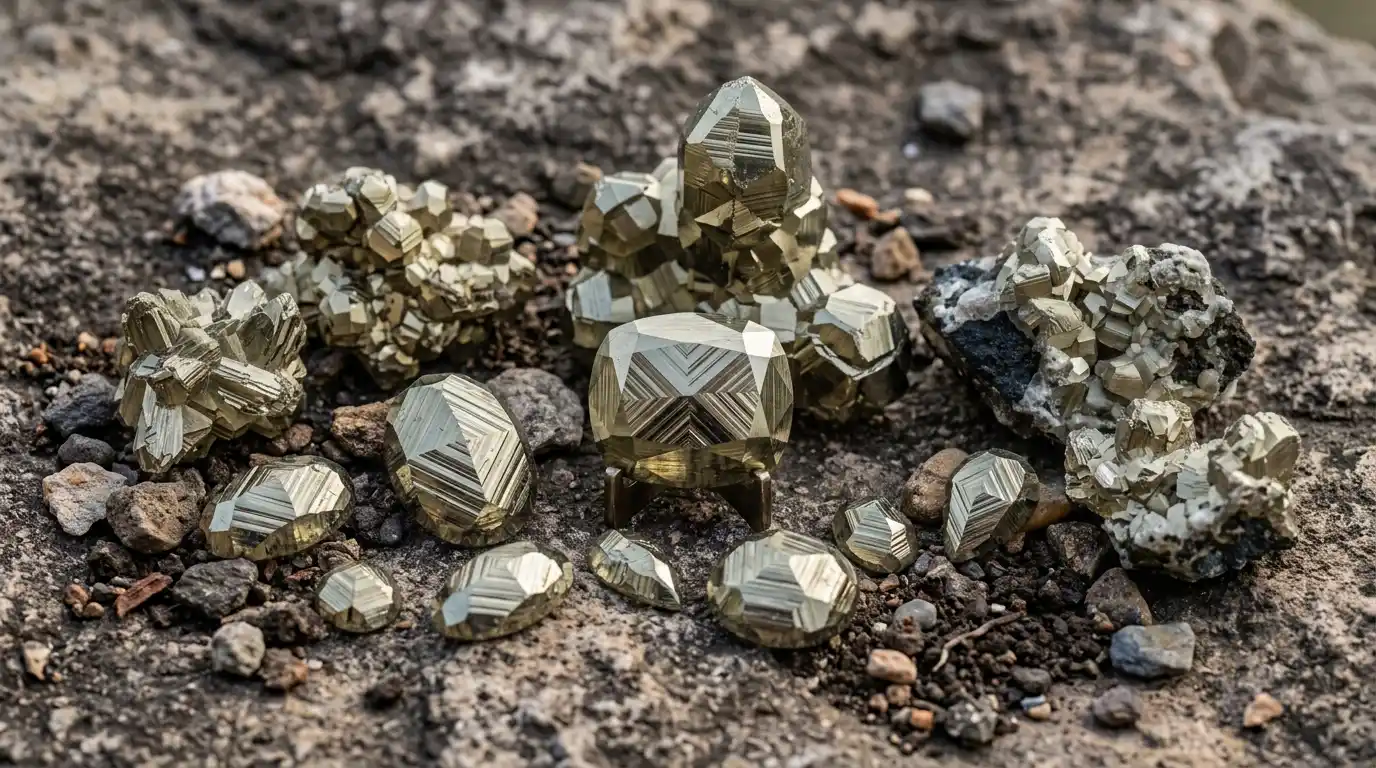
Pyrite benefits extend far beyond the familiar nickname “fool’s gold.” Pyrite is iron disulfide, FeS2, an opaque metallic mineral known for pale brass-yellow color, cubic and pyritohedral crystals, distinctive striated faces, and a hardness of about 6 to 6.5 on the Mohs scale. These measurable properties give pyrite genuine value in mineral collecting, geological education, identification practice, decorative work, historical study, and scientific examination.
Many pyrite benefits also come from the mineral’s ability to teach important distinctions between color, luster, hardness, crystal structure, and actual composition. Its gold-like appearance makes it especially useful for showing why visual resemblance alone cannot identify a mineral. Pyrite is harder and more brittle than native gold, has a different streak, forms characteristic crystals, and contains iron and sulfur rather than elemental gold.
Modern spiritual practice adds wealth manifestation, confidence, motivation, and protective symbolism to discussions of pyrite benefits. Those interpretations are often inspired by the mineral’s metallic golden appearance and geometric crystals. They may be meaningful as personal rituals, but pyrite does not generate money, change financial probabilities, release beneficial sulfur into the body, or medically improve physical or psychological conditions.
9 Pyrite Benefits at a Glance
- Pyrite’s metallic luster and geometric crystals give it strong ornamental and mineral-collection appeal.
- Its hardness, streak, crystal habit, and brittle behavior make pyrite useful for practical mineral identification.
- Cubes, pyritohedra, octahedral combinations, and striated faces provide excellent examples for studying crystallography.
- Pyrite occurs in many geological environments and can provide information about mineralization, sedimentary processes, hydrothermal systems, and ore deposits.
- Its spark-producing history connects pyrite with early fire-making technologies and the origin of its mineral name.
- Pyrite has historical industrial importance as a sulfur-bearing mineral and former feedstock for sulfuric acid production.
- Cut, polished, druzy, and natural crystals can be used decoratively when brittleness and oxidation are considered.
- Golden color has inspired modern pyrite benefits involving prosperity, confidence, motivation, and wealth manifestation as symbolic practices.
- Understanding sulfur chemistry, moisture sensitivity, dust precautions, and oxidation allows pyrite to be collected and handled more responsibly.
Mineralogical Properties Behind Real Pyrite Benefits
The most dependable pyrite benefits come from observable mineral properties. Pyrite consists of iron and sulfur in the formula FeS2 and crystallizes primarily in the isometric system. Well-formed specimens can develop cubes, pyritohedra, octahedra, and combinations of these forms. Crystal faces frequently show parallel striations, which can become an important visual identification clue.
Pyrite has a metallic luster and a pale brass-yellow color that creates its famous resemblance to gold. Yet the two substances behave very differently. Native gold is soft, highly malleable, extremely dense, and capable of flattening rather than shattering under suitable pressure. Pyrite is substantially harder, brittle, and commonly breaks with irregular or conchoidal fracture.
These differences make real vs fake pyrite more than a question of whether something looks golden. Genuine identification considers crystal form, streak, hardness, density, luster, fracture, associated minerals, and professional testing when the specimen is valuable or ambiguous.
One of the strongest educational pyrite benefits is therefore its ability to demonstrate that appearance is only one part of gemological and mineralogical identification. A convincing gold tone does not make a mineral gold, just as a clear stone is not automatically diamond or a red stone automatically ruby.
Pyrite Benefits for Mineral Collecting and Crystallography
Collectors often value pyrite because it can form exceptionally sharp geometric crystals. Cubes may appear almost manufactured because of their straight edges and reflective faces, while pyritohedra display the characteristic twelve-faced form that gives the crystal habit its name. Some specimens combine cubes, octahedra, and pyritohedral faces into much more complex shapes.
This geometric variety is one reason pyrite benefits students learning crystallography. A natural specimen can make concepts such as crystal symmetry, habit, face development, twinning, striation, and growth interference easier to understand than an abstract diagram alone.
Pyrite also occurs as massive aggregates, nodules, disseminated grains, framboids, replacement growths, fossil-associated mineralization, and crystals embedded in matrix. That diversity prevents collectors from assuming that every genuine specimen must consist of a perfect golden cube.
Condition remains important. Pyrite is relatively hard but brittle, so thin projecting crystals and sharp edges can chip. Some specimens are also more prone to oxidation than others, especially when finely crystalline, fractured, porous, or stored under unfavorable humidity. Attractive pyrite benefits therefore include both visual beauty and the opportunity to learn proper mineral conservation.
Geological Value and Important Pyrite Occurrences
Pyrite is one of the most widespread sulfide minerals, and its geological distribution creates another group of practical pyrite benefits. It occurs in igneous, sedimentary, metamorphic, and hydrothermal environments and may appear with quartz, calcite, sphalerite, galena, chalcopyrite, marcasite, and many other minerals.
The question of where pyrite is found is especially important because crystal habit and specimen appearance can vary dramatically by locality. Some deposits are famous for sharply developed cubes, others for pyritohedra, fossil replacements, unusual twins, or pyrite associated with contrasting minerals.
Pyrite can also be geologically significant because sulfide mineralization may record the chemistry of hydrothermal fluids, sedimentary environments, metamorphic alteration, or ore-forming processes. Geologists may examine pyrite textures, trace-element chemistry, sulfur isotopes, and relationships with surrounding minerals to reconstruct parts of a rock’s formation history.
This scientific value is one of the least exaggerated pyrite benefits. A specimen may be visually attractive while also preserving evidence about temperature, fluid chemistry, biological activity, sedimentary conditions, or mineralization events.
Historical Pyrite Benefits and Spark Production
Historical pyrite benefits are closely tied to fire. The mineral’s name traces back to a Greek term associated with fire because pyrite can produce sparks when struck against suitable hard substances. Those sparks result from tiny particles heated during impact, not because the crystal contains stored flame or mystical fire energy.
The documented history of pyrite includes practical fire-making as well as centuries of confusion with gold and other metallic minerals. Its gold-like appearance contributed to the enduring “fool’s gold” nickname, although the phrase can hide the fact that pyrite is a scientifically important mineral in its own right.
Pyrite has also had industrial importance as a sulfur-bearing ore. It was historically used as a source for sulfur and sulfuric acid production, particularly before modern industrial sulfur recovery from petroleum and natural gas became dominant in many markets.
These historical pyrite benefits demonstrate why the mineral mattered long before contemporary manifestation practices became popular. Pyrite had technological, industrial, geological, and educational significance without requiring supernatural explanations.
Decorative, Lapidary, and Jewelry Uses
Decorative use is another practical source of pyrite benefits. Well-formed crystals can be displayed without cutting, while massive or fine-grained pyrite may be polished, carved, incorporated into beads, or used in ornamental objects. Small sparkling crystals can also create attractive druzy surfaces.
Pyrite has appeared in jewelry for centuries, although wearability requires care. Its hardness of about 6 to 6.5 gives better scratch resistance than fluorite or calcite, but hardness does not eliminate brittleness. Edges can chip, and prolonged exposure to moisture can encourage surface alteration in susceptible specimens.
Some jewelry sold under the traditional trade description “marcasite” is actually made using small faceted pieces of pyrite rather than the mineral marcasite. The visual effect comes from pyrite’s bright metallic reflection, which can resemble tiny steel-gray or golden mirrors when correctly cut and polished.
These pyrite benefits are most useful when owners understand that the stone should not be evaluated like a highly durable transparent gem. Its attraction lies in metallic luster, geometry, sparkle, and unusual mineral character rather than high transparency or diamond-like brilliance.
Wealth Manifestation and Modern Pyrite Symbolism
Wealth manifestation is among the best-known modern spiritual pyrite benefits. The connection is visually understandable. Pyrite resembles gold, and gold has long been associated with wealth, success, status, trade, and stored value. Contemporary crystal traditions extend that visual resemblance into symbolism involving prosperity, confidence, ambition, and financial intention.
A person might place pyrite near a workspace while planning a budget, setting business goals, or reviewing spending habits. In that use, the crystal can function as a physical reminder of an intention. The practical action still comes from budgeting, saving, learning, negotiation, business decisions, investing appropriately, or improving professional skills.
Modern pyrite spiritual meaning should not be confused with a guarantee of financial results. No mineral can ensure sales, increase investment returns, attract a specific amount of money, or change the mathematical probability of a financial outcome.
The symbolic ritual can still feel meaningful. Objects often acquire motivational value because people connect them with goals, habits, memories, or commitments. Pyrite benefits in this setting come from personal symbolism and intentional behavior rather than scientifically demonstrated wealth-attracting energy.
Sulfur Safety Limits and Pyrite Oxidation
Sulfur safety is an important part of responsible discussion of pyrite benefits. Pyrite contains sulfur chemically bonded with iron as FeS2. That does not mean wearing a pyrite bracelet delivers useful sulfur into the body, nor does ordinary skin contact provide a nutritional or therapeutic dose of iron or sulfur.
Intact pyrite specimens are commonly handled by collectors, but grinding, drilling, cutting, or deliberately crushing the mineral creates different considerations. Fine mineral dust should not be inhaled or ingested. Natural specimens may also contain trace impurities depending on their geological origin, which provides another reason to avoid turning pyrite into powder for wellness practices.
Moisture is particularly important because pyrite can oxidize when exposed to water and oxygen. The process can produce iron sulfates and acidic products and may eventually damage susceptible specimens. Fine-grained or unstable pyrite can deteriorate much faster than clean, well-crystallized pieces stored under controlled conditions.
Questions about whether pyrite is safe in water should therefore be answered conservatively. Brief accidental contact is not identical to prolonged soaking, but routinely immersing pyrite provides no gemological advantage and can encourage oxidation. Crystal water intended for drinking is unnecessary and should be avoided.
Collectors should store vulnerable pyrite in a dry, stable environment away from persistent humidity. Specimens already showing powdery white, yellow, greenish, or rusty alteration products deserve especially cautious handling because active oxidation may be occurring.
Pyrite Benefits for Identification and Scientific Learning
Pyrite benefits gemology and mineral education because it provides several recognizable identification characteristics at once. Its metallic luster, brass-yellow color, greenish-black to brownish-black streak, hardness around 6 to 6.5, high density relative to many common rocks, and characteristic crystals create a useful diagnostic combination.
Chalcopyrite is commonly softer and often develops tarnish with iridescent colors. Native gold is much softer, more malleable, significantly denser, and does not form pyrite’s characteristic cubes or pyritohedra. These comparisons show why streak, hardness, crystal form, and physical behavior are more reliable than color alone.
Pyrite can also host or occur near economically important metals. In some ore deposits, trace amounts of gold may occur with or within pyrite, but this does not mean every pyrite specimen contains recoverable gold. The presence, concentration, and form of trace metals must be established analytically rather than assumed from appearance.
These scientific pyrite benefits make even an inexpensive specimen useful for teaching. A single well-chosen crystal can demonstrate sulfide chemistry, metallic luster, crystallography, streak testing principles, mineral associations, oxidation, and the limits of visual identification.
How to Get Practical Value From Pyrite Safely
Owners receive the greatest pyrite benefits when they match the specimen to an appropriate use. Sharp crystals are often best kept as display pieces, while polished pyrite may suit decorative objects or jewelry that avoids constant moisture and impact. Valuable locality specimens should be preserved with original matrix and provenance whenever possible.
Cleaning should remain conservative. A soft dry brush or suitable nonabrasive method is generally preferable to soaking. Harsh acids, household chemicals, steam, and unnecessary ultrasonic cleaning can create avoidable problems, particularly for fractured specimens or pieces combined with other minerals.
Handling a stable pyrite crystal briefly is very different from grinding it, ingesting powder, preparing drinking water with it, or storing deteriorating specimens in humid conditions. Understanding these distinctions prevents exaggerated safety fears while still respecting real sulfur chemistry and conservation concerns.
Ultimately, the most useful pyrite benefits come from what the mineral genuinely offers: remarkable geometry, metallic beauty, geological information, historical importance, identification value, scientific interest, decorative potential, and personal symbolism when used responsibly.
Conclusion
Pyrite benefits include mineral collecting, crystallography, geological study, identification practice, decorative use, historical fire-making significance, and meaningful personal symbolism. Wealth manifestation remains a modern belief-based practice, while pyrite’s sulfur chemistry and oxidation behavior make dry storage, gentle handling, and avoidance of ingestible crystal preparations sensible precautions.
FAQs
What are the most important pyrite benefits?
The strongest pyrite benefits include its attractive metallic crystals, educational value, recognizable mineral properties, geological significance, historical role in spark production, former industrial importance as a sulfur source, and decorative appeal. Modern prosperity symbolism can also be personally meaningful, but it is not a scientifically demonstrated financial effect.
Why is pyrite associated with wealth and money?
Pyrite’s brass-yellow metallic appearance resembles gold, so modern spiritual traditions often connect it with prosperity, confidence, success, and wealth manifestation. The symbolism is visually intuitive, but pyrite cannot guarantee income, investment gains, business success, or a particular financial outcome.
Is pyrite actually gold?
No. Pyrite is iron disulfide, FeS2, while gold is the element Au. Pyrite is harder, more brittle, less dense, and commonly forms cubes or pyritohedra. Native gold is soft and malleable, so proper mineral identification quickly separates the two in most cases.
Is the sulfur in pyrite beneficial to the body?
There is no evidence that wearing or holding pyrite supplies beneficial sulfur to the body. The sulfur is chemically bonded within iron disulfide, and ordinary skin contact is not a nutritional delivery system. Pyrite should not be powdered, swallowed, or used to prepare drinking water for health purposes.
Can pyrite get wet?
Brief accidental moisture does not necessarily destroy a stable crystal, but prolonged or repeated exposure to water is unnecessary and can encourage oxidation in susceptible specimens. Pyrite is generally better stored dry, particularly if it is fractured, fine-grained, porous, or already showing deterioration.
Why does some pyrite deteriorate?
Pyrite can oxidize in the presence of oxygen and moisture. The reactions can produce iron sulfates and acidic products, and the resulting alteration may cause cracking, powdering, staining, or structural breakdown. Fine-grained pyrite and specimens stored at unfavorable humidity can be especially vulnerable.
Are pyrite benefits scientifically proven?
Its mineralogical, geological, historical, industrial, decorative, and educational uses are based on observable evidence. Claims that pyrite attracts money, medically protects the body, changes hormones, treats disease, or directly alters emotional states have not been scientifically established.
Evidence-safe note: Wealth manifestation, chakra, emotional, protective, and energetic descriptions of pyrite reflect spiritual beliefs and personal practices. Pyrite is not a medical treatment, financial guarantee, or substitute for professional healthcare or financial advice.