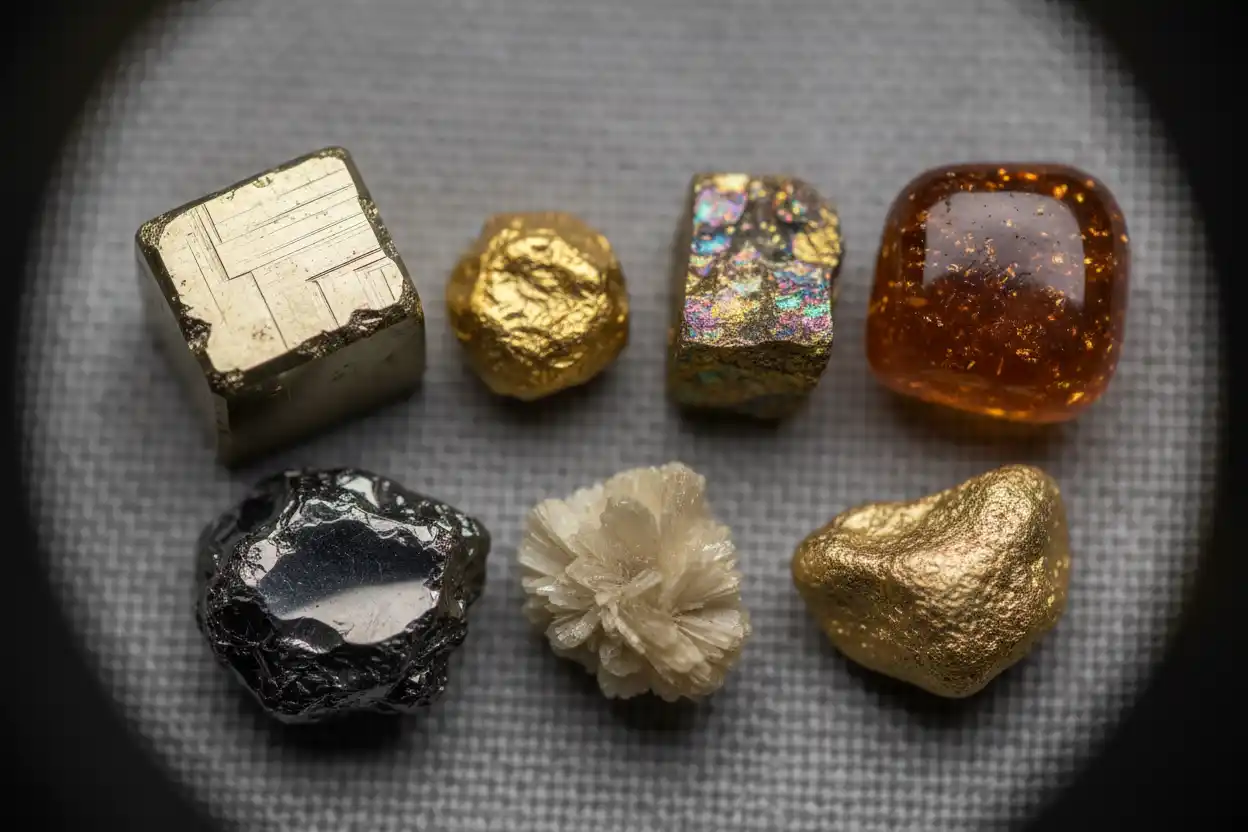
Real vs Fake Pyrite: 8 Easy Ways to Spot Genuine Gold-Tone Crystals
Real vs fake pyrite identification is usually easier than identifying transparent gemstones because pyrite has a distinctive combination of metallic luster, pale brass-yellow color, high hardness, substantial density, brittle behavior, dark streak, and geometric crystal habits. The mineral’s superficial resemblance to gold produced the famous nickname fool’s gold, but pyrite and native gold behave very differently once their physical properties are examined.
Genuine pyrite is iron disulfide, FeS₂. Mindat lists Mohs hardness of 6 to 6.5, specific gravity around 4.8 to 5, metallic luster, a pale brass-yellow color, and isometric crystallography. Pyrite commonly forms cubes, pyritohedrons, octahedrons, massive aggregates, and other intergrown forms.
The main real vs fake pyrite problem is not always deliberate counterfeiting. Gold, chalcopyrite, marcasite, metallic coatings, glitter-filled resin, and other shiny substances can all be mistaken for pyrite. The strongest identification therefore combines crystal habit, face striations, color, streak, hardness, brittleness, density, and professional analysis when a valuable specimen or unusual form creates doubt.
8 Real vs Fake Pyrite Checks at a Glance
- Look for cubes, pyritohedrons, octahedrons, or angular crystalline growth.
- Check for fine striations on crystal faces.
- Compare brass-yellow color with richer native gold.
- Confirm the dark greenish-black to brownish-black streak.
- Use hardness carefully because pyrite is about Mohs 6 to 6.5.
- Compare brittle pyrite with malleable native gold.
- Measure density when visual clues remain uncertain.
- Use professional mineral analysis for coated or unusual specimens.
Genuine Pyrite Has a Distinct Physical Identity
Pyrite is the most widespread sulfide mineral and forms in sedimentary, igneous, hydrothermal, and metamorphic geological settings.
Its chemistry is FeS₂, but that formula is shared with marcasite, which is a different mineral because its crystal structure is orthorhombic rather than isometric. Mindat describes pyrite as the isometric polymorph of FeS₂ and marcasite as its orthorhombic dimorph.
This difference demonstrates an important identification principle. Two minerals can share the same chemical formula yet remain distinct because their atoms are arranged differently.
| Property | Genuine Pyrite | Native Gold |
|---|---|---|
| Composition | FeS₂ | Au |
| Color | Pale brass-yellow | Rich yellow to golden yellow |
| Luster | Metallic | Metallic |
| Mohs hardness | 6 to 6.5 | About 2.5 to 3 |
| Specific gravity | About 4.8 to 5 | About 19.3 when pure |
| Streak | Greenish-black to brownish-black | Yellow |
| Tenacity | Brittle | Malleable |
| Common form | Cubes, pyritohedrons, octahedrons, angular grains | Flakes, nuggets, wires, irregular masses |
| Face striations | Common on cubes | Not characteristic |
Geology.com similarly lists pyrite hardness of 6 to 6.5, specific gravity roughly 4.9 to 5.2, dark streak, brittleness, metallic luster, and common cubic or pyritohedral crystal habits.
Cubic Crystal Form Is One of the Strongest Visual Clues
Pyrite is famous for producing remarkably sharp cubes.
Spanish pyrite specimens in particular can develop geometric crystals that look almost manufactured, with flat faces and precise ninety-degree relationships. Natural pyrite can also form pyritohedrons, which have twelve characteristic faces, as well as octahedrons and combinations of several forms.
This geometry can confuse beginners who assume anything so perfect must be artificial.
Natural crystallography can be extraordinarily precise.
The question is not whether the crystal looks “too perfect.” The question is whether its faces, edges, striations, matrix relationships, intergrowths, and crystal angles make mineralogical sense.
A molded resin cube coated with gold-colored paint may reproduce the shape, but magnification can reveal bubbles, coating boundaries, mold seams, lightweight construction, or a nonmineral interior.
Striations on Pyrite Crystal Faces Are Highly Useful
Many pyrite cubes show fine parallel lines across their faces.
These striations arise from crystal growth and are among the classic identification features of pyrite. Geology.com identifies fine parallel face striations as a useful distinction between pyrite and native gold.
The lines are often oriented differently on neighboring cube faces.
This creates a characteristic visual rhythm when the crystal is rotated under light.
Artificially coated cubes can copy striations, so the feature should not stand alone. Yet a dense metallic specimen showing appropriate cubic geometry, intersecting natural striations, a dark streak, and pyrite-level hardness presents a strong combination of evidence.
Massive pyrite may contain no visible cube faces at all.
Absence of striations therefore does not prove a specimen fake.
Brass Yellow Is Different From Gold Yellow
Pyrite’s color is typically described as pale brass-yellow.
Native gold usually has a richer, warmer yellow color.
The difference becomes easier to recognize when the two are compared directly under neutral light. Pyrite may also tarnish toward dull brass, bronze, iridescent, or brownish tones, while fresh gold retains its characteristic metallic yellow.
Color is useful but not decisive.
Chalcopyrite can also appear yellow and metallic.
Weathering can alter surface color.
Artificial coatings can reproduce almost any gold tone.
The identification becomes much stronger when color agrees with crystal form, hardness, streak, and density.
This is why pyrite’s famous fool’s gold nickname reflects resemblance rather than genuine difficulty once several properties are tested.
The Streak Test Separates Pyrite From Gold Quickly
Pyrite produces a dark streak, commonly greenish-black to brownish-black.
Native gold leaves a yellow streak.
This difference is one of the most useful traditional field tests because powdered mineral color can remain diagnostic even when a specimen’s surface is tarnished. Geology.com lists pyrite’s streak as greenish black to brownish black, while native gold produces a golden-yellow streak.
The test should still be performed carefully.
Pyrite is about as hard as many streak plates, so a hard crystal may scratch the plate rather than leave a clean powder trail. Geology.com’s streak-testing guidance specifically warns that minerals close to or harder than the plate can create misleading scratches or loose fragments rather than a true streak.
Do not drag an aesthetically valuable crystal across ceramic simply to prove what it is.
Use an inconspicuous fragment or professional testing when specimen preservation matters.
Hardness Makes Pyrite Very Different From Gold
Pyrite ranks 6 to 6.5 on the Mohs scale.
Gold is only about 2.5 to 3.
This difference is enormous in practical identification.
A small pyrite grain can resist a steel point and may scratch glass, while gold is soft enough to be scratched and deformed much more easily. Geology.com identifies hardness as one of the major ways to distinguish fool’s gold from real gold.
Again, destructive testing is unnecessary on collectible specimens.
A beautiful crystal cluster may have far more collector value than any information obtained by scratching it.
Hardness should be understood as supporting mineral evidence rather than a requirement to damage a specimen.
Brittle Pyrite Does Not Bend Like Gold
Native gold is famously malleable.
Small gold particles can flatten, bend, or deform under pressure rather than shattering.
Pyrite is brittle.
A small expendable grain tends to crack or break instead of bending.
This mechanical difference provides another strong separation when prospectors encounter gold-colored grains in quartz or placer sediment.
The test should not be applied to a valuable crystal cluster.
A perfect cubic pyrite crystal can chip at corners if squeezed or struck.
The same rule used throughout gemstone identification applies here: preserve attractive specimens and test only expendable fragments when necessary.
Pyrite Is Heavy, but Gold Is Much Heavier
Pyrite feels substantial because its specific gravity is around 4.8 to 5.
That is significantly denser than common quartz or feldspar.
Gold, however, is in another category entirely. Pure gold has specific gravity around 19.3, making it almost four times as dense as pyrite.
This difference becomes obvious when equal-sized specimens are compared accurately.
A metallic-looking nugget that feels astonishingly heavy deserves investigation for native gold or another high-density substance.
A lightweight resin imitation coated in metallic paint may feel suspiciously light compared with genuine pyrite.
Hand feel is still weaker than measured density.
Matrix rock, hollow construction, attached crystals, and sample shape can distort informal comparisons.
Pyrite Versus Chalcopyrite
Chalcopyrite is another copper-iron sulfide that can look gold-colored and metallic.
It is usually yellower than pyrite and often develops colorful tarnish.
One of the most useful differences is hardness.
Geology.com notes that chalcopyrite is only about Mohs 3.5 to 4, substantially softer than pyrite at 6 to 6.5.
Chalcopyrite also generally lacks pyrite’s characteristic sharp cubic crystal habit.
A golden sulfide that scratches easily and occurs as massive irregular grains may therefore deserve consideration as chalcopyrite rather than pyrite.
Both are genuine minerals.
The identification issue is correct naming rather than one being inherently fake.
Pyrite Versus Marcasite
Pyrite and marcasite share the same formula, FeS₂, but their crystal structures differ.
Pyrite belongs to the isometric system.
Marcasite is orthorhombic.
Mindat lists marcasite hardness around 6 to 6.5 and specific gravity about 4.887, meaning several basic physical properties overlap closely.
Crystal habit therefore becomes especially important.
Marcasite commonly forms bladed, tabular, spear-like, cockscomb, or radiating habits rather than classic pyrite cubes.
The similarity between these minerals is also why historical naming can be confusing.
A specimen should be identified from crystallography and structure rather than simply from its metallic yellow color.
Pyrite Versus Real Gold
Gold and pyrite become easy to separate once their physical properties are compared together.
Gold is softer, much denser, malleable, and yellow-streaking.
Pyrite is harder, much less dense, brittle, and dark-streaking.
Pyrite commonly forms angular geometric crystals with face striations, while placer gold often appears as rounded grains, flakes, wires, and irregular nuggets.
One interesting complication is that pyrite can occur in gold-bearing deposits and may even contain microscopic or structurally bound gold.
Finding pyrite therefore does not mean a rock contains no gold.
It means the visible brass-yellow mineral itself should not automatically be called gold.
Metallic-Coated Resin and Decorative Fakes
Counterfeit pyrite products are less widespread than fake moldavite or imitation pearls, but manufactured decorative pieces do occur.
Resin may be cast into geometric forms and covered with metallic pigment.
Plastic clusters can be painted brass yellow.
Other crystals may receive metallic coatings.
A convincing photograph can hide these differences easily.
Physical examination usually reveals them.
Genuine pyrite should feel dense, behave like a hard brittle sulfide, show mineral-like surfaces, and produce the expected streak.
A resin imitation may show bubbles, seams, soft edges, chipped coating, low density, or a nonmetallic interior where the outer layer has broken.
Anyone deciding to buy pyrite should evaluate the specimen’s crystal habit, matrix, weight, surface continuity, and seller disclosure rather than relying on saturated product photography.
Oxidation Can Change Genuine Pyrite Over Time
Pyrite is genuine even when it begins to tarnish or oxidize.
Some specimens are particularly vulnerable to deterioration in humid storage.
The Canadian Conservation Institute notes that pyrite can oxidize at elevated relative humidity, forming iron sulfate and acidic by-products that may cause the specimen to powder, crack, or eventually disintegrate.
The American Museum of Natural History likewise advises storing vulnerable pyritic specimens in dry conditions because high humidity accelerates destructive pyrite oxidation.
Collectors sometimes call this problem pyrite disease.
A dull gray or powdery surface therefore does not necessarily mean a specimen is fake. It may indicate genuine pyrite undergoing chemical deterioration.
Dry storage is far more useful than trying to polish away active oxidation.
Pyrite Price Depends More on Specimen Quality Than the Metal Value
Pyrite contains iron and sulfur rather than precious-metal quantities comparable with a gold nugget.
Its collector value therefore depends heavily on crystal quality, locality, size, luster, form, matrix, rarity of habit, damage, and aesthetics.
Perfect cubes from famous localities, attractive pyritohedral clusters, replacement fossils, unusual twinning, and exceptional matrix specimens can command meaningful collector prices.
The factors behind pyrite price should therefore be judged as mineral-specimen qualities rather than by comparing the yellow color with the gold market.
A visually exceptional pyrite crystal can be valuable even though it is not precious metal.
Spiritual Claims Cannot Authenticate Pyrite
Modern crystal traditions associate pyrite benefits with confidence, prosperity, motivation, protection, manifestation, and personal willpower.
Those beliefs cannot identify FeS₂.
A metallic-painted resin cluster can be marketed using exactly the same metaphysical terminology.
A genuine pyrite cube may produce no perceived energetic sensation.
The claims collected under pyrite healing properties should therefore remain separate from mineral authentication.
Pyrite’s chemistry, crystallography, streak, hardness, and density determine what it is.
Pyrite Safety and Care
Intact pyrite specimens can be handled normally, but several practical precautions make sense.
Avoid grinding, drilling, or producing unnecessary sulfide dust without proper lapidary controls.
Do not place pyrite into drinking water for crystal-elixir practices.
Pyrite can oxidize, particularly in humid conditions, and conservation research shows that deterioration can produce iron sulfates and sulfuric acid.
Store collector specimens dry and monitor any pieces that begin developing powdery white, yellowish, or gray alteration products.
Keep actively deteriorating pyrite away from vulnerable labels, boxes, carbonate specimens, and other collection pieces.
Conclusion
Real vs fake pyrite identification is strongest when several physical properties agree. Genuine pyrite is FeS₂ with pale brass-yellow color, metallic luster, Mohs hardness around 6 to 6.5, specific gravity near 5, a dark streak, brittle behavior, and an isometric crystal structure that frequently produces cubes, pyritohedrons, and striated faces.
These features separate pyrite readily from native gold, chalcopyrite, marcasite, metallic-painted resin, and other lookalikes. The most important principle is to test behavior rather than shine. Gold is softer, malleable, yellow-streaking, and dramatically denser. Pyrite is hard, brittle, dark-streaking, and geometrically crystalline. For collector-quality specimens, nondestructive professional identification is preferable to damaging tests.
FAQs
What is real pyrite made of?
Pyrite is iron disulfide, FeS₂. It belongs principally to the isometric crystal system and commonly forms cubes, pyritohedrons, and octahedrons.
What color is genuine pyrite?
Fresh pyrite is typically pale brass-yellow with metallic luster. Tarnishing can darken or alter the surface without changing the mineral identity.
What streak does pyrite leave?
Pyrite commonly leaves a greenish-black to brownish-black streak, while native gold leaves a yellow streak.
How hard is pyrite?
Pyrite ranks about 6 to 6.5 on the Mohs scale. It is much harder than native gold, which is only around 2.5 to 3.
Does pyrite bend like gold?
No. Pyrite is brittle and tends to crack or break under force, while gold is malleable and can flatten or bend.
Is chalcopyrite the same as pyrite?
No. Chalcopyrite is a different sulfide mineral and is substantially softer, around Mohs 3.5 to 4. It can resemble pyrite because both may appear metallic yellow.
Is marcasite the same as pyrite?
No. Both have the formula FeS₂, but pyrite is isometric while marcasite is orthorhombic. They are distinct mineral species.
Can genuine pyrite deteriorate?
Yes. Some pyrite oxidizes in humid storage, producing iron sulfate and acidic by-products that can crack or powder the specimen. Dry storage reduces this risk.
Disclaimer: Spiritual, prosperity, manifestation, protective, energetic, chakra, and healing interpretations associated with pyrite reflect beliefs and personal practices rather than established medical or psychological effects. Such claims cannot authenticate pyrite and should not replace professional mineral identification or safe handling.