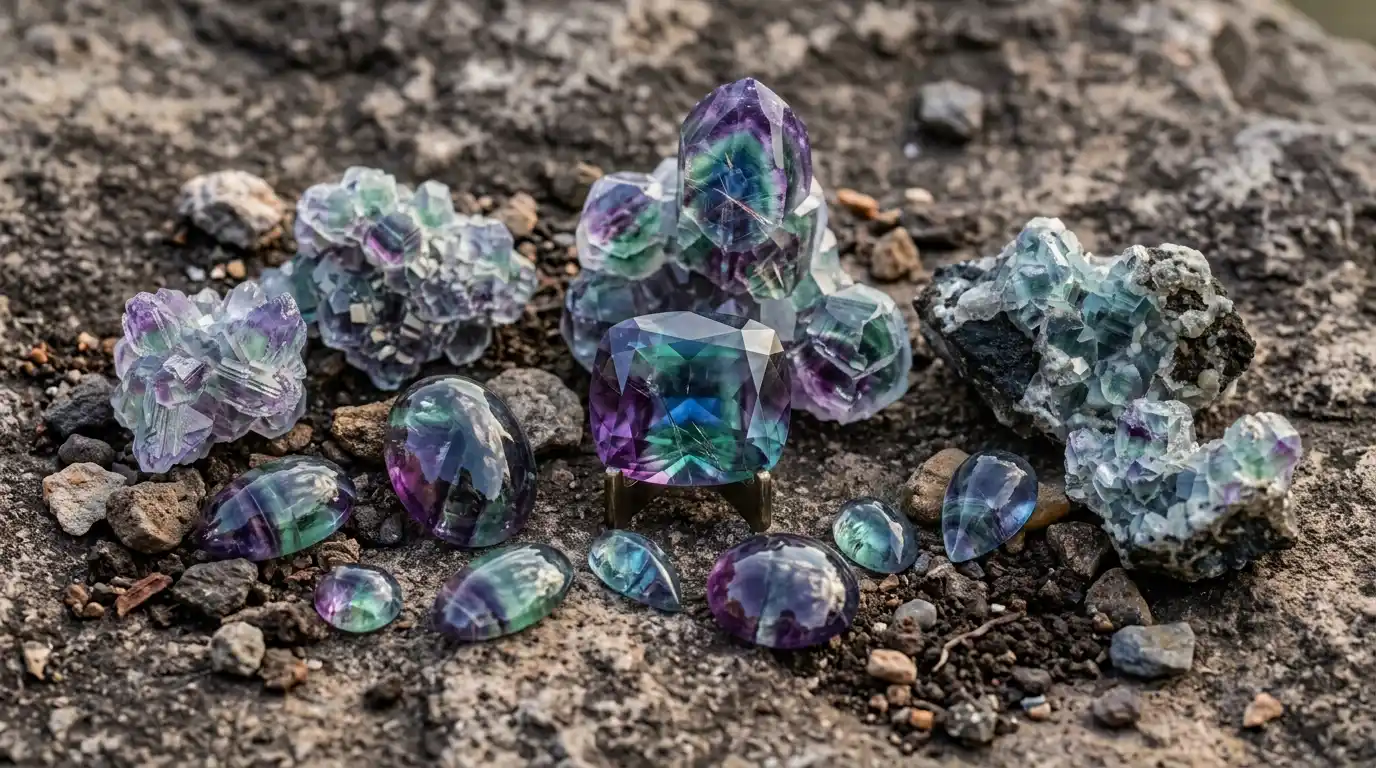
Rainbow Fluorite Benefits: 9 Real Uses, Aura Cleansing & Hardness Scale Cautions
Rainbow fluorite benefits begin with the unusual optical and mineralogical character of fluorite rather than with supernatural claims. Rainbow fluorite is a trade and collector description for fluorite crystals or polished stones that display multiple colors or distinct bands, commonly including purple, green, blue, colorless, yellow, or combinations of these hues. The mineral itself is calcium fluoride, CaF2, and crystallizes in the isometric system, frequently producing cubes and other highly symmetrical crystal forms.
Several rainbow fluorite benefits are practical and observable. Its multicolored zoning makes it visually distinctive, its crystal geometry is valuable for mineralogical study, transparent to translucent pieces can be faceted or polished, and well-formed specimens are highly collectible. Fluorite is also the reference mineral for Mohs hardness 4, making it useful for teaching hardness while simultaneously demonstrating why hardness alone does not determine jewelry durability.
Modern crystal practices add aura cleansing, energetic balance, mental organization, and multi-chakra symbolism to rainbow fluorite benefits. These interpretations can provide a personal focus for meditation, journaling, or intentional routines, but there is no scientific evidence that rainbow fluorite removes invisible energy, cleanses an aura, changes neurological function, or medically treats the body.
9 Rainbow Fluorite Benefits at a Glance
- Multicolored zoning gives rainbow fluorite distinctive collector, decorative, and lapidary appeal.
- Cubic crystal habit and perfect octahedral cleavage make fluorite useful for studying crystallography and mineral identification.
- Mohs hardness 4 provides an important reference point for understanding gemstone scratch resistance.
- Transparent and translucent specimens can be faceted, polished, carved, or displayed as natural crystals when handled carefully.
- Fluorescence in some specimens adds another optical feature for collectors and mineral students.
- Geological occurrences can preserve evidence of hydrothermal mineralization, repeated crystal growth, and changing fluid chemistry.
- Color zoning can provide an engaging way to study successive stages of crystal formation.
- Modern aura-cleansing traditions use rainbow fluorite as a symbolic focus for reflection, order, and emotional intention.
- Understanding perfect cleavage, brittleness, water exposure, heat sensitivity, and low hardness allows safer collection and jewelry use.
Rainbow Fluorite Benefits From Color Zoning and Crystal Growth
Among the most recognizable rainbow fluorite benefits is natural color zoning. A single fluorite crystal can contain purple outer zones, green interiors, colorless bands, blue areas, or multiple transitions between colors. These patterns are not proof of mystical energy layers. They record changes that occurred while the crystal was growing.
Fluorite coloration can be influenced by crystal defects, irradiation-related color centers, trace constituents, rare-earth substitutions, growth conditions, and thermal history. The mechanism is not identical for every fluorite specimen or every color. This complexity is precisely what makes multicolored fluorite scientifically interesting. A crystal can preserve several growth episodes within one visible structure.
The variations described through rainbow fluorite color meaning therefore have two very different dimensions. Gemologically, the bands are real features produced during mineral growth. Symbolically, people may interpret changing colors as representations of transitions, balance, creativity, emotional development, or different areas of life. The mineralogical observation can be measured, while the symbolic interpretation remains personal.
Sharp cubic crystals provide another benefit. Fluorite belongs to the isometric crystal system, and well-developed cubes can show remarkable geometric regularity. Natural striations, stepped growth, penetration twins, modified cube faces, and complex combinations of crystal forms can make individual specimens especially attractive to collectors.
Fluorite Hardness Shows Why Rainbow Fluorite Needs Care
Understanding durability is essential when discussing rainbow fluorite benefits. Fluorite defines hardness 4 on the Mohs scale. That makes it much softer than quartz at 7, topaz at 8, corundum at 9, or diamond at 10. Everyday dust can contain quartz particles capable of scratching a polished fluorite surface, so careless wiping can gradually reduce its polish.
The gemstone hardness chart helps explain why Mohs numbers should be treated as comparative scratch-resistance values rather than as simple measures of overall strength. Fluorite’s hardness of 4 does not mean that it is exactly half as scratch resistant as a stone rated 8, because the Mohs scale is ordinal rather than linear.
More importantly, fluorite possesses perfect cleavage on octahedral planes and has brittle tenacity. A specimen can therefore look solid while remaining vulnerable to impact along structurally weak directions. A hard strike may produce chips or cleavage fractures even if the surface has not accumulated many scratches.
These properties influence jewelry design. Rainbow fluorite can be fashioned into pendants, earrings, brooches, beads, carvings, cabochons, and faceted gems, but highly exposed rings and bracelets face greater risk. Protective mountings and occasional wear are generally more appropriate than treating fluorite like sapphire or diamond.
Rainbow Fluorite Benefits for Collectors and Lapidaries
Collector appeal is one of the strongest rainbow fluorite benefits because each specimen can combine crystal form, color zoning, matrix minerals, transparency, locality, fluorescence, and growth features differently. A sharply formed cube with several internal color zones may be desirable even when it would not produce an ideal faceted gem.
Lapidaries value suitable fluorite for a different reason. Transparent rough can produce attractive faceted stones with strong body color, while translucent pieces can be polished into cabochons, carvings, spheres, decorative objects, or freeforms. Successful cutting requires careful orientation because perfect cleavage can cause damage during sawing, faceting, polishing, setting, or later wear.
Natural fluorescence adds additional collector interest. Fluorite gave its name to the phenomenon of fluorescence, although not every specimen fluoresces and visible body color does not reliably predict ultraviolet response. Some fluorite displays blue, violet, cream, red, green, or other fluorescence depending on activators, impurities, and defects.
Knowing where rainbow fluorite is found can also matter because locality may influence crystal habit, color zoning, associated minerals, fluorescence, size, and specimen appearance. Fluorite occurs in many mineral districts worldwide, particularly in hydrothermal veins, carbonate-hosted deposits, and some igneous, pegmatitic, and metamorphic settings.
Provenance can therefore add genuine value to a specimen. A documented crystal from a recognized locality carries geological information that an unidentified decorative stone cannot provide, even when both are visually attractive.
Geological and Educational Rainbow Fluorite Benefits
Rainbow fluorite benefits extend into geology because fluorite commonly forms from fluorine-bearing fluids moving through fractures, veins, faults, or reactive host rocks. Many economically important fluorite deposits are hydrothermal, although the mineral also occurs in granites, pegmatites, high-temperature veins, marbles, and other geological settings.
Repeated color bands can reflect changing mineral-forming conditions. Fluid composition, temperature, radiation exposure, defect formation, and trace constituents may change during successive stages of crystal growth. A zoned fluorite crystal can therefore preserve a visible record of changing mineralization rather than simply displaying random decorative coloration.
This makes fluorite valuable in educational collections. Students can use specimens to examine isometric symmetry, cleavage, luster, hardness, transparency, color zoning, fluorescence, mineral associations, and hydrothermal mineralization. Few inexpensive collector minerals demonstrate so many concepts clearly in one specimen.
The general fluorite benefits also include an important lesson in identification. Color alone is unreliable because fluorite occurs in purple, green, yellow, blue, pink, brown, colorless, and other varieties. Crystal habit, perfect cleavage, hardness, refractive characteristics, specific gravity, optical behavior, and laboratory testing provide stronger identification evidence.
Aura Cleansing and Modern Rainbow Fluorite Benefits
Aura cleansing is frequently included among modern rainbow fluorite benefits. In contemporary crystal practice, multicolored fluorite may symbolize clearing confusion, releasing unwanted emotional patterns, restoring personal boundaries, or creating a more orderly mental space. The multiple colors are sometimes interpreted as representing different forms of energy working together.
An aura, however, is a spiritual concept rather than a measurable anatomical structure or established biological field. There is no scientific evidence that rainbow fluorite absorbs negative energy, removes invisible contamination, repairs an aura, or alters a person’s physiology through proximity.
The symbolic practice can still have personal meaning. Someone may place rainbow fluorite beside a journal as a reminder to identify unresolved concerns, simplify priorities, or create a calmer workspace. A meditation ritual may encourage a deliberate period of quiet reflection. The benefit in such situations comes from attention, ritual, expectation, and intentional behavior rather than a demonstrated cleansing force produced by the crystal.
Claims associated with rainbow fluorite healing properties should remain clearly separated from medical treatment. Rainbow fluorite has not been proven to treat anxiety, depression, pain, sleep disorders, neurological disease, hormonal conditions, immunity, detoxification, or other health concerns.
Multi-Color Symbolism Without Treating Belief as Science
Different colors within one crystal have encouraged several modern interpretations of rainbow fluorite benefits. Green bands may symbolize renewal or balance, violet may symbolize contemplation, blue may represent communication, and clear zones may be interpreted as clarity or openness. These associations vary among practitioners and are not fixed mineralogical properties.
The important distinction is that the colors themselves are real, while the spiritual meanings assigned to them are interpretive. Fluorite does not change its chemical species because one area is green and another is purple. Both zones remain fluorite unless another mineral is actually present.
A collector can therefore appreciate rainbow fluorite without adopting spiritual beliefs. The same specimen may be valued for crystallography, geological provenance, fluorescence, lapidary workmanship, color zoning, or simple visual beauty. A spiritually inclined owner may add personal symbolism without altering the mineral’s scientific identity.
This layered appreciation is one of the most useful rainbow fluorite benefits. Scientific understanding and personal symbolism do not have to compete as long as one is not presented as proof of the other.
Water, Heat, and Cleaning Cautions
Care practices strongly influence how long rainbow fluorite benefits remain visible. Softness means polished surfaces can scratch relatively easily, while perfect cleavage makes the mineral vulnerable to impact. Some fluorite colors can also be affected by prolonged exposure to strong light or heat, depending on the specimen.
Questions about whether rainbow fluorite is safe in water require more precision than a simple yes or no. Brief contact with clean water is not the same as prolonged soaking, repeated immersion, hot-water treatment, ultrasonic cleaning, or using a crystal in beverages.
A soft dry cloth or very gentle cleaning is preferable for many specimens. Avoid abrasives, steam, unnecessary ultrasonic cleaning, rapid temperature changes, harsh acids, and aggressive household chemicals. Valuable crystals with fractures, delicate matrix minerals, repaired areas, coatings, or uncertain stability deserve especially conservative handling.
Rainbow fluorite should not be ground into powder, swallowed, or used to prepare drinking water for supposed health benefits. Calcium and fluorine within CaF2 do not become beneficial nutrients simply because a person wears or holds the mineral.
Identifying Quality in Rainbow Fluorite
Quality depends on intended use. Mineral collectors may prioritize sharp crystals, strong zoning, unusual crystal modifications, attractive matrix associations, fluorescence, rarity of locality, provenance, and minimal damage. Lapidary buyers may place more emphasis on transparency, color distribution, usable size, fracture placement, and whether the rough can survive cutting.
Faceted rainbow fluorite can be visually appealing, but surface abrasions, cleavage fractures, and edge wear deserve close examination. A well-polished stone should show workmanship appropriate to fluorite’s softness rather than being evaluated by standards designed for much harder gemstones.
Color should also be judged naturally. Dramatic purple-green zoning can be attractive, but uniform saturation is not automatically superior to complex banding. In collector fluorite, unusual growth patterns may be more desirable than the even color traditionally favored in many transparent gems.
Treatment disclosure matters whenever color modification, coatings, fracture filling, composite construction, or other enhancement is suspected. A beautiful specimen has greater educational and collecting value when its identity and any known alterations are represented accurately.
Conclusion
Rainbow fluorite benefits include multicolored zoning, remarkable cubic crystallography, educational value, fluorescence in some specimens, lapidary use, collector appeal, and geological information preserved during crystal growth. Aura cleansing and energetic balance remain modern symbolic practices, while Mohs hardness 4, perfect cleavage, brittleness, and heat sensitivity make careful handling essential.
FAQs
What are the main rainbow fluorite benefits?
The strongest rainbow fluorite benefits include attractive color zoning, collector appeal, usefulness for studying crystallography and hardness, lapidary potential, geological information, and occasional fluorescence. Modern crystal traditions also associate rainbow fluorite with aura cleansing, balance, focus, and emotional reflection, but those interpretations are belief-based rather than scientifically demonstrated mineral effects.
Is rainbow fluorite good for everyday jewelry?
Rainbow fluorite can be used in jewelry, but it is not an ideal gemstone for hard everyday wear. Mohs hardness 4 leaves it vulnerable to scratching, while perfect cleavage and brittle tenacity increase the risk of chipping or splitting. Pendants, earrings, and protected settings are generally safer choices than exposed rings or bracelets.
Does rainbow fluorite really cleanse an aura?
There is no scientific evidence that rainbow fluorite removes negative energy or cleanses a measurable aura. Aura cleansing belongs to spiritual practice. A person may still use the crystal as a symbolic focus during meditation, journaling, or reflection, provided that personal belief is not presented as a medically or physically proven effect.
Why does rainbow fluorite contain several colors?
Multiple colors can develop as crystal-growth conditions change. Defects, irradiation-related color centers, trace constituents, rare-earth substitutions, temperature history, and other factors can influence fluorite coloration. Different growth zones may therefore record separate stages in the mineral’s formation.
Is rainbow fluorite hardness really only 4?
Yes. Fluorite is the reference mineral for Mohs hardness 4. This means it is substantially softer than quartz and many common jewelry gems. The stone also has perfect cleavage, so durability should be evaluated through both scratch resistance and resistance to breakage rather than hardness alone.
Can rainbow fluorite fluoresce under UV light?
Some specimens fluoresce strongly, while others show weak fluorescence or none that is visually obvious. Fluorescence can depend on activators, trace constituents, defects, locality, and growth zones. A multicolored specimen should not automatically be expected to produce a particular ultraviolet reaction.
Is rainbow fluorite safe to put in drinking water?
Rainbow fluorite should not be used to prepare drinking water or ingestible crystal elixirs. There is no proven health benefit from soaking the mineral in drinking water, and prolonged immersion can also be undesirable for specimen conservation. Keeping the crystal external avoids unnecessary ingestion and care risks.
Disclaimer: Spiritual, aura-cleansing, emotional, chakra, and energetic descriptions of rainbow fluorite reflect belief systems and personal practices. Rainbow fluorite is not a medical treatment and should not replace professional healthcare.