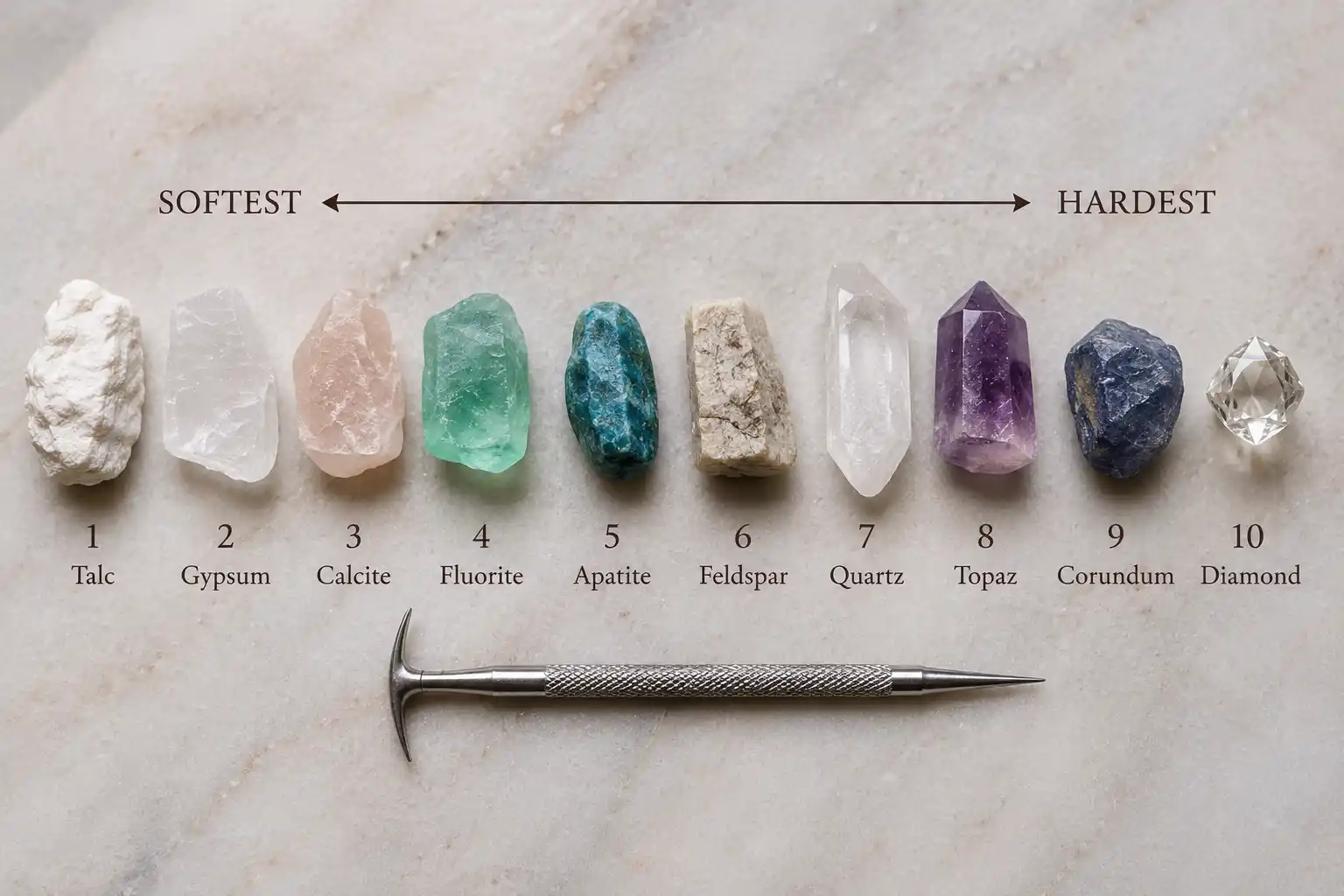
Gemstone Hardness Chart: The Mohs Scale for Every Stone
Gemstone hardness describes resistance to scratching and abrasion. It helps predict how quickly a polished surface or facet junction may become worn, but it does not measure resistance to cracking, chipping, cleavage, heat, light, chemicals, or sudden temperature changes.
The Mohs scale ranks minerals from 1 to 10 using reference materials. Talc occupies position 1, quartz 7, topaz 8, corundum 9, and diamond 10.
The numbers are comparative rather than evenly spaced. A gemstone rated 8 is not simply twice as scratch resistant as one rated 4, and hardness 10 is not only slightly harder than hardness 9.
For jewelry, hardness must be considered with toughness, cleavage, inclusions, treatments, setting design, and intended wear.
Mohs Scale Reference Minerals
| Mohs hardness | Reference mineral | Practical comparison |
|---|---|---|
| 1 | Talc | Scratched very easily |
| 2 | Gypsum | Can be scratched by a fingernail |
| 3 | Calcite | Scratched by a copper coin or steel point |
| 4 | Fluorite | Easily scratched by harder household materials |
| 5 | Apatite | Moderate but vulnerable to abrasion |
| 6 | Orthoclase feldspar | Harder than ordinary window glass in many cases |
| 7 | Quartz | Common environmental dust can contain quartz particles |
| 8 | Topaz | Strong scratch resistance, despite cleavage risk |
| 9 | Corundum | Ruby and sapphire; excellent scratch resistance |
| 10 | Diamond | Hardest natural reference mineral on the Mohs scale |
Complete Gemstone Hardness Chart
Hardness ranges reflect natural variation, mineral composition, orientation, aggregate structure, or differences among related varieties.
| Gemstone or material | Mohs hardness | Important wear note |
|---|---|---|
| Talc | 1 | Far too soft for exposed jewelry |
| Sulfur | 1.5–2.5 | Soft, brittle, and heat sensitive |
| Selenite or gypsum | 2 | Scratches extremely easily |
| Amber | 2–2.5 | Soft organic material; vulnerable to heat and chemicals |
| Jet | 2.5–4 | Soft organic gem; polish abrades easily |
| Pearl | About 2.5–4.5 | Nacre scratches and reacts to acids and cosmetics |
| Coral | About 3–4 | Soft organic material requiring gentle wear |
| Calcite | 3 | Very soft and cleavable |
| Aragonite | 3.5–4 | Soft, brittle, and acid sensitive |
| Rhodochrosite | 3.5–4 | Soft with cleavage; better for protected jewelry |
| Malachite | 3.5–4 | Scratches easily and reacts to acids |
| Azurite | 3.5–4 | Soft and relatively fragile |
| Sphalerite | 3.5–4 | Very soft, brittle, and perfectly cleavable |
| Fluorite | 4 | Cleaves easily despite attractive polish |
| Smithsonite | 4–4.5 | Soft and brittle |
| Apatite | 5 | Vulnerable in rings and bracelets |
| Obsidian | About 5–5.5 | Scratches moderately and chips along sharp edges |
| Moldavite | About 5–5.5 | Natural glass; edges can chip |
| Glass | About 5–6 | Hardness varies with composition |
| Lapis lazuli | About 5–5.5 | Aggregate material with variable hardness |
| Turquoise | About 5–6 | Porosity, matrix, and treatment affect durability |
| Opal | About 5–6.5 | Scratches and may craze or fracture |
| Hematite | About 5–6.5 | Brittle despite metallic appearance |
| Diopside | About 5.5–6.5 | Cleavage and brittleness limit daily ring wear |
| Scapolite | About 5.5–6 | Moderate hardness with cleavage |
| Sphene or titanite | About 5–5.5 | Soft, brittle, and cleavable |
| Moonstone | About 6–6.5 | Feldspar cleavage increases impact risk |
| Labradorite | About 6–6.5 | Cleavage and surface abrasion require care |
| Orthoclase feldspar | 6 | Mohs reference mineral |
| Amazonite | About 6–6.5 | Cleavable feldspar |
| Sunstone | About 6–7.2 | Hardness varies; feldspar cleavage remains important |
| Tanzanite | About 6–7 | Cleavage and fair-to-poor toughness limit rough wear |
| Nephrite jade | About 6–6.5 | Lower hardness but exceptional toughness |
| Jadeite jade | About 6.5–7 | Tough aggregate structure despite moderate hardness |
| Peridot | About 6.5–7 | Can scratch and fracture under impact |
| Demantoid garnet | About 6.5–7 | Softer than many other garnets |
| Tsavorite garnet | About 6.5–7.5 | Good wearability when fractures are limited |
| Rhodolite garnet | About 7–7.5 | Useful scratch resistance and no easy cleavage |
| Spessartite garnet | About 7–7.5 | Suitable for many jewelry types |
| Zircon | About 6.5–7.5 | Facet edges can abrade or chip |
| Kyanite | About 4.5–7 | Strong directional hardness variation |
| Quartz | 7 | Mohs reference mineral |
| Amethyst | 7 | Quartz variety; generally practical for jewelry |
| Citrine | 7 | Quartz variety; scratches less easily than feldspar |
| Rose quartz | 7 | Usually cabochon or carving material |
| Smoky quartz | 7 | Suitable for jewelry but still brittle |
| Chalcedony | About 6.5–7 | Fine-grained quartz with generally good toughness |
| Agate | About 6.5–7 | Durable aggregate quartz for everyday items |
| Jasper | About 6.5–7 | Tough opaque quartz aggregate |
| Iolite | About 7–7.5 | Cleavage makes impact protection important |
| Tourmaline | About 7–7.5 | Good hardness; inclusions and heat sensitivity matter |
| Andalusite | About 7–7.5 | Reasonable jewelry hardness |
| Kunzite | About 6.5–7 | Cleavage and light sensitivity remain concerns |
| Hiddenite | About 6.5–7 | Cleavage limits ring durability |
| Aquamarine | About 7.5–8 | Good scratch resistance; fractures still matter |
| Emerald | About 7.5–8 | Hard but often fractured and clarity enhanced |
| Morganite | About 7.5–8 | Good hardness with possible brittleness |
| Beryl | About 7.5–8 | Family range for aquamarine, emerald, and morganite |
| Spinel | 8 | Strong scratch resistance and generally good durability |
| Topaz | 8 | Hard but has perfect basal cleavage |
| Chrysoberyl | 8.5 | Excellent choice for frequent wear |
| Alexandrite | 8.5 | Chrysoberyl variety with excellent durability |
| Ruby | 9 | Excellent scratch resistance and generally good toughness |
| Sapphire | 9 | Excellent scratch resistance and generally good toughness |
| Moissanite | About 9.25 | Very strong scratch resistance |
| Diamond | 10 | Highest Mohs hardness but can still cleave or chip |
What Hardness Actually Measures
Hardness describes how well a surface resists being scratched by another material.
A harder mineral can scratch a softer mineral under suitable conditions. However, a hardness test does not reveal whether a gemstone will survive a drop, pressure from a prong, a jeweler’s torch, an ultrasonic cleaner, perfume, acid, or extended sunlight.
A diamond can scratch sapphire, but diamond can also chip along vulnerable directions. Nephrite jade is much softer than diamond yet is exceptionally resistant to breaking because of its interlocking aggregate structure.
The separate gemstone toughness-versus-hardness guide owns the detailed comparison between scratching and breakage.
The Mohs Scale Is Not Linear
The numerical gaps on the Mohs scale are not equal units of absolute hardness.
The difference between corundum at 9 and diamond at 10 is substantially greater than the difference suggested by one scale position. Therefore, the scale should be used as an ordered scratch-resistance ranking rather than a mathematical percentage chart.
Statements such as sapphire is 90 percent as hard as diamond are incorrect interpretations of the Mohs scale.
Hardness Is Not Toughness
Toughness describes resistance to chipping, cracking, and breaking.
A gemstone can be hard but brittle. Topaz ranks 8 yet can split along perfect cleavage. Sphene is softer and brittle. Nephrite jade ranks near 6 to 6.5 but can withstand impacts better than many harder single crystals.
When selecting a frequently worn ring, ask two separate questions:
- How easily will the surface scratch?
- How easily will the stone chip or break?
The setting must address both.
Hardness Is Not Cleavage
Cleavage is a mineral’s tendency to split along particular crystallographic planes.
Topaz has excellent scratch resistance but perfect cleavage. Tanzanite, moonstone, spodumene, fluorite, and diamond also have important cleavage considerations.
The dedicated gemstone cleavage guide explains why one concentrated impact can break a hard gemstone along a structural direction.
A seller should not use a high Mohs number to dismiss cleavage risk.
Hardness Is Not Stability
Stability describes resistance to heat, light, chemicals, humidity, and temperature change.
Kunzite has reasonable hardness but may fade with prolonged light exposure. Opal may crack or craze through environmental change. Pearl reacts to acids. Coated gems can lose their surface treatment even when the underlying stone is relatively hard.
The gemstone treatments guide explains how filling, coating, oil, dye, and diffusion can alter care requirements.
Why Quartz at 7 Matters
Quartz is common in the environment and can occur in household dust, sand, soil, and abrasive particles.
A gemstone below hardness 7 may gradually develop surface wear when exposed repeatedly to quartz-bearing dust or careless wiping.
This does not mean every gem below 7 is unsuitable for jewelry. It means cleaning technique, storage, setting, and wear frequency matter more.
Use a clean soft cloth and rinse away grit rather than rubbing a dusty stone aggressively.
Gemstones Rated 8 to 10
Spinel, topaz, chrysoberyl, ruby, sapphire, moissanite, and diamond provide strong scratch resistance.
They can be good candidates for frequent-wear rings, but other properties still apply:
- Topaz has perfect cleavage.
- Diamond can cleave and chip.
- Filled ruby or sapphire requires special care.
- Included spinel can fracture.
- Moissanite settings can still be damaged.
- Surface coatings may be softer than the host gem.
The sapphire buying guide and ruby buying guide explain how treatments and fractures affect otherwise durable corundum.
Gemstones Rated 7 to 7.5
Quartz, tourmaline, garnet, iolite, and several related stones offer practical scratch resistance for many jewelry uses.
They remain vulnerable to:
- Sharp impacts
- Edge chipping
- Cleavage in selected minerals
- Heat-sensitive inclusions
- Filling
- Abrasion from harder stones
- Poorly protected corners
The tourmaline buying guide and spinel buying guide illustrate why similar hardness numbers do not guarantee identical wear performance.
Gemstones Rated 6 to 6.5
Moonstone, labradorite, jade, tanzanite, and several feldspars require more mindful wear.
They can perform well in earrings, necklaces, brooches, or protected rings. However, repeated desk contact and careless storage may dull polished surfaces.
Jade demonstrates why hardness alone can mislead: nephrite is moderately soft but unusually tough, while faceted tanzanite can be harder yet much more vulnerable to cleavage.
The tanzanite buying guide explains that distinction in a practical jewelry market.
Gemstones Below Hardness 6
Pearl, coral, turquoise, opal, fluorite, malachite, rhodochrosite, sphalerite, and other softer gems need conservative use.
They are generally better suited to:
- Earrings
- Pendants
- Brooches
- Protected cabochons
- Occasional-wear rings
- Collector mounts
- Carefully stored strands
A soft gem can still last for generations when its setting, cleaning, storage, and wear frequency suit the material.
The opal buying guide, pearl buying guide, and turquoise buying guide provide material-specific care considerations.
Hardness Can Vary by Direction
Some crystals have directional hardness. Kyanite is the classic example, with significantly different hardness depending on the direction tested.
Diamond also shows directional cutting resistance, which affects how cutters orient and polish it.
A single number or range summarizes practical hardness but may not describe every crystallographic direction.
This variation is one reason home scratch testing produces unreliable identification results.
Mineral Groups Cover Ranges
Garnet, tourmaline, feldspar, zircon, opal, jade, and other groups do not have one exact hardness for every specimen.
Variation may arise from:
- Chemical composition
- Mineral species
- Crystal orientation
- Structural alteration
- Porosity
- Aggregate structure
- Inclusions
- Weathering
- Treatment
A chart should therefore use ranges where appropriate rather than creating false precision.
Treatments Can Change Surface Wear
The underlying gemstone may be hard while its filler or coating is softer.
Examples include:
- Coated topaz
- Filled emerald
- Glass-filled ruby
- Resin-stabilized turquoise
- Coated quartz
- Surface-diffused material
- Assembled doublets and triplets
A scratch can remove a coating without scratching deeply into the host gemstone.
The care plan should follow the most vulnerable component, not the highest Mohs number in the object.
Do Not Scratch-Test Valuable Gems
A scratch test is destructive. It can leave permanent damage, reduce polish, chip an edge, or destroy a coating.
Testing a gemstone against glass also provides limited information because many minerals can scratch glass, while some glasses and treatments vary.
Professional identification uses multiple observations and instruments rather than one scratch.
The how to spot fake crystals guide and how to identify crystals guide explain safer screening methods.
Hardness and Engagement Rings
An engagement ring experiences repeated contact with desks, door frames, cookware, clothing, cosmetics, dust, and other jewelry.
For frequent ring wear, hardness of 8 or above provides a useful scratch-resistance advantage. Nevertheless, some stones around 7 to 7.5 can perform well with a protective setting and informed care.
The best gemstones for engagement rings guide considers hardness alongside toughness, cleavage, stability, treatment, replacement difficulty, and budget.
Hardness and Ultrasonic Cleaning
Mohs hardness does not determine whether a gemstone is safe in an ultrasonic cleaner.
Ultrasonic vibration can aggravate:
- Fractures
- Cleavage planes
- Filling
- Coatings
- Adhesive
- Porosity
- Mounted-stone looseness
- Organic gem damage
The dedicated ultrasonic-cleaner gemstone guide should be used before mechanical cleaning.
A hard emerald with significant fissures can be a worse ultrasonic candidate than a softer but structurally sound gemstone.
Choosing a Setting by Hardness
Settings can reduce abrasion and impact exposure.
A low bezel or protective halo can shield the girdle and corners. High prong settings expose more of the stone to contact.
However, bezel pressure can damage cleavage-sensitive or heavily fractured stones during setting. The jeweler must understand the complete material, not merely its hardness number.
For online purchases, request girdle close-ups and condition disclosure through the safeguards in how to buy gemstones online.
Laboratory Reports and Hardness
A laboratory report identifies the gemstone, but it normally does not scratch-test the stone or guarantee future durability.
Once the material is identified, its expected hardness can be researched. Actual wearability still depends on:
- Inclusions
- Treatment
- Structural condition
- Cut
- Girdle thickness
- Setting
- Existing damage
The how to read a gem lab report guide explains how to connect laboratory identity with practical buying decisions.
Frequently Asked Questions
1. What is the hardest gemstone?
Diamond ranks 10 and is the hardest natural reference mineral on the Mohs scale.
2. What gemstone ranks 9 on the Mohs scale?
Corundum ranks 9. Ruby and sapphire are gem varieties of corundum.
3. Is moissanite harder than sapphire?
Yes. Moissanite is approximately 9.25, while sapphire ranks 9.
4. Is quartz hard enough for everyday jewelry?
Quartz ranks 7 and can work well in jewelry, although it can still chip, scratch against harder stones, or suffer damage from poor settings.
5. Does hardness mean a gemstone will not break?
No. Hardness measures scratch resistance, while toughness and cleavage influence breaking and chipping.
6. Why can topaz break if it ranks 8?
Topaz has perfect basal cleavage, allowing it to split along a structural plane despite strong scratch resistance.
7. Why is jade durable if it is only around 6 to 7?
Jade’s interlocking aggregate structure gives it exceptional toughness even though its scratch resistance is moderate.
8. Is opal suitable for a ring?
Opal can be worn in a protected ring with care, but its moderate hardness, potential fractures, and environmental sensitivity make it higher maintenance.
9. Can a softer gemstone scratch a harder one?
Under ordinary mineral testing, a softer material should not scratch the harder mineral itself, although grit, coatings, residues, or surface damage can create confusing marks.
10. Is the Mohs scale linear?
No. The intervals are not equal, so hardness 10 is not merely 10 percent harder than hardness 9.
11. Can I test gemstone hardness at home?
Scratch testing is destructive and unreliable for valuable stones. Professional identification is safer.
12. Does a coating have the same hardness as the gemstone underneath?
Not necessarily. A thin coating may scratch or wear away more easily than the host gem.
Conclusion
The Mohs scale is most useful when it answers one specific question: how readily will the gemstone’s surface scratch? It cannot predict every chip, cleavage break, faded color, damaged filler, or failed setting. Choose jewelry by combining hardness with toughness, cleavage, treatment, condition, and wear level rather than turning one number into a complete durability grade.