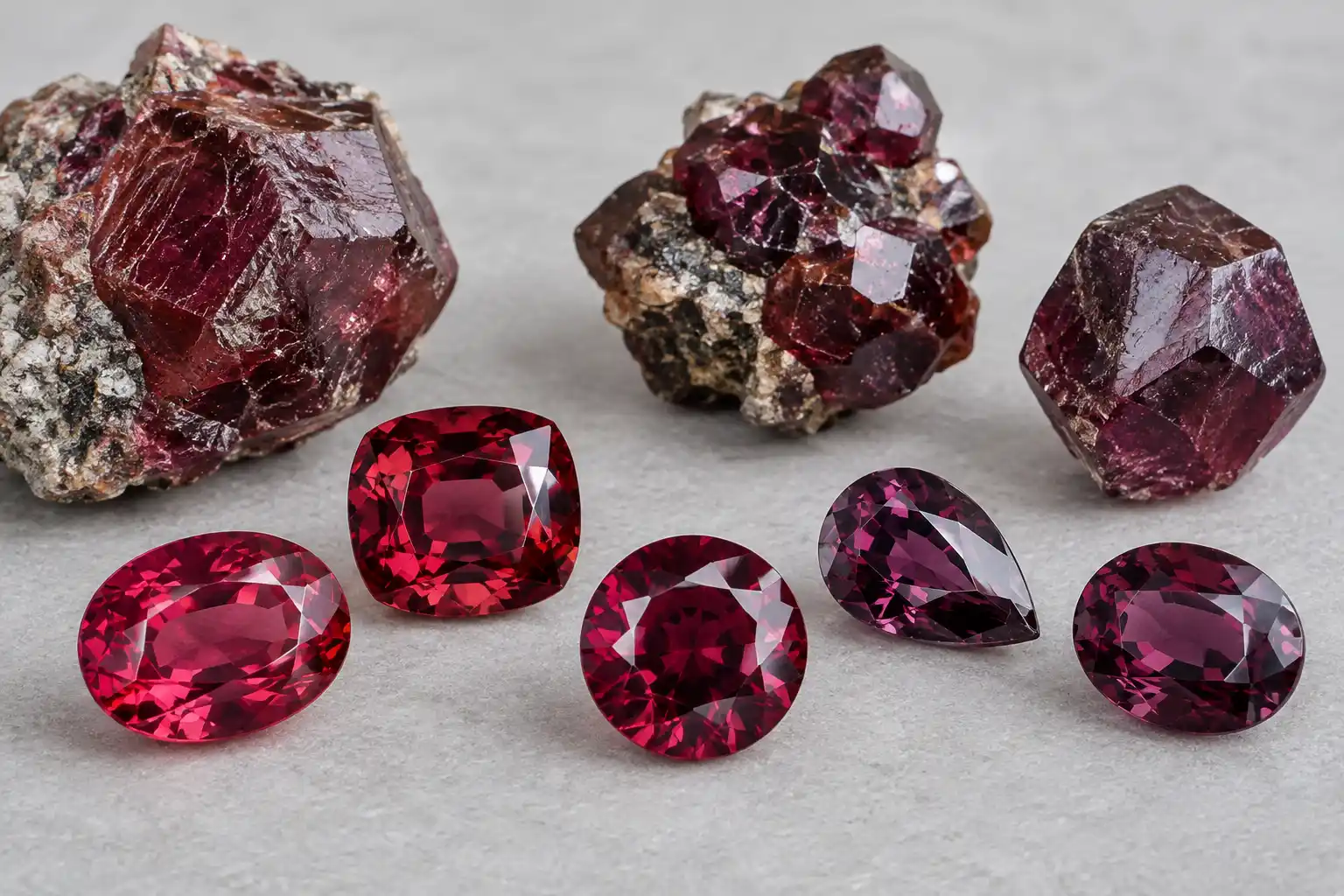
9 Real Rhodolite Garnet Benefits: Heart Chakra Renewal & Pyrope-Almandine Physics
Rhodolite garnet benefits begin with an attractive and relatively durable member of the garnet group rather than with metaphysical claims. Rhodolite is a gem-trade variety within the pyrope-almandine series, typically displaying pinkish red, raspberry red, purplish red, or violet-red color. Its chemistry lies between magnesium-rich pyrope and iron-rich almandine instead of representing a separate mineral species with one rigid composition.
Several practical rhodolite garnet benefits come directly from this mineralogy. Garnets crystallize in the isometric system, have no true cleavage, and commonly fall around 7 to 7.5 on the Mohs scale for rhodolite-like pyrope-almandine gems. This combination makes well-cut rhodolite suitable for rings, earrings, pendants, bracelets, and other jewelry when ordinary impact and abrasion precautions are followed.
Modern crystal traditions also associate rhodolite garnet benefits with emotional renewal, affection, creativity, confidence, and the heart chakra. Those interpretations can provide personal symbolism during meditation or reflection, but rhodolite garnet does not medically heal the heart, regulate circulation, treat emotional disorders, or create a measurable biological energy field.
9 Rhodolite Garnet Benefits at a Glance
- Raspberry-red to purplish-red color gives rhodolite strong jewelry and collector appeal.
- Pyrope-almandine chemistry provides a useful example of solid solution within the garnet group.
- Mohs hardness around 7 to 7.5 gives rhodolite useful resistance to everyday scratching.
- The absence of true cleavage reduces one common breakage pathway found in many other gemstones.
- Good transparency and strong vitreous luster allow finely cut rhodolite to produce attractive brilliance.
- Many gem-quality stones are sufficiently clean for faceting into rings, earrings, pendants, and other jewelry.
- Geological provenance adds scientific and collector value to specimens from recognized garnet-producing regions.
- Modern heart chakra traditions use rhodolite symbolically for affection, reflection, emotional renewal, and relationship intentions.
- Straightforward jewelry care and generally limited treatment concerns make natural rhodolite comparatively easy to maintain.
Rhodolite Garnet Benefits Begin With Pyrope-Almandine Chemistry
Rhodolite garnet benefits are easier to understand once the name is placed correctly within garnet mineralogy. Garnet is a mineral group rather than one single mineral, and many gem garnets contain substantial proportions of two or more garnet end members.
Rhodolite usually lies within the pyrope-almandine series. Pyrope contributes a magnesium-rich component represented ideally by Mg3Al2(SiO4)3, while almandine contributes an iron-rich component represented by Fe3Al2(SiO4)3. Natural rhodolite therefore commonly contains both magnesium and iron in proportions that vary from one occurrence to another.
This continuous chemical substitution is known as solid solution. It explains why assigning every rhodolite a single exact pyrope-to-almandine ratio would be misleading, even though the trade name consistently refers to attractive pink-red to purple-red garnet within this compositional range.
The physics of this solid solution also influences color and optical behavior. Iron, and in some specimens smaller contributions from manganese and other trace elements, affects absorption in the visible spectrum, allowing red and blue transmission to combine into the raspberry or purplish-red appearance characteristic of fine rhodolite.
Color and Brilliance Are Major Practical Benefits
Color is among the most obvious rhodolite garnet benefits. Fine stones can combine saturated raspberry, rose-red, red-purple, or violet-red hues with enough transparency to show lively internal reflections after skilled faceting.
Unlike some darker almandine garnets, good rhodolite can retain brightness without becoming nearly black in ordinary lighting. The best balance depends on tone, saturation, cutting, transparency, and the individual stone rather than one universal color standard.
The principles used in rhodolite garnet quality grading therefore consider more than color alone. Face-up appearance, clarity, cut proportions, brilliance, size, treatments, and overall visual performance can all influence how successfully a finished gem displays its natural characteristics.
Many rhodolites are eye-clean or close to eye-clean, although inclusions remain possible. Microscopic inclusions can also provide useful gemological clues and may help distinguish natural garnet from glass or other red-purple lookalikes.
Rhodolite Garnet Benefits for Everyday Jewelry
Durability is one of the strongest practical rhodolite garnet benefits. Rhodolite commonly falls near 7 to 7.5 on the Mohs scale, meaning it resists scratching better than fluorite, calcite, apatite, and most feldspars.
Garnet also lacks true cleavage. This does not make rhodolite unbreakable, but it removes the pronounced crystallographic splitting planes that make gems such as fluorite, topaz, and some feldspars especially vulnerable to particular impacts.
Understanding rhodolite garnet durability still requires separating hardness from toughness. A gemstone that resists scratching can chip around facet junctions or fracture after a sufficiently hard blow, particularly if it contains preexisting fractures.
Rhodolite can consequently work well in rings when mounted securely and worn sensibly. Earrings and pendants generally face even less impact, making them especially practical choices for fine transparent stones.
Faceting and Lapidary Advantages
Transparent rhodolite is primarily valued as a faceted gemstone because good cutting can emphasize its saturation, brightness, and red-purple flashes. Ovals, cushions, rounds, pears, and other brilliant-style designs are common, although custom cutters may choose more complex designs for unusually clean rough.
The lack of strong cleavage is helpful during cutting because the gem does not have a single obvious plane along which it readily splits. Cutters must still avoid excessive heat, mechanical shock, and unnecessary pressure, particularly when rough contains fractures.
Rhodolite also accepts a high polish. Smooth facet surfaces increase the crispness of reflected light and help a well-proportioned stone appear brighter than poorly polished or overly deep examples.
These rhodolite garnet benefits make the stone useful both commercially and educationally. Students can examine how cut proportions, refractive properties, bodycolor, extinction, windowing, and polish interact to determine the face-up appearance of a transparent colored gemstone.
Geological Provenance Adds Scientific Value
Understanding where rhodolite garnet is found adds another layer of scientific value. Rhodolite was historically described from the Cowee Valley area of Macon County, North Carolina, where garnets occur in gneissic rocks and secondary alluvial concentrations.
Important commercial rhodolite has also come from East Africa and other garnet-producing regions. Tanzania, Mozambique, Sri Lanka, Madagascar, India, and additional localities have produced pyrope-almandine gems that may fall within rhodolite trade usage depending on chemistry and appearance.
Locality can influence color, inclusions, chemistry, size distribution, and geological associations. A documented specimen therefore carries information about its geological occurrence in addition to its decorative value.
Alluvial rhodolite is especially interesting because erosion can release durable garnet grains from their host rocks. Streams and sediments then concentrate those resistant crystals, creating secondary deposits that may be easier to mine than the original bedrock occurrence.
Rhodolite Garnet Benefits for Identification and Gemology
Rhodolite garnet benefits gemological study because it demonstrates why color names alone cannot identify a gemstone. Ruby, red spinel, pink sapphire, tourmaline, glass, synthetic stones, and several garnet varieties can overlap visually with rhodolite.
Garnets are generally singly refractive under standard gemological examination because of their isometric crystal structure. Refractive index, specific gravity, absorption spectrum, inclusions, chemistry, and microscopic examination can help narrow identification and separate rhodolite from visually similar gems.
Rhodolite also demonstrates the limitations of overly rigid trade definitions. Because pyrope and almandine form a solid-solution series, natural specimens do not suddenly change identity at a visually obvious chemical boundary.
Professional testing is especially worthwhile for high-value jewelry. A laboratory can determine whether a stone is natural garnet, distinguish it from an imitation, and provide useful gemological observations without relying on spiritual descriptions or seller claims.
Heart Chakra Renewal and Modern Spiritual Use
Heart chakra renewal is commonly included among spiritual rhodolite garnet benefits because pink and red-purple gemstones are often associated with affection, relationships, compassion, courage, and emotional openness in contemporary crystal practice.
The heart chakra is a spiritual concept rather than an anatomical structure. Wearing rhodolite over the chest has not been shown to alter cardiovascular function, blood pressure, circulation, heart rhythm, or another measurable physiological process.
A person may still use the stone meaningfully during reflection. A rhodolite ring might represent a relationship commitment, while a loose gemstone could be held during journaling about communication, forgiveness, boundaries, or future goals.
In such practices, renewal comes from reflection and subsequent behavior rather than from a medically active force within the gemstone. The stone serves as a symbolic focus for an intention chosen by the person.
Emotional Renewal Without Medical Claims
Some descriptions expand rhodolite garnet benefits into claims about depression, anxiety, trauma, grief, sexuality, or hormonal balance. Scientific evidence does not establish rhodolite as a treatment for these conditions.
The distinction does not make personal symbolism useless. A gemstone can become connected with a constructive habit, such as pausing before an important conversation, writing regularly, or remembering a personal commitment.
For someone who appreciates crystal traditions, rhodolite can therefore be incorporated into meditation or prayer without being treated as healthcare. Persistent psychological or physical symptoms deserve appropriate professional evaluation.
This evidence-safe approach preserves cultural and personal meaning while avoiding claims that the pyrope-almandine composition itself changes mental or physical health.
Treatment, Cleaning, and Long-Term Care
Another practical advantage among rhodolite garnet benefits is that garnets are not among the gemstones most routinely subjected to extensive enhancement. Treatments are possible, and fracture filling has occasionally been encountered within the garnet group, so disclosure remains important.
For ordinary maintenance, the safest way to clean rhodolite garnet jewelry is with warm water, mild soap, and gentle brushing. This method avoids unnecessary thermal or mechanical stress while removing common oils and surface residue.
Ultrasonic cleaning may be acceptable for sound untreated garnets, but it should be avoided when significant fractures or fracture filling are present. Steam cleaning is unnecessary and is generally a less conservative choice.
Storage also matters. Diamond, sapphire, ruby, and other harder gemstones can scratch garnet surfaces, so separating jewelry pieces reduces abrasion around polished facets.
How to Get Real Value From Rhodolite Garnet
The most useful rhodolite garnet benefits depend on choosing a stone for its actual qualities. Strong color, attractive brilliance, good cutting, useful clarity, secure setting, documented identity, and appropriate care provide more reliable value than exaggerated metaphysical claims.
A richly colored stone should still be checked for excessive darkness or extinction. A large rhodolite is not automatically superior to a smaller gem with stronger face-up color and more balanced proportions.
Collectors may prioritize locality or unusual inclusions, while jewelry buyers may care more about brilliance and durability. Neither approach is wrong because the value of the stone depends partly on its intended use.
Rhodolite’s strongest appeal comes from the combination of garnet durability, distinctive raspberry-red color, mineralogical complexity, and accessible jewelry versatility.
Conclusion
Rhodolite garnet benefits include attractive red-purple color, useful hardness, lack of true cleavage, excellent faceting potential, geological interest, gemological educational value, and practical jewelry durability. Heart chakra renewal can serve as modern personal symbolism, while the measurable properties of rhodolite come from its pyrope-almandine chemistry and isometric garnet structure.
FAQs
What are the main rhodolite garnet benefits?
Rhodolite garnet benefits include attractive raspberry-red to purple-red color, good transparency, jewelry durability, useful Mohs hardness, lack of true cleavage, strong faceting potential, and geological interest. Modern crystal traditions also associate rhodolite with emotional renewal and heart chakra symbolism, but those beliefs are not scientifically proven physical effects.
Is rhodolite a type of garnet?
Yes. Rhodolite is a gem-trade variety within the pyrope-almandine garnet series rather than a completely separate garnet mineral species. Its chemistry typically contains substantial magnesium-rich pyrope and iron-rich almandine components.
Is rhodolite garnet durable enough for rings?
Rhodolite is generally around 7 to 7.5 on the Mohs scale and lacks true cleavage, making it suitable for many rings. It can still chip or fracture after hard impacts, so secure settings and normal jewelry precautions remain important.
What makes rhodolite garnet purple-red?
Iron-related absorption is a major contributor to rhodolite’s red-purple appearance, with the precise color influenced by composition and trace constituents. Absorption in parts of the visible spectrum allows red and blue transmission to combine into characteristic raspberry and purplish tones.
Does rhodolite garnet heal the heart chakra?
Heart chakra healing is a spiritual interpretation rather than a medically demonstrated effect. Rhodolite can be used symbolically during meditation or reflection, but it has not been shown to alter the heart, circulation, or another anatomical system.
Does rhodolite garnet have cleavage?
Garnet does not have true cleavage in the way fluorite, topaz, or feldspar does. Rhodolite can still fracture or chip after impact, so the absence of cleavage should not be interpreted as complete resistance to breakage.
How should rhodolite garnet be cleaned?
Warm water, mild soap, and gentle brushing are appropriate for ordinary rhodolite jewelry. Steam should be avoided as a conservative practice, and ultrasonic cleaning is best avoided when fractures, fracture filling, or uncertain treatments are present.
Is rhodolite garnet usually treated?
Rhodolite is not generally known for routine extensive treatment in the way some other colored gemstones are, although treatment is possible. Reliable disclosure and professional identification remain valuable when purchasing significant stones.
Disclaimer: Heart chakra, emotional renewal, love, confidence, and energetic descriptions of rhodolite garnet reflect spiritual beliefs and personal practices. Rhodolite garnet is not a medical or psychological treatment and should not replace professional healthcare.